In this guide
waEV-charge is a UK home charging brand with a deliberately narrow domestic range: two 7.4kW smart chargers, the untethered EV1s and the tethered EV1i, both built around the ev.energy smart charging app rather than a manufacturer's own software1. The company states that more than 10,000 chargers have been installed across the UK, that it is NICEIC certified, and that support is UK-based1. Its chargers are OZEV certified and meet the June 2022 regulations for smart charge points3.
For a household, the appeal is the tariff side rather than the hardware. The chargers and app work with all Octopus tariffs including Intelligent Go, and with all OVO tariffs, and no specific supplier or tariff is required for the unit to function at all4. Charging at home on an overnight EV tariff is put at around 2p a mile, against about 6.6p on a standard tariff5. Independent figures put home off-peak charging at 2p per mile based on an average tested efficiency of 3.18 miles per kWh6.
The dependence is the same one every smart charger carries: scheduling, energy monitoring and remote diagnostics run through ev.energy's platform, a home broadband connection and a phone app. The charger itself is a wallbox, not a source of energy, so the household remains on the grid and on a supplier.
waEV-charge at a glance: who makes it and how many are installed
waEV-charge describes itself as powered by ev.energy, the smart charging software company, and has partnered with it to handle the app experience for its chargers9. That is the central fact about the brand: the hardware is waEV-charge's, the intelligence is ev.energy's. The company works alongside a network of EV installers covering the UK nationwide, offering a combined sales, install and aftercare package4.
The installed base is stated as more than 10,000 chargers across the UK and counting1. For context on scale, that is a domestic-focused figure rather than a public network one: RAW Charging, a public network, had 2,520 chargers across the UK as of the end of August 202610. waEV-charge's chargers are described as suitable for single domestic dwellings, apartment blocks and commercial environments, and the EV1i is set up for single domestic properties as standard, with custom builds available from the UK-based team7.
The chargers ship preconfigured with all setup information, and the company states that any qualified electrician is able to complete the installation, so a household is not locked to a waEV-charge installer for the physical work11. The commercial arrangement is different: the longest support and the finance route run through the company's own installer network.
The range: EV1s and EV1i, both 7.4kW
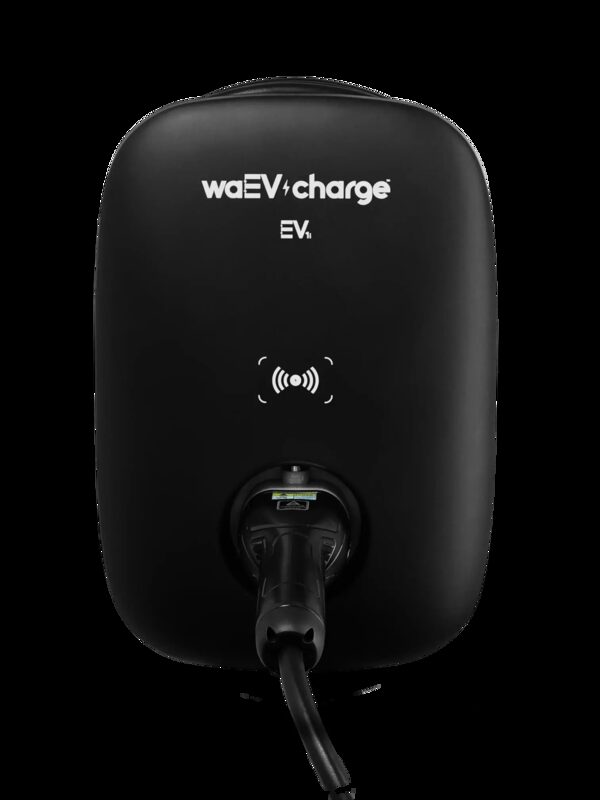
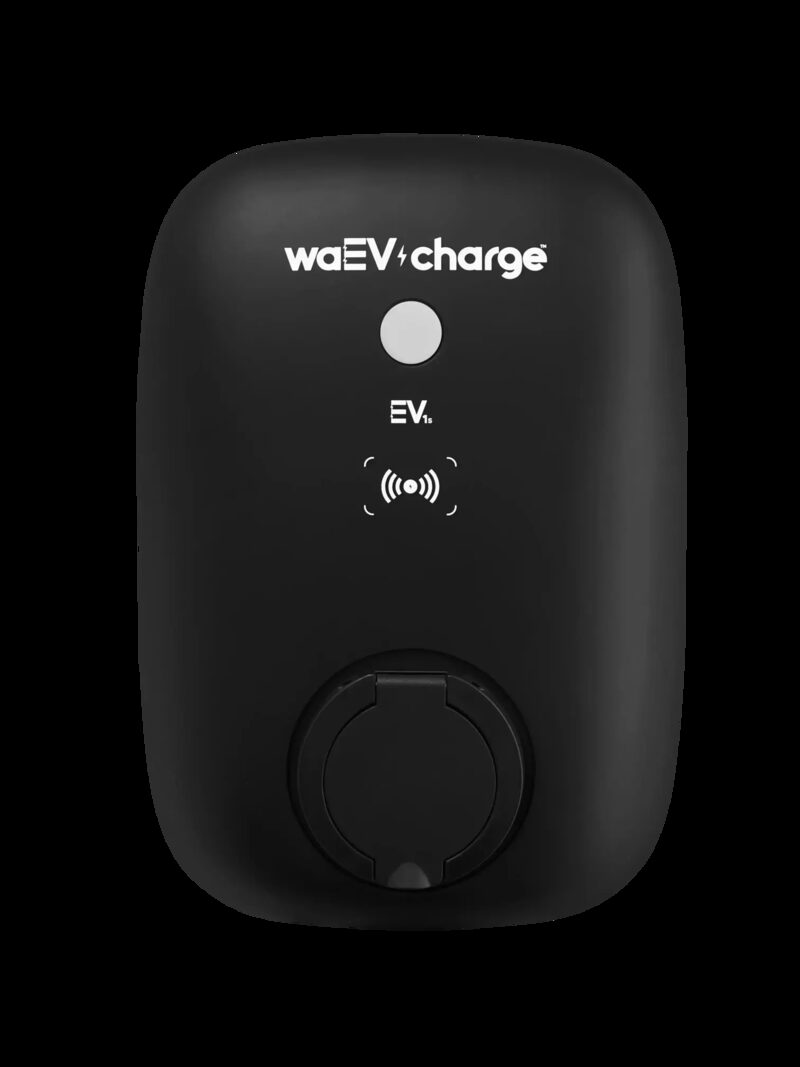
The domestic range is two chargers. The EV1s is untethered, meaning no cable is attached and the household uses its own1. The EV1i is tethered, with the cable attached, described as the option for convenience12. Both are 7.4kW smart chargers, positioned by the company as suiting different needs and budgets13. The EV1i is also listed with 7.4kW and 22kW options available2.
A 7.4kW charger is the standard domestic recommendation. Independent guidance is that a household should be looking at a 7.4kW charger to get the most out of the investment and benefit from reasonable charging times14. That output corresponds to a single-phase, 32 amp supply15.
| Model | Cable | Power | Notes |
|---|---|---|---|
| EV1s | Untethered | 7.4kW | Uses the household's own cable1 |
| EV1i | Tethered | 7.4kW, 22kW option listed | Set up for single domestic properties as standard2 |
The 22kW option matters less than it appears for most homes, because a single-phase domestic supply cannot deliver it; 22kW charging generally requires a three-phase connection. waEV-charge states that dynamic load balancing for the 22kW range is coming later this year, which is the feature that would let such a unit share a supply safely with the rest of the house16. For a fuller explanation of the differences between charger types, see types of home EV charger and EV charging speeds and times.
Smart charging: the ev.energy app, scheduling and tariff compatibility
The smart layer is ev.energy, and it is the reason the chargers qualify for the tariff structures that make home charging cheap. EV-specific tariffs usually require a smart charger that supports scheduled charging and energy data sharing, and waEV-charge's units do both17. With the charger in place, charging can be scheduled to happen automatically during the cheapest rate window17.
Compatibility is broad. The chargers and smart app work with all Octopus tariffs, including Octopus Intelligent Go, and with all OVO tariffs4. The single qualification is OVO Charge Anytime, which requires full control over charging, so the car itself must also integrate with OVO for that tariff to work4. No specific energy provider or tariff is needed for the charger to function at all4.
The app also handles solar. waEV-charge's integration with ev.energy enables the chargers to be fully compatible with a solar array setup, and the chargers are described as connecting with solar panels so the vehicle can be powered from renewable generation18. Most vehicles integrate seamlessly with the smart charging features, though the company notes a small handful of models may have specific requirements9. The integrated vehicle compatibility list is actively being expanded7.
Running costs: from around 2p a mile on an overnight EV tariff
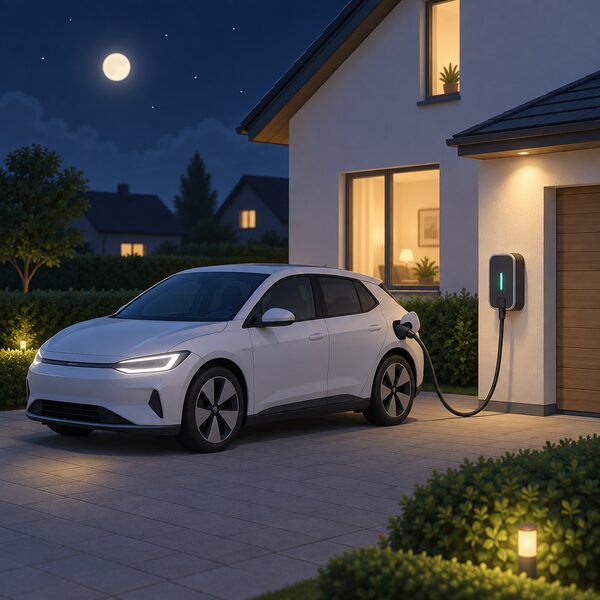
The cost case rests on time-of-use tariffs. Most EV tariffs involve a lower rate for charging overnight19, and the Energy Saving Trust confirms that several such tariffs are available19. waEV-charge puts home charging on an overnight EV tariff at around 2p a mile, against about 6.6p a mile on a standard tariff5. Independent testing reaches the same 2p figure for home off-peak charging, based on an average tested EV efficiency of 3.18 miles per kWh6.
Put another way, one independent source calculates a full charge at £6.00 where overnight electricity costs 10p per kWh20. The gap between the two figures is the whole point of the exercise: the same car, the same battery, charged at a different time of day.
Two things determine what a household actually pays. The first is the tariff, which is why the ev.energy integration matters more than the wallbox specification. The second is how much charging happens at home at all. Zapmap's survey data indicates that drivers with a home charge device meet 85% of their charging needs at home on average, while drivers without one are only 20 to 22% of the EV driver base21. Home charging is where the cost advantage sits, and public charging is where it is lost. More detail is at EV charging running costs and home vs public charging cost.
Warranty and what it covers
All waEV-charge units come with a three year warranty4. Materials installed in conjunction with the charger, such as a new consumer unit, come with a 12 month warranty4. That split is worth reading carefully: the charger itself is covered for three years, the electrical work around it for one.
The warranty sits alongside a support route. waEV-charge runs a UK-based support function, and the published troubleshooting material covers the common failure modes directly: a session that will not start, a charger that will not connect to Wi-Fi, and a charger that does not appear in the app22. The Access Code needed for setup is found at the back of the installer manual supplied with the charger23.
For the wider picture on what charger warranties typically include and exclude, see EV charge point warranties and aftercare.
Cost, grants and 0% finance
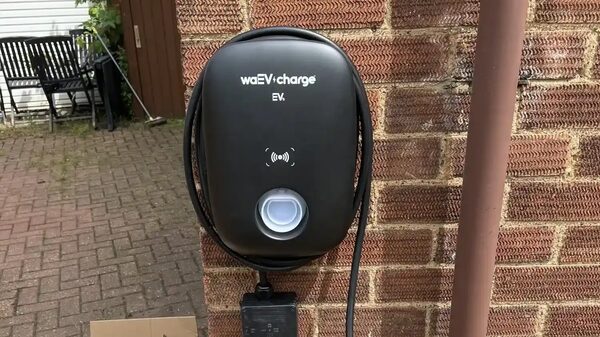
There is no published list price for a waEV-charge unit in the material available, so prices are installer-quoted. What is published is the finance structure and the grant position. waEV-charge offers 0% finance, but it applies only to installed chargers rather than charger-only purchases4. To qualify, the total cost of the installed charger must meet a minimum loan amount of £250, and a 10% deposit is required upfront4.
On grants, the OZEV EV chargepoint grant provides £350 off the cost of the charger and installation13. That grant is aimed at renters and flat owners rather than owner-occupiers with a driveway, and the eligibility conditions are set out at the Electric Vehicle Chargepoint Grant. The fully installed package price quoted by waEV-charge includes the charger unit, a professional standard installation, all safety certification, and VAT13.
The VAT position on domestic charging is favourable compared with public charging, which is covered at why public EV charging VAT is higher than home charging. For the broader market picture on fitted prices, see how much does a home EV charge point cost, fitted.
Installation: lead times, standard scope and extra costs
The published lead times differ. One page states a charger can be installed within 10 days if the order is placed that day, with a Fast Track option carrying extra charges1. Another describes installation in as little as 10 days5. A third gives a typical install timeframe of 2 weeks from the day the order is confirmed8.
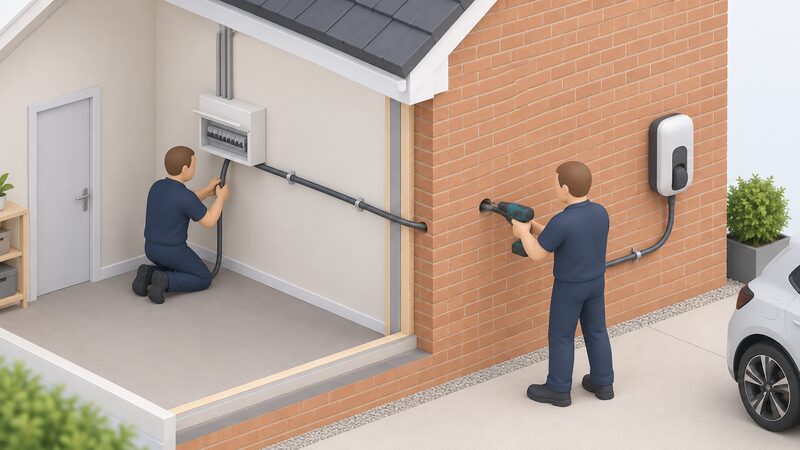
Standard installation covers mounting the charger on a brick or plaster wall, a maximum cable run of 10 metres from the wall-mounted position to the consumer unit, with no civil or remedial electrical work required4. The fuller description adds drilling through one wall, connection to an existing consumer unit or a new two-way consumer unit fitted with an SPD, and all necessary safety testing and certification13. A standard installation typically takes just a few hours on the day12.
Anything beyond that scope is quoted after assessment. UK Power Networks states plainly that it is unable to provide an exact price or time frame online, because both are determined by the specific work required, and that a quotation may follow a site visit24. Independent guidance lists the cost factors as the charging station model, the charging speed, and the electrician's fees25. Where a household wants two chargers, the wall space needed is typically around 1 to 2 square metres depending on the models and the installation method26.
Permissions, planning and who can do the work
Planning permission is usually not needed for a home charger, because it falls within permitted development rights, with exceptions for listed buildings, conservation areas and cross-pavement solutions25. The Planning Portal is more specific: permission is usually required for on-street parking, conservation areas, listed buildings, areas where the installation is restricted through article 4 directives, and more than one upstand per parking space27. Installing a home charger is classified as development, so it is up to the householder to ensure the correct permissions are in place27.
Where the cabling route or the charger location crosses boundary lines not owned by the householder, permissions are needed from the relevant authority4. That covers the common case of a charger on a shared wall or a cable crossing a neighbour's land. The full position across the four nations is at planning permission for a home EV charge point.
On who does the work, waEV-charge states that any qualified electrician can complete the installation11. The company's own route is a nationwide network of EV installers4. Independent guidance from NICEIC covers what competent installation and maintenance involves25. The electrical requirements, including the consumer unit and protection arrangements, are set out at electrical requirements for a home EV charge point.
Where waEV-charge fits in a home energy independence setup
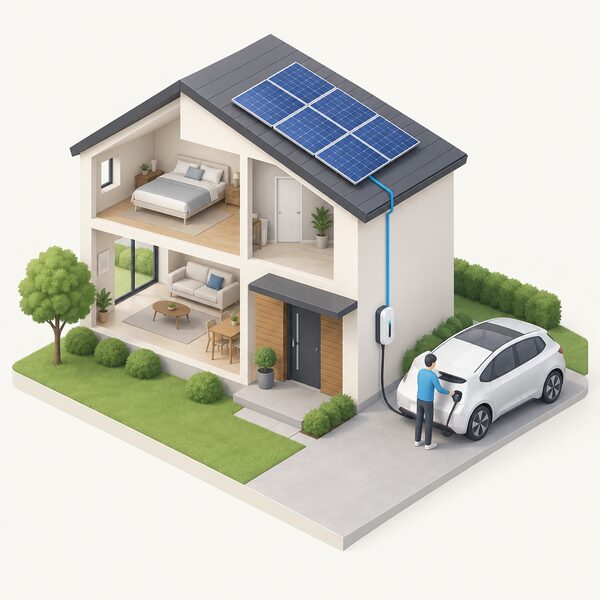
A home charger is the point at which a household's transport energy becomes its own electricity purchasing decision. Charging at home on an overnight tariff at around 2p a mile, against about 6.6p on a standard tariff, is the clearest financial expression of that5. Where a solar array is installed, the ev.energy integration allows the charger to use that generation, and the chargers are described as connecting with solar panels so the vehicle runs on renewable energy at zero additional cost18.
What remains dependent is substantial. The charger draws from the grid, so the household still buys electricity from a supplier. The smart features run through ev.energy's platform, a broadband connection and a phone app, so scheduling and monitoring stop working if any link in that chain fails. The vehicle compatibility list is still being expanded, which means some cars will not deliver the full smart charging experience7. And the longest finance and support arrangements run through waEV-charge's own installer network rather than being available with any electrician4.
For a household already generating its own power, the charger converts that generation into miles, which is the strongest form of energy independence available to a driver today. For a household without solar, the charger is a way of buying the same electricity more cheaply at a different time of day, which is a saving rather than an independence. The wider picture is at EV charging and household energy independence, with solar specifics at charging an EV from solar panels and tariff mechanics at EV energy tariffs and how they change home charging.
Sources27 cited
- waEV-charge home page, waEV-charge, 2026
- waEV-charge EV1i product page, waEV-charge, 2026
- The charger is not connecting to the customer's WiFi, waEV-charge, 2026
- waEV-charge support FAQs, waEV-charge, 2026
- Savings calculator, waEV-charge, 2026
- How much does it cost to charge an electric car, Which?, 2026
- Get help, waEV-charge, 2026
- Home installs, waEV-charge, 2026
- ev.energy software integration, waEV-charge, 2026
- RAW Charging network, Zapmap, 2026
- Can I order without installation, waEV-charge, 2026
- Home EV charger installation: the complete UK guide 2025, waEV-charge, 2025
- How much does EV charger installation cost in the UK: 2025 price guide, waEV-charge, 2025
- Should I buy an electric car, Which?, 2026
- Home charging, Polestar, 2026
- Local Electric Vehicle Infrastructure scheme, Energy Saving Trust, 2026
- Understanding off-peak charging, waEV-charge, 2025
- Tariff integration, waEV-charge, 2026
- Charging electric vehicles, Energy Saving Trust, 2026
- Electric vehicle charge points, Flexi-Orb, 2025
- EV charging VAT, Zapmap, 2026
- My charging session won't start, waEV-charge, 2026
- Who is Axle Energy, waEV-charge, 2026
- Electric vehicles: cost, time and what's involved, UK Power Networks, 2026
- Electric vehicle charger installation and maintenance, NICEIC, 2025
- Best EV tariffs for multi-car families, Uswitch, 2025
- Electric vehicle charging planning permission, Planning Portal, 2026