
In this answer
Short answer
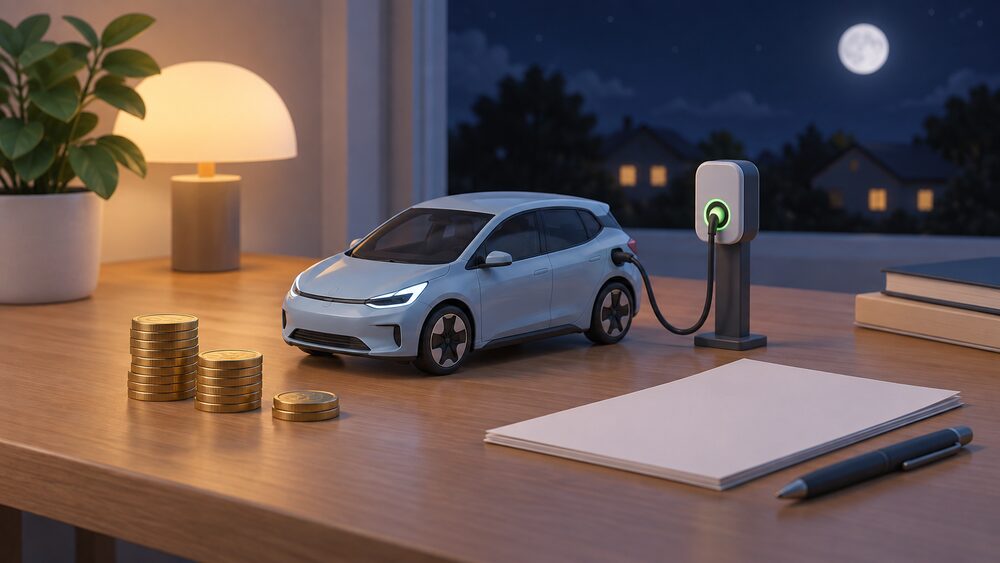
Yes, on the right tariff. Charging an electric car overnight is cheaper than charging it during the evening peak or at a public charge point, because most dedicated EV tariffs are two-rate products where energy used at night costs less per unit1. The saving is not automatic: it depends on the car actually charging inside the off-peak window, and on the household being on a tariff that has one.
The headline numbers are small per mile and large per year. On an off-peak or EV rate, home charging works out at about 2p per mile, based on an average tested efficiency of 3.18 miles per kWh2. A full charge on an off-peak tariff can come in at less than £10, and at 10p per kWh overnight the same full charge would cost £63. One official consultation put the potential saving for a driver smart charging overnight at £330 a year5.
The catch is the tariff, not the car. On a fixed or standard variable tariff the price paid for energy used at night is no different from the price paid during the day, so charging at 2am saves nothing6. Everything below turns on that distinction.
Why night charging costs less: the two-rate structure
An EV tariff is usually a two-rate tariff, where it is cheaper to use energy at night, so the car can be charged more cheaply overnight1. The same structure appears in the wider time-of-use market: a time of use tariff charges different rates depending on the time of day, cheaper when demand is low, usually overnight, and more expensive when demand is high in the early evening8. The cheap hours are not a discount on the car specifically; they are a price signal about when the grid has spare capacity.
There are two shapes of product. One is a full two-rate tariff, so the cheap power can also run other appliances9. The other is an add-on to an existing tariff, where the cheaper rate applies only to charging the car9. Dedicated smart storage battery tariffs follow the same logic, with cheaper rates overnight so a battery can be filled and the power used during the day when buying it would cost more9. Economy 7, the older restricted-meter product, gives a cheaper rate for energy used during the night on the same principle10.
What drives the size of the saving is the gap between the two rates and how much load can be moved into the cheap window. A car is the largest movable load most homes have, which is why EV tariffs exist at all. The dependence that remains is on the supplier setting that window and keeping it: the cheap rate is a contract term, not a property of the electricity, and it can be changed within the terms of the tariff. Households wanting the wider picture of how these products sit alongside fixed and tracker deals can read the UK energy tariffs guide, and the mechanics of the products themselves are set out in time-of-use electricity tariffs explained.
Off-peak windows: typically midnight to 6am
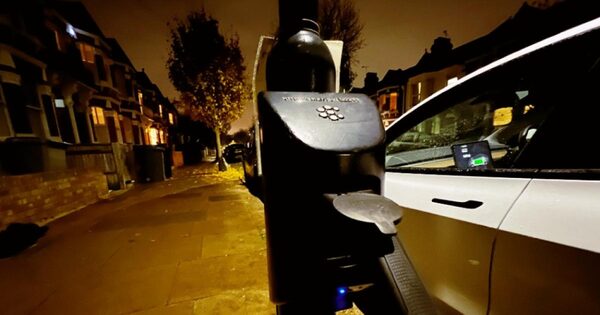
Off-peak hours are set by each supplier, and they vary. One supplier describes lower off-peak rates during designated overnight hours, typically between 12am and 6am7. Another runs midnight to 5am11, a third gives seven hours of cheaper off-peak electricity every night from 11pm to 6am12, and a fourth describes EV tariff hours commonly from midnight to 5am13. Across the market, the common windows are 11pm to 8am, midnight to 7am and midnight to 5am14.
Economy 7, the closest older equivalent, is named after its seven-hour night window, typically 12am to 7am, with times that may vary between suppliers15. Economy 7 and Economy 10 tariffs have cheaper rates overnight, with around 12am to 7am typical and times varying16. One supplier's EV product adds extra daily off-peak hours outside the standard 11pm to 6am window17.
| Tariff or product | Off-peak window | Source |
|---|---|---|
| Supplier EV smart charging guidance | 12am to 6am typical | 7 |
| EV Charge tariff | Midnight to 5am | 11 |
| EDF EV tariffs | 11pm to 6am, seven hours | 12 |
| EV tariff, commonly | Midnight to 5am | 13 |
| Typical UK supplier windows | 11pm to 8am, midnight to 7am, midnight to 5am | 14 |
| Economy 7 | Seven hours, typically 12am to 7am | 15 |
The practical consequence is that a household cannot assume a window. The car or charger has to be scheduled to the hours the tariff actually specifies, and those hours can sit either side of midnight. Where a supplier offers extra off-peak hours beyond the standard window, the scheduling has to account for both17. The Economy 7 night hours page covers the older product's timing in more detail.
What it costs: under 2p per mile overnight
The per-mile figure is the one that makes the comparison concrete. Home charging on an off-peak or EV rate works out at about 2p per mile, based on an average tested EV efficiency of 3.18 miles per kWh2. That is the cheapest of the charging routes tested, and it is the figure to hold against public charging and against a standard daytime rate.
Per-charge costs tell the same story at a larger scale. With an off-peak tariff, a full charge can cost less than £103. At 10p per kWh overnight, the same full charge would cost £64. The difference between those two figures reflects different battery sizes and different off-peak unit rates rather than a contradiction: both are off-peak outcomes, and no single rate applies to every tariff.
What a household should expect in practice is that the saving is proportional to how much of the charging lands inside the window. A car charged from empty every night on a cheap rate captures the full benefit. A car topped up at random times, or charged on a single-rate tariff, captures none of it. The wider running-cost comparison is set out by the Energy Saving Trust, which reports that charging an EV can be around £760 a year cheaper than paying for fuel for the same mileage18. That figure is about electric versus petrol, not night versus day, and it is separate from the £330 modelled smart-charging saving5.
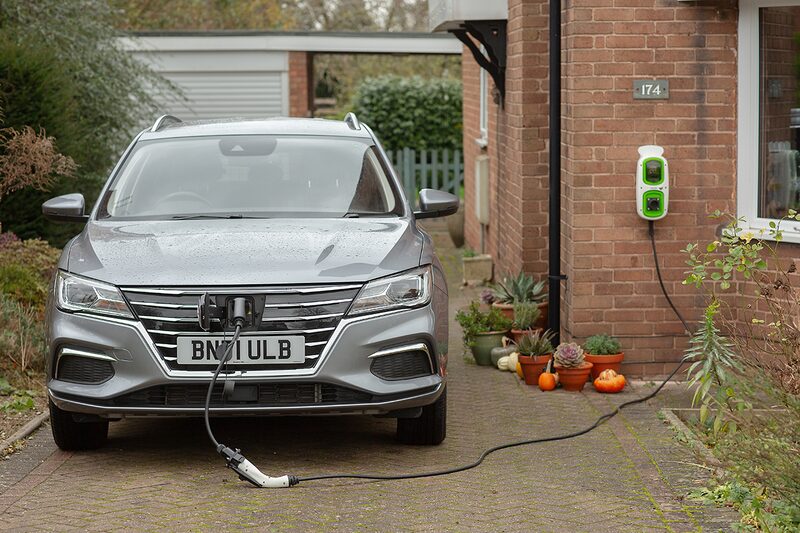
Night versus peak: £3 to £4 at 2am against £7 to £8 in the evening
The comparison is between the small hours and the evening peak, and the direction of it is supported rather than the exact pounds. The mechanism is the time-of-use structure: cheaper when demand is low, usually overnight, and more expensive when demand is high in the early evening8. A car charged in the early evening is buying at the expensive end of the day; the same car charged at 2am is buying at the cheap end.
No peak-rate price per kWh or peak full-charge cost is published, so the £3 to £4 against £7 to £8 split cannot be stated as a fact. What can be stated is the off-peak side: less than £10 for a full charge on an off-peak tariff3, and £6 at 10p per kWh overnight4. The peak side is defined only as more expensive, not as a number.
Two further points bear on the comparison. First, the cheapest hours are not only about price: one supplier identifies 1am to 5am as the window when grid demand is lowest7. Second, the tariff structure that creates the gap is the same one that makes the evening expensive, so a household that moves charging but leaves other heavy loads in the peak still pays peak rates for those loads. The shifting electricity use to cheap rates page covers the wider load-shifting question.
Charging at home overnight versus public charging
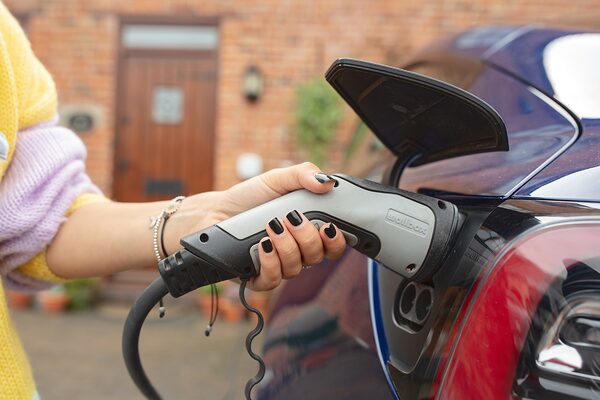
Home charging is likely to be cheaper than charging at a public EV station19. That is the independent finding, and it holds before any off-peak tariff is applied: the home rate is compared with a public rate, and the home rate wins. Adding an overnight tariff widens the gap further, because the home rate in the cheap window is the lowest of the options tested2.
Public charging also has a structural difference. Some public products bill differently: one night-saver tariff charges customers solely for the energy they use on the day they charge, eliminating the uncertainty of a flat fee20. That is a public-network design, not a home tariff, and it does not change the home-versus-public comparison.
The dependence that remains at home is on the electricity supply itself. A household charging overnight is still buying from a supplier, still exposed to whatever the off-peak unit rate becomes, and still reliant on the grid being available in those hours. What the household controls is the timing of the largest single load it owns. The EV tariffs page sets out the products, and EV charging bolt-ons covers the add-on shape where only the car gets the cheap rate.
Cleaner as well as cheaper: less fossil generation on the grid
The cheap hours are also the lower-carbon hours, and the two facts have the same cause. At off-peak times, for example overnight and when it is windy, demand is lower and more electricity comes from renewable sources, meaning lower emissions8. The grid needs to generate less electricity from fossil-fuelled generators, because enough renewable energy is generated to cover more homes for longer throughout the day16.
Smart charging is the household-level version of this. Energy flexibility means letting the car charge when electricity is cheapest and greenest, often overnight, without changing your routine21. The lowest-demand window, 1am to 5am, is where that lands in practice7.
The limit is that the household does not choose the generation mix. Charging overnight shifts demand to hours that are, on average, greener, but the actual mix on any given night depends on weather and on what the grid is running. The claim supported here is a system-level one: shifting charging reduces the need for fossil generation across the day16. The tariffs and household energy independence page covers what that does and does not do for a household's control over its own supply.
Which EV tariffs offer a cheap overnight rate
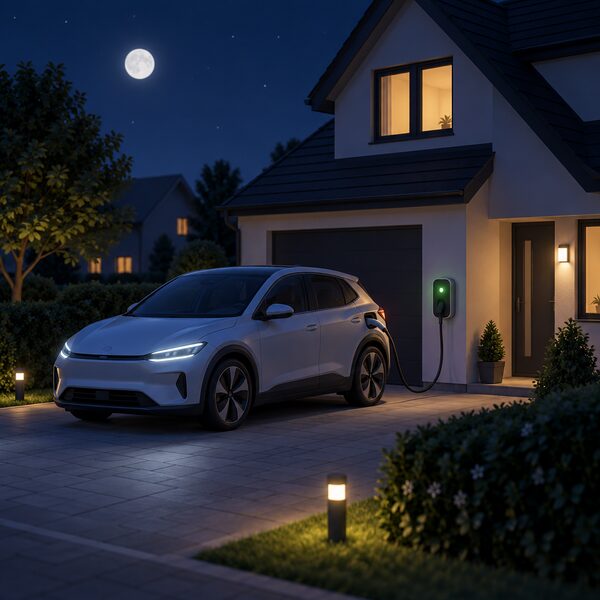
EV tariffs typically charge a cheaper rate for electricity used at night22. Most of the products available involve a lower rate for charging overnight23, and with electric vehicle tariffs it is typically cheaper to use energy at night24. Several work similarly to domestic Economy 7 tariffs, with a lower unit rate for seven hours during the night25. Others offer one period of very cheap electricity in the early hours of the morning for charging the car26.
Named products include Ecotricity's EV tariff, which gives cheaper green electricity overnight to charge electric vehicles27, and Octopus Go, which enables customers to get five hours of cheaper energy every night to charge their car28. EDF's EV tariffs give seven hours of cheaper off-peak electricity every night from 11pm to 6am12, with extra daily off-peak hours outside the standard 11pm to 6am window on the Smart Charging product17. waEV-charge's Dual Rate tariff has separate daytime and nighttime electricity rates9.
| Product | Off-peak offer | Source |
|---|---|---|
| Ecotricity EV Tariff | Cheaper green electricity overnight | 27 |
| Octopus Go | Five hours of cheaper energy every night | 28 |
| EDF EV tariffs | Seven hours, 11pm to 6am | 12 |
| EDF Smart Charging | Extra off-peak hours outside 11pm to 6am | 17 |
| waEV-charge Dual Rate | Separate day and night rates | 9 |
The comparison between named products is covered on Octopus Go vs EDF GoElectric and OVO Charge Anytime vs Octopus Go. No product is recommended here; the rates and windows are set by the suppliers and change.
Smart meters, scheduling and the conditions attached
A smart meter is not needed simply to charge an electric car, but without one some EV-specific tariffs may not be available29. Suppliers running an overnight EV rate generally require a smart meter for the tariff to work5. The meter is what allows consumption in the cheap window to be identified and billed at the right rate.
Scheduling is the other condition. A smart charger or the car itself can be set to charge inside the window, and supplier-controlled smart charging lets the car charge when electricity is cheapest and greenest, often overnight, without changing your routine21. The equipment does not set the window; the tariff does.
Two further conditions matter. First, the cheap rate applies only inside the window, so a charge that overruns into peak hours is billed at the peak rate. Second, the saving depends on the household being able to move load: a driver who cannot charge at home overnight, for example in a flat without a dedicated supply, does not have this option at all. The EV tariff eligibility and smart meter for EV or heat pump tariff pages cover those cases.
Home batteries and other loads on the same cheap window
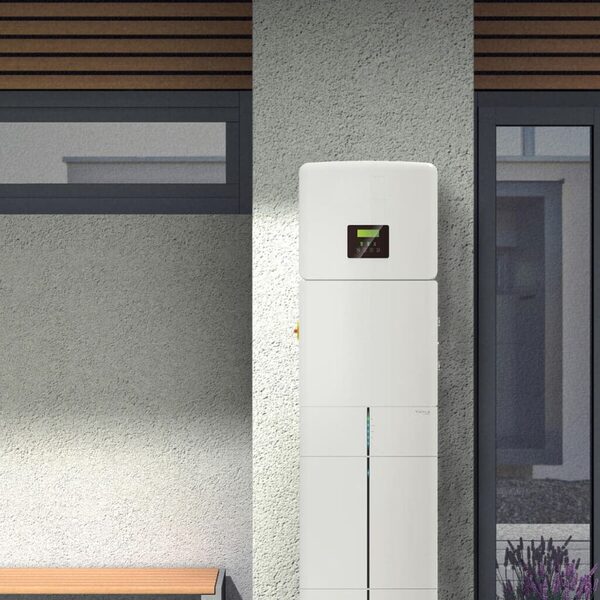
The cheap window is not only for the car. A home battery can be charged with cheap electricity from a supplier, typically on certain tariffs at night or in the middle of the day30. Homeowners can store power during the day, when electricity tends to be cheap, and sell it during the evening, when it is more expensive31. With a home battery, surplus solar energy is captured and held for when it is needed, including overnight EV charging, whereas without one the unused solar electricity is wasted or exported, often at a relatively low rate32.
That makes the battery a way of extending the cheap window into the expensive hours. The car charges at the cheap rate; the battery charges at the cheap rate and discharges later. The limit is that both are still buying from the supplier at the supplier's off-peak price, and the battery adds its own cost and losses. The home battery with a time-of-use tariff and EV tariff with solar and battery pages cover the combinations.
Sources32 cited
- Energy flexibility, Smart Energy GB
- How much does it cost to charge an electric car, Which?
- Should I buy an electric car, Which?
- Electric vehicle charge points, Flexi-Orb
- Smart meter Guaranteed Standards of Performance draft impact assessment, Ofgem
- Using energy flexibly, Smart Energy GB
- EV smart charging at night, E.ON Next
- Should I switch to a time of use tariff, Energy Saving Trust
- Time of use tariffs explained, Which?
- Energy: your questions answered, Confused.com
- Time of use peak and off peak times, Good Energy
- Switch energy supplier, EDF Energy
- When is off peak electricity, Jackery UK
- Time of use tariffs explained UK, 100Green
- What is Economy 7, Smart Energy GB
- Balancing the grid, Uswitch
- EV tariff, EDF Energy
- Electric vehicles: disabled drivers, Energy Saving Trust
- Electric vehicle charger installation and maintenance, NICEIC
- char.gy Night Saver tariff, Zapmap
- What is flexibility, FlexAssure
- Benefits for Britain, Smart Energy GB
- Charging electric vehicles, Energy Saving Trust
- Time of use tariffs: the benefits, Smart Energy GB
- Electric cars and energy bills, Uswitch
- Tariffs for renewable technology, Energy Saving Trust
- How to save energy and money with a smart meter, Ecotricity
- Octopus EV energy tariffs, Uswitch
- EV tariffs and home charging: what consumers need to know, Energy Ombudsman
- Battery storage, Home Energy Scotland
- Batteries in the home, Solar Energy UK
- Can solar panels charge electric cars, The CPA
 Time-of-Use Tariffs ExplainedCan you pay less for electricity by using it at different times of day?
 Electric Vehicle TariffsCharging an electric car at home can cost far less overnight, but only on special electricity plans.
 EV Charging Bolt-OnsCan you get cheap electricity for your car without changing the tariff for the rest of your home?
 Economy 7 TariffsEconomy 7 gives you seven hours of cheaper electricity at night, but the exact hours depend on where you live and who supplies you.
 Supplier-Controlled ChargingSmart charging tariffs let your energy supplier decide when your car charges, usually overnight when electricity is cheaper.
 Cost to Charge an EV at HomeHow home charging cost is worked out from battery size, efficiency, the unit rate paid and the tariff behind it, with full-charge costs of about £8 to £17, cost per mile, annual running costs and what changes for EV owners from April 2028.