In this guide
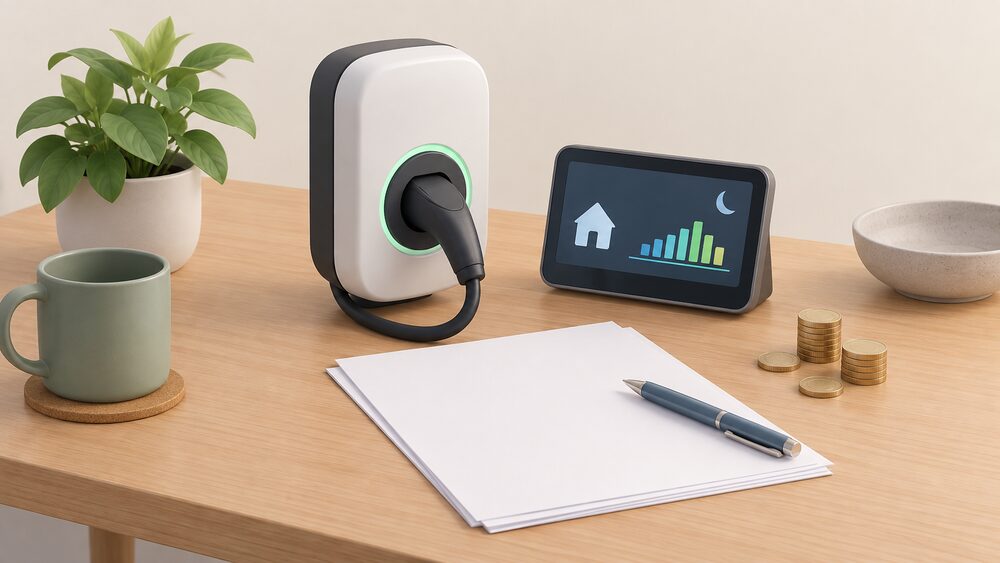
An EV charging bolt-on is a product that gives the electricity used to charge a car a separate, cheaper price while the rest of the home stays on its existing tariff. The Energy Ombudsman describes add-on EV tariffs as deals where "consumers keep their existing household tariff but receive separate EV charging discounts, credits or other benefits"1. Zapmap calls the same idea a Type of Use tariff: an add-on that prices "just the specific energy used to charge your EV", with the cheaper rate applying at any time of day or night, provided the home has a compatible charger and a working smart meter2.
The rates on offer sit well below the standard price of electricity. Which? puts home charging at 7p per kWh on an off-peak or EV rate against 24p per kWh at the standard rate, which works out at about 2p per mile on the off-peak rate3. Good Energy's EV Charge tariff, a whole-home time-of-use deal rather than a pure add-on, charges 8p/kWh from midnight to 5am and states that a full charge costs from £5.204. Some add-ons are sold as a monthly plan instead: Uswitch describes Octopus's Intelligent Drive Pack as an add-on to an existing home tariff where customers pay an extra monthly subscription fee for unlimited smart EV charging5.
For a household's independence, a bolt-on cuts the cost of running a car on home electricity, but it deepens several dependencies at once: on the grid for overnight supply, on the supplier that sets the rate, on a smart meter, and often on a charger maker's app and cloud service to identify and schedule the charging.
How a bolt-on sits on top of your existing tariff
The defining feature of a bolt-on is that it leaves the household tariff alone. The kitchen, heating and lighting stay on whatever fixed, variable or time-of-use deal the home already has, and only the car's charging receives the cheaper price1. That separates it from a whole-home EV tariff, where the entire house moves to a new rate structure with a cheap overnight window and dearer daytime hours.
Because the discount applies to the car alone, the supplier needs a way to tell charging kilowatt-hours apart from everything else the meter records. Zapmap sets out the two conditions: a compatible home charger and a working smart meter2. The charger reports what it delivered to the car, and the supplier then credits or discounts those units. This is why add-ons are usually tied to a list of supported charger brands, and why the charger's connection to the supplier's system matters as much as the meter.
The benefit takes different shapes:
- A cheaper per-kWh price for charging, applied whenever the car charges, not only at night2.
- Separate credits or discounts paid against the bill for the charging energy1.
- A monthly subscription covering unlimited smart charging, as with the Intelligent Drive Pack5.
The trade-off for independence is control. On an add-on that relies on smart charging, the supplier or its software often decides when the car charges within the time the driver allows. That is covered in more depth under smart charging and supplier-controlled tariffs. The household gains a cheaper unit price for its largest single electrical load, but the schedule, the rate and the data flow all sit with outside parties.
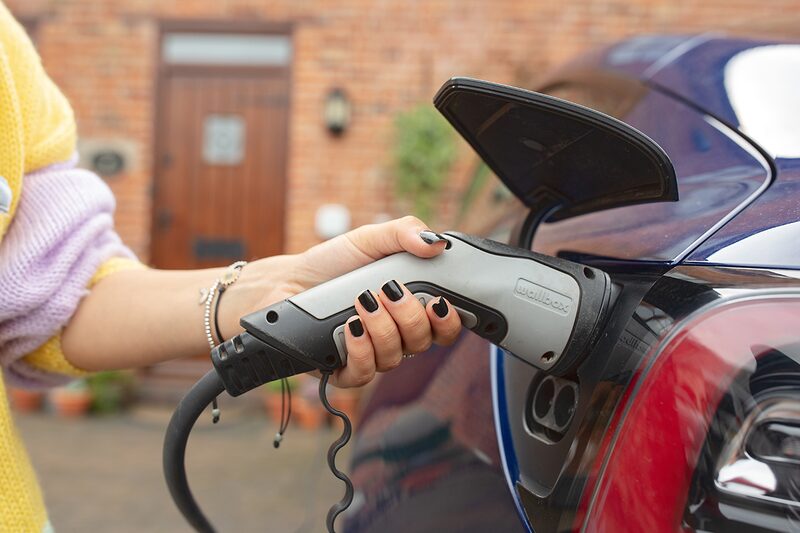
Off-peak rates now: 6.7p to 9p per kWh
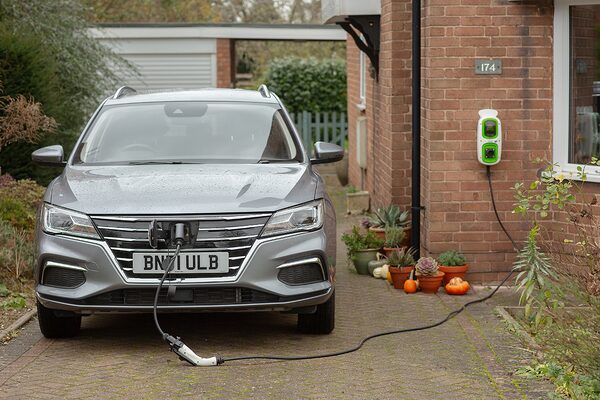
Published EV charging rates cluster in a narrow band. The table below sets out the figures available, with their dates; the older supplier figures date from December 2024 and are "from as little as" prices, so current rates may differ.
| Tariff or measure | Rate | Date |
|---|---|---|
| E.ON Next Drive, EV charging 12 to 7am | 6.7p/kWh8 | 2026 |
| E.ON Next Drive, off-peak from | 6.9p per kWh9 | December 2024 |
| Home off-peak or EV rate (Which?) | 7p per kWh3 | 2026 |
| British Gas EV tariff, from | 7.9p per kWh9 | December 2024 |
| Good Energy EV Charge, midnight to 5am | 8p/kWh4 | 2026 |
| Octopus EV tariffs, from | 8.5p per kWh9 | December 2024 |
| EDF EV tariff, from | 9.0p per kWh9 | December 2024 |
| Home off-peak time-of-use (Uswitch) | 10p per kWh10 | July 2025 |
| Home standard rate (Which?) | 24p per kWh3 | 2026 |
The rates differ for three reasons: the length of the cheap window, whether the product is a pure add-on or a whole-home tariff, and when the figure was taken. A waEV-charge guide quotes off-peak rates "as low as 7p/kWh"11, consistent with the Which? figure.
The gap with public charging is large. Which? states that public chargers can cost more than ten times the home rate, with 79p/kWh typical at a mini charger3. Zapmap reports that a 50 to 149kW FOR EV charge point costs 65p/kWh as of February 202612. For a household that can charge off-street, the bolt-on rate is the single biggest lever on running costs. For a household that cannot, none of these rates apply at all, which is a real limit on who benefits.
Good Energy EV Charge: 8p/kWh from midnight to 5am
Good Energy's EV Charge is a time-of-use tariff for the whole home rather than a bolt-on in the strict sense, but it is often compared with add-ons because its cheap window is built around car charging. The maker states a rate of 8p/kWh with "Five hours of low-cost electricity from midnight to 5am"13. Its published peak times for EV Charge run from 5am to midnight, and its off-peak times from midnight to 5am14. A fixed version carries the same terms: a "5 hour overnight rate of 8p / kWh (12am, 5am)"15.
Good Energy states that the electricity is 100% renewable4, and that it matches every unit used with renewable power from its community of over 3,000 UK generators16. Powervault describes the rate as one of the most competitive, comparable to Octopus8, and notes that "You don’t have to have an EV to access this tariff"8. That last point is the practical difference from a pure add-on: because the whole home moves to the time-of-use structure, other loads such as a washing machine or a home battery can also use the cheap window. More on this is under Good Energy tariffs.
The limits are the other side of the same structure. From 5am to midnight the home pays the peak rate14, so a household with heavy daytime use may see its savings on the car offset by dearer daytime units. A five-hour window also limits how much energy a home charger can deliver each night, which the next section shows in figures.
What a full charge costs on an add-on rate
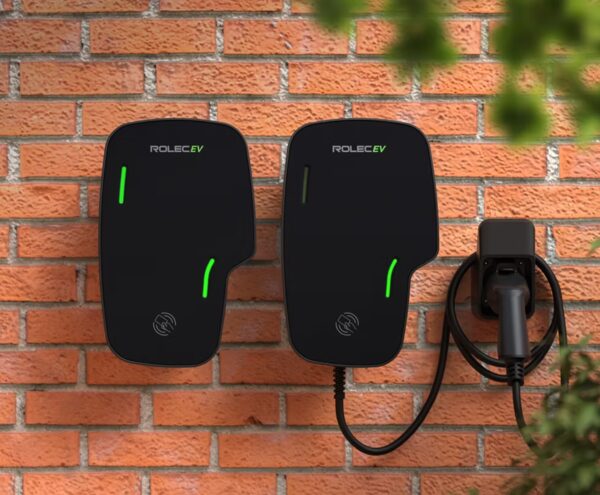
A full charge on an off-peak rate costs a few pounds. The figures below come from different sources and assume different battery sizes and rates, which is why they do not line up exactly.
| Example | Cost | Basis |
|---|---|---|
| waEV-charge guide | £2.8011 | 40kWh charge at off-peak rates as low as 7p/kWh |
| Good Energy, five-hour charge | £2.964 | 8p/kWh, midnight to 5am |
| Good Energy, full charge | from £5.204 | "a 65kW EV battery for 8.8 hours @8p/kWh" |
| Good Energy, eight consecutive hours | around £9.9216 | same car charged for 8 consecutive hours |
Good Energy's own figures are worth reading carefully. The maker bases its £5.20 figure on "charging a 65kW EV battery for 8.8 hours @8p/kWh with an estimated range of 225 miles", giving less than 2.31p per mile13. Yet 8.8 hours is longer than its five-hour cheap window, and elsewhere the same maker puts eight consecutive hours of charging at around £9.9216, because hours outside midnight to 5am are billed at the peak rate. In practice a large battery charged from empty will not fit into one five-hour window, and the cost depends on whether the car tops up over several nights or charges into peak hours.
For comparison at a standard rate, Flexi-Orb uses an assumed tariff of 24.5p per kWh for a typical 60kWh battery17, close to the Which? standard figure of 24p per kWh3.
The charger itself is a separate cost. Zapmap states that a 7kW charge point typically costs between £700 and £1200 fully installed18. Rolec puts the average installation at £500 to £1000, more for underground cable routes19, and Uswitch states installation typically adds up to £500 to £1,000 per charger20. Prices are installer-quoted, and these ranges do not state their VAT position. A bolt-on only saves money once that outlay is recovered through cheaper charging.
Eligibility: the smart meter and who can switch
In most cases a smart meter is required to access EV tariffs7. The Energy Ombudsman is precise about the distinction:
"You don’t need a smart meter simply to charge an EV, but without one you may not be able to access some EV-specific tariffs."
The conditions that commonly apply:
- A working smart meter, usually in smart mode. Smart Energy GB states that energy flexibility schemes need a meter "working in smart mode and sending half-hourly readings"21.
- The bill payer's request. Only the person paying the bills can request a smart meter installation from their supplier22. Tenants who do not pay the bill directly depend on the landlord or bill payer.
- Arranged through the supplier. Smart meter upgrades go through the electricity supplier, not the network operator23.
- A compatible smart charger. waEV-charge states that EV-specific tariffs usually need a smart charger that supports scheduled charging and energy data sharing11, and Which? states that all new chargers now need to be smart24.
- Location. Smart Energy GB's installation guidance excludes Northern Ireland25, so households there face a different route; see tariffs in Northern Ireland.
Eligibility for a smart meter itself "may vary"25. Grants for the charger have their own rules: flat owners and renters seeking the residential chargepoint grant must use or own a vehicle on OZEV's approved list and use an OZEV-approved installer, and households with on-street parking also need permission from the local highways authority and any planning permissions26. A fuller checklist is under EV tariff eligibility and which tariffs your meter allows.
Smart scheduling in the Ohme app

A bolt-on only saves money if the car charges when the rate is cheap, and that is the job of the charger's software. Power NI states that to get the cost-saving benefits of smart charging, the charger has to be paired with an EV tariff offering lower off-peak rates, and lists Ohme's features as smart app control, charging at the lowest-cost times, tariff integration and dynamic load management27. Ohme states its chargers help shift EV charging away from the 5 to 8pm demand peak28.
The app's scheduling tools, as the maker describes them29:
- start, stop and schedule charging, with one-off schedules set by desired charge and departure time;
- monitoring of charging costs and every kWh used;
- switching between several saved cars.
Ohme also describes car app integration: for supported brands the app retrieves the battery level from the car after logging into the car's own account, so a target charge can be set30. A "max charge mode" overrides smart charging and charges at full speed until the battery is full30, which is useful in a hurry but ignores the cheap window.
The price cap is the feature most directly tied to a bolt-on's saving. Ohme states it lets the charger "only charges at the cheapest times"30, and describes it as maximising off-peak savings within a set price31. Its support guidance explains the setting is found on the Charging screen: tap Price cap, enable it and confirm, then edit the "Never charge over" amount as needed32.
This dependence is worth stating plainly. The app is required to activate smart charging30. The savings rely on the maker's software, its servers and a working home internet connection.
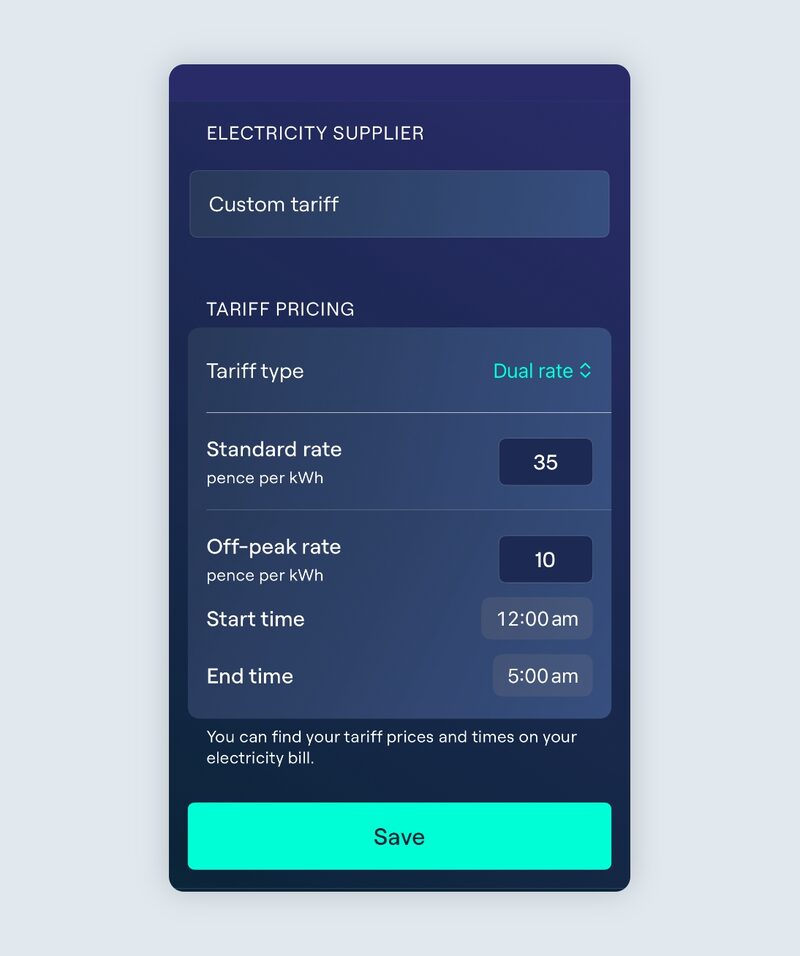
Setting up your tariff in the Ohme app, listed or custom
Ohme's app holds the tariff so it knows when electricity is cheap. The maker states the process is to "select your energy supplier in the Ohme app, select your tariff, and we'll take care of the rest"31, and that the charger then schedules charging into off-peak hours automatically29.
To change a listed tariff, Ohme's support guidance sets out these steps34:
- Check the address is set correctly in Settings.
- Go to Settings, then My tariff.
- Tap "Select a new tariff".
- Choose the energy supplier.
- Choose the tariff and tap Done.
Where a supplier or tariff is not listed, the app allows a custom tariff via "My supplier/tariff isn't listed"35. The maker's guidance lists the inputs as the standard rate price per kWh, the prices and times of any off-peak window, the time zone and whether the meter runs on daylight saving35. Ohme's own example of a dual-rate custom tariff uses off-peak times of 12am to 5am34, the same window as Good Energy's EV Charge.
The accuracy of what is entered matters. Ohme states that a tariff with "the correct prices and times" must be in the My Tariff section for the price cap to schedule correctly32, and that tariff information is used to estimate the cost of each session35. It also states:
"Note: Ohme will never bill you directly for the energy used to charge the car."
So the figures in the app are estimates. The bill still comes from the supplier, and any mismatch between the app's tariff and the real one shows up only when the bill arrives.
Solar charging, earthing and charger compatibility
Many chargers sold alongside bolt-ons can also charge from rooftop solar, which is the one route that reduces grid dependence rather than just making grid electricity cheaper. Ohme states its chargers are solar charging compatible28, through a Solar Boost feature and a CT clamp36. E.ON Next lists solar charging compatibility for its home chargers37, and its installation package includes an Ohme CT clamp for a single-phase 100A supply38.
Not every charger works with a solar array. Rolec notes that "some models may not be compatible with your solar array", that the feature can be app-dependent, and that it is worth checking listed features with the chargepoint supplier19. How an EV tariff interacts with solar panels and a battery is covered under EV tariffs with solar and battery.
On the car side, Ohme states its chargers are compatible with all Type 1 and Type 2 EVs36 and with all energy suppliers39. Supplier compatibility for the charger is not the same as a supplier's add-on accepting that charger, since each add-on names the chargers it can read from. Ohme integrates with E.ON Next Drive Smart40, and E.ON Next's charger range covers the Ohme ePod, Ohme Home Pro and zappi GLO37.
Published charger and tariff guidance does not set out earthing requirements for home chargers, so installation and electrical safety questions sit with a registered installer.
Fixed terms, exit fees and where the price cap fits in

Some EV rates come as fixed deals, such as Good Energy's Fixed EV Tariff15. Fixed energy tariffs usually run for 12 to 24 months, and exit fees apply only to fixed-term deals41. Two rules limit those fees:
- Exit fees "cannot be charged in the last 49 days" of a fixed tariff41.
- Citizens Advice states a supplier cannot charge a fee to switch if the contract ends in the next 7 weeks42.
Exit fees vary. A low standing charge tariff from E.ON Next carries £100 per fuel exit fees43. E.ON Next bills show the tariff name, whether it is fixed or variable, exit fees, unit rates and standing charges44. More detail is under exit fees on fixed tariffs.
A bolt-on changes only the price of charging. The household tariff underneath, including its standing charge, carries on. The standing charge price cap for electricity is 60.97p per day45. Ofgem's cap levels for 1 July to 30 September 2026 in the South East show:
| Electricity, South East | Standing charge (annual) | Annual bill |
|---|---|---|
| Single-rate, 2,500 kWh | £189.27 | £824.22 |
| Multi-rate, 3,400 kWh | £190.23 | £996.63 |
These figures are from Ofgem46. They illustrate that the standing charge alone is a significant fixed cost no bolt-on removes. Whether the cap applies in Northern Ireland is covered under NI price cap coverage.
Switching onto an add-on is typically quick. Uswitch states that switching to any energy tariff "won't cause power outages and typically takes just a few days"6.
Moving home: warranty, disconnection and the next owner
A charger is fixed to the house, but the bolt-on and the app account belong to the household. Three things matter at a move.
Warranty. E.ON Next states its home chargers carry a "3-year product and 1-year workmanship warranty"47. Its installation package includes warranty registration and a Building Control Certificate38. Whether that warranty passes to the next owner is not stated in E.ON Next's published guidance.
Disconnection from the account. Ohme states that when a charger is unpaired, "Your preferences, settings, and charging history will stay saved in your account", so a new charger can be paired later48. The next owner pairs the charger to their own account using the serial number on the white sticker underneath the unit, a 12 digit code beginning "ohme"48.
Grants. The government's chargepoint grant for renters and flat owners is not available if "you’re moving house or planning on moving"49.
What a bolt-on does for independence, and what it does not
A bolt-on makes grid electricity cheaper for the car; it does not make the home more self-sufficient on its own. It adds dependence on a supplier's product, a smart meter and, usually, a charger maker's app, its account system and its internet connection. Without the app, Ohme states its charger runs in "plug and charge" mode, charging instantly until full30, and the scheduling a bolt-on depends on is lost.
The route to reducing grid reliance runs through solar charging and a home battery, covered under tariffs and energy independence and the wider energy tariffs guide.
Sources49 cited
- EV tariffs and home charging: what consumers need to know, Energy Ombudsman, 2026-09-11
- EV energy tariffs, Zapmap, 2024-09-16
- How much does it cost to charge an electric car, Which?, 2026-08-26
- EV charger installation, Good Energy, 2026-09-18
- Octopus EV tariffs, Uswitch, 2025-10-09
- EV energy tariffs, Uswitch, 2025-09-17
- Smart meter benefits for Britain, Smart Energy GB, 2026-04-24
- Time of use tariffs: a guide, Powervault, 2026-09-19
- EV tariffs, waEV-charge, 2024-12-12
- What is the cheapest way to charge an EV, Uswitch, 2025-07-02
- Understanding off-peak charging, waEV-charge, 2025-08-07
- FOR EV charging network, Zapmap, 2026-02
- Greener energy, Good Energy, 2026-07-09
- Time of use peak and off-peak times, Good Energy, 2026-03-24
- Fixed EV tariff, Good Energy, 2026-07-09
- Is it cheaper to drive an EV or a petrol car, Good Energy, 2026-06-18
- Electric vehicle charge points, Flexi-Orb, 2025-04-22
- Home charging, Zapmap, 2025-06-19
- Choosing the right EV charger for your home, Rolec, 2026-01-06
- Best EV tariffs for multi-car families, Uswitch, 2025-07-02
- Energy flexibility, Smart Energy GB, 2026-08-17
- Can I get a smart meter, Smart Energy GB, 2026-03-16
- Adding more power, UK Power Networks, 2026-09-17
- Electric car charging at home, Which?, 2026-02-25
- Get a smart meter, Smart Energy GB, 2026-06-10
- EV charger installation and maintenance, NICEIC, 2025-08
- Smart EV charging, Power NI, 2026-04-13
- Ohme energy, Ohme, 2026-03-16
- Ohme ePod, Ohme, 2026-05-21
- Ohme app, Ohme, 2025-09-17
- How our chargers work, Ohme, 2026-08-13
- How can I charge at my off-peak times, Ohme, 2026-09-17
- How to use the Ohme app widget, Ohme, 2025-12-11
- How do I set my tariff in the Ohme app, Ohme, 2025-07-18
- How do I set my tariff in the Ohme app (support), Ohme, 2026-09-17
- Ohme products, Ohme, 2026-05-21
- EV running costs, E.ON Next, 2026-09-17
- EV charger installation, E.ON Next, 2026-09-17
- How does Next Drive Smart work with Ohme, Ohme, 2026-08-05
- Setting up Next Drive Smart with Ohme, Ohme, 2026-08-05
- How to switch energy supplier, Which?, 2026-05-15
- Your supplier has put up its prices, Citizens Advice, 2026-09-17
- What are low standing charge tariffs, Plymouth Energy Community, 2026-09-20
- How do I read my E.ON energy bill, Uswitch, 2025-09-10
- Standing charge energy tariffs, Energyhelpline, 2026-09-20
- Energy price cap levels 1 July to 30 September 2026, Ofgem, 2026
- Public chargers, E.ON Next, 2026-09-19
- How do I pair my Ohme charger to the app, Ohme, 2026-09-17
- EV chargepoint grant eligibility, GOV.UK, 2026-09-17
 Electric Vehicle TariffsCharging an electric car at home can cost far less overnight, but only on special electricity plans.
 Cost to Charge an EV at HomeHow home charging cost is worked out from battery size, efficiency, the unit rate paid and the tariff behind it, with full-charge costs of about £8 to £17, cost per mile, annual running costs and what changes for EV owners from April 2028.
 EV Tariffs and Home ChargingHow EV-specific import tariffs and charging bolt-ons work, including supplier-controlled charging where the energy company decides when the car draws power, which charge points each scheme supports, and what a household needs in place.
 Time-of-Use Tariffs ExplainedCan you pay less for electricity by using it at different times of day?
 Economy 7 TariffsEconomy 7 gives you seven hours of cheaper electricity at night, but the exact hours depend on where you live and who supplies you.
 Charging and Energy IndependenceCharging an electric car at home can cut your fuel costs, but how much does it really free you from the grid?