In this guide
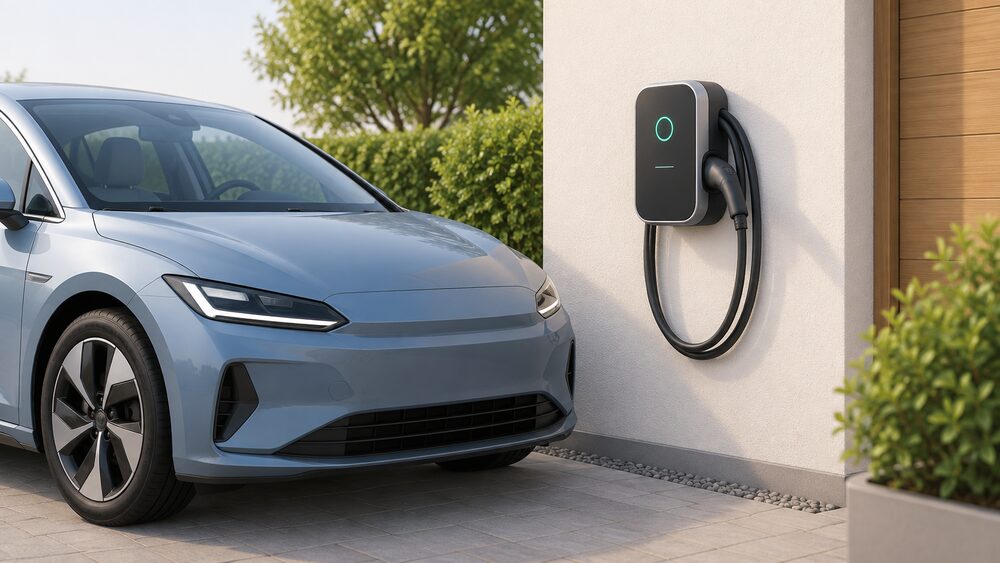
A smart EV charger is a home charge point that can be connected to the internet and controlled remotely, usually through a mobile app, so that charging can be timed rather than simply started when the cable goes in. The Electric Vehicles (Smart Charge Points) Regulations 2021 require all charge points sold in Great Britain for private, meaning domestic or workplace, use to have smart functionality, in order to help manage the increase in electricity demand from the transition to electric vehicles1. The regulations apply to private charge points sold in Great Britain after 30 June 2022 and cover Great Britain only2.
Underneath the software, the hardware job is unchanged. The unit delivers electricity from the home to the vehicle and regulates voltage and current to protect the car battery and the home's electrical system, while the conversion from alternating current to the direct current the battery needs is handled by the vehicle's onboard charger in an AC wallbox3. What the smart layer adds is timing and awareness: running the charge automatically at the best times4, holding back power when the rest of the house is drawing heavily, and in some units following solar generation. Smart chargers also connect to the internet so charging can be controlled remotely through a mobile app5.
The money comes from the timing, not the box. Energy Saving Trust estimates smart charging could save up to 20% on EV charging costs6, while the Public Accounts Committee reported that some suppliers were able to offer tariffs to consumers with smart meters that could save up to two-thirds of the cost of charging an electric vehicle if charging at certain times of day7. Octopus Energy advertises EV charging on Intelligent Octopus Go for as little as 8p per kWh, 8.4p per kWh until 1st October, with up to six hours of super cheap smart charging every 24 hours8.
What a smart charger actually does
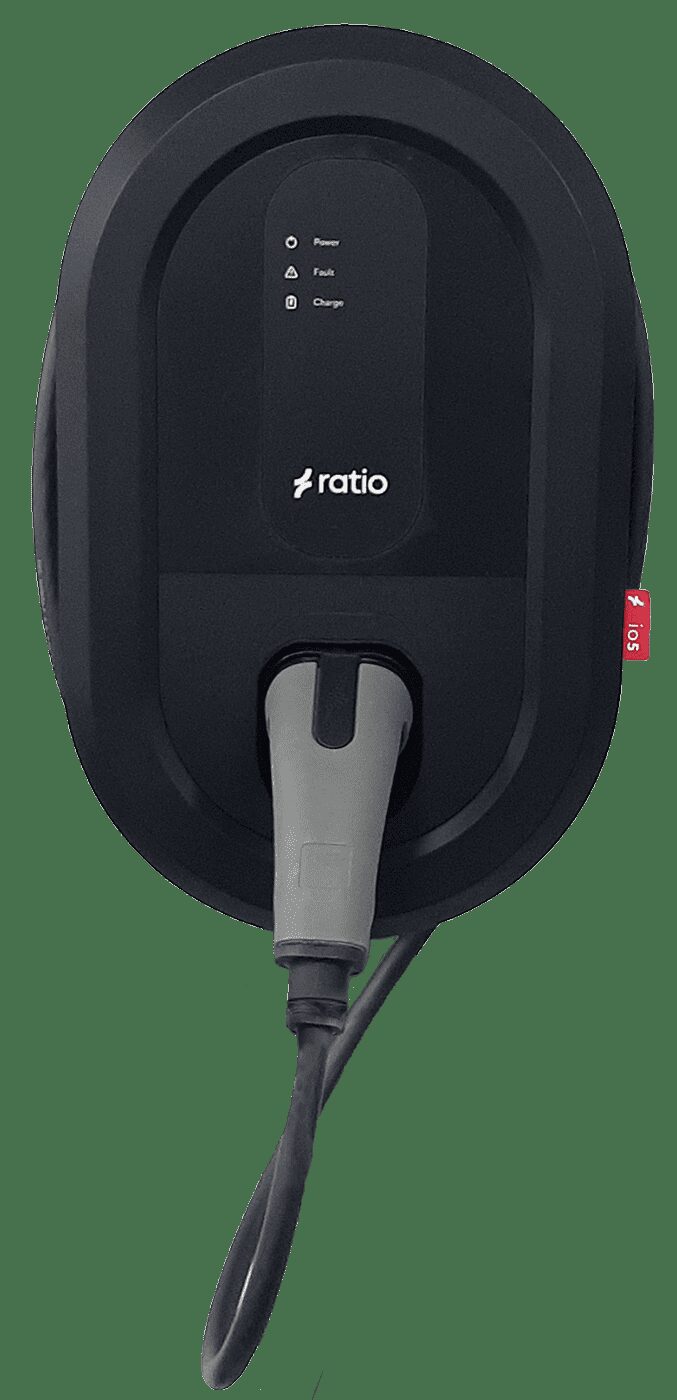
At its simplest, a smart EV charger is a charger that can be connected to the internet9. That connection is what makes scheduling, remote control, tariff pricing and firmware updates possible. Most units also carry an integrated power meter that tracks how much electricity the vehicle is using and feeds real-time data back to the app or wider smart home system3, which is what turns a charge point into something a household can actually measure and manage.
Beyond timing, the unit is a piece of safety-critical electrical equipment. Smart chargers come with built-in safety features such as temperature monitoring and surge protection11. A dedicated wallbox is also the sensible route for routine charging: slow charging at home can be done from a standard 3-pin socket, but because of the higher current demands a dedicated unit is strongly recommended for regular charging12. That point is covered further under charging an EV from a 3-pin socket and electrical requirements for a home EV charge point.
For the household, the independence gain is real but narrow. A smart charger shifts when grid electricity is bought and, where solar is present, how much of it is self-generated. It does not remove the grid connection, the supplier relationship or, for most units, the manufacturer's cloud and app. Ohme, for example, describes its smart chargers as helping to shift EV charging away from the 5pm to 8pm energy demand peak13, which is a grid benefit as much as a household one.
How smart charging works: scheduling, load balancing and tariff data
Three mechanisms do most of the work.
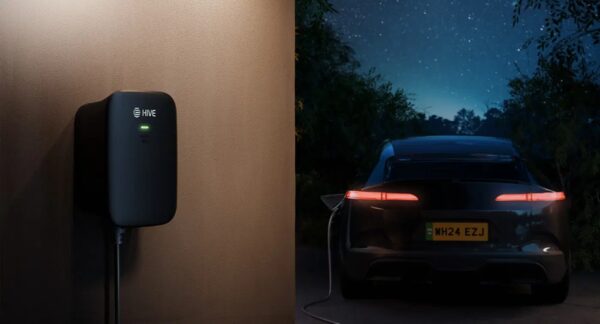
Scheduling against price. A smart charger can schedule charging to start automatically when dynamic tariff rates are lowest, often at night or during off-peak hours3. Zapmap's smart charging service describes the same principle: the EV charges at the cheapest time based on the existing tariff and the driver's preferences14. Some smart chargers automatically power vehicles during off-peak hours when electricity costs are lower, without the driver setting anything15.
Load balancing. The charger dynamically adjusts the charging current based on real-time household consumption, so the main fuse is not tripped when an oven, shower and heat pump run at once3. Growatt describes its smart charger adjusting charging power dynamically according to the home power16. This is the feature that allows a 7.4 kW unit such as the Ohme Home Pro17 to live on a supply that could not otherwise carry it, and it is covered in depth on load management and load balancing.
Tariff and grid signals. Chargers integrate with time-of-use tariffs and economy tariffs9, and many also integrate with solar panels, dynamic load management systems and off-peak electricity tariffs together5. waEV-charge lists tariff integration and smart charging among the features of its EV1i and EV1s units17.
Two behaviours exist specifically to protect the network rather than the customer. Smart chargers have features that release pressure from the grid system, including default off-peak charging and a random delay at the start of a charge9. The randomised delay matters in practice: it means a charge may not begin the instant a cheap window opens, because thousands of chargers starting simultaneously would create a new demand spike of its own.
The law: why every new home charger in Great Britain is smart
The Electric Vehicles (Smart Charge Points) Regulations 2021 require all charge points sold in Great Britain for private, domestic or workplace, use to have smart functionality1. The regulations apply to private charge points sold in Great Britain after 30 June 2022, and their territorial extent is Great Britain only2. Government guidance also gives 30 June 2022 as the date the regulations come into force, with the security requirements in Schedule 1 treated separately; the official documents are not consistent on a single commencement date for every requirement, and both 30 June 2022 and 30 December 2022 appear.
Two consequences follow for households. First, a new charge point bought and installed in England, Scotland or Wales will be smart whether or not the buyer wants the feature: Which? states plainly that all new chargers need to be smart, able to be set to charge when there is less demand on the grid or more renewable electricity is available18. Second, because the regulations cover Great Britain only2, Northern Ireland sits outside their scope, so the legal driver for smart functionality there is different even though the same products are generally sold.
The obligation falls on the product, not the person. As one charger maker puts it, not every homeowner is legally required to have a smart EV charger, but choosing one brings benefits in cost, convenience and energy management5. Owners of older non-smart units are not obliged to replace them. The detail of the rules, including security, measurement and off-switch requirements, is set out on the Electric Vehicles (Smart Charge Points) Regulations 2021.
What smart charging saves, and what it depends on
The saving is entirely a function of the tariff behind it. Some energy providers offer smart charging tariffs that make it cheaper to use electricity at night, or at times of low electricity demand19. Energy Saving Trust puts the benefit at up to 20% on EV charging costs6. The Public Accounts Committee reported savings of up to two-thirds for consumers with smart meters on certain tariffs7. The gap between those figures is mostly a matter of what is being compared: a modest shift within a standard tariff against a full move onto a dedicated EV tariff.
Supplier claims sit at the top of that range. Octopus Energy states that Intelligent Octopus Go charges for up to 69% less than average price cap rates and up to 85% less than public charging, at as little as 8p per kWh, with 8.4p per kWh quoted until 1st October8. Its Octopus Go page repeats the 69% saving against a standard tariff and states the tariff is compatible with all EVs and chargers20. Those are the supplier's own figures for its own product.
| Claim | Figure | Source type |
|---|---|---|
| Smart charging saving on charging costs | Up to 20%6 | Independent |
| Saving with smart meter on time-of-use tariff | Up to two-thirds7 | Official |
| Intelligent Octopus Go vs price cap rates | Up to 69%8 | Supplier |
| Intelligent Octopus Go vs public charging | Up to 85%8 | Supplier |
| Intelligent Octopus Go EV rate | 8p per kWh, 8.4p until 1st Oct8 | Supplier |
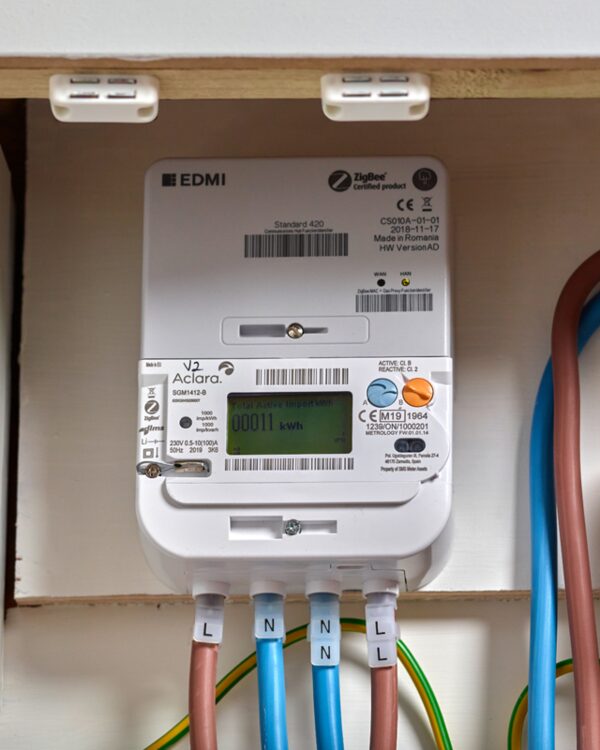
The gateway is metering. The Energy Ombudsman states that a smart meter is not needed simply to charge an EV, but without one some EV-specific tariffs will be unavailable, and that for many EV-specific tariffs, particularly smart or time-of-use tariffs, a working smart meter is required10. In most cases a smart meter is required to access EV tariffs21. Suppliers across Great Britain are obliged to offer everyone a smart meter at no extra cost22, the government having required suppliers to offer smart meters to all homes and small businesses across Great Britain by the end of 202523. Tariff structures are compared further on EV energy tariffs and home charging and EV tariff vs standard energy tariff.
Solar, batteries and wider household integration
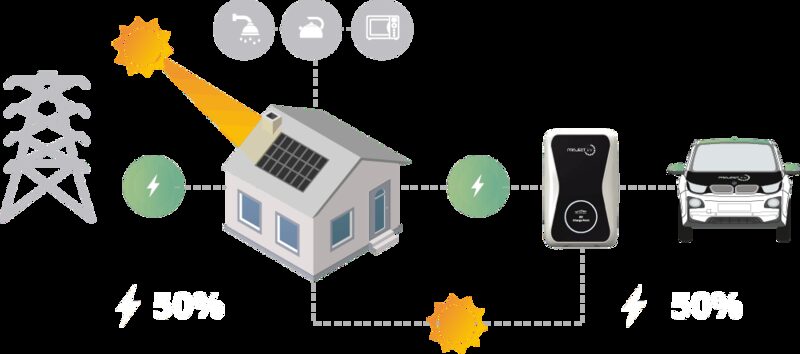
Solar changes the arithmetic from cheaper grid import to less import. Smart chargers can monitor real-time solar electricity production, adjust charging speed accordingly, and switch between solar and grid supply depending on availability24. A solar-aware charger increases charging speed when excess solar electricity is available3. Selected smart chargers feature solar integration, sometimes marketed as Solar Match, detecting excess solar generation and diverting it into the EV battery instead of exporting it to the grid25.
The features worth identifying in a solar-aware unit are solar diversion, so the charger prioritises solar power for EV charging and minimises reliance on the grid, along with app control and dynamic scheduling26. Compatibility is not universal: Growatt states its smart charger solution is compatible with different brand PV and can charge EVs with renewable energy16, which is a maker's claim about its own product rather than a general rule.
Batteries extend the same logic across the day. A smart charger can be integrated with a home battery storage system, storing cheap or solar electricity for later use in charging the car3. A genuinely capable smart charger, in myenergi's description, can also integrate with other renewable sources including solar panels, domestic wind turbines, battery storage and air source heat pumps9. On the tariff side, Intelligent Octopus Go can connect to an Ohme charger, a compatible electric vehicle, a heat pump, a thermostat or a battery27, so the smart layer increasingly reaches beyond the car.
For households already generating, this is the strongest independence case on the page: solar diversion converts surplus generation into miles rather than a low-value export. See charging an EV from solar panels, EV charging alongside a home battery and EV charging and household energy independence.
Example: the Ohme Home Pro in detail
The Ohme Home Pro is a tethered unit with a cable permanently attached28 and a touch screen on the front29. Ohme describes it as the larger of its two home chargers30.
| Specification | Ohme Home Pro |
|---|---|
| Power output and max current | 7.4kW / 32A31 |
| Nominal supply | 230V AC, 50Hz32 |
| Charging mode | Mode 333 |
| Cable | Tethered 5m Type 2 as standard, 8m upgrade optional31 |
| Dimensions | 170mm (H) x 200mm (W) x 100mm (D)31 |
| Connectivity | In-built 3G/4G multi-network SIM card31 |
| Status indication | 3 colour LED strip (green, blue, red), LCD screen (blue, red)33 |
| Control | Built-in LCD screen, smartphone app, or buttons on the charger33 |
| Regulatory | UK Smart Charging Regulations 2021 compliant33 |
| Certifications | CE marked; LVD, EMC, RED, RoHS, WEEE compliant31 |
| Warranty | 3 years as standard31 |
| Price | From £999 including standard installation and VAT32 |
Ohme lists dynamic smart charging, energy tariff integration, home power balancing and over-the-air updates as the Home Pro's smart features31, and states the charger is compatible with all energy tariffs and solar charging compatible via the Solar Boost feature in the app32. Carwow describes it as one of the few chargers that can integrate with both Octopus and OVO's smart tariffs34. Ohme states its chargers meet UK Smart Charge Point Regulations30.
In use, once the charger is plugged into the car the display shows Smart Charging in the top left corner, along with charge added so far, charge target and end time; no light means the charge has finished or the unit is unplugged, and the display turns from blue to red once Max Charge is applied35. Ohme states that with a 7.4kW home charger most EVs can be fully charged in 6 to 8 hours, which suits overnight charging, and cites off-peak rates of around 7 to 9p per kWh on a smart tariff such as Intelligent Octopus Go28. Fuller detail sits on Ohme Home Pro and Ohme smart EV chargers.
Firmware, apps and local control
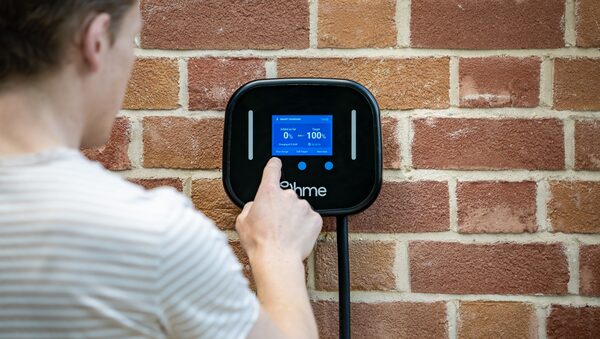
Because the smart layer is software, it is also a maintenance item. On the Home Pro, restoring firmware can resolve display problems, graphical glitches, connectivity issues or other unexpected behaviour, and works as long as the charger is powered on and the buttons are responsive; the procedure is to press and hold all three blue touch buttons until the central menu appears, then hold the right hand blue button to choose Restore firmware, at which point the selected option turns yellow and the charger reboots to the original firmware version from installation37.
"Do not power off the charger while the firmware is restoring."
Local control matters when connectivity fails. The Home Pro can be controlled via the built-in LCD screen, the smartphone app, or the buttons on the charger itself33. Display language is changed from the unit: with the charger unplugged, the left blue button opens the info page, the middle button cycles through the available languages and the left button saves, though the Lock Charger Buttons setting must be disabled in the app first if it has been enabled38. Connectivity choices are covered on EV charger apps, Wi-Fi, 4G and firmware and the data questions on EV charger cybersecurity, data and remote control.
Car-linked or charger-linked: two ways to join a smart tariff
Smart tariffs can take control either through the charge point or through the vehicle, and the choice changes which app runs the charge. Intelligent Octopus Go can be connected to an Ohme charger, a compatible EV, a heat pump, a thermostat or a battery27. Where the household has both a compatible EV and an Ohme charger, the app only offers the EV route at first and does not show the charger option straight away, so Octopus Energy's request form has to be completed, which normally takes one working day to process27. With the Ohme charger integration in place, charging is managed through the Ohme app only27. Disconnection is done in the Octopus Energy app under the Devices tab, through the linked device's Settings and Disconnect device option, after which tariff selection returns to the Ohme app39.
Other makers describe the same split. waEV-charge states its chargers and smart app are compatible with all Octopus tariffs including Octopus Intelligent Go40, and that its chargers work with all OVO tariffs, but that because OVO Charge Anytime requires full control over charging the car must also integrate40. Its Intelligent Octopus Go integration is described as available only on compatible waEV-charge chargers, with smart charging at 8p per kWh including six hours of reduced rates every night from 11:30pm to 5:30am for the whole home41.
The six-hour structure is worth understanding before switching. Intelligent Octopus Go provides up to six hours of super cheap smart charging every 24 hours for the EV, and that limit applies only to EV smart charging; the whole home still receives six hours of off-peak electricity daily between 11:30pm and 5:30am, and the two are separate42. The six smart charging hours can be scheduled during the off-peak window, outside it, or across a mix of both42. Once the six discounted hours are used, any further smart charging is billed at the peak rate even if it happens overnight, and the tariff offers a choice between limiting charging to stay within the six hours or prioritising the charge target and accepting some peak rate charging42.
What to look for when choosing a smart charger
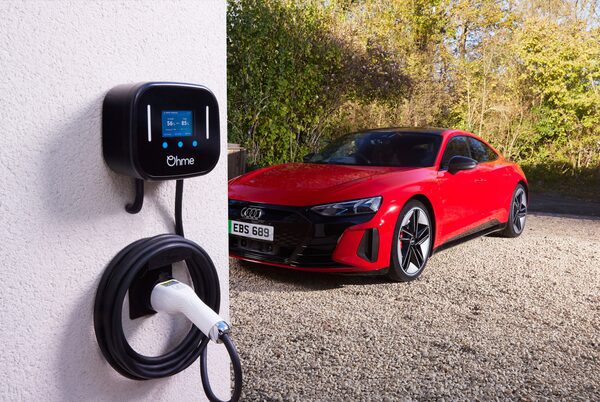
The regulations set the floor, not the ceiling, so the differences between units sit in connectivity, metering and integration.
- Connectivity. E.ON Next advises looking for cellular (4G) or Wi-Fi connectivity and app integration25. A built-in SIM removes the dependence on household Wi-Fi reaching the driveway.
- Independent certification. The BSI Kitemark for smart EV chargers tests demand management, compatibility, user interface, and the accuracy of the charger's energy metering for billing purposes43.
- Tariff breadth. Chargers differ in which supplier integrations they support, and some tariffs require vehicle control rather than charger control40.
- Solar behaviour. Solar diversion, app control and dynamic scheduling are the features that make a charger genuinely solar-aware26.
- Local fallback. Physical buttons and an on-unit screen matter when the app or network is unavailable33.
Related comparisons sit on types of home EV charger, tethered vs untethered and EV charge point safety, standards and certification, with costs on how much a home EV charge point costs, fitted.
Where smart charging falls short
The first limit is dependence. A tariff-linked charger ties the household to a supplier's app, a manufacturer's cloud and, on 4G units, a mobile network. Nothing about a smart charger reduces the need for a grid connection; it changes only when electricity is drawn and at what price. Where a charger integration takes over, control moves with it: on Intelligent Octopus Go with an Ohme charger, charging is managed through the Ohme app only27.
The second is reliability perception. Ofgem's 2021 consumer survey found that 9% of EV owners with a conventional charger gave as a reason that a smart charger is not as reliable as a conventional charger44. Firmware is part of that picture, as the 16A limitation reported on Ohme firmware v2.62 shows36. Supply-side faults have their own remedy: UK Power Networks notes that after a voltage disturbance it may be necessary to switch the charger off and on at the isolator switch45. More on this in EV charge point faults and troubleshooting.
The third is scope. Smart charging is a domestic and workplace mechanism. Energy Saving Trust, responding on public charging network planning, noted that smart charging was absent from the consultation document and that it is a developing part of the industry which should be considered in rolling out electric vehicle infrastructure at scale in Scotland46. Households without off-street parking therefore capture far less of the benefit, a gap addressed on charging an EV without a driveway.
Finally, the saving is not automatic. Default off-peak charging and randomised start delays9 mean the charger, not the driver, decides the exact moment power flows, and a household that needs a full battery at short notice will pay peak rates to get it42. The independence a smart charger buys is control over timing and, with solar, over source. It is not independence from the supplier.
Sources46 cited
- Approved Document S: infrastructure for charging electric vehicles FAQs, GOV.UK, 2023-04-17
- Guide to the Electric Vehicles (Smart Charge Points) Regulations 2021, GOV.UK, 2026-09-18
- EV chargers and optimising their energy use in a smart home, Homey, 2026-09-20
- Smart EV charging guide, Power NI, 2026-04-13
- Home charging FAQs, Ratio EV, 2026-08-24
- Smart charging electric vehicles, Energy Saving Trust, 2025-03-25
- Public Accounts Committee report on decarbonising home energy, UK Parliament, 2023-10-20
- Octopus Charge, Octopus Energy, 2026-09-18
- What is a smart EV charger, myenergi, 2026-04-10
- EV tariffs and home charging: what consumers need to know, Energy Ombudsman, 2026-09-11
- Upgrading to a smart EV charger, OVO Energy, 2025-09-01
- EV buying guide, Zapmap, 2024-12-06
- Ohme and energy tariffs, Ohme, 2026-03-16
- Zapmap Smart Charging, Zapmap, 2026
- Everything you need to know about EV charging points, NICEIC, 2024-09-27
- Smart EV charger solution, Growatt, 2026-09-17
- Home installs, waEV-charge, 2026-09-17
- Electric car charging at home, Which?, 2026-02-25
- Electric vehicle charger installation and maintenance, NICEIC, 2025-08
- Octopus Go tariff, Octopus Energy, 2026-09-16
- Smart meter benefits for Britain, Smart Energy GB, 2026-04-24
- Smart meter costs: are smart meters free?, Smart Energy GB, 2026-03-16
- Smart meter FAQs, Smart Energy GB, 2025-12
- Can solar panels charge electric cars?, The CPA, 2026-04-15
- EV smart charging at night, E.ON Next, 2026-09-17
- Integrating solar panels with EV charging, Uswitch, 2025-07-02
- Troubleshooting for Intelligent Octopus Go and Ohme, Ohme, 2026-08-18
- New to EVs, Ohme, 2026-07-09
- How installation works, Ohme, 2026-08-13
- Smart charging FAQs, Ohme, 2025-12-11
- Ohme home charger product page, Ohme, 2026-08-20
- Ohme Home Pro product page, Ohme, 2026-05-21
- Ohme Home Pro data sheet, Ohme, 2026-09-17
- Home electric vehicle chargers, Carwow, 2026-01-09
- How do I know what my charger is doing?, Ohme, 2026-09-17
- Charge rate limited issue with firmware v2.62, Ohme, 2024-05-08
- How to restore firmware on the Ohme Home Pro, Ohme, 2026-09-17
- How to change the language on my Ohme Home Pro, Ohme, 2025-10-30
- How do I disconnect from Intelligent Octopus Go, Ohme, 2026-08-05
- waEV-charge FAQs, waEV-charge, 2026-09-17
- Intelligent Octopus and waEV-charge, waEV-charge, 2026-09-17
- Intelligent Octopus Go 6-hour smart charging FAQs, Ohme, 2026-09-17
- What makes BSI Kitemark certified EV chargers a smarter choice, BSI, 2026-09-17
- Consumer Survey 2021: decarbonisation and home energy use, Ofgem, 2021
- Voltage changes in your home or business, UK Power Networks, 2026-09-17
- Electric vehicle public charging network implementation plan response, Energy Saving Trust, 2026-02-19
 Supplier-Controlled ChargingSmart charging tariffs let your energy supplier decide when your car charges, usually overnight when electricity is cheaper.
 EV Charger Safety and StandardsHow do you know a home charge point is safe to use?
 Electric Vehicle TariffsCharging an electric car at home can cost far less overnight, but only on special electricity plans.
 Charging With a Home BatteryHow a home battery and an EV charger share one supply, whether a battery can usefully charge a car, and how combined systems are controlled so the battery is not discharged into the vehicle at a loss.
 EV Tariffs and Home ChargingHow EV-specific import tariffs and charging bolt-ons work, including supplier-controlled charging where the energy company decides when the car draws power, which charge points each scheme supports, and what a household needs in place.
 Types of Home EV ChargerWhich home charger suits your car and your driveway?