In this guide
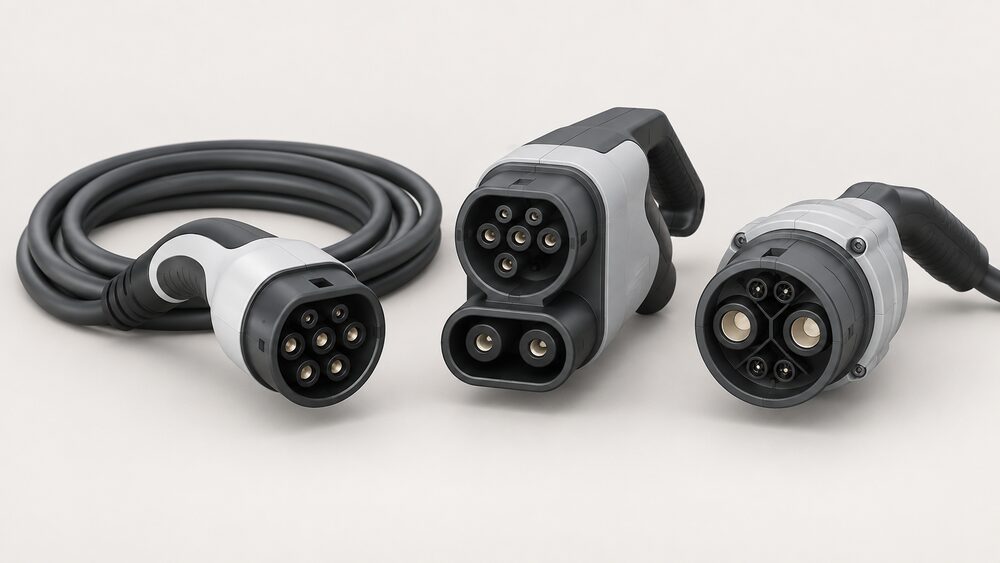
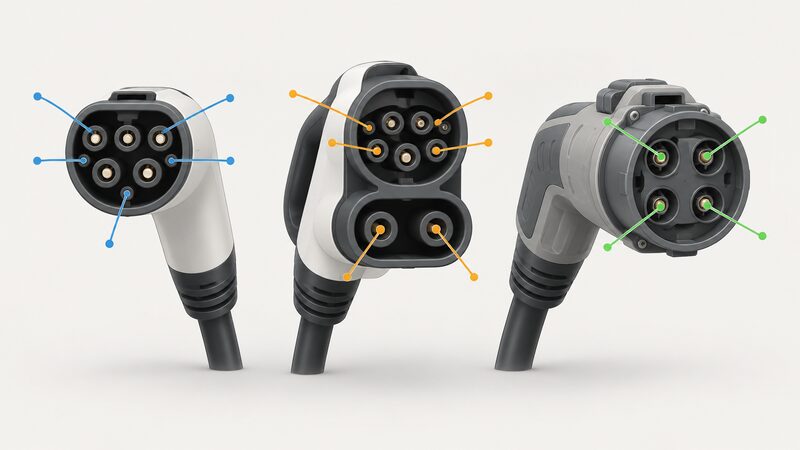
Four connector names cover almost everything a UK household will meet. Type 2 (also called Mennekes) is the standard for electric vehicles in the UK and Europe for home and public AC charging1. CCS, the Combined Charging System, is the standard for rapid DC charging in the UK and Europe1. CHAdeMO is a round four-pin plug used only at rapid charging points, primarily for rapid DC charging on older Nissan Leaf models and generally compatible with Asian-brand vehicles1. Tesla's own Type 2 connector appears on older Model S and Model X cars, used for both AC and DC1; in the UK, Tesla vehicles now use a Type 2 inlet for AC charging, exactly the same as other European EVs, and CCS for DC rapid charging3.
For a home charge point, the practical answer is short: home and slower chargers of around 7kW use Type 2 connectors, while rapid chargers almost always use CCS plugs4. The EU mandated that all plug-in cars from 2014 must have a Type 2 socket, which is why it is the most common type in the UK5. A Type 2 to Type 2 cable is what most modern EVs need1. Adapters between CCS and CHAdeMO do not exist4, so DC compatibility is decided by the car, not by an accessory.
Counting the three-pin domestic plug and the older Type 1 inlet, five plugs are the ones most commonly used in the UK: the UK 3 pin plug, Type 1, Type 2, CHAdeMO and CCS6. The rest of this page sets out where each is used, what cable goes with it, the charging modes behind the standards, and the permissions and costs attached to installing a charge point at home.
Type 2 is the UK and European standard for AC charging
Type 2 is the connector a household deals with daily. It is the standard for EVs in the UK and Europe for home and public AC charging1, and the EU and UK standard for AC charging, mandated across public charging infrastructure since 20143. Most modern electric vehicles sold in the UK use a Type 2 connector for AC home charging10, and equipment follows: E.ON Next home chargers use a Type 2 socket11, and evec states that every charger in its range uses a Type 2 connector12.
Power levels reflect the supply rather than the plug. Type 2 typically supports 3.7kW to 7.4kW for home, workplace and on-street charging, but can also support 22kW with three-phase power, or less commonly 43kW1. Rapid AC charging using a Type 2 connector at 43kW exists, though it is now uncommon beside DC13.
The Type 2 to Type 2 arrangement covers the great majority of cars. Almost all electric cars come from the manufacturer with a cable carrying a charger-side Type 2 connector14, and almost all can charge on a Type 2 unit14. Cable makers specify accordingly: the Ratio E-Line cable is a Type 2 to Type 2 lead, described as suitable for any Type 2 EV charging point15, and Sync Energy lists Mode 3 Type 2 cables compatible with single-phase (7.4kW) and three-phase (22kW) sockets16.
Type 1 is the exception rather than a rival. It is used for AC charging on a few older EVs, notably older Nissan Leaf models1. A car with a Type 1 inlet needs either a tethered charge point fitted with a Type 1 lead, or an untethered charger with a Type 2 socket used with a Type 2 to Type 1 adapter cable17. evec states that with an adapter lead its chargers can also support Type 1 connectors12. Most UK and European EVs use a Type 2 to Type 2 charge connection, but checking the specific vehicle matters18.
CCS and CHAdeMO: the rapid DC connectors
DC rapid charging uses a different pair of standards, and this is where a car's age and origin decide what it can use. CCS is the main connector type for higher-powered DC charging19 and is standard on most UK EVs20. On a CCS car the inlet is combined: the Kia EV6, for example, uses a combined AC and DC inlet port, Type 2 for AC and CCS for rapid DC21.
CHAdeMO is a round plug with four pins, used only at rapid charging points and usually compatible with Asian-brand EVs2. It supports rapid and ultra-rapid charging from 25kW up to 400kW, although the most common rating is 50kW1. On a Nissan Leaf, the CHAdeMO connector required for rapid charging is tethered to the charging unit22, so no cable is carried.
| Connector | Current | Typical rating | Where it is found |
|---|---|---|---|
| Type 2 | AC | 3.7kW to 7.4kW, 22kW three-phase, 43kW rapid AC1 | Home, workplace, on-street, public AC1 |
| CCS | DC | 50kW at a typical rapid point13 | Most UK EVs, rapid and ultra-rapid20 |
| CHAdeMO | DC | 50kW most common, 25kW to 400kW range1 | Older Nissan Leaf, Asian-brand EVs1 |
| Tesla Type 2 | AC and DC | Not stated | Older Model S and Model X1 |
One council network illustrates the mix on the ground: sockets at its locations include CHAdeMO (50kW), CCS (50kW) and Type 2 (22kW)23. Almost all EVs can charge on Type 2 units for fast charging, and on either CHAdeMO, CCS or Tesla Type 2 for rapid charging11. Operators bridge the DC split by fitting both leads: MFG EV Power, Osprey Charging and InstaVolt all provide charging with tethered devices via both CHAdeMO and CCS connectors24. At ultra-rapid sites, some drivers may require a CHAdeMO or CCS adapter where the charging socket does not match their vehicle14.
CHAdeMO also matters to households interested in exporting from the car. Most vehicle-to-grid systems use CHAdeMO, though some models can also use CCS25. That is set out in more detail on vehicle-to-grid and vehicle-to-home charging.
Tethered or untethered: which plug you end up carrying
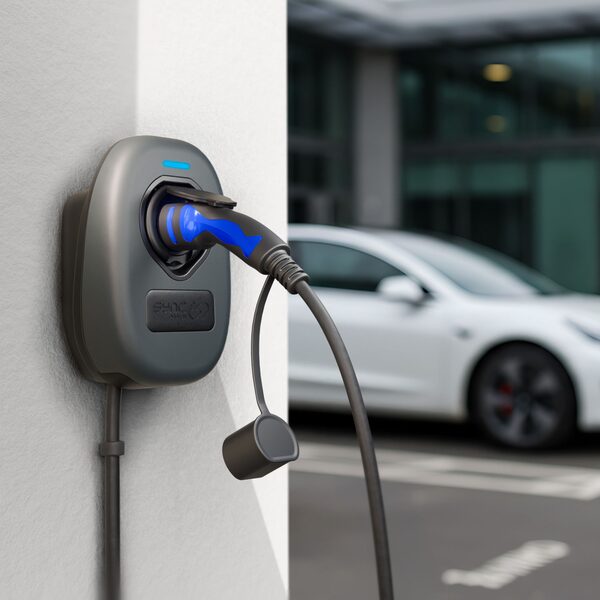
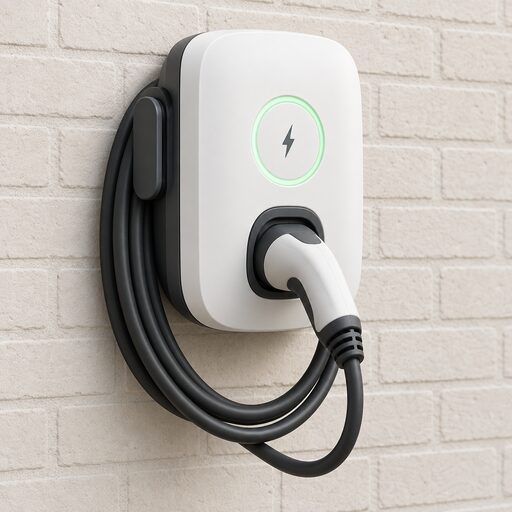
Home charge points come in two forms, and the choice decides whether a cable lives on the wall or in the boot. Tethered units come with a cable and connector already installed; untethered units have only a socket into which a cable is plugged26. An untethered charger in the UK usually carries a Type 2 socket17, and it lets the household use its own cable or the one supplied with the vehicle27.
Home chargers are available either with a tethered Type 1 or Type 2 cable that plugs straight into the car, or with a Type 2 socket for use with the vehicle's own charging cable7.
The trade-offs are straightforward and the sources agree on their shape:
- Tethered: cable always present, described by makers as more convenient for home charging18. Restricted to either Type 1 or Type 2 connections27. If the household changes to a car with a different connection type, the charge unit has to be changed as well28.
- Untethered: no fixed cable, so a cable is plugged in when needed29. Less convenient, since the cable is connected and disconnected each session27. Flexible across connector types, because the cable, not the wall unit, decides the car-side plug.
- Cost and space: with a tethered home charger the household is limited by the connector type and by the length of the cable unless a paid replacement is fitted, and the units take up more room and tend to be more expensive to purchase upfront24.
For independence, the untethered socket is the more future-proof arrangement: it keeps the wall unit useful across a change of vehicle, at the price of handling a lead every time. Cable length is fixed at purchase in both cases, and is worth matching to where the car parks. The trade-off is compared further on tethered vs untethered EV charger and in types of home EV charger.
Charging modes and the standards behind them
"Mode" describes how the car and the equipment talk to each other, not the plug shape. Mode 3 AC charging cables are the most common type of electric car charging cable in use, connecting an EV to a dedicated charging station at home, at the office or in a car park30. Most domestic and small commercial installations are Mode 3, meaning a dedicated wall-mounted or post-mounted charger with a control pilot connection31. With Mode 4 charging, which is DC, the charger always uses a tethered cable32, which is why rapid points carry their own leads.
The contrast is with a standard three-pin plug, which runs at 3kW33 and offers none of the dedicated control and protection of a Mode 3 installation. To achieve faster charging speeds, a dedicated EV charge point is recommended over a standard household socket (13A)34. The question of occasional three-pin use is covered on charging an EV from a 3-pin socket.
Behind the equipment sit the international standards. The series of standards for the design and performance requirements for EV conductive charging equipment is the BS EN IEC 61851 series35. Cables are certified against it: the Ratio E-Line cable is listed as IEC 61851 certified15. Charge point and cable certification schemes exist to demonstrate the safety, security, quality and reliability of electric vehicle chargers, covering charge points for both home and commercial use36. Standardisation was a deliberate industry goal: European manufacturers proposed common recommendations covering all aspects of EV charging, including the method of communication between the vehicle and the power grid, the type of electricity supply, and the differences between fast and slow charging systems37. More on the certification side is set out in EV charge point safety, standards and certification.
Power ratings and what they mean for charge times
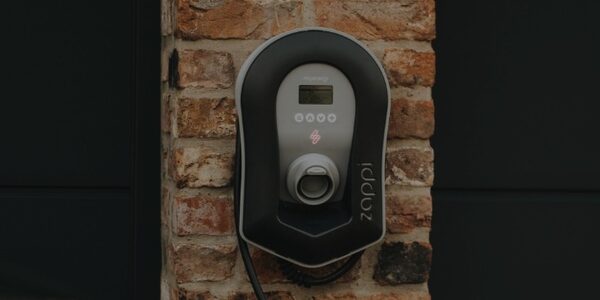
Charge points in the UK are grouped by speed into four types: slow, fast, rapid and ultra-rapid6. Public fast charging is usually 7kW to 22kW11. At home, 7kW is the common single-phase figure and 22kW requires three phases: the EmonEVSE unit, for example, is listed as 7kW single-phase or 22kW three-phase38, and 22kW chargers are the most expensive5. Documents differ on the exact single-phase figure quoted by makers, with both "around 7kW" and 7.4kW in use for what is the same single-phase unit.
| Rating | Typical use | Indicative time |
|---|---|---|
| 3kW | Standard three-pin plug33 | Within the six to 12 hours band for 20% to 80%39 |
| 7kW | Most home charge points10 | 6 to 8 hours for a typical EV10; approximately seven hours for a Nissan Leaf, 0% to 100%8 |
| 22kW | Three-phase home or public fast5 | Not stated |
| 50kW DC | Rapid CCS or CHAdeMO13 | Approximately 43 minutes for a Nissan Leaf, 20% to 80%8 |
Using an EV charger rated 3kW, 5kW or 7kW, charging from 20% to 80% or above generally takes between six and 12 hours39. Fast charging takes hours and suits longer stays or overnight charging40. For a specific car, Zapmap puts the Nissan Leaf at 7.5 hours to 100% at 7kW22, while a 40kWh Leaf reaches 80% in around 6 hours on a 7kW unit7. Those figures differ because they measure different start and end points, not because the equipment differs.
Two practical caveats apply. Some charge points with two connectors split the power 50:50 between the two vehicles, even where that is not the most efficient approach8, so a shared unit is slower for both cars. And the car's own on-board charger caps AC speed regardless of what the wall unit can supply. Charge times are set out at length on EV charging speeds and times and the 7kW against 22kW question on 7kW vs 22kW home charger.
What a home charge point costs
A home charge point is the cheapest way to charge an EV where there is a driveway or garage41. Which? puts the cost of buying and installing a home EV charger at typically between £500 and £1,200 as of February 20265. Zapmap gives a narrower figure for the common size: typically a 7kW charge point costs between £700 and £1,200 fully installed7. Grant support narrows it further for some households, with landlords and flat tenants eligible for a government grant of up to £350 for home EV chargers, which can reduce the installed cost to as low as £65043. Prices otherwise are installer-quoted and vary with the cable run and the consumer unit work required.
Tethered units tend to be more expensive to purchase upfront and take up more room24, which is part of the cable decision as well as the cost one. Cables themselves are a separate purchase on an untethered unit, though almost all cars come supplied with a Type 2 lead14.
Around 1 million home EV chargers are estimated to be installed in the UK9. The grant routes, including the chargepoint grant for renters and flat owners and the cross-pavement schemes, are covered on the Electric Vehicle Chargepoint Grant and the full cost breakdown on home EV charger cost.
Weather, safety features and where the unit goes
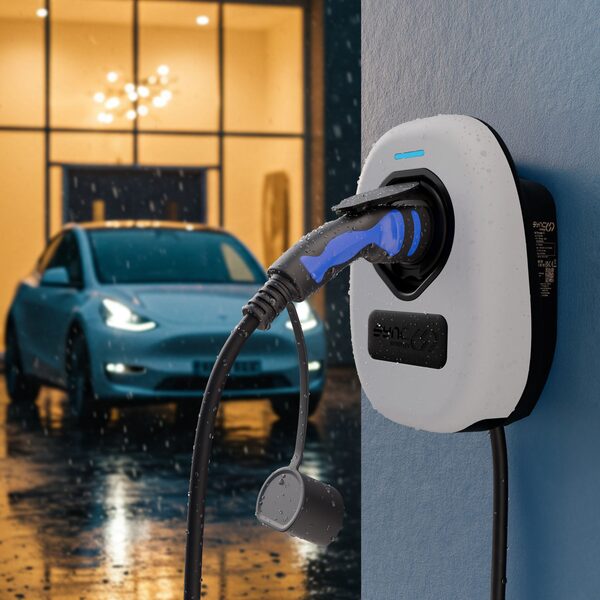
Charging equipment is built for the British outdoors. The hardware in an EV, and the equipment used to charge it, is designed to be used in dry and wet conditions44, and charging in the rain is described by makers as completely safe44. evec states that it is completely safe to charge an EV or plug-in hybrid in the rain and to take them through a car wash18. Cables sold for home use are specified with robust construction and weather resistance, with multiple length options16.
"It is completely safe to charge your EV or PHEV in the rain and take them through a car wash"
Protection rather than weather is the part that needs an electrician. Most local authorities specify that households install a dedicated EV charger with protective earth neutral (PEN) fault protection45. Residual current protection for EV supply equipment is governed by the design and performance standards in the BS EN IEC 61851 series35. What a UK installation must include is set out on electrical requirements for a home EV charge point and what RCD protection does an EV charge point need.
Placement is a matter of cable reach and permission. Cable length is fixed for tethered units unless a paid replacement is fitted24, so the unit's position has to suit where the car parks. Connectivity varies by product: some chargers support multiple communication methods including 4G, Ethernet, Wi-Fi and Bluetooth46, which brings a dependence on a manufacturer's servers and app, discussed on EV charger apps, Wi-Fi, 4G and firmware.
At the network level, charging is not neutral for the grid. Analysis identifies six ways in which EV chargers present a risk to grid security: step, ramp, oscillations, degraded stability, demand control erosion and restoration47. That is one reason home units are smart-controlled and why load management is standard, as covered on load management and load balancing.
Permissions: planning and building regulations
Installing a home charger is classified as development, so it is up to the householder to ensure the correct permissions are in place48. Where the home has off-street parking, the installation is likely to fall under permitted development rights with no planning application required, provided it meets the criteria49.
Planning permission is usually required for48:
- on-street parking
- conservation areas
- listed buildings
- areas where installation is restricted through article 4 directions
- more than one upstand per parking space
Other conditions narrow it further. Planning permission is required where the charger is installed less than two metres from the highway45, and a wall-mounted outlet is exempt provided the outlet and its casing will not exceed 0.2 cubic metres and it is not located on scheduled ancient monument land50. One guide summarises the no-permission case as a unit within the boundaries of the home, not within two metres of a highway, not over 1.6m in height for ground units or more than 0.2 cubic metres in volume for wall-mounted units, and not in or within the grounds of a listed building51. Planning rules depend on whether the dwelling has off-street parking or on-street parking49.
Where a cable must cross a pavement, a further layer applies. Unless the crossing is owned by the Highways Authority, separate planning permission is needed, and a crossing outside the curtilage of the building on highway pavement is unlikely to be covered by householder permission for the charge point53. For permanent pavement crossing solutions, permission from the Highways Authority will be required, and separate planning permission for the crossing may be needed48. The chargepoint grant for households with on-street parking requires evidence including local highways authority consent for the cross-pavement solution and a declaration that necessary planning permissions will be obtained54; applicants must not have already installed the chargepoint, must own or rent the property they live in, must install a non-temporary cross-pavement solution alongside the chargepoint, must not have private and exclusive access to off-street parking, must have adequate on-street parking, and must own or be responsible for an eligible vehicle54.
Planning is devolved, and the detail differs between England, Scotland, Wales and Northern Ireland; the nation-by-nation position is set out on planning permission for a home EV charge point and the crossing routes on charging an EV without a driveway.
Checking your car before you buy a cable or charger
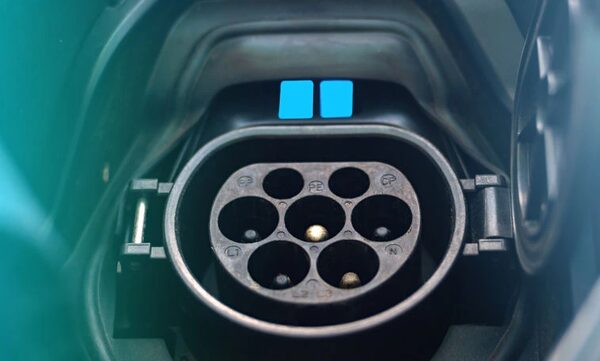
Connector choice follows the vehicle, not the other way round. Most UK and European EVs use a Type 2 to Type 2 charge connection, but it is important to check the specific vehicle18. An electrician will confirm what type of connector is compatible with a given car26. Where a car has a Type 1 inlet, the options are a tethered Type 1 lead or a Type 2 socket with a Type 2 to Type 1 adapter cable17.
Three checks cover most cases:
- The AC inlet. Type 2 on almost all modern cars sold in the UK10; Type 1 on a few older vehicles including early Nissan Leaf models1.
- The DC inlet. CCS on most UK EVs20; CHAdeMO on older Nissan Leaf models and generally on Asian-brand vehicles1. No adapter bridges the two4.
- The on-board AC limit. This caps home charging speed regardless of whether the wall unit is 7kW or 22kW.
Tesla owners are covered by the general case: a Type 2 to Type 2 cable connects to Tesla home and public AC chargers, and Superchargers use tethered cables so no additional cable is required1.
What this changes for household energy independence
A charge point at home moves fuelling from a forecourt to the property's own supply, and it is the cheapest way to charge where a driveway or garage exists41. That is a real shift in control: the household chooses when to charge, and can pair charging with solar generation or an off-peak tariff, as set out on charging an EV from solar panels and EV energy tariffs.
The dependencies that remain are worth stating plainly. The electricity still comes from the grid unless it is generated on site. A tethered unit ties the household to one connector type, and a change of car with a different connection means changing the charge unit as well28. Connected chargers depend on a manufacturer's communications and servers46. Rapid charging away from home depends on which DC standard the car carries, with no adapter route between CCS and CHAdeMO4. And installation depends on permissions: building regulations approval is always required52, and planning permission is needed in the circumstances listed above48. Only vehicle-to-home and vehicle-to-grid arrangements, which mostly rely on CHAdeMO and in some cases CCS25, turn the car into a source as well as a load, and those are a distinct class of equipment rather than an upgrade to a standard Mode 3 charge point.
Sources54 cited
- EV connector types, Zapmap, 2026-05-20
- EV glossary, Uswitch, 2024-11-26
- CCS vs CHAdeMO vs Type 2 connector types explained, Octopus Electroverse, 2026-06
- Electric car charging guide, Carwow, 2025-07-16
- Electric car charging at home, Which?, 2026-02-25
- Electric vehicle guides, E.ON Next, 2026-09-17
- Home charging guide, Zapmap, 2025-06-19
- How long does it take to charge an electric car, Zapmap, 2026-04-15
- Navigating the network: installing low carbon technology, Citizens Advice, 2026-07-01
- EV charger installation in Durham, Fuse Energy, 2026-09-09
- Public chargers guide, E.ON Next, 2026-09-19
- EV chargers, evec, 2026-09-18
- EV connector types, Uswitch, 2022-02-03
- Tethered vs untethered chargers, Zapmap, 2026-02-23
- E-Line EV charging cables, Ratio EV, 2026-06-18
- EV charging cables range, Sync Energy, 2026-09-17
- Tethered vs untethered EV charger, Fuse Energy, 2026-04-26
- Guide to EV charging cables, evec, 2026-09-17
- Guide to EV charging, Zapmap, 2026-09-04
- Bidirectional EV chargers, V2H, V2G and solar terms, Alternergy, 2025-06-02
- Kia EV6 charging, Zapmap, 2026
- Nissan Leaf charging, Zapmap, 2026
- Electric vehicle charging, Isle of Anglesey County Council, 2026-09-20
- Tethered vs untethered, Zapmap, 2026-02-23
- Vehicle-to-grid charging, Uswitch, 2025-07-02
- EV charger installation and maintenance, NICEIC, 2025-08
- Difference between tethered and untethered chargers, myenergi, 2026-04-10
- Questions to ask before getting a home EV charger, Good Energy, 2026-01-22
- Types of EV chargers, Hive, 2026-08-05
- Electric vehicle charging, SMMT, 2025-06-25
- Section 722 EV charging complete guide, Elec-Mate, 2026-07-02
- Guide to electric vehicle infrastructure, BEAMA, 2024-09
- EV charging, Uswitch, 2026-09-19
- Low carbon technologies strategy, Energy Networks Association, 2026-09-17
- RCDs for electric vehicle supply equipment, IET Wiring Matters, 2024-05
- EV charging Kitemark certification, BSI, 2026-09-17
- Common standards for electric vehicle charging, SMMT, 2011-09-22
- EmonEVSE overview, OpenEnergyMonitor, 2026-09-17
- How long does it take to charge an electric car, Zapmap, 2026-04-15
- Clean energy boost, Low Carbon Hub, 2024-06-25
- Charging electric vehicles, Energy Saving Trust, 2026-04-23
- Home charging, Zapmap, 2025-06-19
- EV charging statistics, Uswitch, 2025-12-15
- How much does it cost to charge an electric car, myenergi, 2026-09-17
- Cross-pavement charging solutions, Energy Saving Trust, 2025-07-18
- EV charger product information, Haier HVAC, 2026-09-17
- Resilient electric vehicle charging, Energy Systems Catapult, 2022-02-21
- EV charging: planning permission, Planning Portal, 2026
- Electric vehicle charging house elements, Planning Portal, 2026
- Permitted development for retrofit and energy efficiency, Cotswold District Council, 2026-09-17
- Electric vehicle charge points, Flexi-Orb, 2025-04-22
- EV charging: building regulations, Planning Portal, 2026-09-17
- Approved pavement crossings, Planning Portal, 2026
- Electric vehicle chargepoint grant for households with on-street parking, Find a Grant, 2026-09-17
 Bidirectional Charging StandardsDoes your electric car and charger actually support sending power back to your home or the grid?
 Types of Home EV ChargerWhich home charger suits your car and your driveway?
 EV Charging Speeds and TimesHow long an electric car takes to charge depends on the charger and the car together, so a faster charge point will not always speed things up.
 Accessible Charging and PAS 1899You are disabled or find charge points hard to use.
 Home EV Charger ManufacturersWhich home EV charger brands are worth considering, and how do you choose between them?
 EV Tariffs and Home ChargingHow EV-specific import tariffs and charging bolt-ons work, including supplier-controlled charging where the energy company decides when the car draws power, which charge points each scheme supports, and what a household needs in place.