
In this answer
Short answer
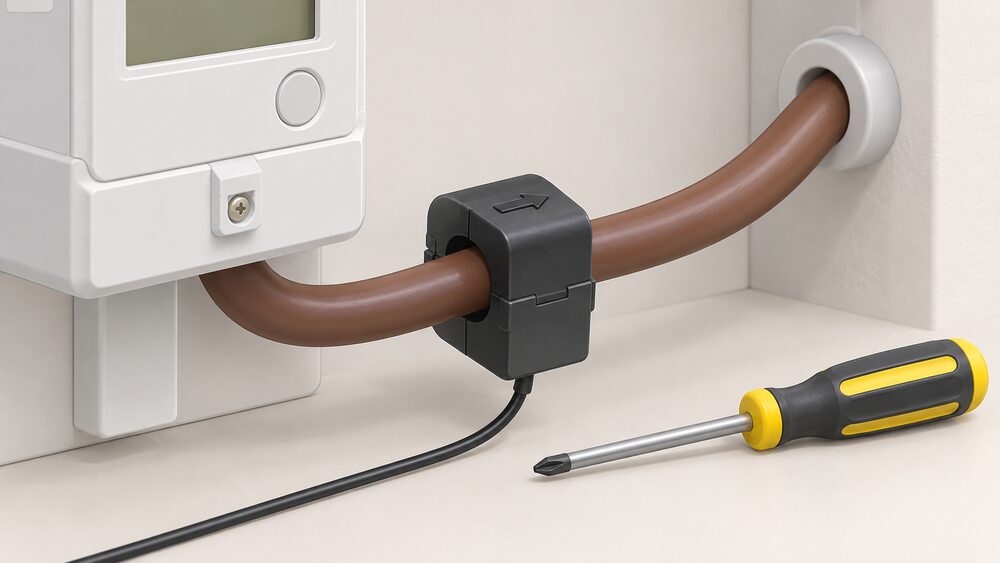
A CT clamp is a small current transformer that clips around a cable and measures the current flowing through it without breaking the circuit. On a home EV charger it is the sensor that tells the charger how much electricity the rest of the house is using, so the charger can hold back and avoid tripping the main fuse. The same component, fitted in a different place, tells a home battery to ignore the car and stop it draining storage into the vehicle.
Whether a clamp is included varies by maker. The EO Mini Pro 3 comes with CT clamps as standard, so the car can be charged from solar panels, supplementing with green grid energy on cloudy days1. All waEV-charge 7.4kW models have dynamic load balancing and come with a CT clamp as standard2. zappi and eddi come with one wired CT clamp as standard3. The Sync Energy EVAB1ESP120 is supplied with a 120A split core CT clamp for easy installation4. Ohme states its chargers include a CT clamp, with built-in open-PEN protection, so no extra components are needed5.
Where a clamp is not in the box, it is bought as an accessory. Prices are installer-quoted or supplier-listed, and no published figure is available.
What a CT clamp does on an EV charger
The clamp is a measuring device, not a switching device. It sits around a live cable and reports the current passing through it, which the charger or inverter then uses to decide how much power it can safely draw. Lux Power describes its clamp as enabling swift and accurate capturing of current variations in real time, with high-precision real-time monitoring6. The clamp itself does not affect the circuit it is clipped around6.
On a charger, that reading feeds load balancing. The charger adds its own draw to the house's existing consumption and reduces charging power when the total approaches the supply limit. This is what allows a charger to be installed on a supply that could not otherwise carry it alongside an oven, a shower and a tumble dryer at once. The alternative, a fixed lower charging rate, needs no clamp but charges more slowly at all times.
The same reading supports solar-surplus charging. The EO Mini Pro 3 uses its standard clamps so the car can be charged from solar panels, falling back to grid energy on cloudy days1. Ohme describes solar boost and solar-only modes that depend on the clamp's view of generation and household demand11.
For a household, the clamp is the component that turns a charger from a fixed load into a responsive one. It does not remove the grid connection, and it does not reduce the total energy a car needs; it shifts when and how fast that energy is drawn. Independence here is partial: the clamp lets a household use its own solar and its own supply headroom more fully, while the charger remains dependent on the grid for whatever the roof and battery cannot cover.
Which chargers need a CT clamp, and who fits it
A clamp is needed wherever the charger is expected to balance its load against the rest of the house, or to follow solar generation. Chargers sold with dynamic load balancing as a headline feature generally include one. The waEV-charge 7.4kW range is described as having dynamic load balancing with a CT clamp as standard2. Ohme includes a clamp and open-PEN protection so no extra components are required5. Sync Energy's EVA120CT1 integrates with all Sync Energy EV Wall Chargers and Balancer, including socketed and tethered designs12.
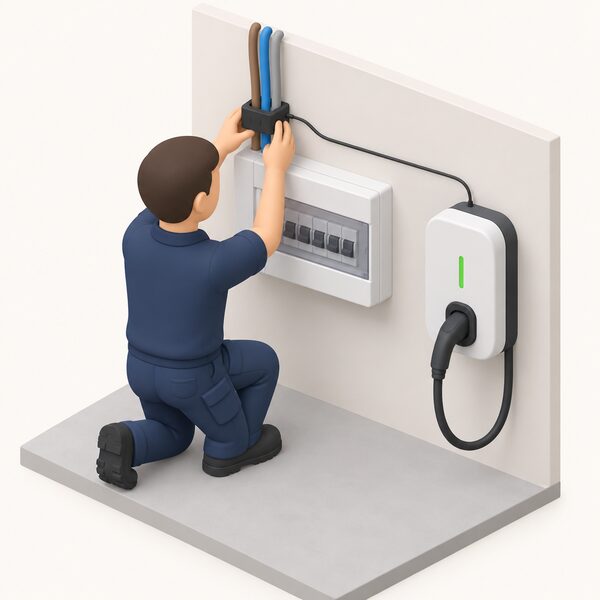
Fitting is not a householder task. NICEIC states EV chargers should be installed by a registered electrician with experience in this type of installation, and that a charger must be installed in line with the current edition of BS 7671, the national standard for electrical installations9. uSwitch states installation should always be done by a qualified and certified electrician13. The planning portal states building regulations approval is always required when installing an EV home charger, with a competent and reputable installer used and specific processes for notifying the local building control authority10.
For grant-funded work the rules tighten further. The Electric Vehicle Chargepoint Grant for Households with On-Street Parking requires an OZEV approved installer to complete the installation of the chargepoint14. Installers themselves need competence in the IET Code of Practice for Electric Vehicle Charging15.
Where the clamp goes on the supply
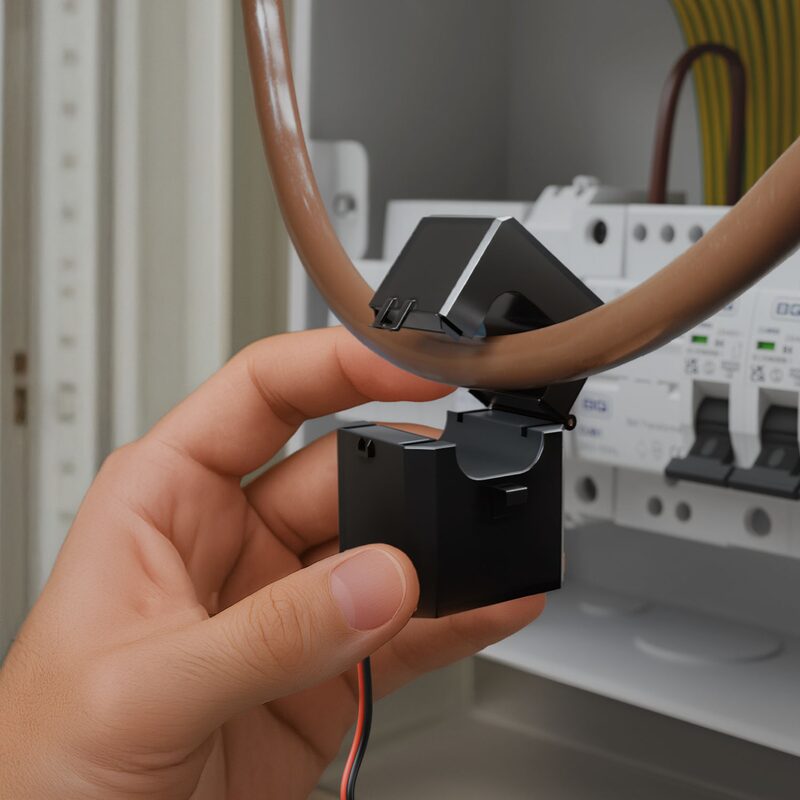
Position decides what the clamp measures, and therefore what the charger can do. Homey's guidance is to place CT clamps at the main incoming electrical connection before any sub-circuits or breakers7. Solis states the clamp must be installed on the live (hot) wire at the grid connection point16. Ohme's support guidance says the clamp needs to be located on a live cable as close to the meter box as possible, around the incoming live cable, with the arrow pointing in the direction of electricity going to the house11.
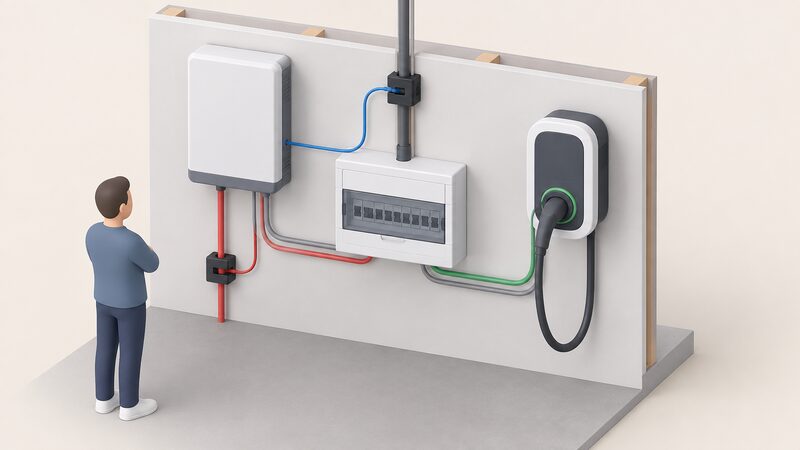
A clamp on the incoming supply sees the whole house, which is what load balancing needs. A clamp on a sub-circuit sees only that circuit, which is what battery protection needs. The two positions are not interchangeable, and a clamp fitted in the wrong place will produce a reading that is accurate but useless for the intended job.
Direction matters too. A clamp fitted with the arrow reversed reads current in the wrong sense, which can invert the picture of whether the house is importing or exporting. That is why the maker instruction specifies the arrow orientation rather than leaving it to the installer11.
For a household, correct positioning is what makes the difference between a charger that genuinely respects the supply limit and one that merely claims to. It is also the point at which the installation stops being a plug-in appliance and becomes part of the fixed electrical installation, with the notification and competence requirements that follow.
Clamps and house batteries: protecting storage while you charge
A home battery changes the problem. Without a dedicated clamp, the battery inverter can read the car's charging draw as household demand and discharge the battery to serve it, so the car is effectively charged from stored energy that was bought or generated earlier. Simpson & Partners describes a dedicated CT clamp ensuring the charger does not discharge the battery while charging the EV, with the battery CT clamp excluding EV load to prevent discharging while charging17.
The battery itself can be charged with cheap electricity from a supplier, typically on certain tariffs at night or in the middle of the day18. That cheap energy is what a household wants to keep for the house, not pass into the car at a moment when the car could be charging on a cheap overnight rate instead. The battery clamp is what separates the two.
Northern Ireland Power Networks advises electric vehicle owners to try charging at a time when there are fewer electricity devices in use in the home19. That is a manual version of what a clamp does automatically, and it matters most where the supply headroom is tight.
"a dedicated CT clamp ensures the charger does not discharge the battery while charging the EV"
The independence question is sharper here than with load balancing alone. A battery plus a correctly clamped charger lets a household decide whether a kilowatt-hour goes into the car or stays in the house, and lets it buy that kilowatt-hour at the cheapest time. What remains is dependence on the tariff structure that makes the cheap window cheap, and on the inverter and charger firmware that interpret the clamp reading correctly.
SALUS CT clamps: compatibility with EV7EU, EV7UK, EVT7EU and EVT7UK models
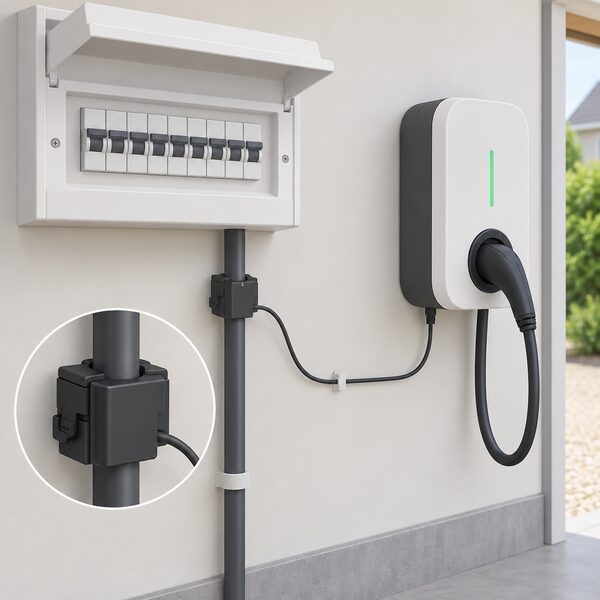
The SALUS CTC Current Transformer Clamp is listed as compatible with the SALUS EV Chargers EV7EU, EV7UK, EVT7EU and EVT7UK8. The maker describes it as providing real-time energy monitoring and automatic load balancing for compatible SALUS EV chargers, helping prevent overloads8. Its stated function is real-time load monitoring with automatic EV charging power adjustment8.
It is designed for residential installations and supports up to 100 A current capacity8. The SALUS EV Charger Series itself uses Mode 3 charging20, the standard AC charging mode for home charge points.
| Attribute | SALUS CTC Current Transformer Clamp |
|---|---|
| Product type | Current Transformer Clamp (CT Clamp)8 |
| Compatible chargers | SALUS EV7EU, EV7UK, EVT7EU, EVT7UK8 |
| Function | Real-time load monitoring with automatic EV charging power adjustment8 |
| Current capacity | Up to 100 A8 |
| Installation context | Residential8 |
The compatibility list is specific. A SALUS clamp is stated as working with compatible SALUS EV chargers20, and the four model numbers above are the ones named. A household with a charger from another maker should not assume the SALUS clamp will pair with it, and a household with one of these four SALUS models should check whether the clamp is supplied or bought separately, since the maker's pages do not state a price.
For independence, the SALUS clamp does the same job as any other: it lets the charger use the household's existing supply without an upgrade, and it supports monitoring that shows what the house is drawing. It does not add generation or storage, and it does not reduce the amount of grid electricity a car needs.
Real-time monitoring and load balancing: what the clamp enables
Two capabilities come from the same measurement. The first is load balancing: the charger adjusts its draw so the total household current stays within the supply limit. The SALUS clamp provides automatic load balancing for compatible chargers, helping prevent overloads8. Sync Energy's clamps are described as designed for intelligent load management, monitoring and balancing power across the installation and protecting circuits21.
The second is monitoring. Lux Power describes high-precision real-time monitoring and swift, accurate capture of current variations6, with applications in power system monitoring, industrial automation and energy management6. In a home, that means the app or portal can show what the house is using and what the charger is adding.
| Maker | Clamp | Stated capability |
|---|---|---|
| SALUS | CTC Current Transformer Clamp | Real-time energy monitoring and automatic load balancing for compatible chargers8 |
| Sync Energy | EVA120CT1 | Integrates with all Sync Energy EV Wall Chargers and Balancer12 |
| Sync Energy | CT Clamps | Intelligent load management, monitoring and balancing power across the installation21 |
| Lux Power | CT Clamp | High-precision real-time monitoring; widely applicable across various current ranges6 |
| Huawei | SCharger-7KS-S0 / 22KT-S0 | Applicable to all European-standard EVs22 |
What the clamp cannot do is create headroom. If the supply is already at its limit when the car is plugged in, load balancing reduces charging power or pauses it; it does not find more capacity. Nor does it remove the need for a separate MCB or RCBO at the distribution board for each charger, with no other loads sharing it15. The clamp is one part of a compliant installation, not a substitute for it.
For a household, the monitoring half of the clamp's job is what makes energy use visible, and visibility is the precondition for shifting load to cheaper hours or to solar generation. The balancing half is what makes a charger installable without a supply upgrade in many homes. Both depend on the clamp being fitted, positioned and configured correctly, and on the charger firmware interpreting it as intended.
Sources22 cited
- EO Charging home charging, EO Charging, 2026-09-17
- waEV-charge standard install, waEV-charge, 2026-09-17
- myenergi shop, myenergi, 2026-09-17
- Sync Energy EVAB1ESP120, Sync Energy, 2026-09-17
- Ohme how installation works, Ohme, 2026-01-07
- Lux Power CT Clamp, Lux PowerTek, 2026-09-04
- Common home battery mistakes, Homey, 2026-09-20
- SALUS CTC Current Transformer Clamp, SALUS Controls, 2026-09-20
- Electric vehicle charger installation and maintenance, NICEIC, 2025-08
- Electric vehicle charging house elements, Planning Portal, 2026
- How to charge with solar boost and solar only, Ohme, 2026-04-15
- Sync Energy EVA120CT1, Sync Energy, 2026-09-17
- EV charging, Uswitch, 2026-09-19
- Electric Vehicle Chargepoint Grant for Households with On-Street Parking, GOV.UK, 2026-09-17
- Section 722 EV charging complete guide, Elec-Mate, 2026-07-02
- Export power management and load monitoring by CT, Solis Inverters, 2026-03-21
- House battery integration, Simpson & Partners, 2026-09-17
- Battery storage, Home Energy Scotland, 2026-09-20
- Temporary power outages for keypad customers, NIE Networks, 2026-09-19
- SALUS EV Charger Series, SALUS Controls, 2026-09-20
- Sync Energy CT Clamps range, Sync Energy, 2026-09-17
- Huawei SCharger-7KS-S0 / 22KT-S0, Huawei, 2026-09-17
 Charging With a Home BatteryHow a home battery and an EV charger share one supply, whether a battery can usefully charge a car, and how combined systems are controlled so the battery is not discharged into the vehicle at a loss.
 Charger Apps and ConnectivityHow a home charge point connects: Wi-Fi, Ethernet, 4G and Bluetooth, what the app controls, what happens when the network drops, and how much of the charger depends on the maker's cloud.
 Load Management for ChargersWill a home charger trip the main fuse when the oven, shower and car all draw power at once?
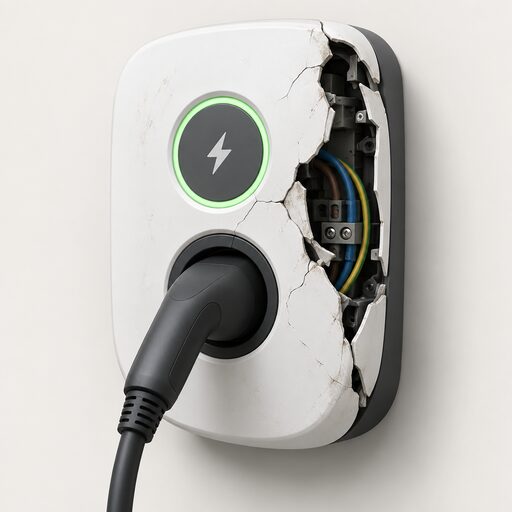 EV Charger Safety and StandardsHow do you know a home charge point is safe to use?
 The Full EV Charging GuideCharging an electric car at home usually means a wallbox, but do you need one, and what will it cost to fit and run?
 EV Tariffs and Home ChargingHow EV-specific import tariffs and charging bolt-ons work, including supplier-controlled charging where the energy company decides when the car draws power, which charge points each scheme supports, and what a household needs in place.