In this guide
Sync Energy is a British brand that sells domestic EV charge points directly to households, alongside the cables, mounting products and protection devices that go with them. Its main home unit, the Link, delivers dynamic charging up to 7.4kW and is described by the maker as its smallest EV charger, an ultra compact residential unit with smart connectivity1. The company states it has been supplying EV chargers since December 2019, having entered the market in 20151.
The proposition for a household is straightforward: a single-phase wallbox at the standard UK domestic charging rate, with the electrical protection built into the unit rather than added upstream. Sync Energy states that the Link carries a standard 3-year manufacturer warranty covering materials and workmanship, and that the same 3-year term applies across its chargers and accessories2. The Link is listed as compatible with all modern EVs and plug-in hybrids that use Type 2 connectors2.
What the range does not do is change where the energy comes from. A Sync Energy charger draws from the grid through the household supply, so it reduces petrol or diesel dependence but leaves electricity supply, tariff and network connection in place. The smart features add a further dependence on a home network and the manufacturer's app, though the load balancer is designed to keep working locally without one.
Who makes Sync Energy chargers
Sync Energy is a UK company that sells its own-brand charging hardware, and it describes itself as trusted by more than 2,000 UK homeowners, with certified installers and a 3-year warranty1. The company's own account of its history places its founding in 2009 by two British entrepreneurs working on renewable energy, with entry into EV charging in 2015 and charger supply running since December 20191.
That history matters for a household weighing independence, because it speaks to whether spares, firmware and support will exist over the life of the unit. The brand sits in the same group as BG Electrical, a long-established UK wiring accessories manufacturer, which gives it a domestic electricals background rather than a pure software start-up profile. The practical consequence is a range built around standard electrical components: Type 2 sockets, DIN-rail load management, screw terminals and interchangeable faceplates rather than proprietary connectors.
The dependence that remains is ordinary for the category. The charger needs a qualified electrician to install it, a grid connection to deliver power, and, for the smart functions, a home network and the maker's app. Sync Energy sells direct rather than only through wholesalers, so the supply relationship is with the manufacturer, and installation is arranged through certified installers with any non-standard work quoted before it proceeds1.
The range: Link, Pro and the accessories around them
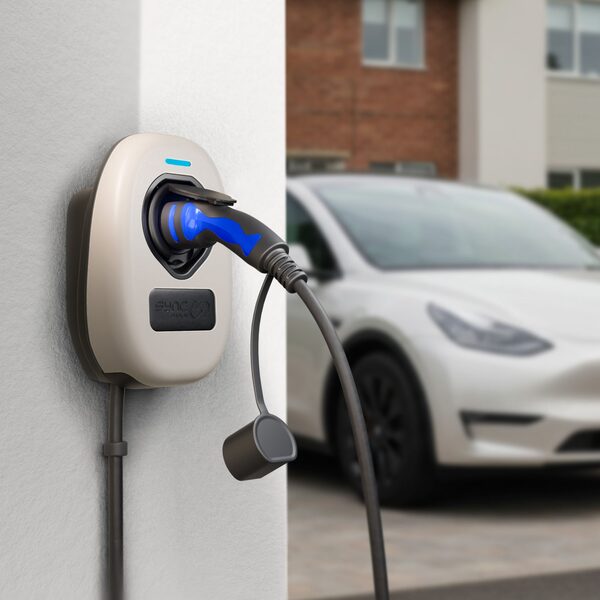
The domestic range centres on the Link EV Charger, sold as a socketed unit and as tethered variants, with metal-enclosure versions that carry the fuller protection package2. The Link is positioned as the residential product: ultra compact, with Wi-Fi, LAN or optional 4G connectivity for remote management2.
The Pro Charger AC sits above it and is aimed at commercial infrastructure rather than the driveway. It is a floor-mounted unit with a light, dual socket, three-phase supply, two 11kW outputs, an integrated MID meter, 4G and a pay terminal8. Other Pro variants are listed with 4G connectivity, RFID, Monta app integration by QR code and contactless card payment options9. These are shared and workplace installations, not single-household products, and the three-phase socket type confirms it8.
Around the chargers sits an accessories range: portable and fixed charging cables, mounting and protection products, and interchangeable faceplates. The cables are Mode 3 Type 2, rated 7.4kW single phase, and sold in lengths including 10 metres11. The mounting and protection range comes in single or twin configurations and is listed as compatible with the EVS, EVT and all Wall Charger 2 models12. The faceplates are suitable for socketed and tethered versions of the range13.
| Product | Type | Key specification |
|---|---|---|
| Link EV Charger | Socketed home wallbox | Type 2 single phase, up to 7.4kW5 |
| Link EV Charger, metal unit | Tethered or socketed home wallbox | Built-in SPD, 40A MCB, Type A RCD, 6mA DC protection4 |
| Pro Charger AC | Commercial floor mount | Dual socket, three phase, 2 x 11kW, 4G, pay terminal8 |
| Charging cables | Accessory | Mode 3 Type 2, 7.4kW single phase, up to 10m11 |
| Dynamic Load Balancer | Accessory | DIN rail, single phase up to 120A, up to 16 chargers7 |
Vehicle compatibility: Type 2 EVs and plug-in hybrids
Sync Energy states that the Link supports all modern EVs and plug-in hybrids that use Type 2 connectors2, and its charging cables are described as compatible with all electric and hybrid plug-in vehicles11. The Pro Charger AC is listed simply as suitable for all EV vehicles9.
Type 2 is the standard connector for UK and European home charging, so this covers the great majority of cars sold here. The independent guidance on connector types is that a tethered charger comes with the cable and connector installed, while an untethered charger has only a socket where a cable is plugged in16. That distinction decides whether a household needs to buy a separate cable, and it is the main practical compatibility question rather than the car brand.
Two limits are worth stating. A plug-in hybrid will normally accept less than the 7.4kW the charger can deliver, so the vehicle sets the rate and the wallbox simply supplies what the car asks for. And a car with a Type 1 inlet, which means some older models, needs an adapter lead rather than a direct connection. For the wider picture on connectors, see EV connectors and cables and Type 2 vs CCS.
Charging power: 7.4kW single phase
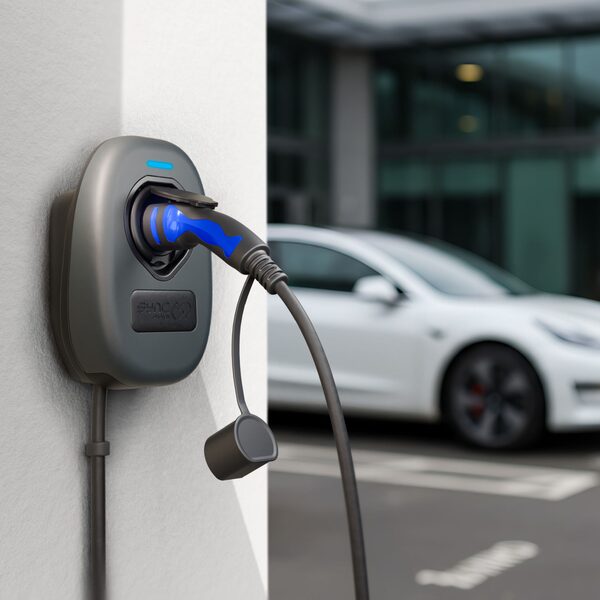
The Link delivers dynamic charging up to 7.4kW at 32A on a single-phase supply2. The same 7.4kW single-phase rating appears across the range: the EVC22328SL and EVC22325SL units are listed at 7.4kW on 250V single phase17, and the charging cables carry the same figure11. The Pro Charger AC moves to three phase with two 11kW outputs8.
7.4kW is the ceiling for a standard UK domestic single-phase connection, and it is set by the supply rather than the charger. A 7.4kW charge point draws roughly 32A, which is why load management matters in a house that also runs an oven, a shower or a heat pump. The Link's answer is dynamic charging, which adjusts the current rather than running at full rate regardless of what else is drawing power2.
For a household, the practical effect is that charging speed is a function of the car's onboard charger as much as the wallbox. Many EVs accept 7.4kW on single phase and will charge overnight at that rate; some accept less. The wider context on rates and times is at EV charging speeds and times, and the running cost implications are at EV charging running costs.
Dynamic Load Balancer: up to 16 chargers and solar pairing
The Sync Energy EV Dynamic Load Balancer is the accessory that manages supply capacity across multiple charge points. It supports installations with up to 16 chargers, with each charger communicating over RS485 protocol for real-time power management7. The single-phase option is rated up to 120A, and three supporting options are available7.
Two features stand out for a household. First, the balancer operates locally without requiring a yearly subscription or ongoing network connection, which the maker describes as providing a cost-effective solution7. That is a meaningful limit on dependence: the load management function does not stop working if the internet goes down or the manufacturer's servers change. Second, it can be used alongside solar PV or other renewable sources to maximise energy efficiency when paired with compatible EV chargers7.
On compatibility, Sync Energy states the balancer works with Sync Energy chargers and most other smart chargers that support dynamic load balancing7. That is a maker's claim about third-party equipment, so it is worth confirming against the specific charger before relying on it. If communication with a charger is lost, the balancer defaults all connected chargers to a safe 6A charging rate7. It mounts on an existing DIN rail only7. More on the principles is at load management and load balancing and CT clamps and sensors.
Built-in RCD and PEN protection, with no earth rod
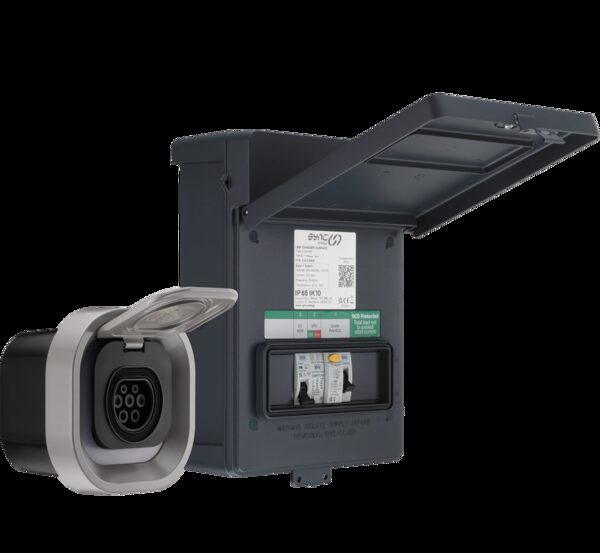
The electrical protection is built into the charger rather than added as separate upstream devices. Sync Energy states that the Link has integrated open-PEN protection that eliminates the need for a separate earth rod2, and the Wall Charger 2 is described as offering quick installation with RCD and PEN protection1. The metal-unit Link models go further, with a built-in SPD, a 40A MCB, Type A RCD and 6mA DC protection, which the maker says eliminates the need for extra upstream devices4.
This matters because open-PEN faults are the reason many installations historically needed an earth electrode, an extra cost and an extra piece of work. A charger with integrated PEN protection removes that step in most cases. The 6mA DC protection is the other half of the requirement: DC leakage from a vehicle can blind a standard Type A RCD, so charge points need either a Type B RCD or a 6mA DC detection device built in.
The wider standards picture, including what certification a charge point should carry, is at EV charge point safety and standards and RCD protection for EV charge points.
Durability and installation details
The Link and Pro ranges carry an IK10 impact rating, which is the highest of the mechanical impact categories and indicates resistance to a substantial blow rather than mere weather sealing5. The Link is described as suitable for both indoor and outdoor installations in its metal enclosure2, and it is listed as retrofittable with no specialist tools or complex setup required2. Fixings for both recessed and surface mounting are included2.
The metal-unit Link models use screw terminals of the combi type, with the switch positioned centrally4. The Pro Charger AC variants use inline terminal arrangements and knockout cable entry15. These are installer-facing details, but they bear on how long a job takes and therefore on labour cost.
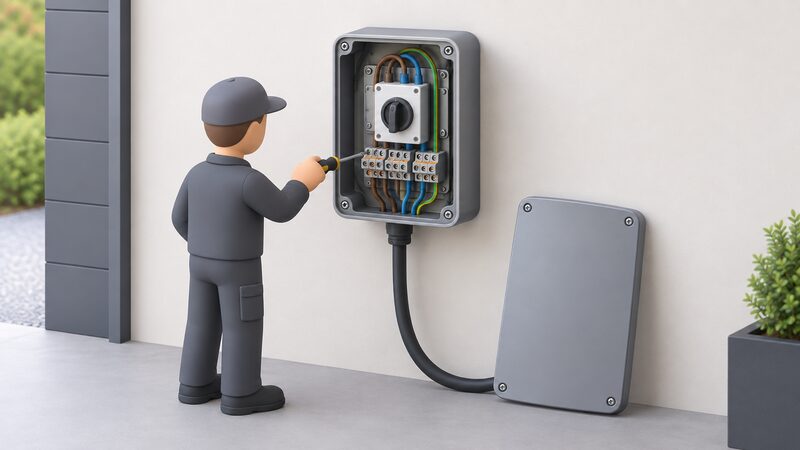
Installation itself is arranged through certified installers, and Sync Energy states that where extra requirements are identified, the company will assess what is needed and provide a no-obligation quote for those extra costs1. That covers the common variables: cable run length, consumer unit capacity, and whether the supply needs upgrading. The process and who may carry it out are covered at home EV charge point installation, and the supply-side questions at electrical requirements for a home charge point.
The app, smart charging and what depends on the network
The Sync Energy app is available on the Apple App Store and Google Play, and it manages both EV charging and the Sync Energy Flow home energy system in one place19. It shows real-time charging and system status, including active sessions, energy flow and device activity, along with charging costs, solar generation, battery charge and grid interaction19. It also supports multi-user access and charger sharing19.
The Link's smart features are Auto Solar Charging and Tariff Sense, both run through the app2. The charger connects by Wi-Fi, LAN or optional 4G2. The app is not required to deliver power, and the Dynamic Load Balancer is explicitly designed to operate locally without a yearly subscription or ongoing network connection7.
That split is the honest way to read the dependence. Local charging and local load management continue without the internet. Scheduling from away, energy monitoring, tariff-based optimisation and remote diagnostics depend on a home broadband connection, the manufacturer's servers and an app that the maker controls. If the company changed its platform or withdrew the app, the charger would still charge but the smart layer would be at risk. The general position is set out at EV charger apps and connectivity and EV charger cybersecurity and data.
Warranty: 3 years as standard
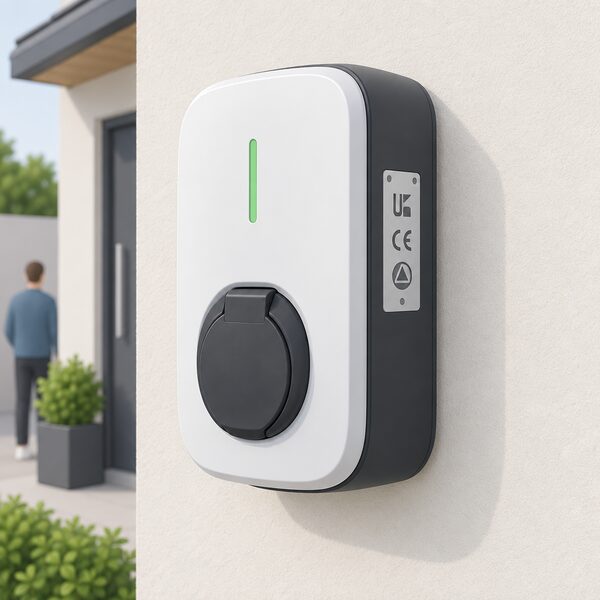
Sync Energy states that the Link comes with a standard 3-year manufacturer warranty covering materials and workmanship2, and the same 3-year term is repeated across the charger and accessory ranges, including charging cables, portable cables, faceplates and mounting products3. The warranty is described as a guarantee against faulty materials and workmanship22.
Three years is longer than the 2-year minimum that applies to consumer goods in the UK, and it is a manufacturer's term rather than an insurance-backed scheme. What it does not cover is wear, accidental damage or faults caused by installation outside the maker's instructions, which is standard across the industry. The comparison with other brands and what aftercare typically includes is at EV charge point warranties and aftercare.
"The Link comes with a standard 3-year manufacturer warranty, covering materials and workmanship."
The range also carries ASTA approval and UKCA and CE marking, which are the certification marks a household should expect to see on a charge point sold in the UK13. What those marks mean in practice is covered at EV charge point safety and standards.
Buying, delivery and the accessories range
Sync Energy sells the full range of EV chargers and accessories directly from its own site, with free next-day delivery available on orders placed by 2pm Monday to Friday3. That direct model means the buyer deals with the manufacturer for supply and warranty rather than a wholesaler.
The accessory range is broader than the chargers themselves. It includes Mode 3 Type 2 charging cables rated 7.4kW single phase in lengths up to 10 metres11, portable charging cables20, mounting and protection products in single or twin configurations12, and interchangeable faceplates for socketed and tethered versions of the range13. The EVA120CT1 and EVA400CT1 accessories are listed as integrating with all Sync Energy EV Wall Chargers and the Balancer, including socketed and tethered designs22.
Prices are not published in the material reviewed here, so a household should expect charger and installation costs to be quoted by the supplier and the installer rather than taken from a list. The general cost picture, including what drives a fitted price, is at how much a home EV charge point costs, and the choice between cable arrangements is at tethered vs untethered.
What the range means for household independence
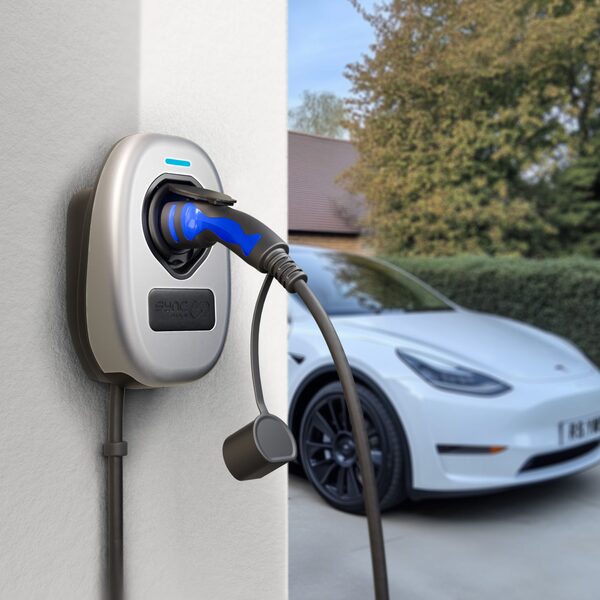
A Sync Energy charger does one clear thing for independence: it moves car fuelling from forecourts to the home electricity supply, so the household is no longer dependent on petrol or diesel retailing. Everything else stays in place. The charger draws from the grid through the home's connection, so the household remains dependent on an electricity supplier, on network capacity and on the tariff it can secure.
The design choices reduce some of the secondary dependencies. Integrated PEN protection removes the need for an earth rod in most cases2, which removes a piece of infrastructure and a cost. The Dynamic Load Balancer works locally without a subscription or a permanent network connection7, so load management does not depend on the maker's cloud. The 3-year warranty is a manufacturer's commitment rather than a service contract2.
The dependencies that remain are the app and the installer relationship. Smart charging, solar matching and cost reporting run through the Sync Energy app and a home network19, and installation runs through certified installers1. A household that wants to charge from its own solar would pair the charger with a PV system and, where the balancer is used, with compatible equipment7. The wider context is at EV charging and solar, EV charging and household energy independence and smart EV chargers.
Sources25 cited
- Home EV charger installation, Sync Energy, 2026-09-17
- Link EV Charger with Metal Unit, Sync Energy, 2026-09-17
- EV chargers and accessories range, Sync Energy, 2026-09-17
- Link EV Charger with Metal Unit, tethered, Sync Energy, 2026-09-17
- Link EV Charger, Sync Energy, 2026-09-17
- Link EV Charger with Metal Unit, Sync Energy, 2026-09-17
- EV Dynamic Load Balancer, Sync Energy, 2026-09-17
- Pro Charger AC, dual socket, Sync Energy, 2026-09-17
- Pro Charger AC, Sync Energy, 2026-09-17
- Pro Charger AC, Sync Energy, 2026-09-17
- EV charging cables range, Sync Energy, 2026-09-17
- Mounting and protection range, Sync Energy, 2026-09-17
- EV charger range, Sync Energy, 2026-09-17
- Interchangeable faceplates range, Sync Energy, 2026-09-17
- Pro Charger AC, 11kW, Sync Energy, 2026-09-17
- EV charger installation and maintenance, NICEIC, 2025-08
- EV charging cable, 7.4kW, Sync Energy, 2026-09-17
- EV charging cable, 7.4kW, Sync Energy, 2026-09-17
- Sync Energy app, Sync Energy, 2026-09-17
- Portable EV charging cables, Sync Energy, 2026-09-17
- EV charger accessories range, Sync Energy, 2026-09-17
- EVA120CT1 accessory, Sync Energy, 2026-09-17
- EVA400CT1 accessory, Sync Energy, 2026-09-17
- EV charger wall holder, Sync Energy, 2026-09-17
- Wall Charger 2 tethered, Sync Energy, 2026-09-17
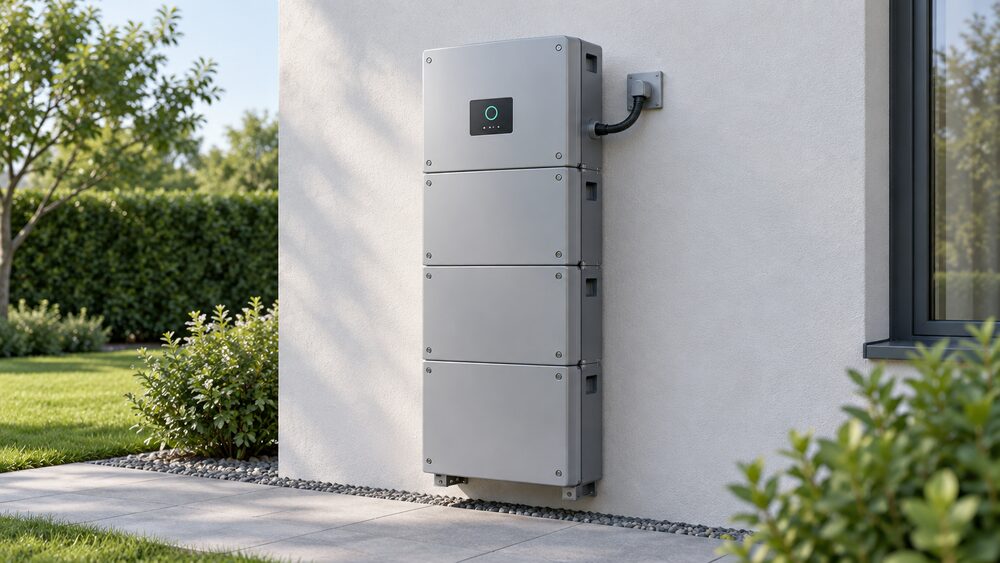 Sync Energy Home Battery SystemsSync Energy's Flow battery kits store solar power at home, but how much do they cost, what warranty comes with them, and can you add more batteries later?