
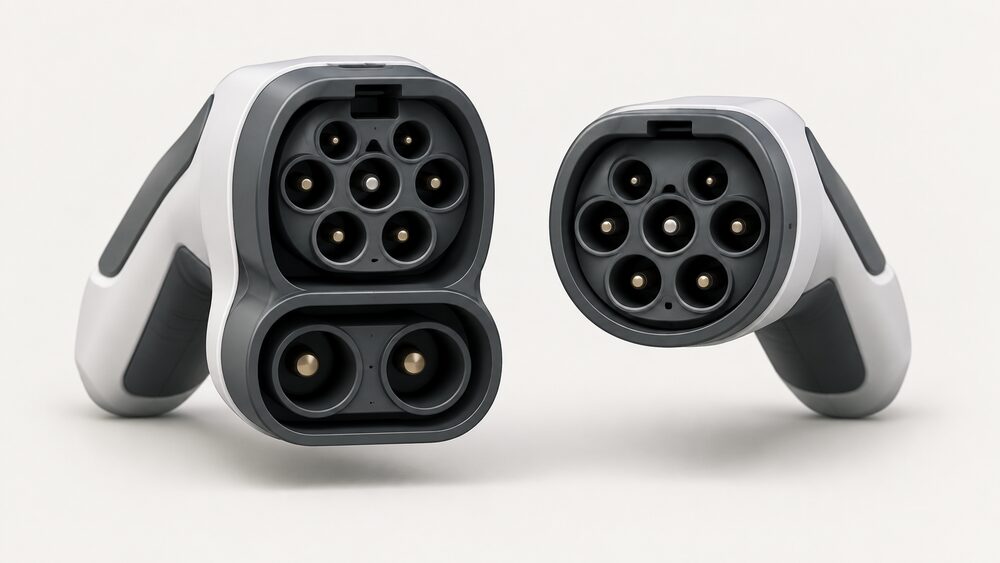
In this comparison
Two connectors dominate UK electric car charging, and they are not rivals so much as two halves of the same socket. Type 2 is the main connector for lower-powered AC charging, and CCS (Combined Charging System) is the main connector type for higher-powered DC charging1. A CCS inlet on a car is actually a Type 2 inlet with the extra DC pins built in below, so a car with CCS can still accept a Type 2 plug2.
That single design decision answers most of the confusion. Type 2 is a seven-pin connector used for home charging, workplace charging and slower public points, typically at 3.7kW to 7.4kW, 22kW where three-phase power is available, or less commonly 43kW3. CCS adds two DC pins below those seven and supports rapid and ultra-rapid charging from 25kW to 400kW+3. Public DC chargers in the UK and Europe feature a CCS connector, described as the universal standard for almost all new EVs3.
For a household, the practical position is that the car usually carries both inlets and the cable question is settled by the socket you are standing in front of. Almost all electric cars come from the manufacturer with a cable carrying a charger-side Type 2 connector4. Rapid chargers are almost always tethered, so no cable is needed at all5.
Type 2 and CCS at a glance
The two connectors sit at different points in the same charging hierarchy. Type 2 is the standard for EVs in the UK and Europe for home and public AC charging, and the EU mandated that all plug-in cars from 2014 must have a Type 2 socket, which is why it is the most common type in the UK7. CCS has been the dominant DC charging standard in Europe since the EU required all public DC chargers to include a CCS connector from 20172.
The result is a near-universal pairing. Public DC chargers, meaning rapid and ultra-rapid units, feature a CCS connector that is the universal standard for almost all new EVs in the UK and Europe3. CCS is also described as standard on most UK EVs8. Tesla vehicles sold here follow the same pattern: a Type 2 inlet for AC charging, exactly the same as other European EVs, and CCS for DC rapid charging2.
| Type 2 | CCS | |
|---|---|---|
| Current type | AC2 | DC2 |
| Charging type | AC (Slow/Fast)8 | DC (Rapid)8 |
| Pins | Seven3 | Seven AC plus two DC6 |
| Typical use | Home and slower chargers around 7kW5 | Rapid chargers, almost always CCS plugs5 |
| UK status | Standard for home and public AC charging3 | Universal standard for almost all new EVs3 |
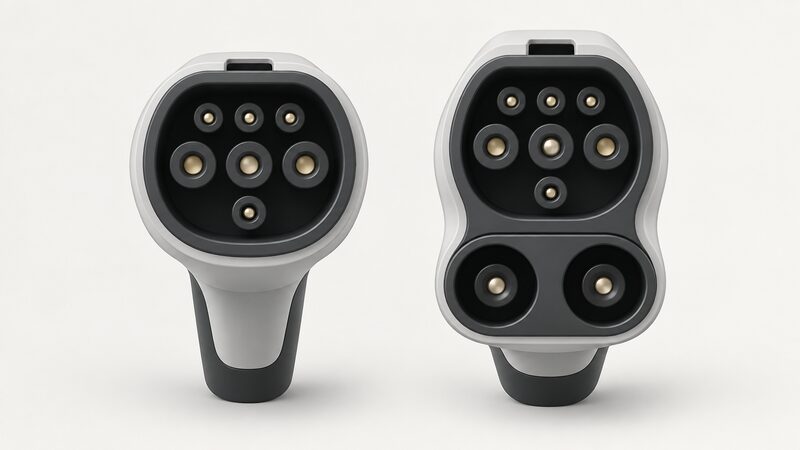
What each connector looks like: two DC pins make the difference
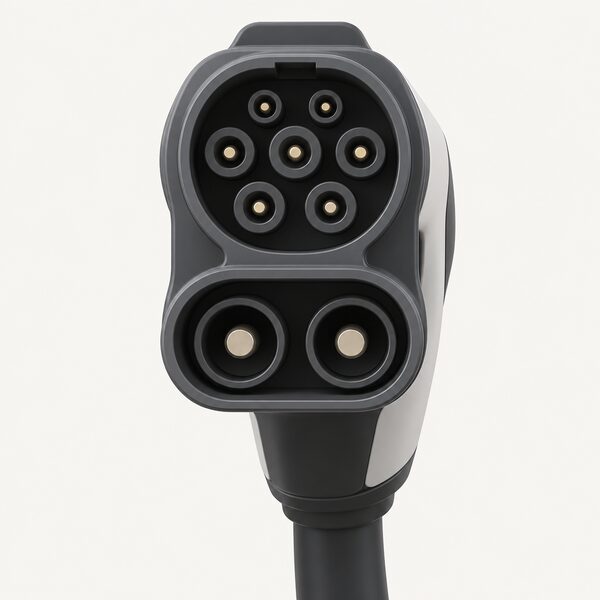
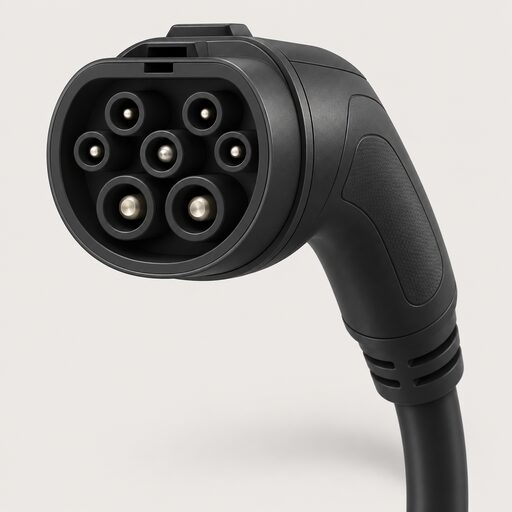
Physically, the two are close relatives. CCS connectors look similar to the Type 2 connector but have an additional two DC pins3. The Type 2 part is a seven-pin connector3, and the CCS version is described as seven pins for AC plus two pins for DC6. A CCS plug looks like a Type 2 socket with two additional pin holes below9.
That shared geometry is deliberate. CCS combines a standard Type 2 connector and a fast-charging DC connector within a single socket10, and the Combined Charging System combines two Direct Current pins arranged below the Type 2 AC connector, using three of the Type 2 pins11. The upper section is not decorative: it is the AC interface, which is why a CCS car can be charged from an ordinary Type 2 point.
The naming follows the same logic. CCS2 is Type 2 plus DC pins, while CCS1 is Type 1 plus DC pins12. CCS1 belongs to North America; the UK and Europe use CCS2. Older cars with a five-pin Type 1 inlet need a Type 1 to Type 2 cable to access the AC public network3, and home chargers typically have Type 2 inlets, although some have Type 13.
"a CCS inlet on your car is actually a Type 2 inlet with the extra DC pins built in below"
AC vs DC: what each connector is for
The split is about where the conversion from grid electricity to battery voltage happens. Type 2 carries alternating current and relies on the car's onboard charger, which is why the power ceiling is set by the vehicle rather than the post. CCS carries direct current, with the conversion done in the charger itself, which is what allows far higher rates.
Type 2 is classed as AC (Slow/Fast) and CCS as DC (Rapid)8. CCS also allows charging on both DC and AC, which is what makes faster charging possible6. The connector is not the only variable: a car fitted with CCS can also accept a Type 2 connector, which charges it at a slower rate13.
This matters for what a household can actually do with the car. A Type 2-only connection at home is the normal case and is not a limitation for overnight charging. The DC pins come into play on longer journeys, where the same car uses a different part of its inlet. Where bidirectional features such as vehicle-to-home or vehicle-to-grid are wanted, only CCS connectors are currently suitable9, so the DC pins carry a second role beyond speed.
Equipment reflects the same division. A combined unit can carry a CCS connection, a CHAdeMO connection and a 22kW AC Type 2 connection on one unit14, and a DC charger can be built with two CCS2 DC connectors plus Type 2 AC15. Home chargers, by contrast, are offered with a Type 2 cable or socket16.
Charging speeds: what Type 2 and CCS can deliver
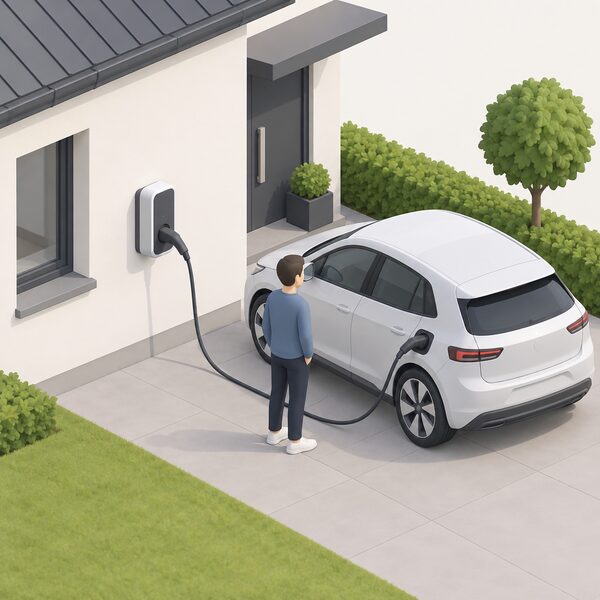
The speed gap is the headline difference. Type 2 typically supports power levels from 3.7kW to 7.4kW for home, workplace and on-street charging, and can support higher rates of 22kW with three-phase power, or less commonly 43kW3. CCS supports rapid and ultra-rapid charging with power levels from 25kW to 400kW+3. One maker gives charge speeds up to 350kW for CCS6.
Older guidance draws the same line from the network side. Rapid chargers work with both alternating current, which uses a Type 2 43kW connector, and direct currents, which use CCS and CHAdeMO 50kW connectors13. Fast charging connector types are available as Type 1 or Type 213. AC rapid chargers use a Type 2 connector, so a charging cable with a Type 2 connector is needed13.
| Connector | Current | Typical power | Where it is found |
|---|---|---|---|
| Type 2 | AC | 3.7kW to 7.4kW; 22kW three-phase; less commonly 43kW3 | Home, workplace, on-street, public AC3 |
| CCS | DC | 25kW to 400kW+3 | Rapid and ultra-rapid public chargers3 |
| Tesla Type 2 | AC | Up to 11kW or 22kW3 | Older Model S and Model X3 |
The practical ceiling is usually the car, not the plug. A 400kW-capable CCS post will only deliver what the vehicle's battery management system will accept, and a home Type 2 supply is limited by the property's electrical capacity as much as by the connector. For a household, the meaningful figure is the overnight rate: a 7kW Type 2 connection is the standard domestic case, and the DC pins are for journeys rather than the driveway.
Do all electric cars sold in the UK use CCS?
Not literally all, but the direction of travel is clear. CCS is the universal standard for almost all new EVs in the UK and Europe3, and is standard on most UK EVs8. Type 2 is the standard for home and public AC charging, mandated for all plug-in cars from 20147.
The exceptions are older or specialist vehicles. Some older models use a Type 1 connector exclusively17, and those need a Type 1 to Type 2 cable for the AC public network3. On the DC side, the UK public network has historically carried two entirely different DC plugs, CCS or CHAdeMO, each requiring its own socket18. CHAdeMO remains in use on some cars, and a council charge point list can include CHAdeMO at 50kW, CCS at 50kW and Type 2 at 22kW on the same site19.
Tesla is a special case worth knowing. Early Tesla models used Type 2 charging connectors, and all European Supercharger stations offer both that and the CCS Combo type20. Tesla Destination chargers have Type 2 connectors so they can be used by a wide range of non-Tesla electric cars21. A Tesla Model 3 uses two charging standards for its inlets, Type 2 and CCS22.
Can I charge a CCS car on a Type 2 charger?
Yes, and this is the everyday case for most households. Because the CCS inlet contains a full Type 2 inlet, a Type 2 plug connects to the upper section and charges on AC. Home and slower chargers around 7kW use Type 2 connectors, while rapid chargers almost always use CCS plugs5. Public AC chargers, classed as Standard and Standard Plus, typically have Type 2 connectors3.
The cable arrangements differ by location. Home chargers are available either with a tethered Type 1 or Type 2 cable that plugs straight into the car, or with a Type 2 socket for use with the vehicle's own charging cable23. Workplace chargers are usually untethered, so a cable has to be brought along, usually a Type 2 connector13. Type 2 charging cables generally have a Type 2 connector on each end, though Type 1 to Type 2 cables exist24.
Almost all electric cars come from the manufacturer with a cable carrying a charger-side Type 2 connector4, so the AC network is normally accessible without buying anything. Almost all electric vehicles can use a Type 2 connector, though some older models will exclusively use a Type 1 connector17.
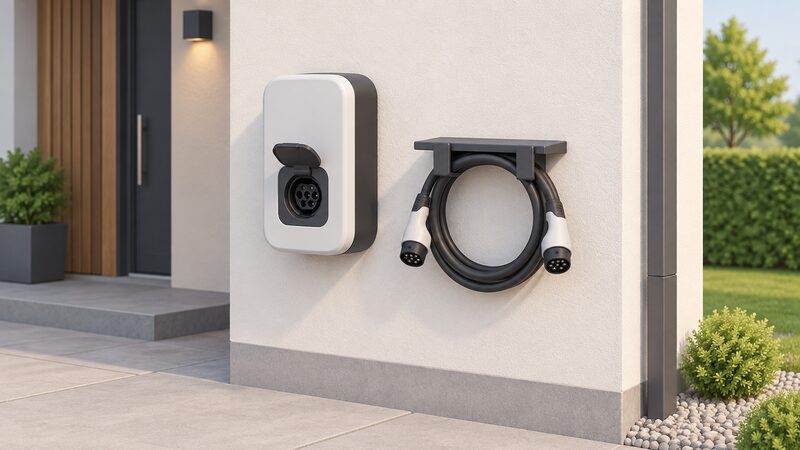
Home charging vs public rapid charging: where each connector matters
At home, the connector question is settled before the car arrives. A domestic wallbox is a Type 2 device, whether tethered or untethered, and the car's Type 2 inlet is what it connects to. The DC pins play no part in domestic charging, because no domestic unit supplies DC. This is the arrangement that gives a household its independence from the public network for routine mileage, and it is also the arrangement that keeps the household dependent on the grid and on a supplier for the electricity itself.
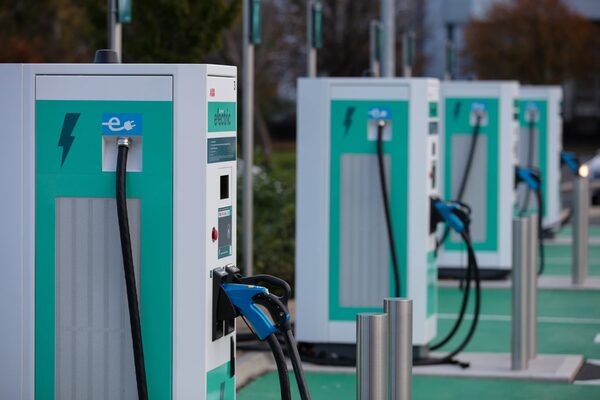
On the public network, the connector determines what is possible. Public AC chargers typically have Type 2 connectors3. Public fast charging locations offer both CCS and CHAdeMO options25. For rapid charge points, two connector types are recommended, and it is good practice to include connectors for both26. A council site can carry CHAdeMO at 50kW, CCS at 50kW and Type 2 at 22kW together19.
The Tesla network adds a further layer. The Supercharger network can only be connected to with a Tesla Type 2 or CCS connector13, and European Supercharger stations offer both20. Tesla Superchargers charge at rates of between 150kW and 250kW using a CCS connector21.
For a household planning journeys, the useful habit is to read the connector type on a charge point listing rather than the power figure alone, since a 22kW Type 2 post and a 50kW CCS post serve different purposes and only one of them uses the DC pins. The EV connectors and cables page covers the wider set, including CHAdeMO and Mode 3, and charging speeds and times sets out what each rate means in practice.
What is a CCS2 connector?
CCS2 is the European form of the Combined Charging System: Type 2 plus DC pins12. The alternative, CCS1, is Type 1 plus DC pins and belongs to North America12. In the UK, the CCS2 pattern is what appears on public DC chargers, on new cars and on DC-capable home energy equipment. A DC charging module for a home battery system can specify a CCS2 charging interface27.
The distinction matters mainly when buying equipment or importing a car. A CCS1 vehicle or charger is built around a five-pin Type 1 AC interface, which is not the UK standard. Type 2 cables have seven pins and Type 1 cables have five13, so the two families are not interchangeable without an adapter cable, and adapters do not add DC capability.
For most UK households the term is simply another name for the DC socket on the car. The practical checks are the same: confirm the car has a CCS inlet if rapid charging is wanted, confirm the home unit is a Type 2 device, and confirm the cable supplied with the car has a Type 2 connector at the charger end. The home charging guide covers how those choices fit together with tariffs, load management and installation.
Sources27 cited
- Guide to EV charging, Zapmap, 2026-09-04
- CCS vs CHAdeMO vs Type 2: EV connector types explained, Electroverse, 2026-06
- EV connector types guide, Zapmap, 2026-05-20
- Tethered vs untethered EV chargers, Zapmap, 2026-02-23
- Electric car charging guide, Carwow, 2025-07-16
- Different types of EV chargers, SolaX Power, 2026-01-08
- Electric car charging at home, Which?, 2026-02-25
- Bidirectional EV chargers, V2H, V2G and solar terms: UK guide, Alternergy, 2025-06-02
- EV charging cables buyer's guide, go-e, 2022-07-27
- What type of EV charger is best for me?, Andersen, 2023-07-17
- EV glossary, Uswitch, 2024-11-26
- Guide to electric car charging at home, ScottishPower, 2023-10
- How to charge an electric car, Uswitch, 2022-02-02
- Project EV EVC-AC22S-DC60D datasheet, Westech Solar, 2026-09-17
- EV charging product portfolio, Eaton, 2026-09-17
- EV charging, Eaton, 2026-09-17
- Choosing an EV charging cable, Uswitch, 2022-02-04
- 5 problems with electric car charging and how to fix them, Which?, 2021-03-19
- Electric vehicle charging, Isle of Anglesey County Council, 2026-09-20
- Tesla opens its Supercharger network to other car brands, Which?, 2022-05-20
- Can non-Tesla cars use Tesla Superchargers?, Carwow, 2025-07-31
- Tesla Model 3 charging, Zapmap, 2026
- Home charging, Zapmap, 2025-06-19
- The second-hand electric vehicle accessories guide, E.ON Next, 2024-11-13
- EV charging 101, Wallbox, 2026-09-20
- Electric vehicle infrastructure national standards, Welsh Government, 2023-06
- SigenStor EVDC datasheet, Sigenergy, 2026-09-17
 EV Connectors and CablesWhich cable fits your car, and will it work at every charge point you pull up to?
 Bidirectional Charging StandardsDoes your electric car and charger actually support sending power back to your home or the grid?
 EV Charging Device StatisticsHow many public charging points are there in the UK, and why do different sources give different totals?
 Types of Home EV ChargerWhich home charger suits your car and your driveway?
 Micro-CHP TypesWhich type of micro-CHP actually gets fitted in UK homes, and how much electricity does one make while it heats your house?
 Accessible Charging and PAS 1899You are disabled or find charge points hard to use.