In this guide
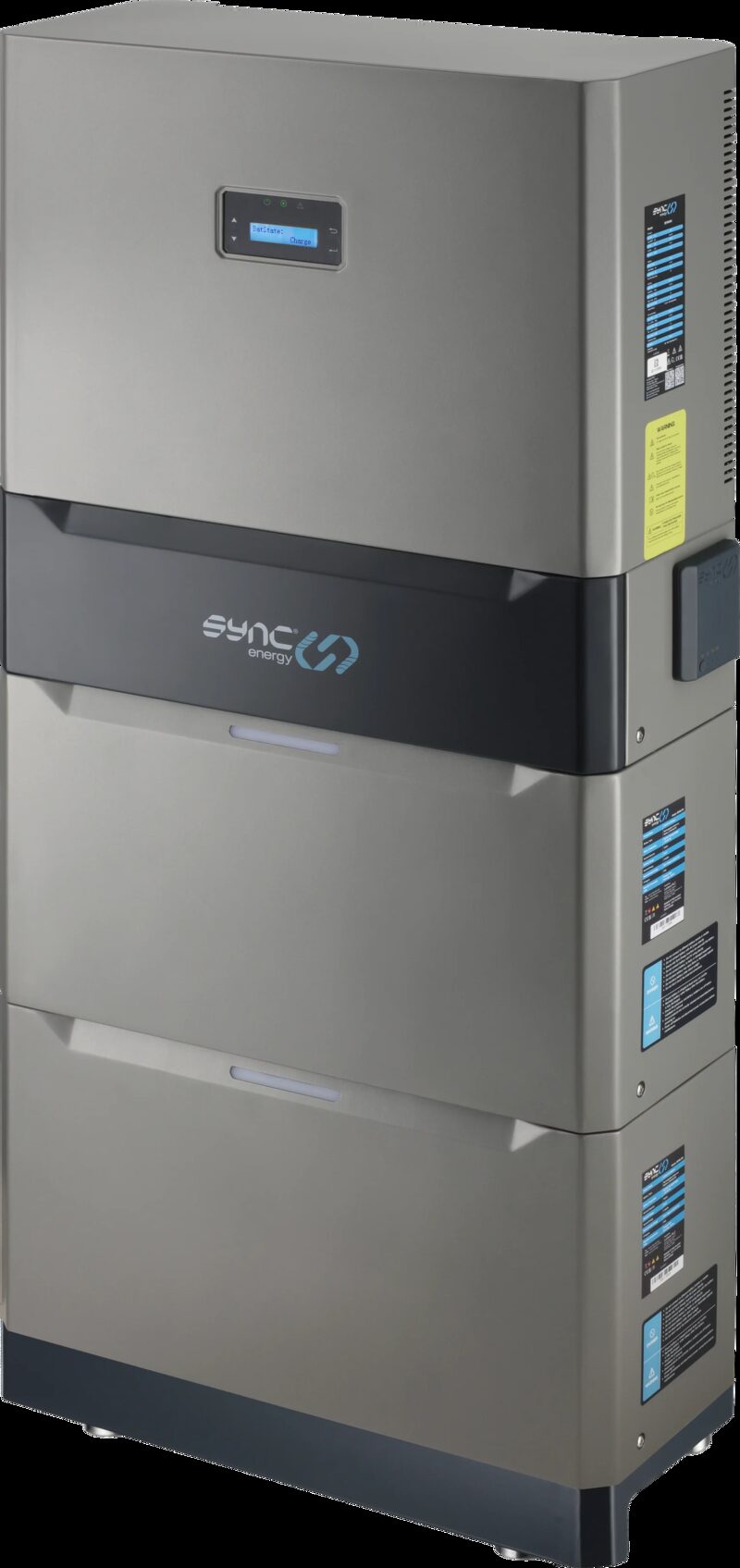
Sync Energy sells the Flow range of All-in-One home battery kits, stackable units that combine a hybrid inverter and modular battery storage in a single steel enclosure. The kits are described as PV-ready, so solar can be added at any time, and they are available in 3.6 kW or 6 kW power options with one, two or three battery configurations1. Each 5.12 kWh module is replaceable on its own, so the inverter core can stay in place while batteries are swapped later1.
The company came to home storage from EV charging, having supplied chargers since December 2019, and its app now covers solar generation, battery storage, EV charging and grid usage in one place2. The Flow Battery Stacks are marketed for homes and light commercial use, and the units are IP65 rated with IK10 impact protection for outdoor installation4.
For a household, the appeal is straightforward: a battery that stores surplus solar for evening use, shifts grid import away from peak periods, and can be expanded module by module without replacing the inverter. The dependence that remains is on the grid for top-up charging, on the Sync Energy app and its cloud services for monitoring and control, and on the installer network for commissioning and warranty work.
From EV chargers to home batteries: the company's track record
Sync Energy began supplying EV chargers in December 2019, which gives it roughly seven years in the UK charging market before the Flow battery range appeared2. That matters for a household weighing an unfamiliar brand: the company's service network, app and installer relationships were built around charge points first, and the battery range extends the same platform rather than starting from nothing.
The charger side of the business is well documented. Sync Energy home installations are described as trusted by more than 2000 UK homeowners, with certified installers and a 3-year warranty, and the company states that 95% of customers are covered by its standard installation2. Installation pricing depends on the run to the consumer unit, with distances over 10 m potentially costing extra2.
The wider market context is that EV charging and home storage are converging. Independent guidance notes that a home battery captures surplus solar energy for later use, including overnight EV charging, whereas without one the surplus is wasted or exported at a relatively low rate9. Home batteries are also described as storing renewable electricity to power a heat pump, making a household less reliant on grid electricity10. Sync Energy sits in that convergence: the same app manages the charger and the battery, and the Dynamic Load Balancer is designed to keep both within the home's supply limit.
What the track record does not yet show is a long installed base of Flow batteries in UK homes. The 2000+ figure refers to charger installations, not battery systems, and the battery range is newer. A household considering the brand is therefore buying into a charging company's storage platform, with the charger network as the evidence of UK support.
The Flow battery range: All-in-One kits for homes and light commercial use
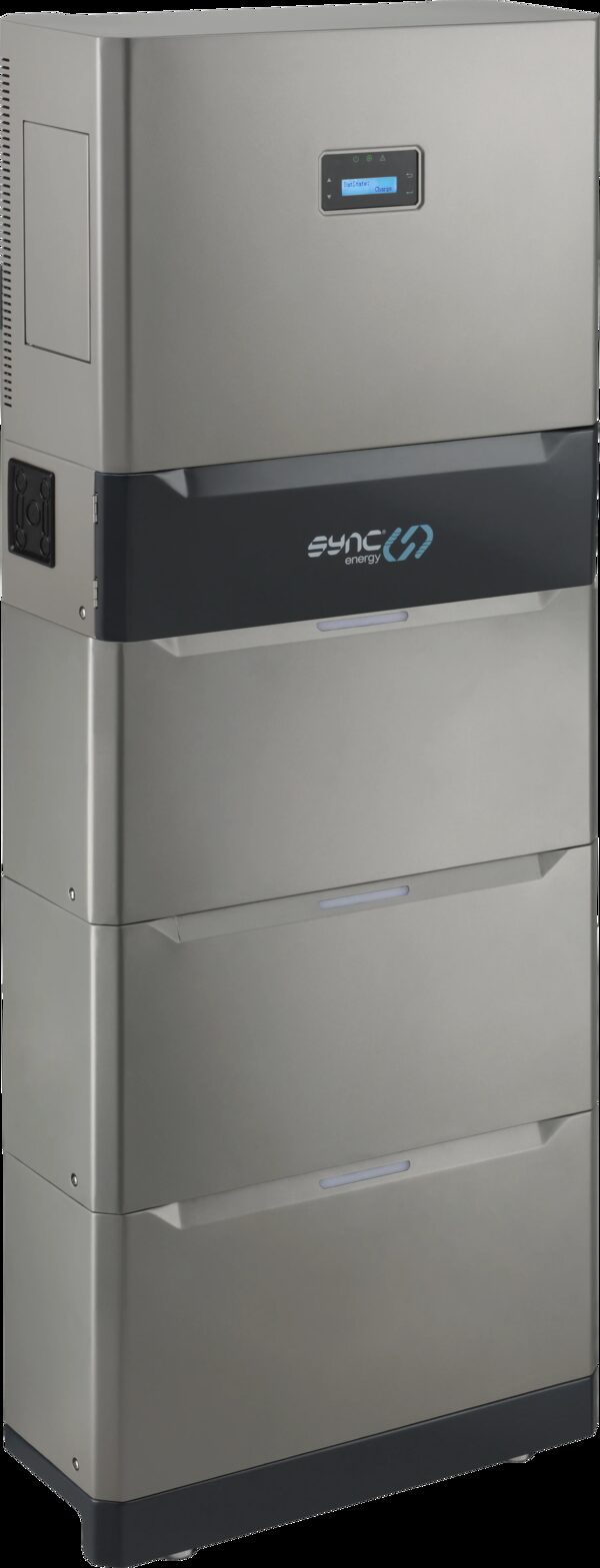
The Flow range is built around a single idea: put the inverter and the batteries in one enclosure so the installation is a stack rather than a collection of separate boxes. The All-in-One Kit combines a hybrid inverter, modular battery storage, safety features including fire suppression and surge protection, and remote monitoring, all in a compact, stackable enclosure1. The kit is available in 3.6 kW or 6 kW power options and in one, two or three battery configurations1.
The battery modules use plug-and-play connectors, so each module links to the next without complex wiring or configuration1. That is what makes later expansion practical: a household can start with the capacity it needs and add storage without changing the inverter1. Individual battery modules are replaceable, so the inverter core can remain in service and the batteries swapped when required1.
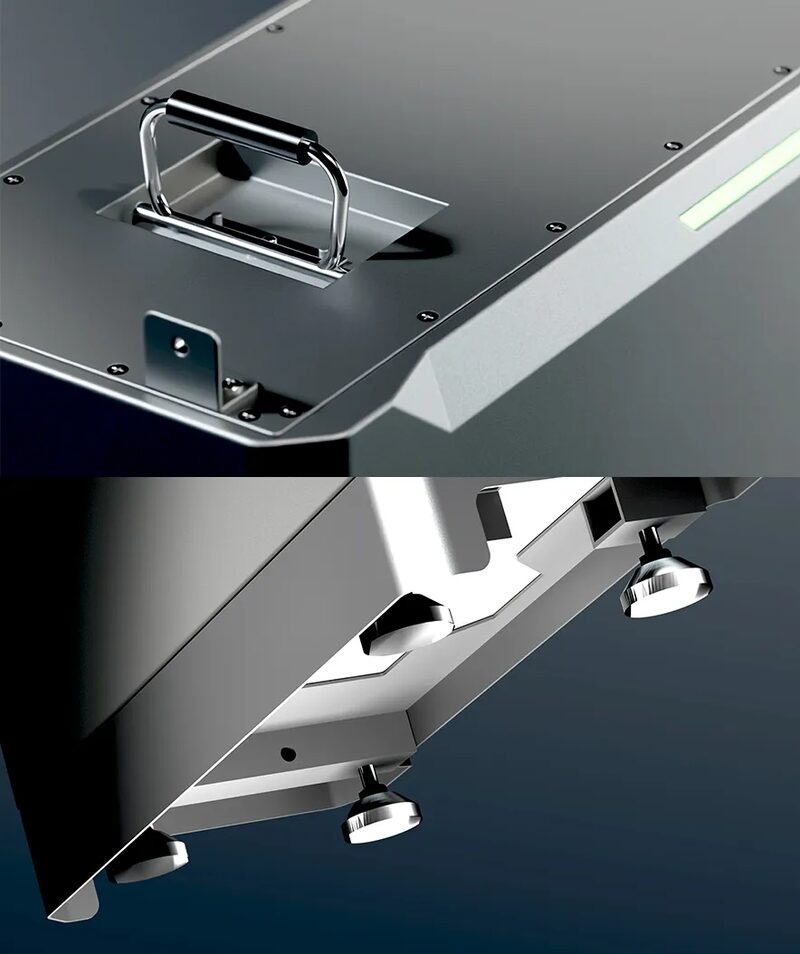
The Flow Battery Stacks are described as a flexible, future-ready solution for homes and light commercial use4. The outdoor rating supports that: the units are IP65 rated and IK10 for impact, which the maker states makes them suitable for outdoor installation4. For a home without space in a garage or utility room, an externally mounted stack avoids the siting problem that affects many indoor-only systems. More on siting options is at where a home battery can be installed.
The range sits in the all-in-one category rather than the separate inverter and battery approach, which changes the upgrade path. A household that later wants a different inverter cannot keep the enclosure, but it can keep the batteries. The trade-off between the two architectures is set out in all-in-one home battery systems and modular and stackable home batteries.
Specifications: steel-housed All-in-One kits
The published specifications are consistent across the kit pages. Each unit is housed in steel with a painted base finish and a polycarbonate base material, and each includes integrated heating that operates below 5°C5. That heating matters in a UK context: an outdoor battery in a cold snap needs to keep its cells within their operating window, and the integrated heater is the mechanism the maker provides.
| Specification | SEF1A60G3-01 | SEF1A60G1-01 | SEF1A36G3-01 | SEF1A60G2-01 |
|---|---|---|---|---|
| Battery capacity | 5120 Wh5 | Not stated | Not stated | Not stated |
| Modules | Not stated | 16 | Not stated | 211 |
| Housing material | Steel5 | Steel6 | Steel7 | Steel11 |
| Base material | Not stated | Polycarbonate6 | Polycarbonate7 | Not stated |
| Base finish | Painted5 | Not stated | Painted7 | Painted11 |
| Integrated heating | Below 5°C5 | Below 5°C6 | Below 5°C7 | Not stated |
| Fire suppression | Yes5 | Yes6 | Not stated | Yes11 |
| Surge protection | Not stated | Not stated | Not stated | Integrated AC and DC11 |
| Scalability | Up to 35.84 kW5 | Up to 35.84 kW6 | Up to 35.84 kW7 | Up to 35.84 kW11 |
| IK rating | IK105 | IK106 | IK107 | Not stated |
| ENA reference | SYNCE/17266/V2/A25 | SYNCE/17266/V2/A26 | SYNCE/17268/V2/A27 | SYNCE/17266/V2/A211 |
| Terminal type | Screw5 | Not stated | Screw7 | Screw11 |
| Terminal screw type | Combi5 | Not stated | Combi7 | Combi11 |
| Meter accuracy | Class C 2.0%5 | Not stated | Not stated | Not stated |
| Cable entries | Not stated | 96 | Not stated | Not stated |
| Fixing screws supplied | Not stated | Yes6 | Not stated | Not stated |
Two entries are worth reading carefully. Battery charge cycles are listed as N/A on the kit pages, and battery charge time is listed as NA, so the published specification sheets do not give a cycle life or a charge time for these units5. A household comparing warranties and expected lifespan will need those figures from the installer or the manufacturer directly, since they are not on the product pages. The ENA reference is the identifier used in the network operator notification process, which is covered at telling the network operator about a home battery.
Scale of the installed base: chargers, app users and CO₂ saved
The clearest measure of scale in the published material is on the charger side. Sync Energy home installations are described as trusted by more than 2000 UK homeowners, with certified installers and a 3-year warranty2. The company also states that 95% of customers are covered by its standard installation, which indicates a fairly standardised fitting process rather than a bespoke job each time2.
The app is the other measure. It is described as uniting smart home and EV charging in one intelligent system, with no need for multiple third-party apps4. It provides real-time charging and system status, including active sessions, energy flow and device activity, and covers charging status, live performance, EV energy usage, charging costs, solar generation, battery charge and grid interaction3. The homeowner-facing features include Auto Solar Charge, Tariff Sense optimisation and real-time energy insights8.
On CO₂ saved, the published pages do not give a figure. The environmental case is made indirectly: the battery stores surplus solar that would otherwise be exported at a relatively low rate9, and combining solar with a home battery allows that electricity to run a heat pump instead of importing from the grid10. Any CO₂ saving depends on the carbon intensity of the grid at the time of charging and on how much solar the household generates, neither of which is stated for the Sync Energy range.
The commercial charger range adds a further signal of scale. The Pro Charger is aimed at commercial EV charging infrastructure and is suitable for all EV vehicles, with 4G connectivity, RFID, Monta App integration with QR code, contactless card payment options and accurate metering12. That is a business-facing product line rather than a domestic one, and it suggests the company's installed base spans sites beyond single homes.
Government-backed pilot: the SynchroStor LODES funding
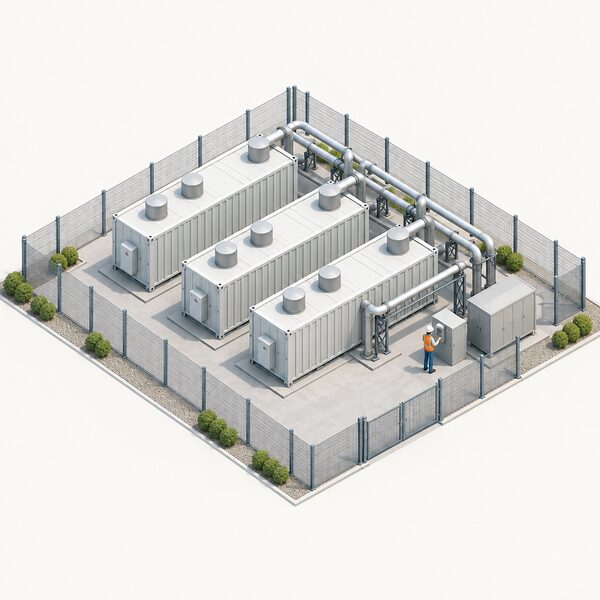
The name SynchroStor appears in the UK's longer duration energy storage programme. SynchroStor won Longer Duration Energy Storage Demonstration funding in April 2023 to demonstrate a megawatt-scale pilot at technology readiness level 6. The funding was awarded through the Longer Duration Energy Storage Demonstration programme, part of the Net Zero Innovation Portfolio from the Department for Business, Energy and Industrial Strategy13.
That programme is a government-backed route for storage technologies that can hold energy for longer than lithium-ion batteries typically manage, and it is separate from the domestic Flow product line. The distinction matters for a household reading about Sync Energy: the LODES award relates to a megawatt-scale thermal storage pilot, not to the All-in-One kits sold for homes. The two share a name association rather than a product.
The wider policy context is that battery storage is being built into new housing at scale. The Cosmeston Farm development in Wales is described as every highly energy efficient home being powered by photovoltaic panels and batteries14. That is a Welsh Government press release about a specific scheme, and it illustrates the direction of travel rather than any Sync Energy involvement.
For a household, the practical reading is that government funding for storage research sits alongside, not inside, the consumer product. The Flow kits are a commercial offering, and their case rests on the specifications, the app and the installer network rather than on any subsidy attached to the brand. Current support schemes and their conditions are covered at home battery cost.
What owning a Sync Energy battery means for household energy independence
A Sync Energy Flow kit changes where a household's electricity comes from for part of the day. The battery stores surplus solar generation and releases it later, and the app's Auto Solar Charge and Tariff Sense features are aimed at maximising that self-consumption and shifting import away from expensive periods8. Independent guidance supports the principle: a home battery captures surplus solar for later use, including overnight EV charging, where otherwise it would be wasted or exported at a low rate9.
The dependence that remains is worth stating plainly. The battery still charges from the grid when solar is short, so the household remains a grid customer and a supplier customer. The inverter and battery are a single manufacturer's product, so spares and service run through Sync Energy and its installers. The app adds a further layer: remote monitoring, scheduling and energy insights depend on a home broadband connection, the manufacturer's servers and the app itself. The Dynamic Load Balancer is the exception, described as operating locally without requiring a yearly subscription or ongoing network connection15.
Backup capability is claimed but not specified in detail. The All-in-One Kit is described as helping homeowners cut bills, store solar power and stay powered during outages1. What stays running during an outage depends on how the backup circuit is wired, which is covered at battery backup in a power cut.
The EV charging side reinforces the same pattern. The Dynamic Load Balancer is compatible with Sync Energy chargers and most other smart chargers that support dynamic load balancing, supports up to 16 chargers, and defaults all connected chargers to a safe 6A rate if communication is lost15. It can be used alongside solar PV when paired with compatible chargers15. That makes the battery and the charger a single managed system, which is the strongest argument for the brand and also the clearest statement of the dependence it creates.
Sources15 cited
- Sync Energy Flow All-in-One Kit range, Sync Energy, 2026-09-17
- Sync Energy home installations, Sync Energy, 2026-09-17
- Sync Energy app, Sync Energy, 2026-09-17
- Sync Energy Flow Battery Stacks range, Sync Energy, 2026-09-17
- Sync Energy Flow SEF1A60G3-01 All-in-One Battery Kit, Sync Energy, 2026-09-17
- Sync Energy Flow SEF1A60G1-01 All-in-One Battery Kit, Sync Energy, 2026-09-17
- Sync Energy Flow SEF1A36G3-01 All-in-One Battery Kit, Sync Energy, 2026-09-17
- Sync Energy app for homeowners, Sync Energy, 2026-09-17
- Can solar panels charge electric cars?, The CPA, 2026-04-15
- How to ensure a heat pump runs efficiently, Energy Saving Trust, 2026-05-19
- Sync Energy Flow SEF1A60G2-01 All-in-One Battery Kit, Sync Energy, 2026-09-17
- Sync Energy Pro Charger AC, Sync Energy, 2026-09-17
- Our Homes Net Zero Toolkit, Energy Systems Catapult, 2025-07-31
- UK's largest net zero housing development to be delivered in Wales, Welsh Government, 2025-10-02
- Sync Energy EV Dynamic Load Balancer, Sync Energy, 2026-09-17
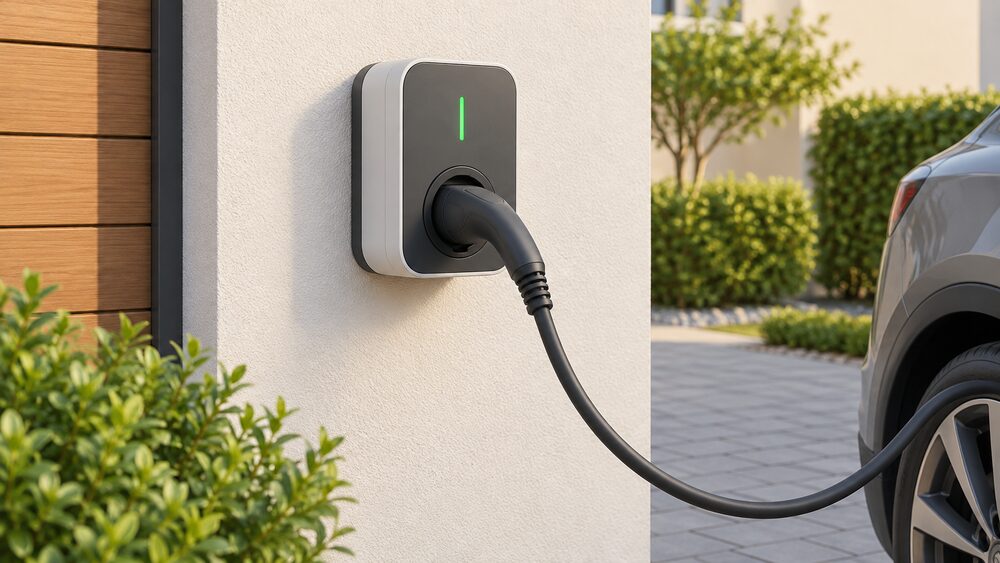 Sync Energy EV chargersSync Energy sells home EV chargers in the UK, and the Link is its compact wallbox for charging on a driveway or in a garage.