
In this guide
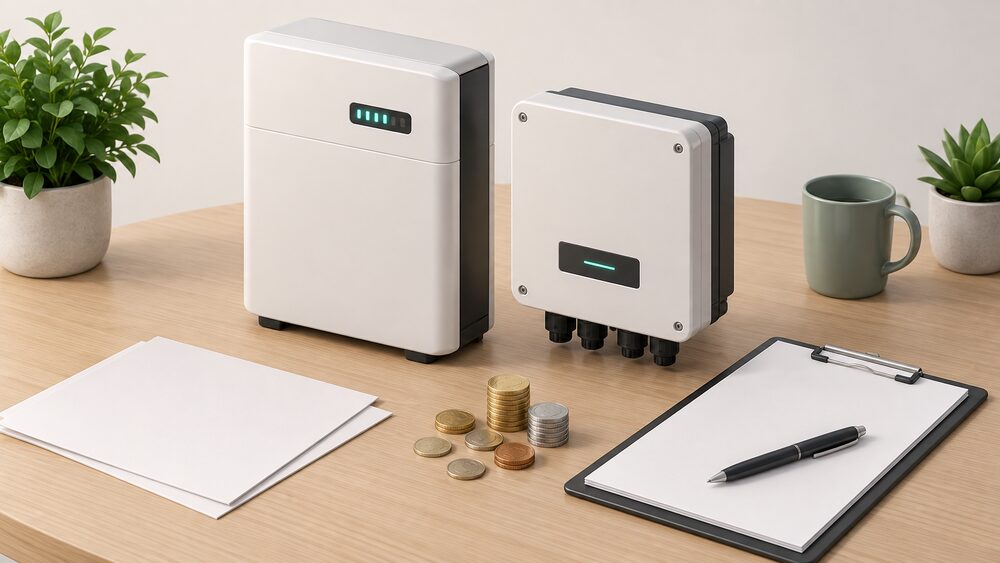
Home battery storage in the UK costs between £1,500 and £10,000, with a 5 kWh battery system at around £4,600 according to the Energy Saving Trust1. A Parliamentary briefing repeats that framing, putting storage costs at up to £10,000 depending on size, with a typical 5 kWh system around £4,6002. Those are whole-job figures: the battery, the electrical work to connect it and VAT where it applies.
Below that headline sit two different numbers that are often confused. Hardware alone is cheaper: research for ClimateXchange found 8 to 10 kWh batteries had a battery-only price of £2,800 to £4,500 and an installed price of £4,500 to £7,000 as at March 20263. Installation, in other words, adds something in the region of £1,700 to £2,500 to a mid-sized system. Independent consumer guidance agrees on the order of magnitude, describing buying and installing a battery as usually costing upwards of £2,0004, and putting the extra up-front cost of adding a battery to a solar job at up to £2,5445.
The financial case is tight rather than obvious. The Centre for Sustainable Energy reports payback periods in the region of 8 to 12 years, which is similar to a battery's reported lifespan6, and domestic battery storage has a lifetime of around 10 to 15 years2. A battery buys a household control over when it draws from the grid, not independence from it.
What the headline price covers, and what it leaves out
The official statistics on MCS domestic retrofit battery installations define the cost value recorded against each installation as including the cost of the battery, the cost of installing and connecting it to the electricity supply, and VAT where applicable8. That is the figure a householder actually pays, and it is the right basis for comparison.
Quoted prices diverge because different publishers measure different things. The Centre for Sustainable Energy and the Energy Saving Trust describe installed system costs. Manufacturers' own guides usually quote installed prices too, but for their own product tiers. Comparison sites quoting installer panels tend to sit lower: Uswitch gives £2,500 to £3,400 for a standard 5 kWh solar battery and £3,700 to £5,000 for a large 10 kWh battery, as at September 20269. An independent installers' association describes battery systems as typically starting from around £4,00010. A broader survey puts solar battery costs at £2,000 to £12,500, depending on capacity, chemistry and lifespan11.
Beyond capacity, the variables that move a quote are the inverter arrangement, whether the battery is AC or DC coupled to any existing solar, the difficulty of the installation, and whether backup equipment is fitted. Manufacturer guidance for the UK market describes a 10 kWh battery as costing £4,000 to £10,000 installed depending on brand, chemistry, inverter type and installation difficulty12. Where a price is not published, it is installer-quoted, and quotes for the same capacity can differ by thousands of pounds for reasons that have nothing to do with the cells.
Cost by size: 5 kWh, 10 kWh and large systems compared

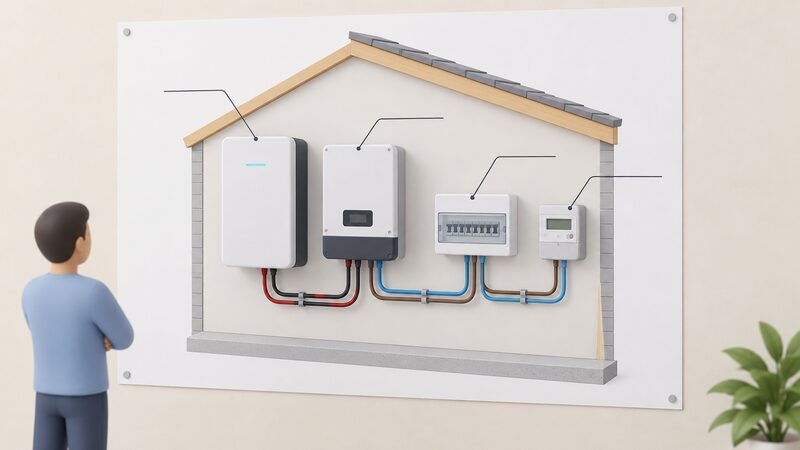
Price rises with capacity but not in proportion to it. Much of the fixed cost, the inverter, the electrical work, the paperwork and the labour, is the same whether the stack is 5 kWh or 10 kWh, so the cost per usable kWh falls as systems grow. That is visible in the range for storage fitted without solar, where a single battery of 5 kWh to 10 kWh costs between £3,000 and £7,000: doubling the capacity does not double the price13.
| Capacity | Source and basis | Price |
|---|---|---|
| 5 kWh | Energy Saving Trust, system cost1 | around £4,600 |
| 5 kWh | Uswitch installer estimates, Sept 20269 | £2,500 to £3,400 |
| 5 kWh | Modelled retrofit measure cost14 | £2,250 |
| 5 kWh | Maker guidance, installed, mid-202615 | £3,800 to £5,500 |
| 8 to 10 kWh | ClimateXchange, hardware only, March 20263 | £2,800 to £4,500 |
| 8 to 10 kWh | ClimateXchange, installed, March 20263 | £4,500 to £7,000 |
| 10 kWh | Uswitch installer estimates, Sept 20269 | £3,700 to £5,000 |
| 10 kWh | Modelled retrofit measure cost14 | £4,000 |
| 10 kWh | Maker guidance, installed12 | £6,000 to £8,000 |
| 10 to 13.5 kWh | Maker guidance16 | £8,000 to £11,000 |
| 13.5 kWh | Maker guidance, installed, mid-202615 | £8,500 to £10,500 |
| 15 kWh and above | Maker guidance, installed, mid-202615 | £9,500 to £13,500 and above |
The official and independent figures sit at the lower end of that table and the makers' figures at the upper end. Both are describing real transactions; the independent numbers generally reflect competitive installer quoting, while manufacturer tables tend to describe fuller systems including inverter and controls.
On sizing, common standalone home battery capacities sold in the UK run from 4 kWh to 13.5 kWh, with 5 to 8 kWh described as suiting average three to four bedroom homes16. A four to five bedroom house is matched with a 13 to 14 kWh battery alongside a 6 kW solar array, at £10,000 and above12. Further detail on matching capacity to evening demand is set out in what size home battery you need and in usable versus nominal capacity.
Installation costs: upwards of £2,000 on top of the battery
The gap between the hardware price and the installed price is the labour, the inverter or inverter upgrade, isolation and protection devices, cabling, commissioning, network notification and certification. ClimateXchange's paired figures imply that gap directly: £2,800 to £4,500 for an 8 to 10 kWh battery on its own, £4,500 to £7,000 once installed, as at March 20263.
Consumer guidance puts the same cost in different words. Which? describes buying and installing a battery as usually costing upwards of £2,0004. NICEIC gives the up-front cost of adding battery to a solar installation as up to £2,544 more5. Uswitch describes a battery as typically adding £2,500 to £5,000 to an installation17. Manufacturer guidance for fitting a 5 kWh battery at the same time as a solar installation gives about £2,000 to £4,000 added, and notes that a later retrofit can be £5,000 and above18.
That last point is the practical one. Fitting the battery during the solar installation shares scaffolding, isolation and the electrician's visit; fitting it later repeats them. The same logic applies to the inverter: an AC-coupled retrofit needs its own inverter, while a DC-coupled or hybrid arrangement designed in from the start does not. The difference is set out in AC-coupled and DC-coupled systems, and the sequence of a job in the installation process.
VAT: zero-rated in Great Britain now, 5% from April 2027

In Great Britain, a household currently pays a rate of 0% VAT on both certain energy-saving products supplied by the installer and the cost of all work to install those products in the home7. HMRC's guidance describes the available rates for energy-saving materials as either 5% or 0%7. The zero rate is what makes the installed prices above achievable; it applies to the whole job, not just the box.
That relief is time limited. The zero rate for energy-saving materials, including battery storage, is scheduled to end on 31 March 2027, with the rate reverting to 5% from 1 April 2027 unless the rules are extended or changed. A separate and unrelated measure introduces a temporary zero rate of VAT for qualifying supplies of domestic electricity in Great Britain from 1 October 2026 to 31 March 202719; ordinarily, VAT on domestic energy bills is charged at 5%20.
Northern Ireland applies a different test. Where the cost of the products, excluding VAT, is 60% or less of the total cost of the installation, excluding VAT, the reduced rate applies to the whole supply21. HMRC's guidance on the treatment where the products exceed that 60% threshold is not consistent across its pages, so the position on a product-heavy job in Northern Ireland should be confirmed before signing. The VAT position by nation is developed further in the VAT rate on home battery storage.
What a battery saves: £300 to £1,000 a year in most published estimates
Savings depend almost entirely on tariff and on how much electricity the household shifts. A battery charged at off-peak prices and discharged during peak hours, typically 4pm to 8pm, avoids the expensive units6. The Energy Saving Trust puts the mechanism plainly:
"You can store cheap electricity when prices are low and use it later, even during peak times. This can significantly inc..."
Published savings figures span a wide band. Manufacturer guidance describes a well-set-up battery system as typically saving a UK household £300 to £700 per year15, and a 10 kWh battery as saving around £300 to £900 per year, higher for homes with solar, EVs, heat pumps or smart time-of-use tariffs12. Independent figures for solar plus storage are higher because they include the solar generation: a medium-use household with a 10-panel system and a 5 kWh battery is calculated to save between £822 and £1,069 per year depending on tariff5, and adding a £2,500 solar battery is described as potentially increasing annual savings to £93211.
Standalone storage saves less. Annual savings for a UK home battery without solar are reported at £150 to £40023. The Centre for Sustainable Energy's worked example, with no solar PV installed and charging at 12p per kWh, gives an annual electricity cost of £4206.
One maker's claim that solar batteries can save an average household between £1,500 and £4,100 a year12 sits far outside every independent figure above and should be read against them.
Payback: 8 to 12 years against a 10 to 15 year lifespan
This is the heart of the decision. The Centre for Sustainable Energy gives payback periods in the region of 8 to 12 years, "which is similar to their reported lifespan", and its worked example finds that a £4,600 battery pays back in 9 years6. Domestic battery storage has a lifetime of around 10 to 15 years, shorter than solar panels2. The Energy Saving Trust puts typical lifespan at about 10 to 12 years1; an installers' association says systems last about ten years10.
Payback is arithmetic, so the sensitivity is easy to see. Manufacturer modelling gives 8.9 years for an £8,000 installed battery saving £900 a year, 10 years for a £10,000 battery saving £1,000 a year, 15 years for a £6,000 battery saving £400 a year, and 16 years for an £8,000 battery saving £500 a year12. A £2,000 swing in price or a £400 swing in annual saving moves payback by half a decade.
| Scenario | Payback | Source type |
|---|---|---|
| General domestic storage6 | 8 to 12 years | independent |
| £4,600 battery, time-of-use example6 | 9 years | independent |
| Battery-only install15 | 8 to 12 years | maker |
| Battery added to new solar15 | 5 to 8 years | maker |
| Standalone battery, realistic estimate23 | 10 to 15 years | maker |
| 10 kWh battery, range12 | 8 to 15 years | maker |
Shorter claims exist: one manufacturer table gives 3 to 6 years for a 10 kWh family-sized battery and 3 to 5 years for 15 kWh and above24. Those sit against every independent estimate and against the same publisher's own 8 to 15 year range elsewhere. Where payback and lifespan overlap, the household is betting on tariff spreads holding for a decade. The method installers must use to calculate the benefit is covered in MGD 003, and the arithmetic in more depth in battery savings and payback.
Standalone battery or solar add-on: which costs less
Fitting storage alongside a new solar array is the cheaper route per kWh installed, because the electrical work and inverter are shared. Adding roughly 3 kWh of storage to a 2 kW solar system is quoted at £1,800 to £2,500 extra; fitting a 5 kWh battery during the installation adds about £2,000 to £4,000, where a retrofit can be £5,000 and above18. Solar systems themselves, without battery, are quoted at £4,600 to £5,800 for 2 kW, £5,000 to £7,000 for 4 kW and £6,000 to £8,000 for 6 kW17, with battery storage adding around £5,000 to £8,000 according to the Energy Saving Trust25.
A standalone battery, with no solar at all, costs £3,000 to £7,000 for 5 to 10 kWh and £6,000 to £9,000 for 10 to 15 kWh23. It earns only the tariff spread between off-peak and peak units, which is why reported savings of £150 to £400 a year produce a 10 to 15 year payback on realistic assumptions23. Whether that works is entirely a function of the tariff, a subject taken further in batteries and smart tariffs and can a battery save money on Economy 7.
Independent bodies are blunt about the current position. The Centre for Sustainable Energy says battery systems "may save on imported electricity costs, but they're currently very expensive"26. The Centre for Alternative Technology observes that for a grid-connected house, storage "may not be worthwhile" at present, citing both cost and the environmental impacts of manufacture and disposal27. Domestic batteries use principally lithium, and also cobalt and nickel6.
MCS certification and what it affects
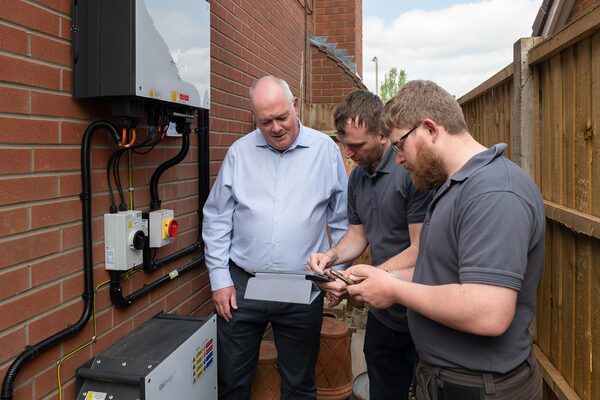
MCS is the certification scheme for installers of domestic renewable technologies including heat pumps, solar panels and batteries28. It is not optional if the household wants to be paid for what it exports: residential solar systems in the UK must be MCS accredited to be eligible for the Smart Export Guarantee29, and for batteries paid for exporting stored renewable energy, the installation must be MCS certified6. Most energy suppliers require a valid MCS certificate, though some may allow export on their own tariffs without one30.
MCS certification is also a requirement for accessing many UK government incentives, and gives access to consumer protections31. Under the Warm Homes: Social Housing Fund, domestic batteries must be installed by an MCS certified installer to the relevant MCS installation standard, MCS 3012, and carry UKCA or CE marking as required by the MCS Battery Installation Standard32. The Centre for Sustainable Energy's advice is simply to make sure the installer is MCS certified6.
The scheme also produces the only official picture of what people are paying. Statistics on MCS domestic retrofit battery installations cover the United Kingdom, include the battery, the installation and connection, and VAT where applicable, and exclude records where cost per kW was below £100 or above £5,0008. They are published as official statistics in development, so they indicate direction rather than a settled benchmark8.
Backup during a power cut: an extra cost, not a standard feature
A battery that is full does not automatically keep the lights on when the grid fails. Not all batteries can deliver electricity during a power cut6. Which? states that some, but not all, battery storage systems can be set up to provide electricity during a power cut, and they must be specifically set up to do so33. The network operator Electricity North West notes that in some cases storage devices can provide backup supplies in a power cut, "but this is not always possible", and advises checking with the installer34. The Centre for Sustainable Energy adds that it is the more expensive systems that can do it26.
Practically, backup means additional hardware and additional cost: a changeover arrangement and, usually, a separate protected circuit. The questions worth putting to an installer, per Which?, are whether the battery will work in a power outage and for how long4. Capacity sets that duration; one manufacturer states a fully charged 10 kWh battery can typically power a home for around 30 hours, less with heavier use12. The mechanics are covered in backup in a power cut: EPS and changeover and backup interfaces.
Backup also has a value that is not purely in avoided bills. Where a power cut is long, compensation is payable: for unplanned cuts affecting more than 5,000 homes, £100 if the power is off for longer than 24 hours, then £45 for every 12 hours after that, up to a maximum of £40035. That is a small sum against the cost of backup-capable storage, but it frames how rare and how short most outages are.
What a battery does and does not buy in independence terms
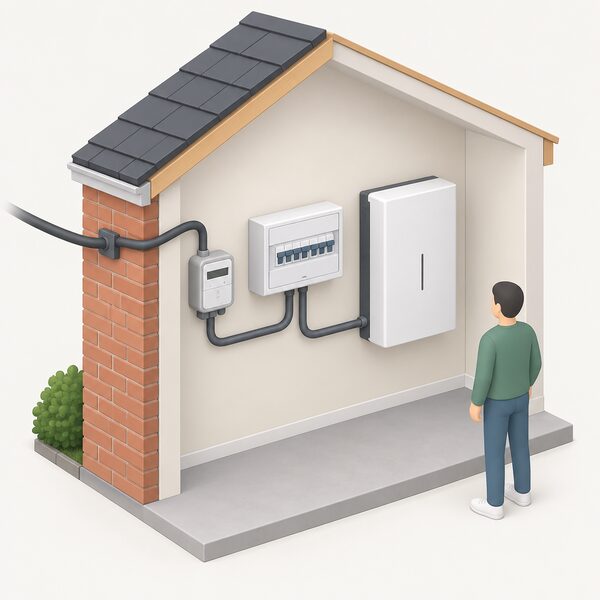
For the money, a household gets control over timing: the ability to buy electricity when it is cheap and use it when it is dear, and, on a solar system, to keep more of its own generation instead of exporting it. What remains is substantial. The grid connection stays, and so does the supplier relationship, because a standalone battery's entire return depends on a time-of-use tariff continuing to offer a wide spread. Export payments depend on MCS accreditation and on supplier terms29. Monitoring and tariff optimisation usually run through a manufacturer's app and cloud service, which is a dependence on a company remaining in business for the 10 to 15 year life of the asset2. And unless the system was specified and paid for with backup, a power cut still means a dark house6.
The cost question, then, is not only what the battery costs but what it is being asked to do. At £4,600 for 5 kWh1 with payback at 8 to 12 years against a 10 to 15 year life6, the margin for error is thin, and it narrows further if the zero VAT rate lapses in April 2027. The wider case is set out in home batteries and household energy independence and in the full guide to home battery storage.
Sources35 cited
- Battery storage advice, Energy Saving Trust, 2026-08-19
- Domestic battery storage briefing, UK Parliament POST, 2026-06-25
- Balancing investment in clean heat and energy efficiency in Scottish housing retrofit, ClimateXchange, 2026
- Solar panel battery storage, Which?, 2026-05-14
- Solar panel installation, maintenance and repair, NICEIC, 2026-09-17
- Battery storage advice, Centre for Sustainable Energy, 2025-10
- VAT on energy-saving products, GOV.UK, 2026-09-17
- MCS domestic retrofit battery installations statistics 2025 to 2026, GOV.UK, 2026-05-28
- Are solar panels worth it?, Uswitch, 2026-09-16
- Solar battery storage guide, Independent Installers Association, 2026-09-20
- Battery storage and solar panels, CPA, 2026-01-06
- 10 kW solar battery price in the UK, Jackery, 2026-06-04
- Store and save, Centre for Alternative Technology, 2022-10-27
- Clean heat: supporting low income households, Energy UK, 2026-06-11
- Solar battery cost, BLUETTI, 2026-08-03
- Home battery storage in the UK without solar, EcoFlow, 2025-06-24
- Solar panels, Uswitch, 2026-09-09
- Solar panels: are they worth it?, EcoFlow, 2025-07-23
- Temporary zero rate of VAT for domestic electricity in Great Britain, GOV.UK, 2026-10-01
- Understand your electricity and gas bills, Ofgem, 2026
- VAT on energy-saving materials, HMRC, 2026-09-20
- Should I switch to a time-of-use tariff?, Energy Saving Trust, 2026-01-23
- Home battery storage in the UK without solar, Jackery, 2026-05-29
- Are solar batteries worth it?, Jackery, 2026-06-04
- Solar panels advice, Energy Saving Trust, 2026-08-27
- Making the most of your solar PV panels, Centre for Sustainable Energy, 2026-08
- Solar photovoltaic information, Centre for Alternative Technology, 2026-03-10
- Financing low carbon home heating, Which?, 2025-09
- Solar energy, Solar Energy UK, 2026-09-17
- Plug-in solar panels, Energy Saving Trust, 2026-09-17
- Why MCS certification matters, MCS, 2026-08-17
- Warm Homes: Social Housing Fund wave 3 guidance addendum, GOV.UK, 2026-06
- Should you get solar panels?, Which?, 2024-07-03
- Energy storage, Electricity North West, 2026-09-19
- Get compensation if you have a power cut, Citizens Advice, 2026-09-17
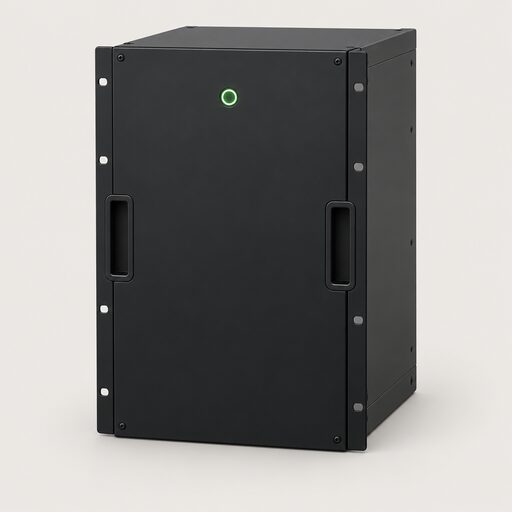 Home Battery ManufacturersWho makes the home batteries sold in the UK, and what does a battery bought direct from a UK brand actually cost and cover?
 Cost to Charge an EV at HomeHow home charging cost is worked out from battery size, efficiency, the unit rate paid and the tariff behind it, with full-charge costs of about £8 to £17, cost per mile, annual running costs and what changes for EV owners from April 2028.
 Home EV Charger CostA home charge point usually costs between seven hundred and fifteen hundred pounds fitted, with most people paying around a thousand.
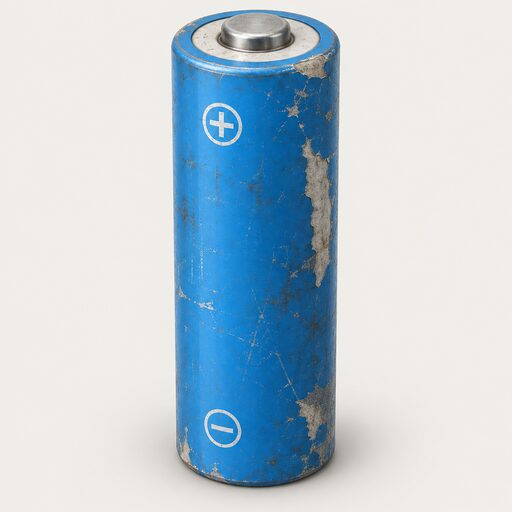 Cycle Life and DegradationHow long will a home battery actually last, and what decides that?
 Solar Panel CostsA typical UK home pays somewhere between four and eleven thousand pounds for solar panels fitted, with most landing in the middle.
 Portable Power Station CostHow much does a portable power station cost in the UK, and what does the money actually buy?