
In this guide
A home battery does not need a flue, an air brick or a dedicated supply of combustion air. It needs a location that keeps it inside the temperature window its maker specifies, and a building whose general ventilation already works. The two questions, whether a battery needs ventilation and what temperature it can operate at, are really one question about siting.
The regulatory backdrop is Approved Document F, which sets the ventilation standards for dwellings and supports Part F of Schedule 1 to the Building Regulations 20101. It is not written about batteries. It is written about air quality and condensation, and a battery installed in a dwelling has to live with whatever that document requires of the building. Alongside it sits PAS 63100:2024, the BSI specification for protecting electrical battery energy storage systems against fire when installed in dwellings, which covers installation location in respect of safety and external influences that affect fire safety2.
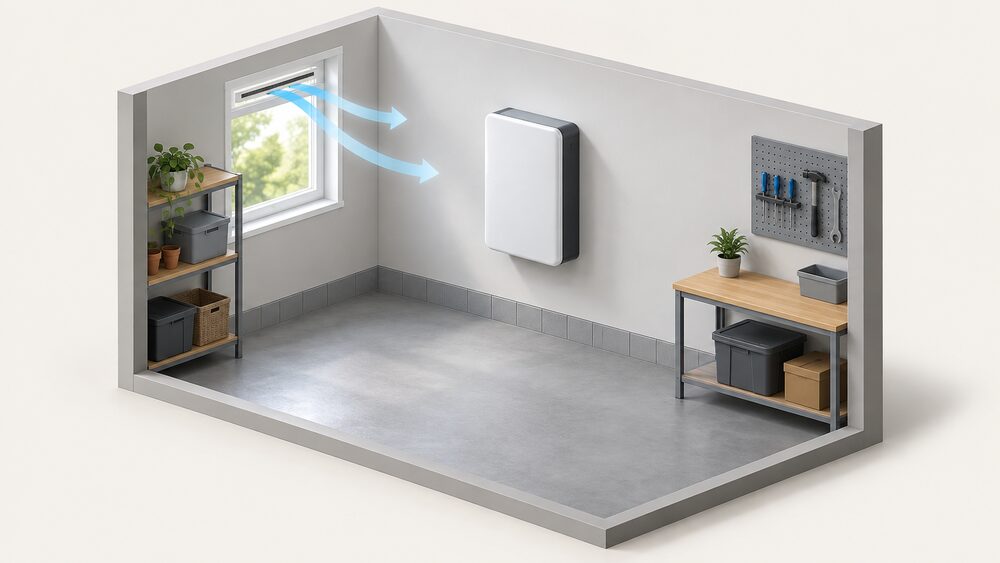
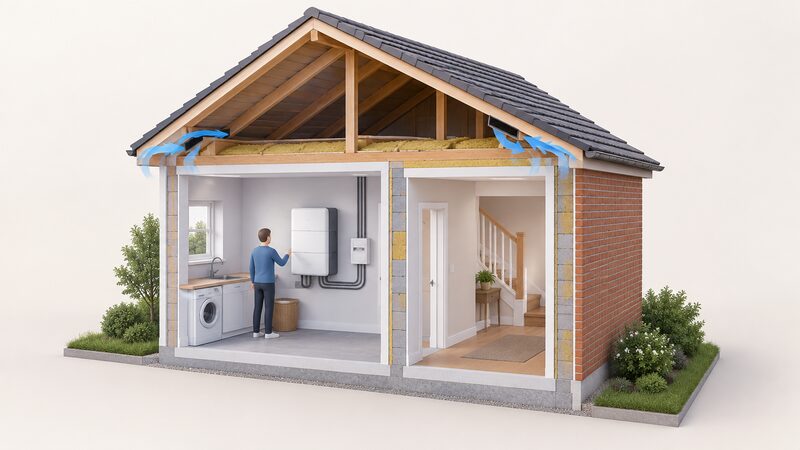
The practical answer is that lithium home batteries are sealed units with their own management electronics, and the ventilation that matters is the ventilation of the space they sit in, not of the battery itself. A garage, plant room or utility area that already meets the building's ventilation requirements is normally the kind of space an installer will consider. A sealed cupboard with no air movement is not.
What the ventilation rules actually require of a dwelling
Approved Document F: Volume 1 applies to dwellings and provides guidance on building ventilation, including building air quality and preventing condensation in a domestic structure1. Its requirements are stated in three parts: ventilation must be circulated continuously throughout the whole building, extract ventilation must be used within an area of increased humidity or pollution, and purge ventilation must be possible1. That is the baseline any room containing a battery inherits.
The document was published in December 2021, valid from 15 June 2022, and replaced the 2010 edition incorporating 2010 and 2013 amendments1. It sets standards for ventilation in new dwellings9. Volume 2 applies to buildings other than dwellings, so a battery in a domestic outbuilding that is not itself a dwelling falls outside Volume 1's scope10.
Where steam is produced, the rules are stricter. Rooms such as kitchens, bathrooms and utility rooms should be provided with higher levels of ventilation, normally mechanical fans and windows, than other rooms where suitably sized window openings and background trickle ventilators may suffice11. Independent guidance puts the same point plainly: in places where lots of moisture is produced, extractor fans are required to remove the excess moisture, and if there is no extractor fan, opening a window will help12.
The purpose of all this is to supply fresh air to the home and remove stale air, stopping the build-up of carbon dioxide and harmful pollutants such as radon12. A battery does not produce either. What it does produce is heat, and what it is sensitive to is moisture and temperature. A room that already meets Part F is a room with moving air and controlled humidity, which is the environment a battery wants.
Airtightness changes the calculation. More air-tight homes are more likely to need continuous and mechanically assisted ventilation, while a less complex system might be more suitable if the home is not very airtight12. A battery installed in a well-sealed modern home therefore sits in a space with designed ventilation rather than incidental draughts, and the installer's assessment of that space matters more, not less.
Temperature: the window the maker sets, not the regulator
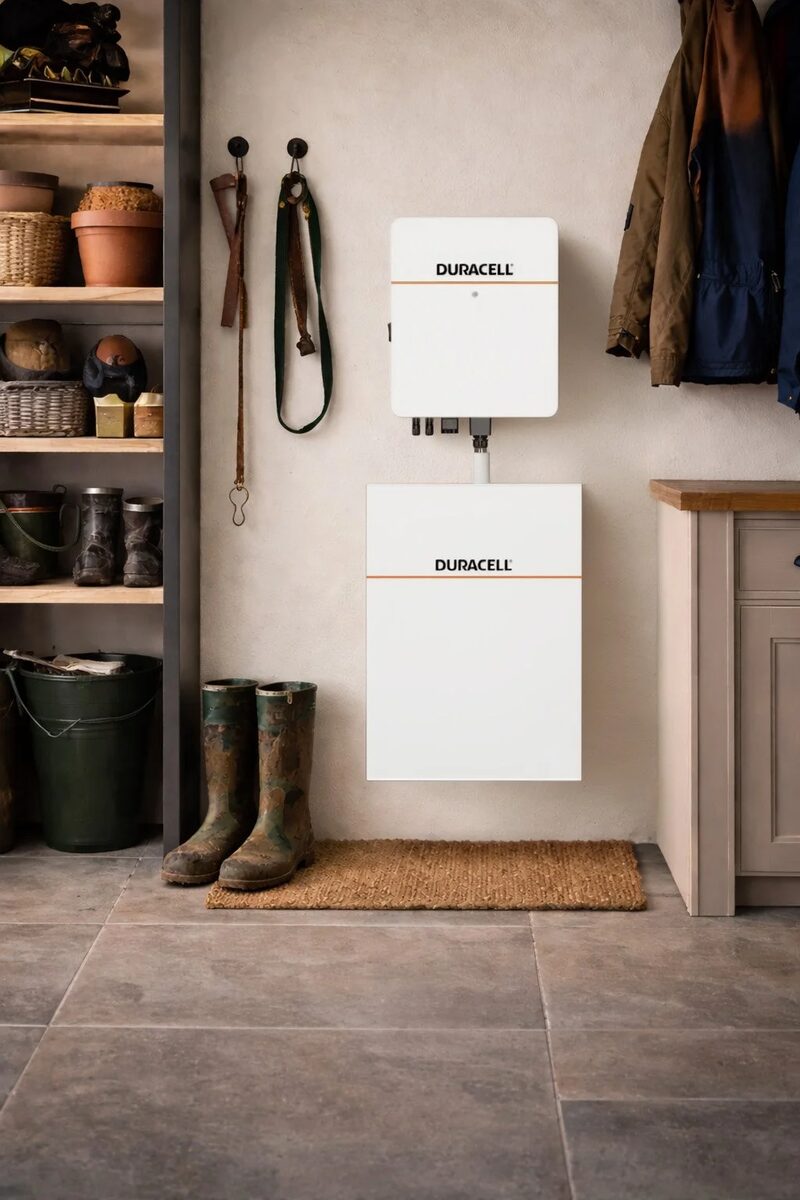
There is no statutory operating temperature for a home battery in the UK. The window comes from the manufacturer, and it varies by chemistry and by model. What the standards do is require the installer to think about it: PAS 63100:2024 covers installation location in respect of safety and external influences that affect fire safety, and external influences include temperature3.
The reason temperature dominates the subject is that lithium cells charge and discharge at different rates depending on how warm they are. Cold slows the chemistry, and most battery management systems restrict charging below a threshold while allowing discharge to continue. The visible symptom is a battery that appears to stop accepting charge on a cold morning while still running the house. That is the management system protecting the cells, not a fault.
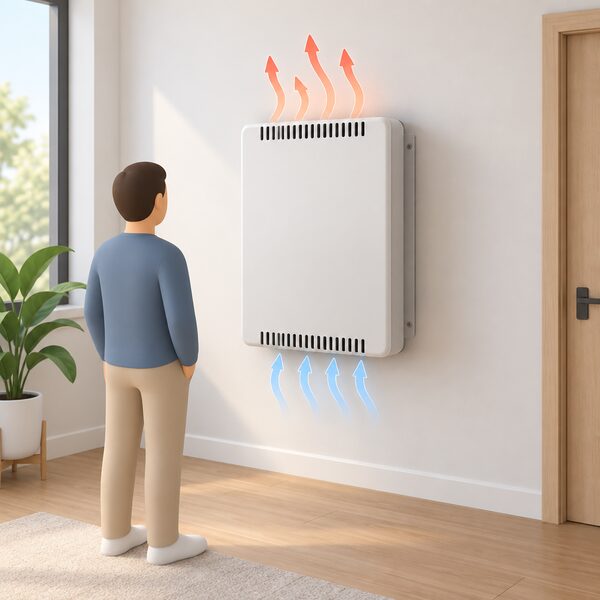
Heat is the other end of the window. A battery working hard in a warm space generates its own heat, and the enclosure has to let that escape. This is where ventilation and temperature stop being separate subjects: the air movement that Part F requires of a dwelling is also what stops a plant room becoming a heat trap in summer.
The standard's scope is specific. It provides the specification for protecting electrical battery energy storage systems against fire when installed in dwellings, covers requirements such as battery and fault management and installation locations, and is intended for suitably competent designers and installers of BESS that form part of electrical installations, for dwellings and similar simple electrical installations2. It excludes battery systems with nominal voltages on the AC or DC side exceeding low voltage as defined in BS 76713.
Cold weather, charge limiting and what a household sees
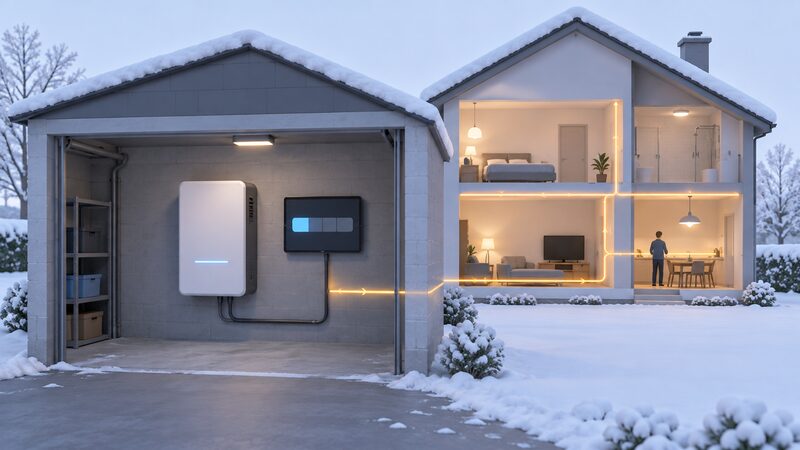
Cold-weather behaviour is the single most common reason a household notices the temperature question at all. A battery in an unheated garage, a detached outbuilding or a loft can sit below the maker's charging threshold for weeks in a British winter. Discharge continues, so the house still runs on stored power, but the unit will not refill until it warms.
The monitoring evidence shows how usage shifts with the seasons. Energy Systems Catapult's Living Lab, which ran alongside a baseline group of 230 homes with no low-carbon technologies including electric vehicles, heat pumps, solar PV and batteries, found that homes with batteries consistently show lower total daily grid consumption across three seasons, with winter energy consumption seeing an increase attributed to a suspected arbitrage pattern8. In other words, battery households draw more from the grid in winter, and the pattern suggests they are charging when it is cheap rather than when it is warm.
That behaviour interacts with temperature. A battery charged overnight on a cheap tariff is charging in the coldest part of the day, which is exactly when a cold-sited unit is most likely to be limited. Siting the battery inside the thermal envelope removes most of the problem, and it is one reason installers prefer an internal wall in a utility room or garage attached to the house over a detached structure.
"If your device or equipment is stored without being used for any length of time, the battery should be removed."
That instruction is written for consumer devices rather than fixed storage, but the underlying point holds: a lithium cell left unused for a long period is a cell nobody is watching. For a fixed home battery the equivalent discipline is the monitoring app and the annual service, not removal.
Humidity, storage and the moisture question
Humidity limits are the least discussed and most consequential part of siting. A battery is an electrical assembly in a sealed case, and while the case is rated for a degree of ingress protection, sustained damp is a different proposition from a splash. A garage that floods, a cellar that sweats or an outbuilding with a leaking roof are all poor locations regardless of what the maker's temperature range says.
The building regulations treat moisture as a ventilation problem, which is why the two subjects are linked. Rooms where steam is produced should be provided with higher levels of ventilation, normally mechanical fans and windows11. Landlord guidance in Wales goes further, requiring sufficient means of ventilation to cope with moisture from normal domestic activities without the need to open windows that could lead to heat loss, noise and security risks14. A battery installed in a rented property therefore sits in a space with designed moisture control.
For storage rather than operation, the position is simpler. A battery that is not being used should not be left in a damp, unheated space for a long period. The fire service guidance on lithium-ion devices in the home is explicit that a device stored without being used for any length of time should have its battery removed, and that charging should happen in a room with a working smoke alarm, away from any heat source, with the door closed and the escape route clear13.
The average UK household has many rechargeable items containing lithium-ion batteries, including laptops, mobile phones, e-scooters, e-cigarettes and mobility vehicles13. A fixed home battery is a larger version of the same chemistry, and the fire service's advice on siting and charging is written for the whole category.
Where a battery can sit: loft, garage, outbuilding
PAS 63100:2024 includes the location of battery storage products in a loft space, so the standard addresses loft installation directly5. That does not make a loft automatically suitable. A loft is the most thermally extreme space in most houses, hot in summer and cold in winter, and it is often the least ventilated. The standard's coverage of installation location in respect of safety and external influences is precisely the mechanism by which a loft is assessed rather than assumed3.
The regulatory standing of the standard matters for anyone expecting it to be enforced. PAS 63100 has no current standing in any UK regulations such as Building Regulations, and is not directly referenced in the Battery Storage Installation Standard MIS 30125. It is a specification that competent designers and installers follow, not a statutory instrument. That distinction is worth holding on to when a quotation claims compliance as if it were law.
Planning is a separate question from ventilation and temperature, and it differs by nation. In Scotland, planning permission is not required for domestic battery storage within a residential building, under permitted development rights15. For England, Wales and Northern Ireland the position is set out in each nation's planning rules, and a battery in a detached outbuilding is a different case from one inside the dwelling.
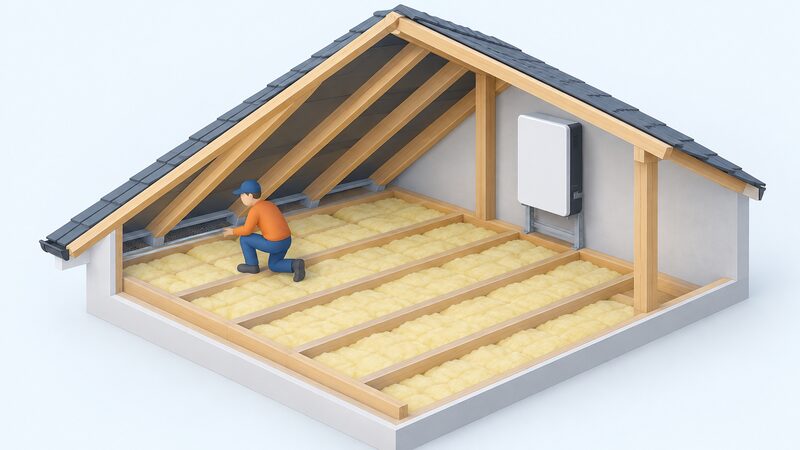
Where a conversion or a roof project is involved, the building regulations add their own ventilation conditions. A flat roof will need to be ventilated16. Care should be taken not to block any ventilation at the edges, at the eaves, when insulation is installed17. Building regulations need adequate ventilation when installing loft insulation, and the local building control office should be consulted18. A battery installed in a loft at the same time as insulation work has to satisfy both sets of requirements at once.
What the standards say, and what they do not
Three documents shape this subject, and none of them is a battery ventilation regulation.
Approved Document F: Volume 1 is the ventilation standard for dwellings, published December 2021 and valid from 15 June 2022, supporting Part F of Schedule 1 to the Building Regulations 20101. It applies to dwellings only, and Volume 2 covers buildings other than dwellings10. In a mixed-use development, Volume 1 applies to each individual dwelling and Volume 2 gives guidance for the non-dwelling parts19.
PAS 63100:2024 is the fire-safety specification for domestic battery storage, published 20 March 2024, covering battery and fault management, installation locations and more, and intended to increase the fire-safety of BESS installations2. It is current, and it is a fast-track standard rather than a full British Standard3.
Approved Document L: Volume 1 is the energy efficiency standard, and it applies to dwellings only, with Volume 2 covering non-domestic parts of mixed-use buildings and rooms for residential purposes20. The 2021 edition incorporating 2023 amendments gives guidance for existing dwellings in Sections 4, 5, 6, 10 and 11 for extensions to and work on existing dwellings21. The 2026 edition gives guidance for new dwellings in Sections 1 to 9 and for existing dwellings in Sections 3, 4, 5, 10, 11 and 1222.
| Document | Applies to | Key point for a battery installation |
|---|---|---|
| Approved Document F, Volume 1 | Dwellings1 | Continuous, extract and purge ventilation required1 |
| Approved Document F, Volume 2 | Buildings other than dwellings10 | Covers non-domestic parts of mixed-use buildings19 |
| PAS 63100:2024 | Domestic BESS2 | Installation location and external influences3 |
| Approved Document L, Volume 1 | Dwellings only20 | Energy efficiency of the building fabric21 |
The gap is that no document states a ventilation rate for a home battery. The requirement is indirect: the room must meet the building's ventilation standard, and the battery must sit within the maker's temperature window. Everything else is the installer's judgement under PAS 63100.
How the position differs across the UK nations
Ventilation and building standards are devolved, and the documents diverge.
In England, Approved Document F: Volume 1 applies to dwellings and is the current edition, with a 2026 publication running to 66 pages6. Approved Document L, Volume 1 applies to dwellings only21.
In Wales, Approved Document F: Volume 1 takes effect on 4 March 20277. The Welsh Government has also consulted on Approved Document L, Volume 1, with a consultation version published in 202523. The 2026 edition of Approved Document L, Volume 1 for Wales applies to dwellings only20. The 2022 edition of Approved Document F, Volume 1: Dwellings was approved with effect from 23 November 202224.
In Scotland, ventilation is covered by the Building Standards Technical Handbook 2022 (Domestic), which includes a specific rule for conservatories: a conservatory may be built over a ventilator if its ventilation is to outside air with an opening area of at least 1/30th of the total combined floor area, and the internal room ventilator has at least 1/30th of that room's floor area25. Planning permission is not required for domestic battery storage within a residential building in Scotland15.
In Northern Ireland, building regulations guidance is published by the Department for Communities, and the Warm Healthy Homes Fund consultation proposes that the installation of loft and cavity wall insulation, draught proofing and ventilation will be mandatory for all properties unless existing insulation and ventilation meet acceptable standards26. That is a consultation proposal, not current law.
| Nation | Ventilation document | Battery planning position |
|---|---|---|
| England | Approved Document F, Volume 1, 2026 publication6 | Set out in England's planning rules |
| Wales | Approved Document F, Volume 1, effective 4 March 20277 | Set out in Wales's planning rules |
| Scotland | Building Standards Technical Handbook 2022 (Domestic)25 | Not required within a residential building15 |
| Northern Ireland | Department for Communities guidance26 | Set out in Northern Ireland's planning rules |
The practical consequence is that a household in Scotland or Wales may be working to a different edition of the same document than a household in England, and an installer operating across a border has to check which applies. The temperature and humidity requirements, by contrast, come from the maker and do not vary by nation.
What this means for a household's energy independence
A battery's contribution to independence is real but conditional. Batteries are a way for homeowners to store excess electricity produced from their solar system, and they enable power produced during the day to be stored and used at another time, for example in the evening when demand is higher27. The combined potential of millions of homes with batteries to help balance supply and demand across the country, releasing stored power onto the grid when needed, is a system-level benefit that sits alongside the household one27.
The dependence that remains is the grid, a supplier and the manufacturer. A battery does not generate anything. It shifts when electricity is drawn, and it can store renewable electricity generated from other technologies including wind turbines28. It cannot make a home self-sufficient on its own, and the temperature window is one of the reasons: a unit that is charge-limited in cold weather is a unit that cannot take full advantage of a cheap overnight tariff.
The conditions under which a battery is most worthwhile are stated by independent guidance as wanting backup power, not having full-retail export rates, or being able to access cheap overnight charging tariffs29. Two of those three depend on the battery working when the household wants it to, which brings the siting question back to the centre.
"Battery storage - Householder's use of solar generated electricity is maximised by battery storage."
The Welsh Government's Cosmeston Farm development describes every highly energy efficient home as powered by photovoltaic panels and batteries31. That is the model: generation, storage and a building fabric that keeps the storage within its operating window. The ventilation and temperature requirements are not an obstacle to that model. They are part of how it is delivered.
For a household weighing up a battery, the honest position is that the unit reduces dependence on timing, on tariffs and on the grid's peaks, and increases dependence on a manufacturer's management system, an app and a warranty. The home battery storage guide sets out the wider picture, and the siting decision is one of the first things an installer will assess.
Sources31 cited
- Approved Document F, Volume 1: Dwellings, Planning Portal, December 2021
- PAS 63100: Protection against fire of battery energy storage systems, BSI, 2026
- PAS 63100:2024 specification, BSI, 20 March 2024
- Domestic battery storage, Parliamentary Office of Science and Technology, 25 June 2026
- Update on PAS 63100 and IET Code of Practice, MCS Certified, 9 May 2024
- Approved Document F, 2026, GOV.UK, 24 March 2026
- Approved Document F: Ventilation (Wales), Welsh Government, 4 March 2027
- Grid impacts of heat pumps, EVs and solar revealed, Energy Systems Catapult, 18 August 2025
- Approved Document F, Volume 1: Dwellings frequently asked questions, GOV.UK, 15 June 2022
- Approved Document F: previous editions, Planning Portal, 17 September 2026
- Doors and windows: building regulations, Planning Portal, 2026
- Ventilation advice, Centre for Sustainable Energy, July 2025
- Lithium-ion batteries safety guidance, North Wales Fire and Rescue Service, 2026
- Fitness for human habitation guidance for landlords, Welsh Government, 13 January 2022
- Extending permitted development rights in Scotland, Scottish Government, November 2019
- Building regulations: roof and conversion projects, Welsh Government, 17 September 2026
- Extensions: building regulations energy efficiency, Planning Portal, 2026
- Loft insulation ventilation, nidirect, 2 September 2026
- Building Regulations Part L and F review stage 2a: Approved Document F, Welsh Government, November 2020
- Building Regulations Approved Document L, Volume 1 (Wales), Welsh Government, April 2026
- Approved Document L, Volume 1: Dwellings, 2021 edition incorporating 2023 amendments, GOV.UK, 2021
- Approved Document L, Volume 1: Dwellings, GOV.UK, 2026
- Approved Document L, Volume 1 consultation version, Welsh Government, August 2025
- Building Regulations etc (Amendment) (Wales) Regulations 2022, Welsh Government, 24 May 2022
- Building Standards Technical Handbook 2022: Standard 3.14 Ventilation, Scottish Government, 1 June 2022
- Warm Healthy Homes Fund consultation, Department for Communities, May 2026
- Batteries in the home, Solar Energy UK, 17 September 2026
- Solar battery storage guide: is a home battery worth it?, Independent Energy Advisers Association, 20 September 2026
- Solar panel battery popularity is booming, Which?, 2019
- Building for 2050: low cost, low carbon homes, GOV.UK, 5 December 2022
- UK's largest net zero housing development to be delivered in Wales, Welsh Government, 2 October 2025
 Siting and LocationWhere can a home battery actually go?
 Home Battery Fire SafetyHow likely is a home battery to catch fire, and what keeps it safe if it does?
 Batteries by Home TypeLooks at how house type, occupancy pattern, electrical supply and available space change what storage can achieve, from flats and terraces to rural and off-grid properties.
 Home Ventilation SystemsWhy do modern insulated homes need extra ventilation, and what happens if they do not get it?
 Planning Permission in EnglandWhen a domestic battery or its enclosure falls within permitted development in England, when an application is needed, and how the position differs for outbuildings, listed buildings and conservation areas.
 Modular and Stackable BatteriesCan you buy a small home battery now and add more storage later?