In this guide
A virtual power plant is a network of home batteries, electric vehicles and other flexible devices that a grid operator or supplier can call on as though it were a single power station. For a household, joining one means letting an aggregator or supplier dispatch the battery at agreed times in return for payment. The UK's national scheme for this is the Demand Flexibility Service, launched in winter 2022/23 and run by NESO, which pays homes and businesses for shifting electricity use away from peak periods1.
The scale is already substantial. Tesla reports 2.4 GW of total capacity and 230,152 homes participating across its virtual power plant programmes, which operate in California, Texas, Massachusetts, Australia and the UK2. The Demand Flexibility Service alone incentivised 1.6 million households and businesses in winter 2022/23, saving over 3.3GWh of electricity, and delivered 3.9GWh of flexibility across 44 events between December 2024 and March 20251.
What a household gives up is control of when the battery discharges, within limits the provider sets. What it keeps, in Tesla's terms, is control of its backup reserves, payment for each kilowatt-hour supplied, and the ability to opt out at any time2. The sections below set out how the schemes work, what they pay, who can join, and where the limits lie.
What a virtual power plant is, and how a home battery fits in
A virtual power plant connects distributed devices into one dispatchable block. Tesla describes its own version as connecting Powerwalls worldwide to provide sustainable power to communities, support electric grids when demand is high, and help households earn money for excess energy from their batteries2. The household unit is a domestic battery: an electrochemical battery installed to be used in conjunction with solar PV panels in residential buildings, in the wording of the Warm Homes Social Housing Fund guidance5.
The mechanism is straightforward. A battery stores electricity when it is cheap or when the sun is shining, and releases it when the grid is under strain or prices are high. Tesla's platform prepares enrolled Powerwall units to send energy to the grid when a grid operator declares an emergency, updating those actions every few seconds2. The household is paid for the energy it supplies, and in retail-integrated programmes also benefits from dynamic tariffs that optimise when devices charge or discharge2.
For energy independence, the picture is mixed and worth stating plainly. A battery in a virtual power plant still depends on the grid to export into, on a supplier or aggregator to enrol with, and on a manufacturer's cloud platform to dispatch it. It does not make a home self-sufficient. What it does is convert a battery from a device that only saves money on a household's own bill into one that earns from the wider system, which improves the economics of buying storage in the first place. The dependence on the manufacturer's app and servers is real: Tesla's own application route is through the Tesla App, and the dispatch logic sits with Tesla rather than the household2.
The Demand Flexibility Service: how the UK's main scheme works
The Demand Flexibility Service is the national framework for paying households to shift electricity use. NESO states its purpose is to make it easier for homes and businesses to take part in the electricity market and be rewarded for shifting when they use electricity1. It was designed to help manage potential winter pressures by reducing demand during evening peak periods and reducing reliance on more expensive electricity generation, and launched in winter 2022/231.
The scheme has been through several revisions. From 9 April 2026 it introduced a reduced eligibility threshold of 0.1MW, bi-directional flexibility, zonal procurement, Primacy, and a Self-Nominated Baseline option1. From 7 October 2026 it will launch the capability to procure constraint management actions, and participants will be able to take part in both margin and system tagged actions1. Those changes matter to households because bi-directional flexibility is what allows a battery to be paid for exporting as well as for reducing import, and zonal procurement means payments can differ by region.
The service uses several energy saving events throughout the year7. It started in late 2022 and encouraged people to lower their energy use during peak times over the winter months7. Electrical Safety First describes it as a scheme developed by National Grid ESO under which energy suppliers are able to financially reward customers if they run appliances during off peak hours, typically overnight8.
The results so far are documented. The winter 2024/2025 overview report covers the period from 27 November 2024 to 28 March 20251. Across events to date at the time of the cited news article, the service delivered a reduction of almost 800 megawatt hours, with some companies earning up to £8,0001. For a household, the relevant point is that the scheme is national infrastructure, not a trial, and it has been through four winters of operation.
Rewards and earnings: what shifting demand is actually worth
Payments depend heavily on how much load a household can move and what heating and transport it runs. The Centre for Sustainable Energy publishes per-event figures that show the spread clearly.
| Household type | Shift a quarter of load | Shift half | Shift three quarters | Shift almost all |
|---|---|---|---|---|
| Gas heating, single occupant | £0.25 | £0.49 | £0.74 | £0.94 |
| Gas heating, 2 adults and 2+ children | £0.62 | £1.23 | £1.85 | Not given |
| Electric heating or EV charged at peak | £0.81 | £1.61 | £2.42 | £3.06 |
All figures are per event3. The pattern is that a home with electric heating or an electric car has far more to shift, and therefore earns several times what a gas-heated home can. A single occupant with gas heating shifting a quarter of their load earns £0.25 for an event; the same household with electric heating or an EV earns £0.813.
FlexAssure gives a worked example of accumulated rewards: +£8.40 in a month9. That is a household-level illustration rather than a guarantee, and it sits within the range the per-event figures imply across a handful of events.
The honest reading is that flexibility payments are a modest supplement, not a substitute for the savings a battery makes on a household's own bill. A battery that shifts a home's own consumption off peak saves money every day; an event payment arrives only when the grid operator calls one. The two stack, and the battery is what makes the event payment possible without the household changing its routine. Households wanting to understand the tariff side of that stack should read stacking a home battery with smart and time-of-use tariffs.
Eligibility: smart meters, suppliers and where you live
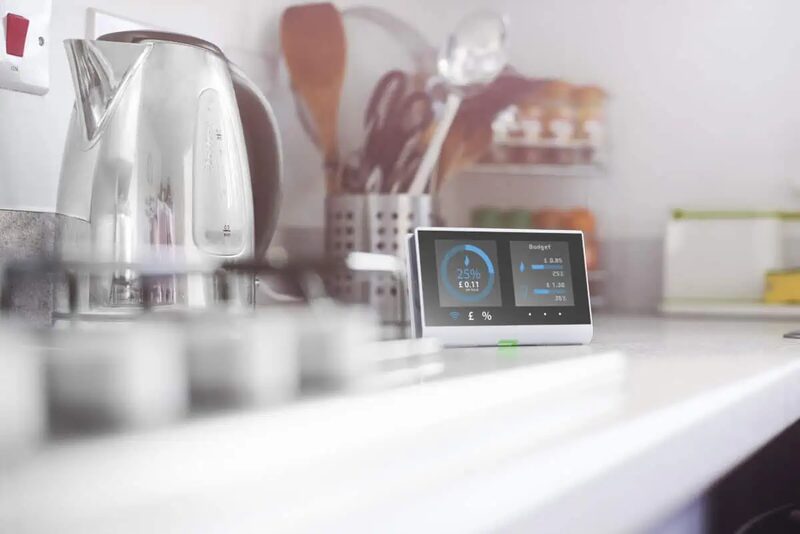
Three conditions govern access to the Demand Flexibility Service. A household must live or have a business in England, Scotland or Wales; get energy from a registered supplier or third-party app; and have a working smart meter7. All three must be met.
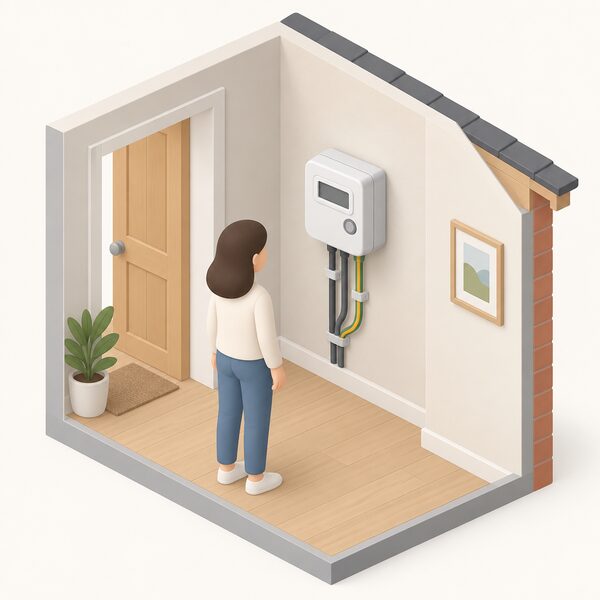
The smart meter requirement is the practical barrier for some homes. Smart meters are installed by energy suppliers at no extra cost4, and the rollout target is for all UK households to have been offered one by the end of 20304. Without half-hourly data there is no way to verify a shift, which is why the meter is not optional.
Northern Ireland sits outside the scheme. The service covers England, Scotland and Wales only7. Households in Northern Ireland have their own network operator and support arrangements, and the national flexibility scheme and its event payments are not available there. That is a genuine gap in coverage rather than a detail.
For battery installations, the Warm Homes Social Housing Fund guidance requires that a domestic battery is installed where there is a functioning electricity smart meter, or installed alongside one if one is not present in the property already5. That is a funding condition rather than a flexibility rule, but it points the same way: metering comes first.
Supplier participation is the second gate. Not every supplier is registered to take part, and the household's route in is through one that is7. The Energy UK Vulnerability Commitment, whose 15 signatories supply energy to more than 95% of UK homes, is a separate arrangement about customer service rather than flexibility, but it indicates how concentrated the supplier market is10. In practice a household's choice of flexibility provider is constrained by who its supplier is or which aggregator will work with its hardware.
How events work: notification, timing and the baseline calculation
An event is a window in which the grid operator asks participants to reduce import or increase export. The service uses several energy saving events throughout the year7. Suppliers and aggregators notify participants ahead of each one, and the notice period is set by the provider rather than by a single national rule.
The baseline is the counterfactual against which a household's reduction is measured: what the home would have used had the event not been called. NESO introduced a Self-Nominated Baseline option from 9 April 2026, which allows participants to nominate their own reference consumption rather than relying solely on a calculated one1. That matters for households with unusual or highly variable patterns, including those with a battery that already shifts load automatically.
Timing is concentrated in the evening peak, because that is when the system is under strain. The scheme was designed to reduce demand during evening peak periods and reduce reliance on more expensive generation1. Electrical Safety First notes that suppliers can reward customers for running appliances during off peak hours, typically overnight8. The two halves fit together: the household defers the appliance to overnight, and the battery covers the evening.
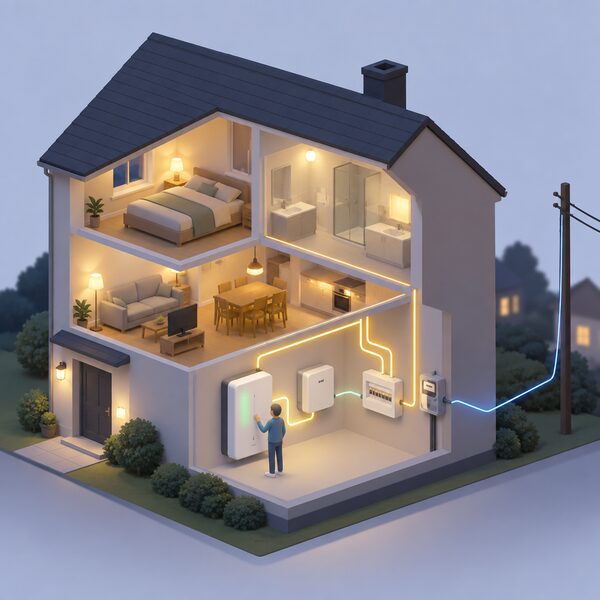
For a household with storage, the practical sequence is that the battery discharges into the home during the event window, the household's import from the grid falls, and the measured reduction is what gets paid. Tesla's platform updates its dispatch actions every few seconds during a grid emergency2. A household that wants to understand what its battery can carry through an outage rather than an event should read battery backup in a power cut.
Tesla Virtual Power Plants: 2.4 GW across 230,152 homes
Tesla operates the largest named virtual power plant network of those with published figures, at 230,152 homes and 2.4 GW of total capacity2.
| Metric | Figure |
|---|---|
| Total capacity | 2.4 GW |
| Total homes participating | 230,152 |
| Programmes supported | 104 |
| Operating regions named | California, Texas, Massachusetts, Australia and the UK |
All figures are Tesla's own, as of 17 September 20262. Tesla states that homeowners keep control of their backup reserves, are paid for each kilowatt-hour supplied, and can opt out at any time2. Customers earn payments for participation and daily savings on electricity bills2.
The compensation model varies. In performance-based models, payouts are determined by the actual level of support provided; in fixed-fee models, the data confirms ongoing eligibility2. That distinction matters to a household deciding whether to enrol: a performance model rewards a battery that can actually deliver during an event, while a fixed-fee model pays for availability.
Eligibility is not uniform. Eligible Powerwall owners in regions where Tesla Virtual Power Plants are currently active can apply to join through the Tesla App, and Tesla states that program details, including eligibility, vary by programme2. A UK household therefore cannot assume the terms that apply in California apply to it.
The dependence to note is that dispatch sits with Tesla. When a grid operator declares an emergency, Tesla automatically prepares enrolled Powerwall units to send energy to the grid2. The household is not making that decision event by event. That is the trade: less control, in exchange for payments and daily bill savings. Households weighing the hardware itself should read Tesla Powerwall 3 and Tesla home batteries.
Joining through a supplier, aggregator or app
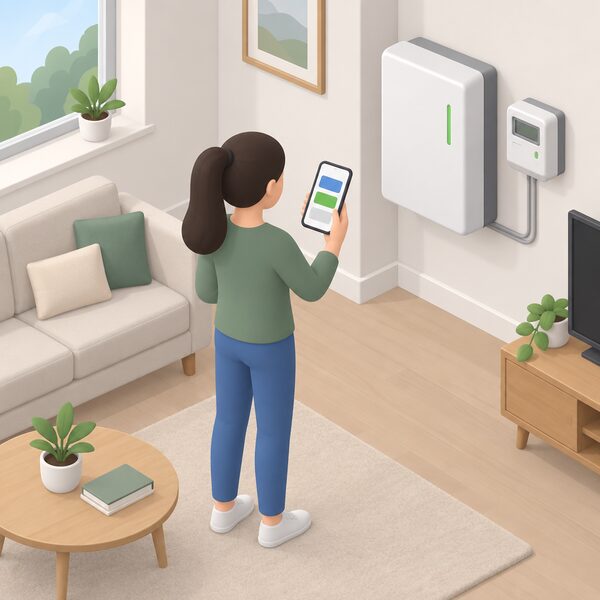
There are three routes into flexibility payments, and they differ in who holds the relationship.
The first is through an energy supplier registered to take part in the Demand Flexibility Service7. The household stays with its existing supplier and receives event notifications and payments through it. This is the simplest route and requires no new hardware beyond the smart meter.
The second is through a third-party app or aggregator, which the eligibility rules explicitly allow7. An aggregator pools many homes and bids the combined flexibility into the scheme. This is the route that makes a home battery useful to the grid even when the household's own supplier is not registered.
The third is through a manufacturer's own platform. Tesla's route is the Tesla App, open to eligible Powerwall owners in active regions2. Enphase's AC Battery is available in the UK via UK installers11, and Tesla Powerwall is available direct from Tesla11. The manufacturer route ties dispatch to one brand's hardware and cloud.
The Energy Storage Association (UK) is working with industry, industry partners, manufacturers and the Department for Energy Security and Net Zero to help develop an evidence-based framework for the safe deployment of plug-in battery energy storage systems in UK homes12. That framework is under development, which means the rules for plug-in storage participating in grid services are not yet settled.
Why flexibility matters: the savings behind the Smart Systems and Flexibility Plan
The case for flexibility is a system-level one, and the numbers behind it are large. Ofgem's case study on vehicle-to-grid charging states that if 50% of the UK's EVs were V2G enabled, they could provide around 16GW of daily flexible capacity to the grid by 203013. That is a projection, not a measurement, and it depends on a technology that is not yet widely available.
The Contracts for Difference scheme is the UK Government's main mechanism for supporting new low-carbon electricity generation projects in Great Britain14. Flexibility reduces the amount of generation capacity that has to be built to meet peak demand, which is why the government treats demand-side response as part of the same picture as generation support.
The Feed-in Tariff scheme's costs are spread across all licensed electricity suppliers in Great Britain through the levelisation process, based on their share of the electricity supply market15. That is a reminder that support schemes for small-scale generation have historically been funded through supplier obligations, and flexibility schemes are structured differently: they pay for a service rather than subsidising an installation.
The Smart Export Guarantee supports solar PV, wind, micro-combined heat and power, hydropower and anaerobic digestion, up to 5 megawatts in capacity, or up to 50 kW for micro-CHP, with installations located in Great Britain16. It is the export-side counterpart to flexibility: one pays for generating, the other for timing.
For a household, the significance is that flexibility payments are a second revenue stream on top of export payments and bill savings. A battery can earn from all three. Households wanting the full picture of how those streams combine should read home battery savings and payback and home batteries and household energy independence.
Where home batteries change the picture: automation and bi-directional flexibility
A battery changes flexibility from something a household has to remember into something that happens on its own. That is the central difference between a home that shifts appliances manually and one that lets software dispatch storage.
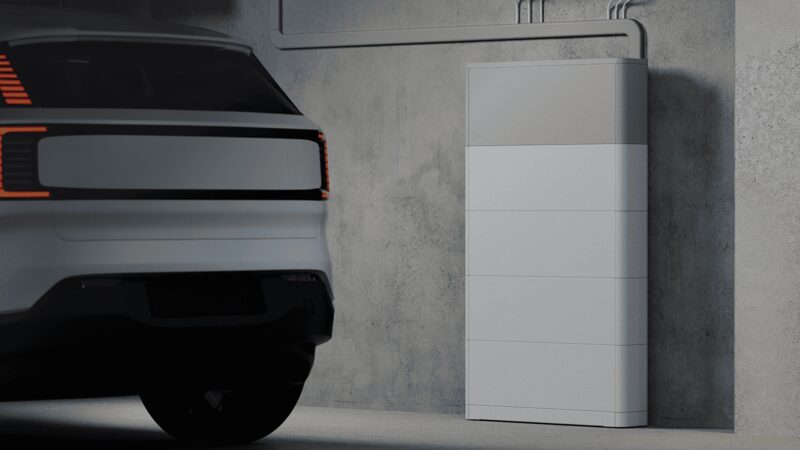
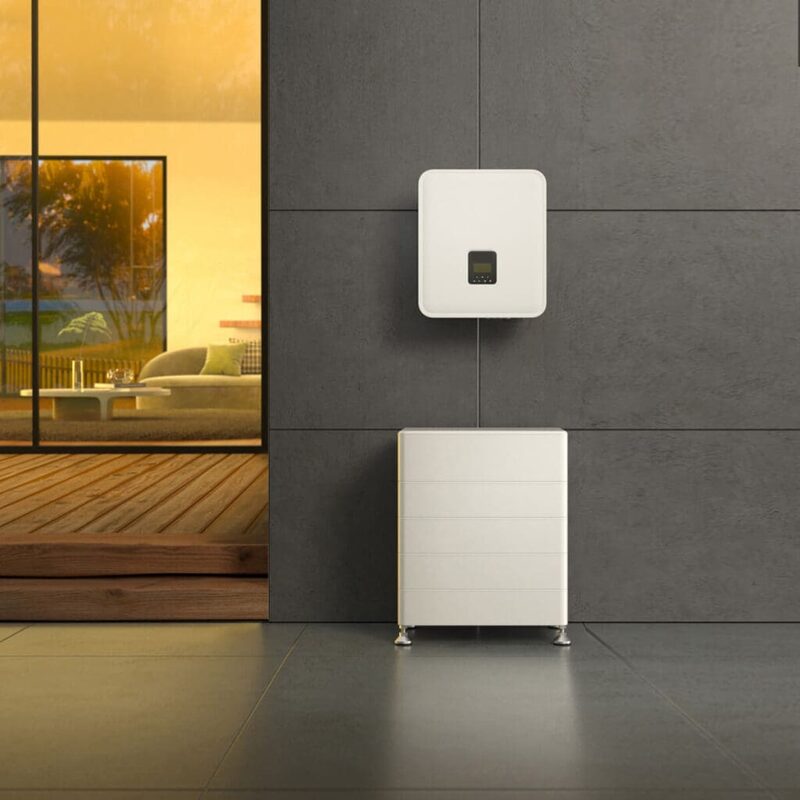
The physical setup is unremarkable. A battery can be installed in garages, on external walls or utility rooms, depending on which one you choose6. If you have battery storage, you can store excess electricity from wind turbines and solar panels to use later6. A household with an EV and a battery typically charges both at night on a cheaper off-peak tariff17.
Bi-directional flexibility is the newer capability. NESO introduced it to the Demand Flexibility Service from 9 April 20261, which means a battery can be paid for exporting during an event rather than only for reducing import. That is a meaningful change for storage owners, because a full battery has nothing to gain from reducing import but plenty to gain from discharging to the grid.
Vehicle-to-grid is the adjacent technology, and it is not yet a household option. Energy Saving Trust states that generally you cannot use your EV as a battery, and that bidirectional charging is being trialled in some places but is not widely available6. Ofgem's projection of around 16GW of daily flexible capacity from V2G-enabled EVs by 2030 is therefore a modelled figure rather than a description of what a household can buy today13.
The safety context is worth keeping in view. The average UK household has many rechargeable items containing lithium ion batteries, such as laptops, mobile phones, e-scooters, e-cigarettes and mobility vehicles18. A home battery is a larger version of the same chemistry, installed permanently and cycled by software. Households should read home battery fire safety and battery ventilation and temperature before enrolling in a scheme that increases cycling.
The UK battery fleet in numbers
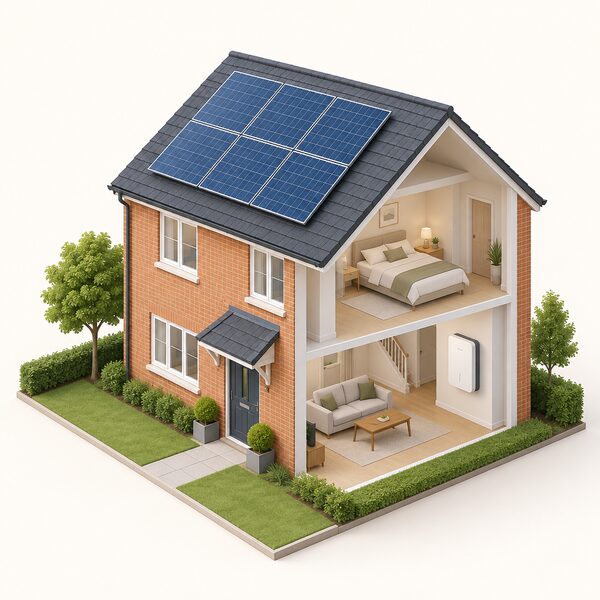
The installed base that flexibility schemes draw on is growing but still modest relative to the housing stock. MCS domestic battery installation statistics record 1,202 installations in February 2024, with 1,192 in the sample and 9,670 kWh of total capacity in that sample19. Those are monthly figures from the early part of the market's growth.
Solar installation numbers give the wider context. Domestic solar installations recorded 697,538 detached houses in the UK as of April 202620. The gap between solar installations and battery installations is the headroom that flexibility schemes are trying to close.
New-build development is adding storage as standard in some places. The Cosmeston Farm development in Wales is described as having every highly energy efficient home powered by photovoltaic panels and batteries21. That is a single scheme rather than a national trend, but it shows storage being specified at the point of construction rather than retrofitted.
The Energy Storage Association (UK) is working with industry, industry partners, manufacturers and the Department for Energy Security and Net Zero on a framework for safe deployment of plug-in battery energy storage systems in UK homes12. Plug-in storage would lower the barrier to entry considerably, since it avoids a full installation, but the framework is still under development and the rules are not settled.
For a household, the practical implication is that flexibility payments are available now to homes with a smart meter and a registered supplier, and become more valuable with a battery. The fleet is small enough that early participants are in a favourable position, and large enough that the schemes are no longer experimental.
Sources21 cited
- Demand Flexibility Service, NESO, 2026-09-17
- Tesla Virtual Power Plant, Tesla, 2026-09-17
- How much could you earn from the Demand Flexibility Service?, Centre for Sustainable Energy, 2026-06-22
- Do you have to have a smart meter by law?, Smart DCC, 2026
- Warm Homes Social Housing Fund wave 3 scheme guidance addendum, Department for Energy Security and Net Zero, 2026-06
- Battery storage, Energy Saving Trust, 2026-08-19
- Demand Flexibility Service, Energy Saving Trust, 2026-05-21
- Demand Flexibility Service: running appliances at cheaper times, Electrical Safety First, 2026-09-19
- What is flexibility?, FlexAssure, 2026-09-19
- Bring down bills, Energy UK, 2026-07-27
- Solar panel battery storage, Which?, 2026-05-14
- Plug-in battery, Energy Storage Association (UK), 2026-08-27
- Case study: UK electric vehicle grid V2G charging, Ofgem, 2030
- UK Solar Roadmap, Department for Energy Security and Net Zero, 2025-06
- Feed-in Tariffs, Ofgem, 2026
- The Smart Export Guarantee, House of Commons Library, 2026-05-13
- Beth Martin story: solar panels and electric vehicle, Energy Saving Trust, 2025-03-03
- Lithium-ion batteries, North Wales Fire and Rescue Service, 2026
- MCS domestic retrofit battery installations 2025 to 2026, MCS, 2024-02
- POST note: domestic solar installations, Parliamentary Office of Science and Technology, 2026
- UK's largest net zero housing development to be delivered in Wales, Welsh Government, 2025-10-02
 Flexibility Payments for HomesCan you really get paid for using less electricity at peak times, and how much would a household actually earn?
 Home Battery WarrantiesHow long does a home battery warranty really last, and what does it actually promise?
 Suppliers and IndependenceCan you really cut your energy bills by making your own power, and how much of your supplier do you still need?
 Charging and Energy IndependenceCharging an electric car at home can cut your fuel costs, but how much does it really free you from the grid?
 Payback and SavingsHow long until a home battery pays for itself, and why do quoted payback times vary so much?
 EV Batteries and DegradationDoes fast charging really wear an electric car battery out, and does keeping it between certain levels make it last longer?