
In this guide
The National Energy System Operator (NESO) is the whole system planner, the operator of the electricity system and expert advisor to government and Ofgem1. It was established in October 2024 and is responsible for running Great Britain's electricity grid in real time, planning future generation and storage, and reforming the connections queue1.
NESO's remit extends well beyond keeping the lights on. It produces the Strategic Spatial Energy Plan, which sets out future generation and storage needs, and assesses the resilience of the energy system2. It has planned a connections reform that will deprioritise almost 500GW of projects in the oversubscribed connections queue1. It also manages flexibility markets and has set a target to secure an additional 750MW of non-domestic flexibility in its services and markets by 20303.
For households, NESO matters because its costs feed into electricity bills. Constraint payments, which compensate generators for being curtailed when the network cannot carry their output, were over £1 billion and were set to rise to £2 billion in the mid-2020s4. NESO does not sell electricity to consumers; that is done by the electricity retailers whose name appears on your bill5. But the charges it levies on the industry are ultimately recovered from billpayers.
What NESO does: running the grid in real time
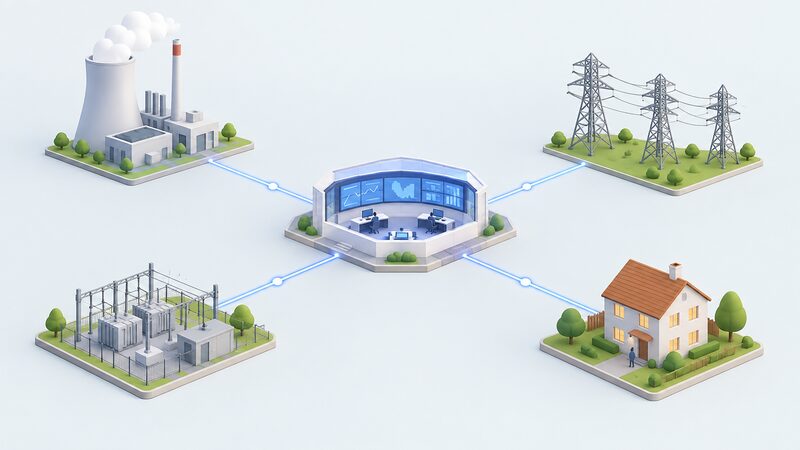
NESO operates the electricity system for Great Britain, balancing supply and demand second by second. Its role is defined in official guidance as the whole system planner, the operator of the electricity system and expert advisor to government and Ofgem1. That combination gives it a wider remit than a traditional system operator: it does not simply keep the grid stable, it also shapes what the grid will need to become.
The real-time operation is the foundation. NESO works with those who developed the Open Banking system to ensure that an open electricity system can work in real-time whilst keeping everyone safe6. That work points to a future in which distributed assets, from home batteries to electric vehicle chargers, can participate in grid operations without compromising security.
NESO also has a national coordination role. It will establish a GB-wide National Steering Committee including representatives from NESO, government and Ofgem1. That committee is intended to align the many bodies involved in planning and operating the energy system, from transmission owners to distribution networks.
The Operational Transparency Forum, held on 15 July 2026, is part of this transparency work. It presented the year-ahead constraint cost forecast and discussed network outages and demand data3. For an operator whose decisions affect bills, publishing that material is a way of being held to account.
What this means for a household is indirect but real. A grid that is run securely keeps supply reliable. A grid that is planned well keeps future costs lower. NESO sits at the centre of both, but it does not control the price a household pays or the fuel a household uses.
The Strategic Spatial Energy Plan: planning future generation and storage
The Strategic Spatial Energy Plan (SSEP) is NESO's long-range blueprint for Great Britain's electricity infrastructure. On 20 October 2024, the UK, Scottish and Welsh governments jointly commissioned NESO to produce it7. The first iteration covers infrastructure for electricity generation and storage8. Its location will be at zonal level as opposed to specific sites8.
The plan is intended to drive transmission networks in the medium to long term9. That matters because transmission investment takes years, and a plan that identifies where generation and storage should go can reduce the risk of building networks that are later stranded or inadequate.
The SSEP sits alongside Regional Energy Strategic Plans (RESPs). NESO is expected to establish regional strategic boards to steer and oversee plan development and sign off RESPs where a clear majority position can be reached1. It will also work with relevant local actors to develop an in-development register of early-stage projects within each region1. Strategic planning through the RESPs will guide both DNO investment plans and Ofgem's decisions1.
The timetable is set out in official guidance. NESO plans to consult on the draft SSEP in early 2027, with the final plan aimed for publication in autumn 2027 subject to government endorsement4. NESO has already consulted on a draft methodology for the SSEP, which closed on 20 January7. It will set out its approach to consumer-led flexibility in its RESP methodology, due to be published in Summer 20263.
For a household, the SSEP is the mechanism that determines whether the grid can carry the electricity that heat pumps, electric vehicles and new industry will demand. A plan that underbuilds means constraints and higher costs. A plan that overbuilds means unnecessary expense. The zonal approach is a compromise: it gives direction without dictating individual sites.
Grid connections: the Gate 2 process and accelerated projects
The connections queue is one of NESO's most consequential responsibilities. Ofgem approved NESO's 'first ready, first connected' connections reform proposals on 15 April 20258. The reform will deprioritise almost 500GW of projects in the oversubscribed connections queue1. That figure is far larger than the capacity Britain will need for decades, and it reflects a queue that had become a barrier in its own right.
NESO has also changed its approval process for new grid connections in a bid to curtail stalled projects in the connection queue4. In September 2026 it identified three projects needing acceleration to meet Clean Power 2030 and eight further projects where acceleration would reduce constraint costs4.
The Gate 2 process is the next stage for interconnectors. NESO will issue updated connection offers to Gate 2 interconnectors by Q3 2026 (phase 1) and Q4 2026 (phase 2)3. That timetable matters for cross-border electricity trading, which affects both security of supply and price.
Wales has its own interest in connection times. The Welsh Government has recommended working with DNOs and the development community to better understand grid net capacity requirements to meet Net Zero 2050 targets and the impacts of connection delay times by region8. That recommendation reflects a wider concern that connection delays are not evenly distributed and can hold back regional generation.
For a household, connection reform is about whether new generation and storage can be built in time to serve the grid. A queue that takes a decade to clear delays everything downstream, including the renewable capacity that reduces reliance on gas.
Constraint costs: the £12.7bn a year problem and how new network cuts it

Constraint payments are the cost of a grid that cannot carry all the power that generators want to produce. Current costs for constraint payments are over £1 billion and were set to rise to £2 billion in the mid-2020s4. The figure reflects the gap between where generation is built and where the network can deliver it.
The longer-term prize from better planning is large. The Electricity Networks Strategic Framework estimates a £40-50 billion system cost reduction to 2050, with £10-20 billion saved from lower distribution network reinforcement and £30 billion from lower generation and storage capital costs10. That is a modelled figure, not a guarantee, but it shows the scale of the opportunity.
Constraint costs are not the only network cost. Distribution Network Operators did not perform well against the Interruptions Incentive Scheme in 2023-24, incurring a total penalty of £29.7 million10. That penalty is a signal that reliability matters and that regulators will act when it slips.
The Committee on Climate Change has framed the wider cost picture. Losses in a Net Zero system are valued at £30 billion per year, compared to £60 billion a year in today's energy system11. In Northern Ireland, the net costs of Net Zero are estimated at around 0.2% of GDP per year on average12.
For a household, constraint costs are a component of bills that no individual action can avoid. They are a system cost, and they fall on all consumers. The way to reduce them is to build the network in the right places, which is what the SSEP and connections reform are intended to do.
| Cost or target | Figure | Source |
|---|---|---|
| Constraint payments, mid-2020s | over £1 billion, set to rise to £2 billion | 4 |
| System cost reduction to 2050 | £40-50 billion | 10 |
| DNO penalty, 2023-24 | £29.7 million | 10 |
| Net Zero system losses | £30 billion per year | 11 |
| Northern Ireland Net Zero cost | around 0.2% of GDP per year | 12 |
Flexibility and reactive power markets for households and small energy users
NESO's flexibility work is where households and small energy users can engage most directly. NESO has published a target to secure an additional 750MW of non-domestic flexibility in its services and markets by 20303. That target is for non-domestic participants, but the market design affects domestic flexibility too.
NESO will remove key barriers to enable Wider Access participants, Virtual Lead Parties and suppliers to join by Q3 20273. It will also set out the future direction for the Local Constraints Market and Demand Flexibility Service by the end of 20263. It will publish skip rate figures for consumer-led flexibility behind thermal constraints by Q3 20263. And it will complete an impact assessment of previously delivered load response actions to determine next steps by October 20263.
On reactive power, NESO published an open letter to industry in July 2026 stating it would not allow Distributed Energy Resources and DNO/DSOs to participate in Reactive Power Markets, with the decision kept under review3. An industry Q&A call was scheduled for 22 July 20263. NESO will develop a Market Navigator Tool in 20273.
The Renewable Energy Consumer Code sets out the standards applicable to the selling or leasing of small-scale heat and power generators, whether from renewable or other low carbon sources, to domestic consumers13. That code is relevant to households considering generation or storage that might later participate in flexibility markets.
Ofgem will report on the findings of its review into the DSOs' use of flexibility in ED2 and will share its findings by Autumn 20263. That review will shape how much of the flexibility market is open to smaller participants.
For a household, the direction is towards more participation, but the timelines are long. The 750MW target is for non-domestic flexibility, and the Wider Access changes are not due until 2027. Domestic participation in NESO's markets remains indirect for now, largely through suppliers and aggregators.
Ofgem oversight and the end-scheme assessment

NESO operates under Ofgem's oversight. Ofgem published its end-scheme assessment of NESO's BP3 performance on 2 September 20263. That assessment is part of the regulatory cycle that holds NESO to account for its performance against the targets set for it.
The oversight extends to specific areas. Ofgem will report on the findings of its review into the DSOs' use of flexibility in ED2 by Autumn 20263. It has also undertaken a review of the regulatory arrangements governing iDNOs by the end of 2025, including considering alignment with other DNOs8.
Ofgem's role as regulator is separate from its role as scheme administrator for other energy programmes. It administers ECO4 on behalf of DESNZ14, and it runs the Central FIT Register and the Renewable Electricity Register, publishes reports and data, processes ROO-FIT applications, manages fuelling and sustainability requirements for AD installations, runs the levelisation process, and ensures suppliers comply with the FIT scheme requirements15. Those functions are distinct from its oversight of NESO, but they show the breadth of Ofgem's remit.
The Department for Energy Security and Net Zero sets the overall policy for the ECO scheme14, while Ofgem administers it14. That split between policy and administration is similar to the relationship between government and NESO: government sets direction, NESO operates, Ofgem regulates.
For a household, Ofgem's oversight of NESO is a form of accountability. The end-scheme assessment is a public document. The flexibility review will shape how much households can benefit from grid services. But the oversight does not change the fundamental position: NESO is a monopoly operator, and its costs are recovered from consumers.
What NESO means for household energy independence
NESO is a system operator, not a supplier. It does not sell electricity to consumers; that is done by the electricity retailers whose name appears on your bill5. A household cannot choose NESO, switch to NESO, or buy anything from NESO. What a household can do is understand how NESO's decisions affect the grid that serves it.
The dependence NESO represents is structural. A household connected to the grid depends on NESO to balance supply and demand in real time. That dependence is unavoidable for anyone using the grid, and it is the foundation of reliable supply. The alternative, full disconnection, is a different proposition entirely.
There are programmes that support households in reducing their energy use. The Northern Ireland Sustainable Energy Programme is an energy efficiency programme for domestic and non-domestic customers16. It is administered by Energy Saving Trust on behalf of the Utility Regulator17. NI Energy Advice offers independent and impartial energy advice to domestic householders in Northern Ireland, plus referrals to energy grants and other sources of help18. The energy company obligation scheme, known as ECO, helps to make homes more energy efficient by installing improvements, free of charge to eligible households14.
For a household in Great Britain, the practical position is that NESO's planning and connections work determines the future cost and carbon intensity of the electricity supply. A grid that is planned well and connected efficiently supports lower bills and greater security. A grid that is constrained supports neither. The household's own independence comes from reducing demand, generating where possible, and using flexibility when it is available, but the grid remains the backbone.
"NESO is the whole system planner, the operator of the electricity system and expert advisor to government and Ofgem"
Sources18 cited
- Electricity Distribution Networks Study: Government Response, GOV.UK, 2025
- Well-Adapted Energy System Monitoring Framework, Climate Change Committee, 2026
- Clean Flexibility Roadmap: July 2026 Update, GOV.UK, 2026
- Accelerating to Net Zero: Government Response to CCC Progress Report, GOV.UK, 2025
- What to Do in a Power Cut, Met Office, 2026
- What is Consumer-Led Flexibility and What It Means for Your Home and Business, Low Carbon Hub, 2025
- Tackling Fuel Poverty in Scotland: Periodic Report 2021-2024, Scottish Government, 2025
- Preparing Wales for a Renewable Energy 2050, Welsh Government, 2024
- Annex: Welsh Government Response to Recommendations, Welsh Government, 2024
- Consumer Consent Solution Impact Assessment, Ofgem, 2026
- Cost of Net Zero by 2050 Less Than a Single Fossil Fuel Price Shock, Climate Change Committee, 2026
- Northern Ireland's Fourth Carbon Budget, Climate Change Committee, 2025
- Renewable Energy Consumer Code, Trading Standards, 2026
- Energy Company Obligation: Homeowners and Tenants, Ofgem, 2026
- Feed-in Tariffs, Ofgem, 2026
- 2024/2025 Annual Report: Northern Ireland Sustainable Energy Programme Published, Utility Regulator, 2026
- NISEP List of Schemes 2026-27, Utility Regulator, 2026
- Insulation, nidirect, 2026