
In this comparison
NESO and National Grid are two separate organisations that share one history. The National Energy System Operator, NESO, was established in October 2024 and manages the entire system: it is the whole system planner, the operator of the electricity system and expert adviser to government and Ofgem1. National Grid remains a network owner and operator, owning and operating the electricity transmission network in England and Wales2. The confusion arises because the system operator role was once carried out inside National Grid under the name National Grid ESO, and much household guidance still carries the old wording.
For a household, the practical split is simple. NESO does not connect directly to homes or other domestic properties3. The company a household actually deals with when the power fails, when a connection is needed or when a supply is upgraded is the local distribution network operator, which owns and operates the distribution network of towers and cables that bring electricity from the national transmission network to homes and businesses4. Network operators are different from the energy supplier, which is the company a household pays to use electricity5.
The distinction matters most in an emergency. The system operator can legally instruct distribution network operators to disconnect power supplies, and the duration of any such disconnection is determined by the system operator rather than the local network6. Everything below sets out who does what, what the network costs add to a bill, and where a household's own independence begins and ends.
NESO and National Grid: two different jobs, one old name
The name National Grid ESO stands for Electricity System Operator, and that body was responsible for ensuring there was enough power to meet demand6. It could instruct regional network operators to reduce demand through emergency power cuts11. That role has since moved into NESO, which was established in October 2024 and now acts as the whole system planner, the operator of the electricity system and expert adviser to government and Ofgem1.
National Grid's remaining role is ownership and operation of infrastructure. In England and Wales, the electricity transmission network is owned and operated by National Grid2. The transmission network in England and Wales is operated by National Grid, while the distribution network that reaches individual streets is run by separate distribution network operators12. Gas transmission is a further piece: it is owned and operated by National Grid Gas13.
The two jobs are genuinely different in kind. One balances a live system second by second and advises government on what the system will need in 2030 and 2040. The other owns steel, wire and substations and maintains them. A household reading an outlook document, a connections notice or a power cut page will meet both names, often in the same paragraph, and the old ESO wording still appears in guidance published after the change.
| NESO | National Grid | |
|---|---|---|
| Role | Whole system planner, electricity system operator, adviser to government and Ofgem1 | Network owner and operator2 |
| Electricity transmission | Does not own it | Owns and operates it in England and Wales2 |
| Gas transmission | Not its role | Owned and operated by National Grid Gas13 |
| Domestic connections | Does not connect directly to homes3 | Distribution arm serves the Midlands, South West England and South Wales12 |
| Emergency instruction | Can instruct network operators to disconnect supply6 | Carries out the instruction locally7 |
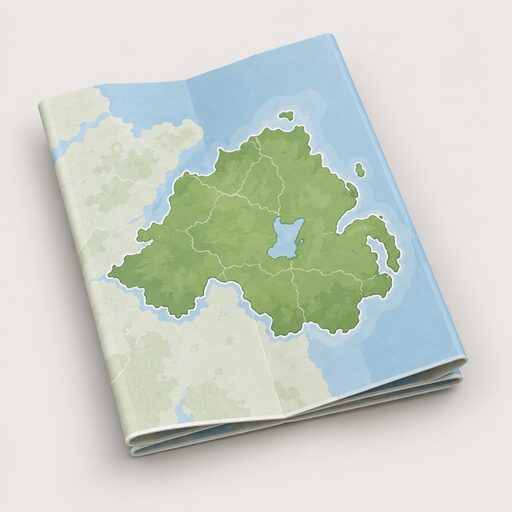
Northern Ireland sits outside this structure. There, a single distribution network operator, Northern Ireland Electricity, is regulated as the sole DNO, and NIE Networks transports electricity to over 910,000 customers including homes, businesses and farms14. The Great Britain split between NESO and National Grid does not describe the Northern Ireland arrangement.
What NESO does as the independent system operator
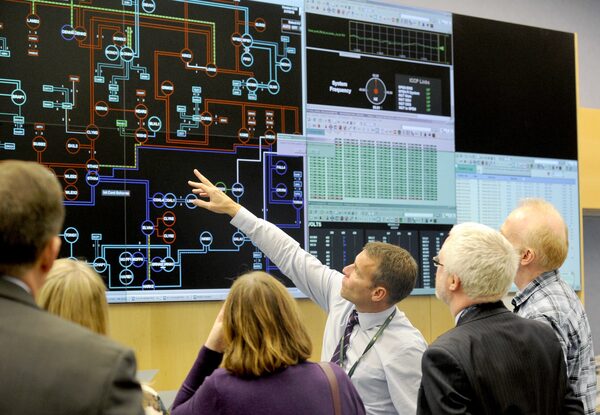
NESO's formal description is the whole system planner, the operator of the electricity system and expert advisor to government and Ofgem1. In practice that covers three strands: running the system day to day, planning what the system needs over decades, and coordinating demand flexibility nationally through its Power Responsive programme15.
The planning strand is where households will feel the effects most. NESO's whole-system advisory role includes producing a Strategic Spatial Energy Plan, which sets out future generation and storage needs, and assessing the resilience of the energy system16. That plan was jointly commissioned on 20 October 2024 by the UK, Scottish and Welsh governments17. NESO plans to consult on the draft in early 2027 and aims to publish the final plan in autumn 2027, subject to government endorsement. A separate methodology for the clean flexibility element of Regional Energy Strategic Plans is due in summer 202618.
The flexibility strand reaches into homes directly. Flex Assure lists the regional distribution system operators who manage local electricity networks, and NESO's Power Responsive programme, among its supporters15. Household demand flexibility is the mechanism by which appliances and electric vehicle charging are moved away from peak periods, and it is coordinated at national level by NESO rather than by any supplier.
NESO also holds the connections reform agenda. It has planned a connections reform, and the reform proposals will deprioritise almost 500GW of projects in the oversubscribed connections queue1. That queue is the reason a new large connection can wait years, and it is the single clearest example of NESO's decisions shaping what individual properties and businesses can do.
What National Grid does as network owner and operator
National Grid owns and operates the electricity transmission network in England and Wales2. It is also the distributor for customers in the Midlands, South West England and South Wales, across a 55,300 square kilometre service area, and it operates 185,000 substations12. Those three regions are served by National Grid Electricity Distribution, the former Western Power areas.
The company's role extends into gas measurement as well as wires. Every day, National Grid measures the calorific value of gas in each local distribution zone and helps energy suppliers calculate an average for a bill period2. That is a billing function rather than a supply function, but it explains why National Grid's name appears on gas documentation for households that buy gas from an unrelated supplier.
National Grid also runs the customer-facing side of network operation. Its published remit covers how to contact it, registering for priority services, power cut advice, planned interruptions, home visits and access, complaints, and the Safety and Security of Supplies Enquiry Service statement20. It aims to respond to every request within 24 hours or sooner, and it maintains a 24-hour contact number where customers can speak to a manager who can resolve customer issues20. It holds Action on Hearing Loss (formerly RNID) 'Louder than Words' deaf accreditation20.
The workforce side is substantial. National Grid predicts 400,000 people are needed by 2050 to deliver the UK's decarbonisation goals, and 800 more apprentices are being recruited this year13. That figure is a company projection rather than an official statistic, and it is included here as the company's own estimate.
Balancing the grid: frequency, demand peaks and constraint costs
Balancing is the system operator's core task, and the steps taken before any emergency instruction are set out in network guidance. They include encouraging additional generation through the supply market, asking heavy industrial users to limit their demand during peak periods, and reducing domestic power demand, including paying customers to change appliance use or reducing voltage across the country by a small percentage21. A parallel account lists encouraging additional generation, asking heavy industrial users to limit demand, paying customers to shift appliance use, and reducing voltage across the country by a small indiscernible percentage11.
The pre-emergency sequence runs in this order:
- Encourage additional generation through the supply market21.
- Ask heavy industrial users to limit demand during peak periods21.
- Pay customers to shift appliance use away from the peak11.
- Reduce voltage across the country by a small, indiscernible percentage11.
The voltage reduction step is the one households notice least and should understand best. It is described as small and indiscernible, which is why it is used before anything more disruptive. Paying customers to shift appliance use is the demand flexibility mechanism in its emergency form, and it has been used before: in winter 2022 the system operator offered discounted bills for customers to shift electricity usage outside peak hours, and put two coal power stations in the UK on stand-by to help manage demand22.
The cost of balancing badly is now a live policy question. The National Audit Office warned in September 2026 that consumers face rising energy bills without urgent electricity grid upgrades, and that constraint costs could rise substantially by 2030. NESO identified three projects needing acceleration to meet Clean Power 2030 and eight further projects where acceleration would reduce constraint costs, and it changed the approval process for connecting new facilities in a bid to curtail stalled projects in the connection queue.
Grid connections: from 40-50 applications a year to about 400
The connections queue is the clearest measure of how far the network has fallen behind demand. NESO's reform proposals will deprioritise almost 500GW of projects in the oversubscribed connections queue1. NESO has planned a connections reform, and it has changed the approval process for connecting new facilities in a bid to curtail stalled projects19.
For households, the relevant route is different. NESO does not connect directly to homes or other domestic properties3. Domestic connections, upgrades and metering arrangements run through the distribution network operator for the area, and the operator for a given postcode can be found through the industry's network operator search4. In Northern Ireland, NIE Networks connects approximately 9,000 customers a year to the electricity network14.
The scale of the queue has a knock-on effect on what a household can install. National Grid has suggested that installing a third wire on current lines, consisting of two wires on wooden poles, would significantly increase the capacity of the existing network to meet requests for solar, wind and EV charge points and heat pump connections23. It also proposed removing the 25% volume limit for increases in the size of electricity installations, while retaining the height limitation, and removing the requirement for prior approval for certain works including portable relay rooms and substation assets23. Those are proposals in a Welsh Government consultation summary, not settled rules.
Upgrading the network: costs, delays and what they mean for bills

Network costs are defined as the costs to build, fix and repair pipes and wires to move energy24. They are not the cost of the energy itself, and they appear on every bill regardless of supplier. Some £63 has been added to bills since 2021 as a result of rising network charges8.
The delay side is where the pressure sits. The National Audit Office warned in September 2026 that consumers face rising energy bills without urgent electricity grid upgrades, and that constraint costs could rise substantially by 2030. NESO identified three projects needing acceleration to meet Clean Power 2030 and eight further projects where acceleration would reduce constraint costs. The same reporting notes that NESO changed the approval process for connecting new facilities in a bid to curtail stalled projects in the connection queue.
Upgrades do happen at a local scale. In August 2026 National Grid completed a £250,000 underground cable upgrade in Saltash, giving more than 130 homes more reliable electricity supplies and extra capacity for low-carbon technologies. That is a small project against a national backlog, but it shows the shape of the work: capacity added at the point where households connect, funded through network charges.
For a household, the practical reading is that network charges are a fixed element of the bill that no switching decision changes, and that the pace of upgrade work determines how quickly a heat pump, electric vehicle charger or solar array can be connected in a constrained area.
Power cuts and support: who to contact and what you can get
The first contact in a power cut is the distribution network operator, not the supplier. National Grid Electricity Distribution says customers can call it 24 hours a day10. The industry-wide number 105 connects callers to their local network operator, and Northern Powergrid lists separate contacts for supply assessment and safety concerns4. The number to use depends on the network area, so it is worth checking the operator for the postcode before an outage.
The Priority Services Register is the main support mechanism. National Grid's register is open to households that are elderly, very ill, disabled or rely on power for medical equipment, and the support services are free10. The Met Office advises contacting your distribution network operator at any time if electricity is crucial for medical equipment, as they may be able to add you to their priority register for assistance during an outage25.
Food safety during an outage has a published figure. According to Food Standards Agency guidance cited by National Grid, a fridge will keep food safe for up to four hours during a power outage provided the door is kept closed as much as possible9. No equivalent duration for a freezer appears in the material.
What it means for household energy independence
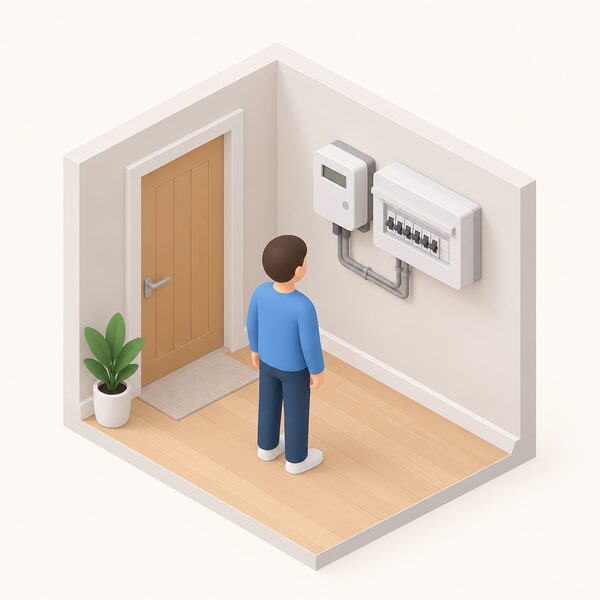
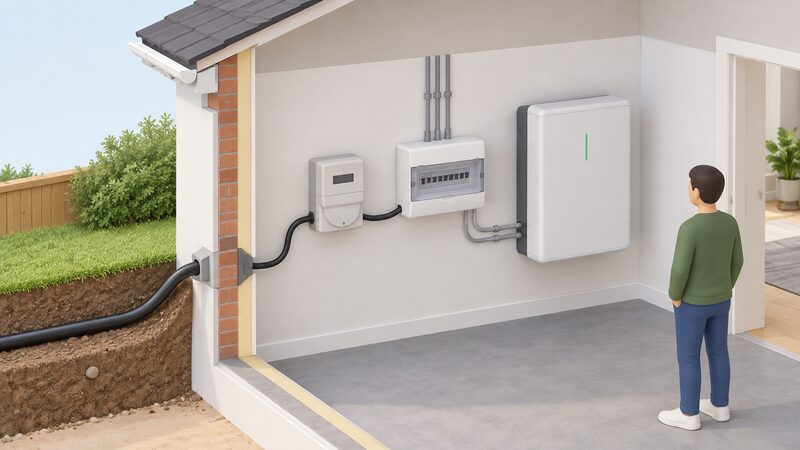
The split between NESO and National Grid clarifies what a household can and cannot control. NESO does not connect directly to homes or other domestic properties3. The physical connection, the meter and the upgrade path all run through the distribution network operator, and the energy itself is bought from a supplier. A household's independence therefore sits in three places: what it generates on site, what it can shift away from peak periods, and what it can store.
On-site generation is not counted in official consumption statistics. The National Energy Efficiency Data Framework records gross grid consumption, and on-site generation and exports are not taken into account, so a property with solar panels is measured as though it drew everything from the grid26. That is a measurement convention rather than a policy, but it means the official picture understates what an independent household is doing.
Demand flexibility is the second lever, and it is coordinated nationally. NESO's Power Responsive programme coordinates demand flexibility across the country, and regional distribution system operators manage the local networks that flexibility acts on15. A household that shifts appliance use or charging is participating in a national mechanism, not just trimming its own bill.
The remaining dependence is structural. The grid, the network operator, the supplier and the balancing decisions taken by NESO all sit outside a household's control, and network charges of £63 added to bills since 2021 are paid regardless of supplier choice8. Support schemes differ by nation: the Northern Ireland Sustainable Energy Programme is an energy efficiency programme for domestic and non-domestic customers, funded and reported separately from Great Britain arrangements27. For households in Great Britain, the Strategic Spatial Energy Plan will shape what generation and storage exists to draw on, but it is not due in final form until autumn 202717.
Sources28 cited
- Electricity distribution networks study: government response, GOV.UK, 2025-07-07
- What role does National Grid play in your energy bill, National Grid
- Domestic and homeowners connections help, NESO
- Find my network operator, Energy Networks Association
- Energy terms explained, Ofgem
- What happens in an energy shortage, Energy Networks Association
- Electricity Supply Emergency Code, SSEN
- Electricity prices in Great Britain, House of Lords Library, 2026-06
- Standards of performance, National Grid
- Benefits of being on our register, National Grid
- Emergency power cuts, Electricity North West
- Distribution area search, National Grid
- Energy networks explained, Energy Networks Association
- Emergency power cuts, NIE Networks
- For homes, Flex Assure
- Well adapted energy system, Climate Change Committee
- Tackling fuel poverty in Scotland, Scottish Government, 2025-04
- Clean Flexibility Roadmap update, GOV.UK
- POST note on connections, Parliament
- Customer service, National Grid
- Rota load disconnections, National Grid
- V2G mitigating future winter blackouts, Cenex
- Changes to permitted development rights: summary of responses, Welsh Government, 2025-12
- Check if you are owed money on your energy bill, Ofgem
- What to do in a power cut, Met Office
- National Energy Efficiency Data Framework 2026, GOV.UK, 2026-06-11
- Renewable energy deep dive, Welsh Government
- NISEP 2024/2025 annual report, Utility Regulator, 2026-07-03
 Distribution Networks and DSOsWho actually owns and runs the cables and substations bringing power to your home?
 Microgrids and Local EnergyA microgrid shares electricity between neighbours, using local solar and batteries instead of relying only on the national grid.
 The Full Rules and Regulation GuideConfused about who actually decides what you pay for gas and electricity, or why rules differ in Scotland and Wales?
 The Transmission NetworkWondering who owns the pylons near your house, or why the grid needs upgrading before you can run a heat pump or an electric car?
 The NESO Winter OutlookWill the lights stay on this winter?
 Suppliers in Northern IrelandNorthern Ireland runs its own energy market, with its own regulator, its own suppliers and no price cap.