In this guide
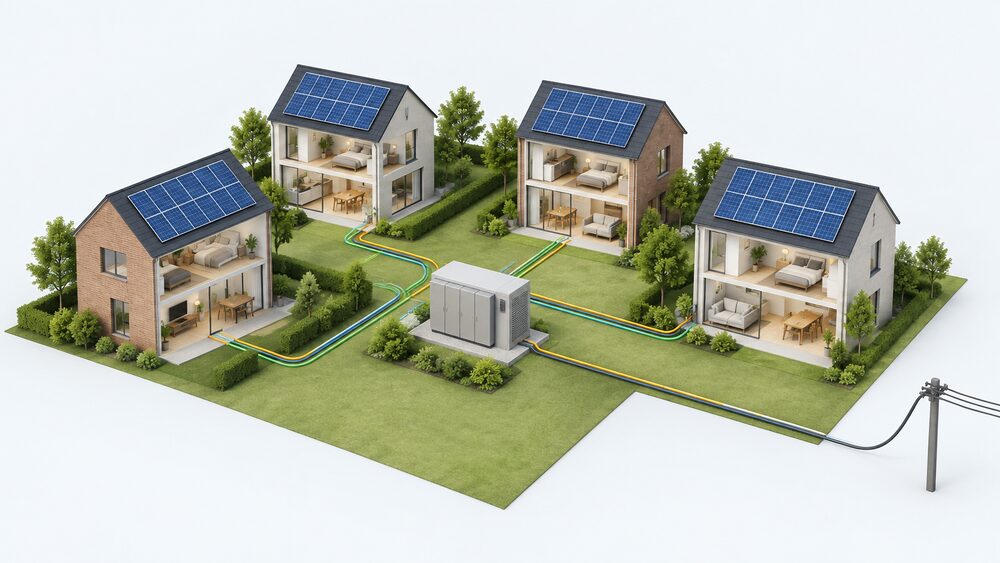
A microgrid is a local energy system that generates, stores and manages electricity close to where it is used, rather than drawing everything from the national transmission network. In the UK the term covers two quite different things: a grid-connected local system that trades with the wider network, and an island system that runs independently of it. The distinction matters because it decides who owns the wires, who is licensed to supply, and what happens when the generation stops.
The building block is the behind-the-meter system: a localised energy solution installed at a specific site, typically featuring on-site generation such as rooftop solar PV, often paired with battery storage, and using smart energy management to prioritise on-site use of generated electricity1. A microgrid is what happens when that logic is extended across more than one building or consumer, which brings in questions of control, metering and licensing that a single home never faces.
Scale in the UK is dominated by small installations. Under the Feed-in Tariffs scheme, the 0 to 50kW microgeneration band accounted for 862,944 installations and 3,489.9 MW of installed capacity2. Across all technology types, micro scale installations made up over 99.21% of installations but only 53.82% of installed capacity, while installations over 50kW were less than 1% of installations yet 46.18% of capacity3. The UK's local energy fleet is therefore numerous, small and individually modest.
What a microgrid is, and how it differs from a behind-the-meter system
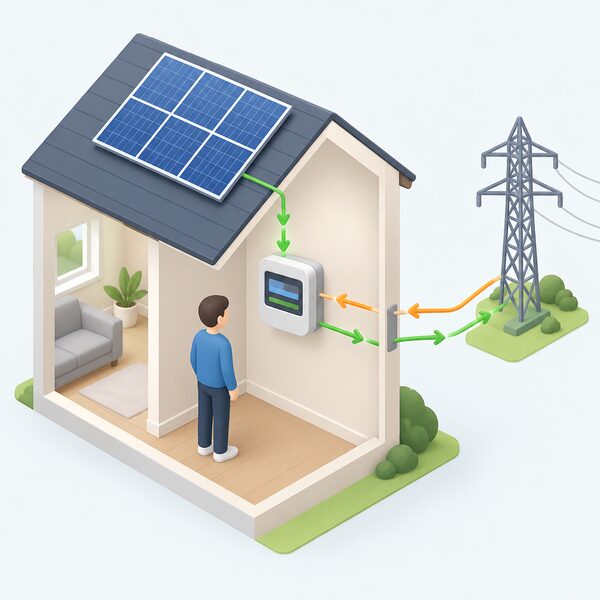
The two terms are often used interchangeably, and they are not the same. A behind-the-meter system sits behind a single meter: it is a localised energy solution installed at a specific site, typically featuring on-site generation like rooftop solar PV, often paired with battery storage1. It serves one consumer, and the meter is the boundary between that consumer and the network. Everything the system does is invisible to the grid except as a change in import or export.
A microgrid crosses that boundary. It may serve several buildings, a whole street or a village, and it may include its own private wires between them. That is where the complexity begins, because the moment electricity is supplied to someone other than the person who generated it, questions of licensing, metering and network ownership arise that a single-site system never has to answer.
The Welsh Government's guidance sets out the underlying principle that both share: these systems use smart energy management to prioritise on-site use of generated electricity, and they apply to both domestic and commercial buildings1. The guidance is explicit that behind-the-meter systems fundamentally require on-site generating technology, so a microgrid without generation is not a microgrid at all, it is just a distribution arrangement1. Surplus energy can often be exported, which is what connects a local system to the wider market1.
The technologies counted as microgeneration are broad. Northern Ireland legislation lists biomass, biofuels, fuel cells, photovoltaics, water including waves and tides, wind, solar power, geothermal sources, combined heat and power systems and other sources of energy or technologies for the generation of electricity or the production of heat6. A micro hydro plant is defined as one that generates less than 100 kilowatts7. That range is why local energy systems look so different from one place to another: a village with a burn can do something a village on flat farmland cannot.
For a household, the practical difference is about control. A behind-the-meter system gives a home more control over when it imports and exports. A microgrid gives a group of homes control over the local balance between generation and demand, but only if the group can agree who operates it, who pays for the wires and who carries the risk when something fails. Those are governance questions as much as engineering ones, and they are covered in more detail in community energy.
Behind-the-meter systems: generation, storage and smart energy management

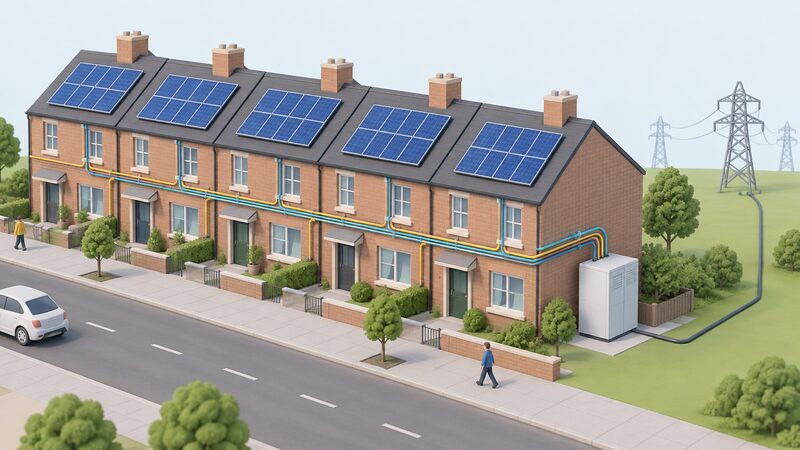
The behind-the-meter model is the foundation on which local energy systems are built, and its logic is simple: generate on site, store what is not used immediately, and manage demand so that as little as possible crosses the meter in either direction. Smart energy management is the part that makes this work, prioritising on-site use of generated electricity rather than exporting it1.
The requirement for on-site generating technology is fundamental, not optional1. A battery alone is not a behind-the-meter energy system in the sense the guidance uses; it is a storage device that shifts when electricity is drawn from the grid. Pairing storage with generation is what allows a site to serve itself first. Solar panels are commonly used to charge up an on-site battery storage system, which is the arrangement most UK households will recognise8.
Sizing is where many systems go wrong. Building regulations guidance states that systems should be an appropriate size for the site, available infrastructure and on-site energy demand, a rule that applies to photovoltaic panels and battery storage alike9. An oversized array with too little storage exports most of its output at times when export is least valuable; an undersized one leaves the household importing through the evening peak. The relationship between generation, storage and the share of output actually used on site is examined in self-consumption.
Metering underpins all of it. Smart meter data puts households in control of their energy usage, meaning they can take energy-saving steps to reduce their CO2 emissions, and it helps make the energy system more efficient by recording demand more accurately10. At the smaller non-domestic end, 61% of all meters in smaller non-domestic sites in Great Britain were smart or advanced meters by the end of 20245. That matters for local energy systems because a group of buildings cannot balance supply and demand without knowing what each one is drawing.
Data flows are part of the picture. Electralink stores data on smart meter installation numbers and location, supplier switching, and industrial and commercial consumption, among other datasets12. For a community running a local system, access to that data, and the protections around it, determines whether the group can see what is happening across its own members. The question of who holds and can release that data is treated in energy data ownership.
Do you need a grid connection? Export and what the grid adds
A grid connection is not mandatory for a behind-the-meter system, but it enhances the value of the system by enabling the export of surplus electricity1. That single sentence captures the trade-off at the heart of every local energy decision: the grid is not required, but it is useful, and giving it up means giving up the ability to sell what you do not use.
The value of export depends on what is being generated and when. A system sized to its site will have surplus in summer and a shortfall in winter, which is the seasonal pattern described in the winter gap. Without a connection, that summer surplus has nowhere to go unless it can be stored, and storage sized for a whole winter is expensive. With a connection, the surplus becomes revenue or credit, and the winter shortfall is covered by import.
Off-grid operation is possible in principle. Micro hydro guidance notes that in off-grid applications the power is used for lighting and electrical appliances, and that space and water heating can be supplied when available power exceeds demand7. That is a useful description of how an island system behaves: lighting and appliances first, heat only when there is spare capacity. It also shows the limit, because heat is the largest load in a UK home and it is the first thing to be curtailed when generation falls short.
For a community, the grid connection question is sharper than for a single house. A group that keeps its connection can export collectively and use the network as a buffer. A group that severs it takes on full responsibility for reliability across every member, including the members who use the most. The technical and legal dimensions of that step are set out in disconnecting from the electricity grid and in islanding and anti-islanding, which explains why most home systems shut down in a power cut rather than continuing to run.
Technologies that pair with on-site generation: batteries, heating and EV charging

Behind-the-meter systems are adaptable, integrating with technologies like battery storage, heating and electric vehicle charging1. Those three categories cover most of what a household or a community group will add, and each changes the shape of the local load.
Battery storage is the most direct pairing, because it lets generation be used later rather than exported immediately. VAT relief for energy-saving materials was extended to add electrical batteries that store electricity generated by certain energy-saving materials and from the National Grid, along with water source heat pumps and diverters, and certain preparatory groundworks for ground and water source heat pumps13. That tax treatment applies to the equipment, and the practical effect on system economics is covered in home battery vs hot water tank.
Heating is the largest single load in most UK homes, and it is where local systems are most often tested. A Welsh Government supported project, Boomerang Cardiff, is decarbonising four industrial units by fitting air source heat pumps, battery storage, and EV chargers linked to an existing rooftop solar system14. That combination, generation plus heat pump plus storage plus charging, is the pattern that local energy systems increasingly follow, because it moves the biggest loads onto the local supply.
EV charging is the newest and most flexible addition. The electric vehicle chargepoint grant for households with on-street parking funded 59 socket installations, of which 31 were in the last 12 months, as at 1 July 202615. That is a small number against the size of the UK fleet, and it indicates how early the on-street charging route still is. For a community microgrid, chargepoints are attractive because charging can be shifted to times when local generation is high, which is the subject of charging an EV from home solar vs a cheap overnight tariff.
The common thread is flexibility. A local energy system with generation, storage, a heat pump and a chargepoint has several ways to absorb its own output and several ways to reduce its draw at peak times. A system with generation alone has one. The design question of how these parts fit together is treated in whole-home energy system design.
Permissions and network rules: notification, DNO consent and the 3.68kW threshold
The network rules turn on a single figure. Small systems usually only need the electricity network operator, the Distribution Network Operator, to be notified1. Larger systems, over 3.68kW, will usually need the DNO's approval before they can be connected to the grid1. That threshold is the dividing line between a notification and an application.
The routes have names. A solar installer must contact the Distribution Network Operator via 'connect and notify' or 'apply to connect'16. 'Apply to connect' is for larger installations exceeding 3.68kWp and requires a G99 application16. The 'connect and notify' route covers installations up to 3.68kWp, which is the maximum capacity for G98 install and notify installations17. G99 applications cover installations over 3.68kWp which require prior approval from the DNO17.
| System size | Network route | What it requires |
|---|---|---|
| Up to 3.68kWp | Connect and notify (G98) | Notification to the DNO17 |
| Over 3.68kWp | Apply to connect (G99) | Prior approval from the DNO17 |
Behind-the-meter systems may be subject to certain regulatory requirements, such as permission from planning authorities and District Network Operators1. Those are two separate consents, and holding one does not imply the other. A system can be within permitted development for planning purposes and still need DNO approval, or the reverse.
For a community group, the threshold matters more than it does for a single house, because a shared system will almost always exceed 3.68kW. That pushes the project onto the G99 route, with prior approval, and the timing of that approval becomes part of the project schedule rather than an afterthought. The same threshold logic runs through behind-the-meter systems, which sets out the general framework.
Planning: when a system falls under permitted development
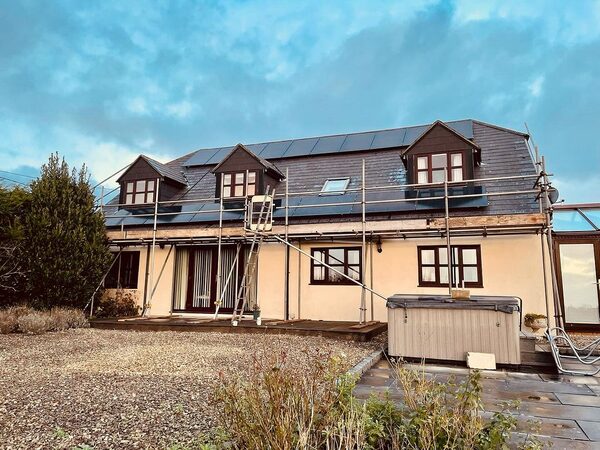
The installation of behind-the-meter equipment typically falls under permitted development1. That is the starting position across the UK, and it is why most domestic solar and battery installations proceed without a planning application. Permitted development is not unlimited, however: it is subject to relevant exceptions, limitations and conditions6.
In England, the guidance for solar equipment on a house or block of flats relates to the planning regime for England, and the policy in Wales may differ18. The same territorial caveat appears on the guidance for stand alone wind turbines, for the Microgeneration Certification Scheme, and for flues, chimneys and soil and vent pipes19. A householder in Wales, Scotland or Northern Ireland should not assume the English limits apply.
Where the limits and conditions are not met, or permitted development rights have been removed in the area, a householder or full planning application is required in England22. Roof alterations follow the same pattern: if the limits and conditions are not met, or permitted development rights have been removed, an application is needed23. Internal alterations are given as an example of development that falls within permitted development23.
The output limits for equipment not on a roof are set out in the Scottish guidance: permitted development rights for solar thermal equipment not on a roof are limited to microgeneration output of 45 kilowatts, and for solar photovoltaic equipment not on a roof to 50 kilowatts24. Stand alone wind turbines are permitted only if the installation complies with the Microgeneration Certification Scheme Planning Standards or equivalent standards19. In Wales, separate guidance covers planning permission for wind turbines25.
Northern Ireland has its own order. The Planning (General Permitted Development) Order (Northern Ireland) 2015 provides that planning permission is granted for the classes of development described as permitted development in the Schedule, subject to relevant exceptions, limitations and conditions6. Among those classes is development by councils: the erection, construction and maintenance, improvement or other alteration by a council of electric vehicle charging points and similar structures or works required in connection with the operation of any public service administered by it26.
Scotland has consulted on extending permitted development rights. Under the proposed rights, development falling within the criteria and thresholds established by the rights would not require planning permission but would remain required to gain non-planning consents such as a building warrant24. That distinction, between planning permission and other consents, is the one households most often miss.
Community energy projects and what they can deliver locally
Community energy is where microgrid thinking becomes practical at scale. Smart local energy systems can be delivered by community energy organisations, social enterprises, public sector bodies, and SMEs developing them27. That breadth of eligible organisations is what allows a village hall, a housing association and a small business on the same street to be part of one arrangement.
The Welsh Government's renewable energy analysis recommended providing support for communities to develop smart local energy systems where these could help balance supply and demand or provide a solution where grid capacity is constrained28. That second condition is important: local energy systems are not only about generation, they are also a way around a network that cannot take more connections. Where the grid is full, a local system that keeps generation and demand close together can proceed when a conventional export connection cannot.
The bill impact is stated in Scottish Government policy: demand side response could make household energy bills cheaper29. Demand side response is the mechanism a community project uses when it shifts when members draw power, and it is the same principle that lets a local system absorb its own generation rather than exporting at a low price. The scale of any saving depends on the project, and no single figure applies across the UK.
The ambition is set out in a parliamentary briefing, which states that the community energy target is 8 GW by 2030, and that GB Energy is reported to have committed to support at least 1000 local and community projects by 20304. Those are targets and commitments rather than delivered capacity, and they should be read as such.
Wales has run dedicated support. A £10 million programme was announced to help Welsh communities cut energy bills, and a separate £129 million programme was announced to support Welsh communities in the transition to renewable energy14. Both are Welsh Government announcements, and the delivery detail sits with the programmes themselves.
For a household, the appeal of a community project is that it can reach people who cannot put solar on their own roof, whether because they rent, live in a flat or have a shaded or listed building. The trade-off is that the household's independence is shared rather than individual: the member depends on the project's governance and finances as well as on the weather. The different ownership models are compared in community energy share offers and joining a community energy scheme vs installing your own solar.
Selling power locally: the licensed supplier barrier
The hardest constraint on local energy is not technical. Supplying electricity to domestic and non-domestic consumers in Great Britain is a licensed activity, and the licence is granted by the regulator. Tesla Energy Ventures Limited was granted a licence authorising it to supply electricity to domestic and non-domestic consumers in Great Britain, and the new licence applies to electricity supply activities in Great Britain only30. That example shows the shape of the requirement: a company wanting to sell power to homes holds a supply licence, and the licence has a territorial extent.
For a community group, this is the barrier that shapes every local trading model. A group that generates and sells power to its own members is, in substance, supplying electricity, and the route to doing that lawfully runs through an existing licensed supplier rather than around it. That is why local supply arrangements are structured as partnerships with a licence holder rather than as independent retailers. The models that work within this constraint are set out in local energy supply and energy local clubs and peer-to-peer energy trading.
The Smart Export Guarantee is the route most households use instead. It is the scheme to sell surplus solar electricity to the grid31. It works through a licensed supplier, which is precisely why it does not require the household to hold a licence of its own. For a single home, that is the whole answer: generate, use what you can, export the rest through a supplier.
Consumer protection follows the licence. The Energy Ombudsman is approved by Ofgem, the UK energy regulator, to handle service disputes in the energy sector32. That matters for local supply arrangements because it means a member of a community scheme supplied by a licensed supplier has recourse to the same dispute route as any other domestic customer. A group that tried to supply without a licence would leave its members outside that protection.
Funding and support: hubs, community funds and the Energy Redress route
Funding for local energy comes from several directions, and the routes have different eligibility rules and deadlines. The most significant recent change is the Energy Redress route: community energy organisations in England, Scotland and Wales became eligible to apply to all Energy Redress Funds including the Main Fund, around 75% of scheme funding, from 23 July 202633. The Main Fund is the largest part of the scheme, so eligibility for it changes what a group can attempt.
The London Community Energy Fund has a ninth round with feasibility and delivery streams closing at 11:59pm on 30 September 2026, and a development stream opening in October 2026 with more details to follow34. The Bristol City Leap Community Energy Fund has a closing date of 23 September 202635. Both are dated, and both are time-limited, which is the normal pattern for community energy funding.
In Scotland, the Community and Renewable Energy Scheme has a network of development officers across Scotland to provide free, expert and impartial advice and support to community groups, charities and other eligible organisations seeking to explore their renewable energy options29. It also offers dedicated guidance for repowering projects, including support on financing, evaluation and governance, as well as targeted support from Local Energy Scotland through the scheme, including help to develop proposals29. That combination of advice and grant support is unusual and is the reason Scottish community projects often progress further than equivalent projects elsewhere.
For households rather than groups, the Warm Homes: Social Housing Fund includes an incentive offer under which up to 10% of homes in an application can gain access to a £20,000 grant fund per home to install low carbon heating measures, for homes on the gas grid36. That is a scheme rule with a per-home figure, and it applies within the parameters of the fund rather than as a general entitlement.
Heating oil support has been delivered differently in different nations. In England, funding will be distributed by local authorities via the crisis and resilience fund, and the Government has made it clear that this money is going through the crisis and resilience fund, which is discretionary for local authorities37. That discretionary element means eligibility and delivery vary by council area.
The wider support landscape, including the membership bodies that advise groups and the funds available in each nation, is covered in funding for community energy projects and the Local Power Plan.
Sources37 cited
- Behind-the-meter energy systems guidance, GOV.WALES, 2026-07-28
- Feed-in Tariffs Annual Report Scheme Year 14, Ofgem, 2024-12
- Feed-in Tariffs Annual Report Scheme Year 13, Ofgem, 2023-12
- Community energy report, Parliamentary Office of Science and Technology, 2026-06-17
- Smart Meter Guaranteed Standards of Performance, Ofgem, 2024
- The Planning (General Permitted Development) Order (Northern Ireland) 2015, legislation.gov.uk, 2026-09-17
- Hydro electricity, Planning Portal, 2026
- Solar panels, East Hertfordshire District Council, 2026-09-17
- Approved Document L, Volume 1: Dwellings, HM Government, 2026
- Get help with your smart meter, Ofgem, 2026
- Smart meters and decarbonisation, Smart DCC, 2026
- Data protection and smart meter data, Open Energy, 2026-09-20
- VAT relief for energy-saving materials, legislation.gov.uk, 2026-09-17
- £10 million to help Welsh communities cut energy bills, GOV.WALES, 2026-03-03
- Grant schemes for electric vehicle charging infrastructure, Department for Transport, 2026-07-01
- Building regulations renewables guidance, Bedford Borough Council, 2026-09-17
- Barcud Solar Panel Installation Scheme Specification, Sell2Wales, 2026-06-15
- Planning permission for solar equipment on a house or block of flats, Planning Portal, 2026-09-17
- Planning permission for stand alone wind turbines, Planning Portal, 2026-09-17
- The Microgeneration Certification Scheme, Planning Portal, 2026-09-17
- Flue, chimney or soil and vent pipe, Planning Portal, 2026-09-17
- Roof planning permission, Planning Portal, 2026-09-17
- Householder planning consent, Planning Portal, 2026-09-17
- Householder permitted development rights guidance, Scottish Government, 2021-04-01
- Planning permission for wind turbines, GOV.WALES, 2026-09-17
- The Planning (General Permitted Development) Order (Northern Ireland) 2015, Schedules, legislation.gov.uk, 2026-09-17
- £129 million to support Welsh communities transition to renewable energy, GOV.WALES, 2025-09-17
- Preparing Wales for a renewable energy 2050, GOV.WALES, 2023-10
- Local and small scale renewables, Scottish Government, 2026-09-17
- Tesla Energy Ventures Limited granted electricity supply licence, Ofgem, 2026-03-12
- Smart Export Guarantee, Solar Energy UK, 2026-09-17
- Energy Ombudsman FAQs, Energy Ombudsman, 2026-09-19
- Energy Redress funding, Energy Saving Trust, 2026-09-17
- London Community Energy Fund ninth round, Community Energy England, 2026-09-17
- Bristol City Leap Community Energy Fund, Community Energy England, 2026-09-17
- Warm Homes: Social Housing Fund wave 3 scheme guidance addendum, HM Government, 2026-06
- Heating oil support, Hansard, 2026-03-16
 Community Energy in EnglandCommunity energy lets neighbours own their own power together, often through solar panels, and share the money it makes.
 Peer-to-Peer Energy TradingSharing power with your neighbours sounds simple, so why does it need a supplier in the middle?
 Off-Grid in a UK WinterHow does a home with no mains connection keep the lights on through the darkest, stillest weeks of a UK winter?
 MicroinvertersMicroinverters sit behind each panel and turn its power into household electricity right there on the roof.
 Household Resilience and RiskWhat happens to your heating and lights if the power goes off for days?
 Going Off-Grid in the UKA whole-picture account of an off-grid UK home: electricity, heat, hot water, cooking, water and waste, and the seasonal management it demands.