In this guide
A mortgage on an off-grid property in the UK is not a separate product. It is an ordinary mortgage on a property a valuer has to be able to describe as habitable, saleable and supplied. Around 47 per cent of owner-occupied homes are covered by a mortgage, a market worth around £275bn a year, and off-grid homes sit inside that market rather than beside it1. What changes is the evidence: the lender wants to know what provides power, heat, water and drainage, who installed it, and whether it will still be working when the loan is being repaid.
The scale of the question is larger than many buyers expect. Approximately 15 per cent of the 28 million properties in the UK are off the grid, which is four million households, or 15 per cent, off the mains gas grid2. In Great Britain the share of domestic properties not connected to the gas grid was 16.0 per cent in 20244. Off-grid is therefore not a niche at the edge of the housing market; it is a substantial minority of it, concentrated in rural areas and in particular regions.
For a household, the financing question and the independence question are the same question seen from two sides. A home that generates and stores its own power reduces what it draws from the grid, but it also introduces a system that a lender, an insurer and a future buyer all have to be able to understand. This page sets out how each of those three parties treats an off-grid or heavily self-sufficient home, what evidence is normally asked for, and what the published figures say about value.
What counts as an off-grid home in the UK
The term covers more ground than the phrase suggests. The narrowest definition is a property with no connection to the mains gas grid, which is how the official statistics count it: four million UK households, 15 per cent, are off the mains gas grid3. That is a fuel definition, not an electricity one. A home can be off the gas grid and still have a perfectly ordinary mains electricity supply, which is the commonest arrangement in rural Britain.
The wider definition, and the one that matters for lending and insurance, is a property that is not connected to one or more of the standard utility networks: gas, electricity, mains water or mains drainage. The regional spread shows how uneven this is. In 2024, 16.0 per cent of domestic properties in Great Britain were off the gas grid, but the figure was 19.5 per cent in Wales, 13.4 per cent in the West Midlands and 11.9 per cent in the East Midlands4. Within London the range runs from 14.9 per cent in Outer London to 26.6 per cent in Inner London4.
Scotland shows the rural concentration most sharply. In 2024, 57 per cent of dwellings in rural areas were not connected to the gas grid, against a much lower share in urban areas6. That single figure explains why off-grid finance is largely a rural question: the properties most likely to have their own power arrangements are the ones furthest from the networks, and they are also the ones where a valuer has the fewest comparable sales to work from.
For a household, the practical test is simpler than the statistical one. If the property depends on a supply the owner controls, whether that is a borehole, a septic tank, a generator, a battery or a wood fuel store, it is off-grid in the sense that lenders and insurers use. The rest of this page deals with the power side, because that is where the evidence requirements are heaviest.
Why lenders treat off-grid properties differently

Lending on any home rests on two judgements: can the borrower repay, and can the property be sold if they do not. Off-grid features complicate the second. A valuer has to be satisfied that the property is mortgageable, which in practice means that power, water and drainage are available and continuing, and that a future buyer would not be taking on an unquantified liability.
The market context matters here. Around 47 per cent of owner-occupied homes are covered by a mortgage, and the market is estimated to be worth around £275bn per year1. Lenders are not short of business, so an unusual property has to clear a higher evidential bar rather than a different one. There is no published off-grid mortgage product, and no lender is named in the official material as an off-grid specialist.
What lenders ask for is documentation. The published scheme rules for retrofit finance give a clear picture of the standard expected: a borrower must provide a copy of the quotation from the installer, in the form the scheme requires, and all information must be true, accurate and complete7. The same rules require that the named Retrofit Coordinator be instructed and registered under TrustMark, that the borrower own and occupy the property, that a Project Information Form aligned with the Recommendations Reports be supplied, that installers be registered, that work not start before the offer letter is issued, that the measure be completely new, and that no other public financial support be received7.
That list is drawn from a Welsh scheme, but the shape of it is what any lender or valuer will recognise: who did the work, to what standard, with what paperwork, and was it new. For new dwellings, the requirement is a signed copy of the Building Regulations England Part L compliance report and photographic evidence of the build quality8. For self-builds, acceptable evidence can include proof of ownership, self-build VAT exemption, loan or mortgage documents, invoices for substantial structural materials or labour, self-build insurance, bank statements and traders' or builders' invoices or contracts8.
The dependence that remains is procedural rather than technical. A household can be entirely self-supplied and still need an installer's paperwork, a registered coordinator and a compliance report to satisfy a lender. That is the price of mortgageability, and it is worth assembling before a sale rather than during one.
Power systems: solar panels, windchargers and backup generators
The power system is the part of an off-grid home that lenders, insurers and valuers examine most closely, because it is the part that determines whether the property functions. The published evidence on what a good system looks like comes largely from grant-funded housing schemes, which is useful precisely because those schemes had to satisfy funders that the installations would last.
The Active Homes development in Neath, South Wales, is a documented example. Its grant-funded low carbon features include off-site manufactured timber frames and double glazing, PV panels with battery storage, and MVHR9. At Etopia Homes in Corby, Northamptonshire, the electric supply arrangement is described as battery storage, with the householder's use of solar generated electricity maximised by battery storage and exported to the grid9. Those two descriptions capture the two possible relationships with the network: one where the home exports surplus, and one where it simply stores what it makes.
For households considering a smaller intervention, the position on plug-in solar has changed. Plug-in solar panels are now available to buy and use across Great Britain, helping households generate some of their own electricity10. That is a meaningful shift for flats and rented homes, though it does not by itself create an off-grid property.
Backup generation is the least documented element in the published material. No official or independent source in the public record sets out a standard specification for a domestic backup generator, and no scheme treats a generator alone as evidence of a habitable power supply. Where a generator forms part of the arrangement, it is assessed as one component among several, and the questions a valuer will ask are the ordinary ones: what does it run, how often is it serviced, and what happens if it fails.
Energy storage: batteries for use when generation is low
Storage is where the legal definition of a home battery becomes relevant to a purchase, because the definition is narrow and specific. An electrical storage battery qualifies under the legislation if it is intended for use solely for storing energy converted from electricity supplied to the residential accommodation or building in question, or generated by a microgeneration system11. The same wording appears in the 2024 regulations13.
That definition matters for two reasons. First, it ties the battery to the dwelling it serves, which is what a valuer needs: the storage is part of the property, not a separate asset. Second, it excludes batteries used for other purposes, which means a household cannot assume that any storage installation will be treated as a qualifying domestic measure.
In practice, storage is what makes a self-sufficient home workable through the winter gap, and the documented case studies treat it as standard rather than optional. At Etopia Homes the householder's use of solar generated electricity is maximised by battery storage and exported to the grid9. At Active Homes the same principle applies without the export element9. Both descriptions come from official guidance on low carbon homes, which is a stronger basis than a manufacturer's claim.
The limits are real. A battery sized for summer generation will not carry a household through a British winter, and the seasonal mismatch between generation and demand is the central constraint on any self-sufficient design. Storage reduces the amount drawn from the grid; it does not remove the need for a grid connection, a generator or a willingness to reduce consumption in the darkest weeks. For a household weighing how much storage to install, the relationship between battery capacity and the proportion of generation used on site is set out in how much a battery increases self-consumption.
Power management: charge controllers and inverters
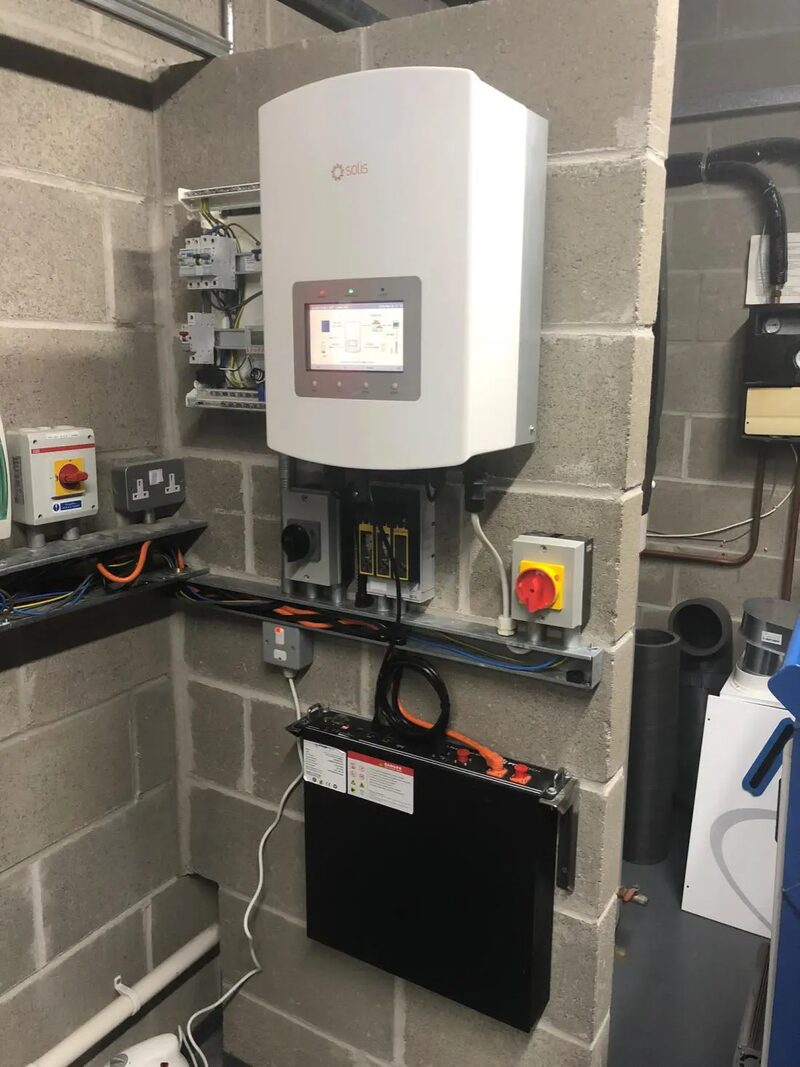
The management layer, the charge controllers and inverters that move power between panels, battery and house, is the least visible part of a system and the part most likely to be undocumented at sale. It is also where the household's dependence on a manufacturer becomes concrete: an inverter with a cloud portal ties monitoring and sometimes control to a company's servers, while a locally controlled inverter does not.
The published material does not set a specification for domestic power management, but it does show what the wider system costs the country when management is poor. Constraint payments, the sums paid to generators to stop generating when the network cannot absorb the power, currently cost over £1 billion14. That figure is a national one, not a household one, but it illustrates why the grid treats distributed generation as something to be managed rather than simply absorbed.
For a household, the practical questions at purchase are straightforward. What is the inverter's expected life, and is it still supported by its maker? Is monitoring local or cloud-based? If the maker withdraws the app, does the system still run? The answers affect both insurability and resale, because a buyer is taking on a system whose useful life may be shorter than the building's. The wider question of who controls a home's energy data, and what happens when a manufacturer's cloud service ends, is covered in local control versus the manufacturer's cloud.
Insurance for off-grid and self-sufficient homes
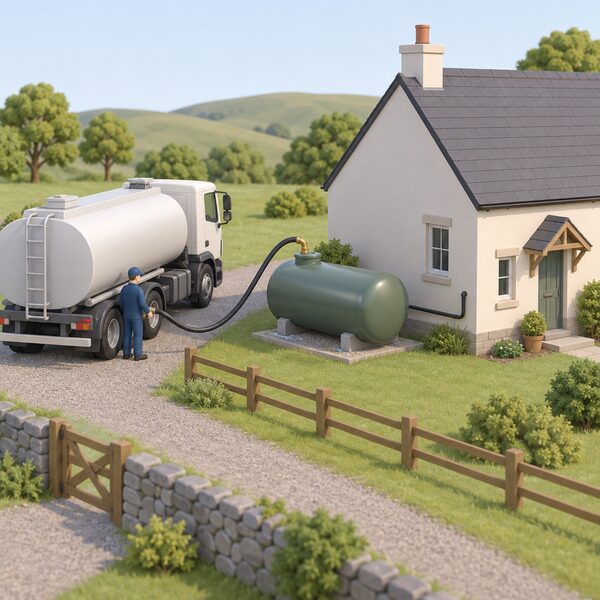
Insurance is where the household's own disclosure does most of the work. An insurer prices the risk it has been told about, and a home with no mains gas, its own electricity generation, a battery store, a generator and a fuel tank is a different risk from a standard connected home. The material facts are the ones that change the risk: what supplies the property, how it is maintained, and what happens when it fails.
The published material does not set out a standard off-grid insurance product, and no insurer is named as a specialist. What it does show is the pattern of support available to off-grid households in difficulty, which indicates how the risks are understood. In Wales, the Discretionary Assistance Fund provides up to £250 for a one-off oil payment, available to off-grid households which are unable to afford their next delivery of oil or LPG due to extreme financial hardship15. That is a crisis payment, not insurance, but it identifies the specific risk that off-grid households carry: a fuel delivery they cannot fund.
Local authority support is similarly limited and time-bound. Limited assistance with off-grid fuel may be available through a council's financial inclusion team, but only until current funding expires16. The Energy Price Guarantee scheme documents describe support for households across the UK17, which is the broadest statement of coverage in the published material.
For a household, the practical implication is that the insurance conversation should happen before purchase, not after. A broker who understands rural and off-grid risks will ask about the age and servicing of the power system, the fuel storage arrangements, and whether the property has a working heating system independent of the electricity supply. A home that depends entirely on one inverter for both heat and power is a concentration of risk that an insurer will want to see mitigated.
Valuation: how off-grid features affect what a home is worth
Valuation is where the published evidence is thinnest and the numbers most contested. The clearest recent figure comes from a Solar Energy UK report, which estimated that a solar energy system could add £1,800 to the value of an average home and save over £300 on energy bills5. That is a modest uplift, and it is an estimate rather than a transaction price.
Older official research found larger effects from energy performance generally. A typical home in the West Midlands in band B was estimated to be valued at nearly £17,000 more than a band D home, and in the North East the difference could be over £19,000, £3,000 more than the national average18. Those figures date from 2013 and measure the energy rating, not off-grid status, so they should be read as evidence that efficiency affects price rather than as a valuation of any particular system.
The countervailing evidence is that off-gas-grid homes are more likely to be poorly rated. In Scotland, detached houses and housing which is off the gas grid are more likely to be F or G rated than other housing types, while flats are more likely to be A, B or C rated19. That is a structural disadvantage: the properties most likely to have their own power arrangements are also the ones most likely to score badly on the standard measure a buyer sees.
The two findings are not contradictory. A well-executed solar and battery installation can lift a property's rating and its value; an off-grid home with an ageing system and poor insulation carries a discount. What a valuer is assessing is the condition and remaining life of the installation, not the fact of being off-grid. For a fuller picture of what a self-sufficient system costs to install in the first place, see what energy independence costs a UK household.
| Factor | Effect on valuation | Evidence |
|---|---|---|
| Solar energy system | Estimated £1,800 uplift on an average home | Solar Energy UK report, 20255 |
| Energy rating, band B vs band D | Nearly £17,000 in the West Midlands; over £19,000 in the North East | Official research, 201318 |
| Off-gas-grid status | More likely to be F or G rated in Scotland | Scottish House Condition Survey, 202619 |
Where off-grid homes are suitable: remote locations and who they suit
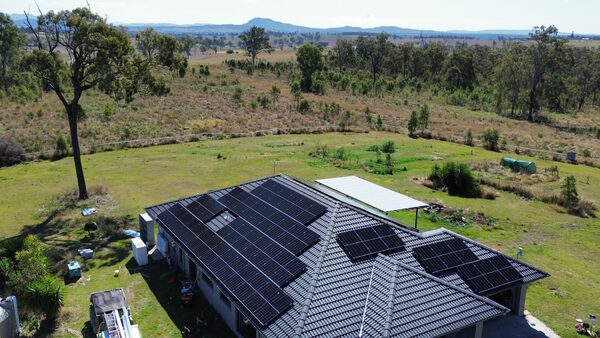
Off-grid homes cluster where the networks do not reach, and the support schemes follow the same geography. In Scotland, 57 per cent of rural dwellings are not connected to the gas grid6, which is why Scottish policy has developed separate instruments for remote and island communities. The Area Based Schemes provided an additional £2,000 per household for insulation measures in remote rural and island communities20.
England's support has moved between schemes. The Home Upgrade Grant Phase 1 allocated £218 million to improve energy efficiency in low-income homes off the gas grid, with the latest funding totals at £220 million21. Phase 2 applied to England and targeted households that are low income, off the gas grid, and have an EPC between D and G22. The scheme ended in March 2025, with off-grid homes previously supported by it now covered by the Warm Homes: Local Grant23. That grant supports low income households in private housing in England, including off-grid homes24, and is open to all fuel types, including on-gas-grid and off-gas-grid households25.
The Welsh and Scottish positions differ. The Retrofit Coordinator Grant excludes properties outside of Wales26, and the Warm Homes: Social Housing Fund Wave 3 carries an additional £7,500 of grant funding where low carbon heating measures are installed in homes off the gas grid27. The same scheme states that the off gas grid low carbon heating cost cap uplift is available alongside the base cost cap, meaning the total available grant funding for each off gas grid home with the uplift is £15,00027. The two figures describe the same uplift from different angles: £7,500 as the additional sum, £15,000 as the total once the base cost cap is included.
Who off-grid homes suit is a question the evidence answers indirectly. The Optimised Retrofit Programme recorded an increasing number of objections, with tenants very cautious around switching to electric heating, particularly with bills rising28. That caution is rational: an off-grid home asks the occupant to manage generation, storage and fuel in a way a connected home does not. It suits households who want that control and can carry the maintenance, and it suits remote locations where connection costs would be prohibitive. It suits less well households who want the supply to be someone else's responsibility.
What owning an off-grid home means for energy independence
The independence an off-grid home delivers is real but partial, and it is worth being precise about what remains dependent. A home with its own generation and storage is independent of the gas grid and largely independent of the electricity grid for the power it uses, but it remains dependent on the equipment manufacturer for spares and support, on an installer or maintainer for servicing, and often on a cloud service for monitoring. It may remain dependent on a fuel supplier for oil, LPG or wood, and on a delivery schedule that can fail.
The national picture shows why this matters beyond the individual household. Constraint payments currently cost over £1 billion14, a figure that reflects the difficulty of balancing a network with distributed generation on it. Households that generate and store their own power ease that pressure, but they also take on the management burden the network would otherwise carry.
The financial dimension is where independence and dependence meet most sharply. A household that installs solar and storage may see an estimated £1,800 added to the value of an average home and over £300 saved on energy bills5, but it also takes on the maintenance of a system with a finite life. The grant landscape that has supported much of this work is uneven across the four nations: England's Warm Homes: Local Grant24, Wales's Retrofit Coordinator Grant with its Wales-only restriction26, Scotland's remote rural uplift20, and the Warm Homes: Social Housing Fund Wave 3 uplift for off-gas-grid low carbon heating27. Northern Ireland does not appear in the published material on these schemes.
For a household weighing an off-grid purchase, the honest summary is that independence is bought with responsibility. The property will not depend on a supplier for its power, but it will depend on the owner to keep the system running, documented and insurable. The evidence a lender, an insurer and a valuer all want is the same evidence: what the system is, who installed it, how it is maintained, and how long it will last. Assembling that before a purchase or a sale is the single most useful thing a household can do.
Sources28 cited
- Mortgage market inquiry, UK Parliament, 2026
- Written evidence on off-grid properties, UK Parliament, 2026
- Off-grid households briefing, House of Commons Library, 2026
- Off-gas-grid households by region, House of Commons Library, 2024
- The Value of Solar Property, House of Commons Library, 2025
- Scottish House Condition Survey 2024, Scottish Government, 2026
- Green Homes Wales loan terms, Development Bank of Wales, 2026
- Boiler Upgrade Scheme guidance, Ofgem, 2023
- Building for 2050, UK Government, 2022
- Simple tips for a greener Easter, Home Energy Scotland, 2026
- Social Security Contributions and Benefits Act, Schedule 7A, legislation.gov.uk, 2026
- Electrical storage battery definition, legislation.gov.uk, 2024
- Energy legislation 2024, legislation.gov.uk, 2024
- Constraint payments briefing, UK Parliament, 2025
- Welsh Government cost of living support, Welsh Government, 2022
- Help with household costs, Isle of Anglesey County Council, 2026
- Energy Price Guarantee scheme documents, UK Government, 2022
- Energy saving measures boost house prices, UK Government, 2013
- Scottish House Condition Survey energy efficiency tables, Scottish Government, 2026
- Heat in Buildings Strategy assessment, Scottish Government, 2021
- Home Upgrade Grant Phase 1, UK Government, 2026
- Home Upgrade Grant Phase 2, UK Government, 2022
- Home Upgrade Grant closure, House of Commons Library, 2025
- Warm Homes: Local Grant, UK Government, 2026
- Heat pump deployment tables, UK Government, 2026
- Retrofit Coordinator Grant terms, Development Bank of Wales, 2026
- Warm Homes: Social Housing Fund Wave 3 addendum, UK Government, 2026
- Optimised Retrofit Programme case study, Welsh Government, 2024
 Energy Independence RulesExamines how the regulatory framework helps or hinders a household trying to generate, store and use its own energy, from connection rules to export arrangements and metering obligations.
 Going Off-Grid in the UKA whole-picture account of an off-grid UK home: electricity, heat, hot water, cooking, water and waste, and the seasonal management it demands.
 Batteries by Home TypeLooks at how house type, occupancy pattern, electrical supply and available space change what storage can achieve, from flats and terraces to rural and off-grid properties.
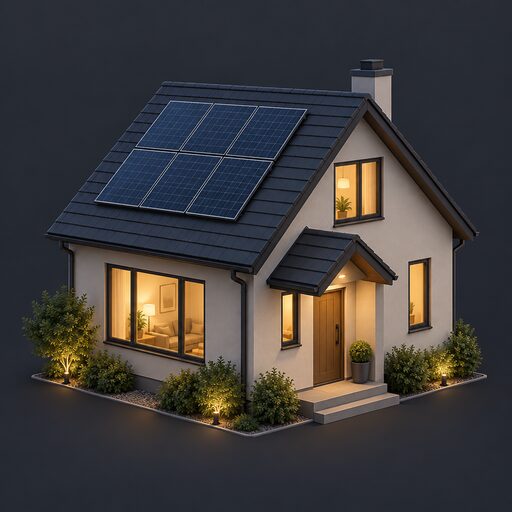 Backup Power and IndependenceA power cut leaves most homes completely dark, so how much backup do you actually need to keep the lights on?
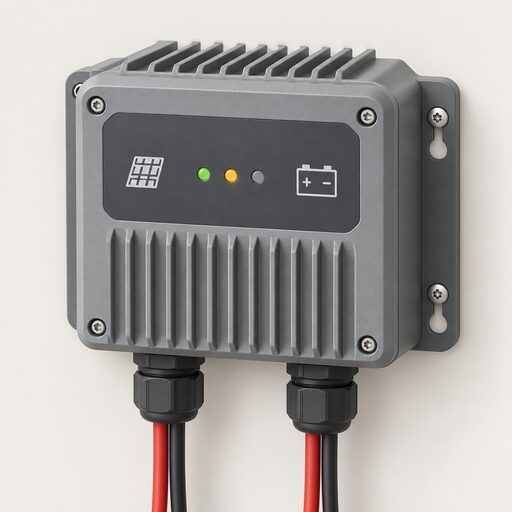 Off-Grid SolarOff-grid solar means your home, cabin or boat runs on its own power, with no connection to the grid.
 Leaving the Electricity GridCan you really cut your home off the grid completely, and what does it cost to have your electricity supply removed for good?