In this guide
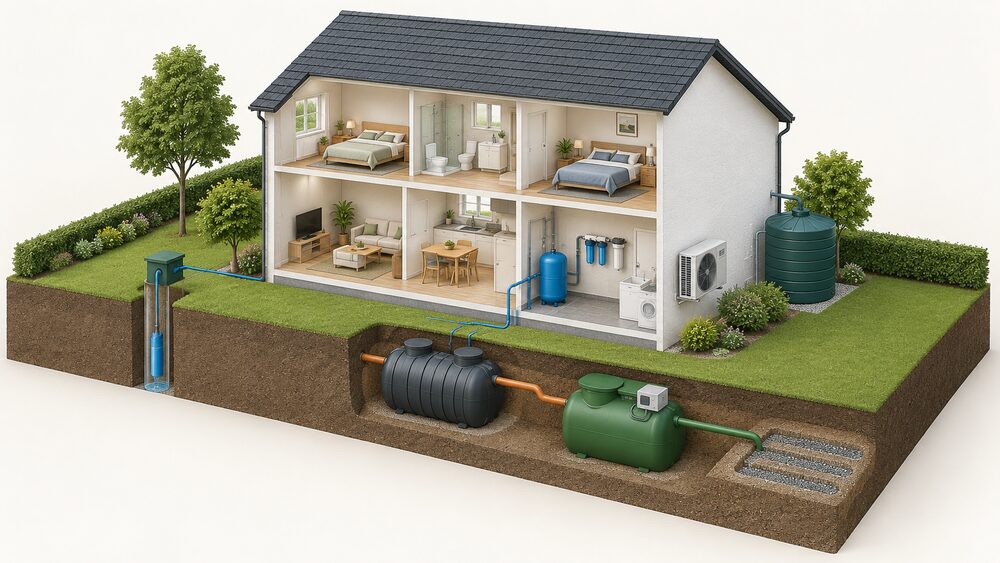
Off-grid water, drainage and waste are the parts of household independence that the electricity conversation usually skips. A home can generate its own power and still depend on a borehole pump, a treatment plant aerator and a tanker lorry. Four million UK households, 15%, are off the mains gas grid, and a smaller but significant number are off mains water and mains sewerage as well1. Those homes carry a second set of regulators, consents and running costs that have nothing to do with the electricity meter.
The energy load is the link between the two subjects. A private water supply needs a pump. A septic tank or package treatment plant needs either passive drainage or an air blower running continuously. Rainwater harvesting needs a pump and often a UV unit. Each of those draws power around the clock, which changes the sizing of a battery and the winter gap a household has to cover. The whole-home energy system design page sets out how those loads sit alongside heat and transport.
This page covers what the rules require, who enforces them, and what the pumping and treatment energy adds to an off-grid load. It also covers the F-Gas rules that apply to the refrigerant-charged equipment some of these systems use, because that is where household buyers most often meet a regulator they did not expect.
The Environment Agency's role in off-grid home systems
The Environment Agency is the body a household is most likely to encounter when an off-grid system touches environmental regulation. Its role splits into two distinct areas that are often confused. The first is environmental permitting and enforcement, including the GB F gas Regulation in England. The second is the HFC quota system, which the Agency runs for the whole of Great Britain2.
For an off-grid home, the practical relevance is narrower than it first appears. A domestic borehole, a rainwater tank and a septic tank discharge are largely matters for the local authority and, in some cases, the water company, rather than the Agency. Where the Agency does come in is refrigerant. Heat pumps, air conditioning and some refrigeration equipment contain fluorinated gases, and the handling, certification and quota rules around those gases sit with the Agency in England and with the devolved regulators elsewhere.
The Agency's remit also covers larger environmental permitting, such as the environmental permits issued for major infrastructure. That is a different scale of activity from a household system, but it illustrates the same principle: environmental regulation attaches to what a system releases or handles, not to whether the building is connected to a network.
For a household, the independence question is straightforward. An off-grid water and waste system removes dependence on a water company and a sewerage undertaker, but it substitutes dependence on a pump, a treatment process and a regulator. The going off-grid page covers the wider picture of what disconnection involves.
F-Gas rules: what householders must follow
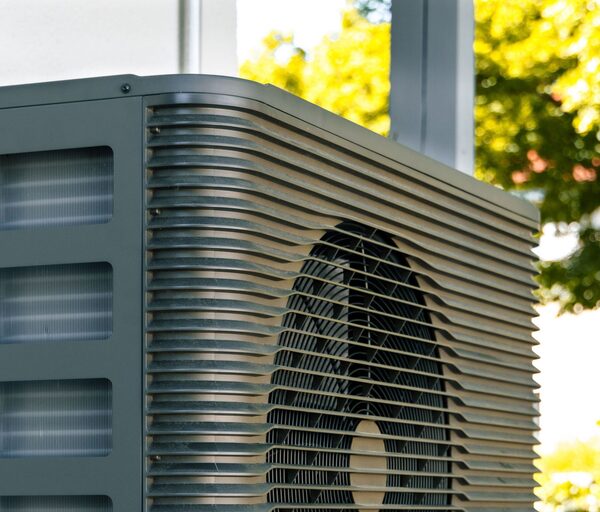
Fluorinated gases, usually called F-Gases, are the refrigerants used in heat pumps, air conditioning and refrigeration. The rules that govern who may handle them are set out in retained Regulation 2015/2067, which establishes the minimum requirements for the training and certification of handlers of stationary refrigeration, air conditioning and heat pump equipment and refrigerated trucks and trailers4.
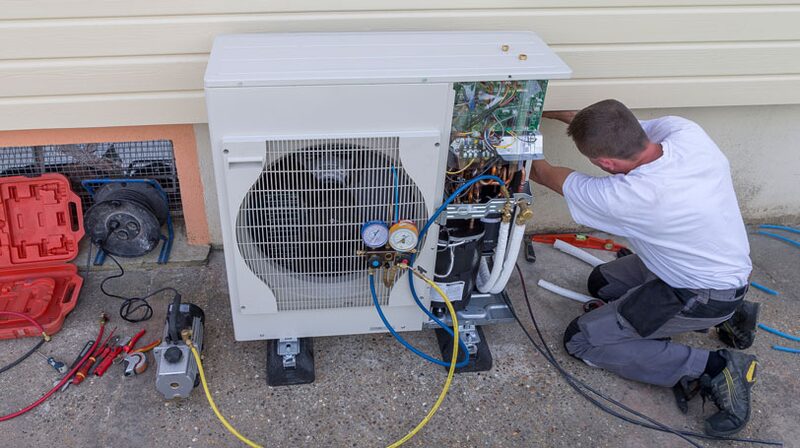
The practical effect for a household is that refrigerant work is not a DIY task. Handling, charging and recovering refrigerant requires a certified handler. The UK recognises equivalent qualifications issued by an EU Member State, so a qualification gained elsewhere in Europe can be recognised here4. That recognition matters for households buying equipment from overseas suppliers or using installers who trained outside the UK.
The F-Gas regime also sits behind the choice of equipment. A heat pump installed as part of an off-grid heating system will contain a refrigerant charge, and the installer's certification is part of what makes the installation compliant. This is one of the few areas where an off-grid household's independence is limited by a licensing regime rather than by physics: the gas itself is regulated, and the person who touches it must be certified.
For households weighing a heat pump against other heating options, the heat pump and import dependence page sets out what a heat pump and an electric vehicle do to a home's reliance on imported energy.
Buying equipment charged with refrigerant gas: the evidence retailers need
When a household buys equipment that arrives pre-charged with refrigerant, the transaction sits at the intersection of two regimes. The first is the F-Gas certification requirement, which governs who may install and service the equipment. The second is product safety law, which governs what may be sold.
The UK's new product safety framework proposes that only safe products will be able to be sold online to UK buyers, whether the seller is based in the UK or overseas5. That is a significant change for households buying equipment from overseas marketplaces, because it removes the assumption that an overseas seller sits outside UK product safety expectations. The obligations on online marketplaces and the new enforcement powers will apply across the whole of the UK5.
Online marketplaces would also have a duty of due diligence to identify and take action against sellers that repeatedly sell dangerous products or do not comply with product safety obligations5. For a household buying a pre-charged unit, that duty is the mechanism that is meant to keep non-compliant equipment off the market.
There is a Northern Ireland dimension. A business that is a distributor or a fulfilment service provider in Northern Ireland will be an onward supplier under the new regulations in Great Britain5. That means the supply chain obligations follow the goods across the Irish Sea in a way that households in Great Britain buying from Northern Ireland suppliers should be aware of.
The evidence a retailer needs is therefore twofold: certification for the refrigerant work, and compliance with product safety obligations for the goods themselves. A household buying a pre-charged unit should expect the supplier to be able to demonstrate both.
Enforcement: prosecutions of online sellers

Enforcement of consumer protection and competition law in the off-grid market has historically sat with the Office of Fair Trading, which regulates the off-grid market1. That framing is worth noting because it shows the off-grid market has been treated as a consumer protection matter, not only an environmental one.
The newer enforcement picture is built around online marketplaces. The proposed duty of due diligence on marketplaces is explicitly aimed at bad actors, and the enforcement powers that accompany it will apply across the whole of the UK5. For households, the practical consequence is that a marketplace is expected to act against a seller that repeatedly breaches product safety obligations, rather than leaving the buyer to pursue an overseas seller alone.
Where a household has a dispute with an energy supplier rather than a marketplace seller, a different route applies. The Energy Ombudsman is approved by Ofgem to handle service disputes in the energy sector, and it only handles disputes involving suppliers trading in Britain6. That territorial limit matters for off-grid households in Northern Ireland, who fall outside the Ombudsman's remit for supplier disputes.
For households dealing with a supplier problem, the Ofgem complaints route and the Energy Ombudsman processes set out how a dispute escalates. The Ombudsman requires that a complainant has already complained to the supplier and received a deadlock letter or waited eight weeks, and has sufficient evidence including the complaint date7.
The HFC quota system and what it covers
The HFC quota system is the mechanism that limits the quantity of hydrofluorocarbons placed on the market. The Environment Agency runs it for the whole of Great Britain2. That territorial scope is the key fact for households: the quota covers England, Scotland and Wales, and Northern Ireland sits outside it.
The quota system matters to an off-grid household indirectly. It constrains the supply and cost of the refrigerants used in heat pumps and refrigeration equipment, and it shapes which equipment is available. A household choosing a heat pump is choosing a product whose refrigerant is subject to a national quota, and the phase-down of high global warming potential gases is what drives manufacturers towards alternatives.
The quota is not something a household interacts with directly. There is no household registration, no annual return and no fee. The obligation sits on companies that place bulk gas or pre-charged equipment on the market. What a household sees is the downstream effect: equipment specifications, refrigerant types and, occasionally, availability.
For an off-grid home, the quota is one more reminder that independence is rarely absolute. A home can generate its own electricity and pump its own water, but the refrigerant in its heat pump is part of a regulated national market. The local control versus cloud page covers a parallel dependence, where a manufacturer's software rather than a gas quota constrains what a household can do with its own equipment.
Contacting the Environment Agency
For F-Gas queries, the Environment Agency is the enforcement body in England and the operator of the Great Britain HFC quota system2. Households and installers with a query about certification, quota or enforcement should approach the Agency through its published routes.
For the environmental schemes that sit alongside off-grid energy, Ofgem publishes contact addresses. General Energy Company Obligation questions go to eco@ofgem.gov.uk, and supplier compliance questions go to ecogbis_compliancequeries@ofgem.gov.uk8. Boiler Upgrade Scheme enquiries go to BUS.Enquiry@ofgem.gov.uk, and administration feedback goes to feedback@ofgem.gov.uk9. Whistleblowing concerns can be raised at whistle@ofgem.gov.uk10.
For Northern Ireland, the Better Energy Homes Plus and Better Energy Homes Cashback schemes are managed by O'Kane Plumbing and Electrics Ltd, with telephone contact on 028 8675 1049 and email at teresa.mccullagh@okpe.co.uk11. That is a different administrative route from the Great Britain schemes, and it reflects the separate energy policy arrangements in Northern Ireland.
Where a household has a complaint about an energy supplier rather than a scheme, Citizens Advice consumer service may refer a case to the Extra Help Unit if the household needs support with a difficult or urgent complaint, cannot deal with the supplier alone due to personal circumstances, is considered vulnerable, or is at risk of being disconnected12. That referral route is available in England and Wales.
What off-grid water and waste add to the energy load
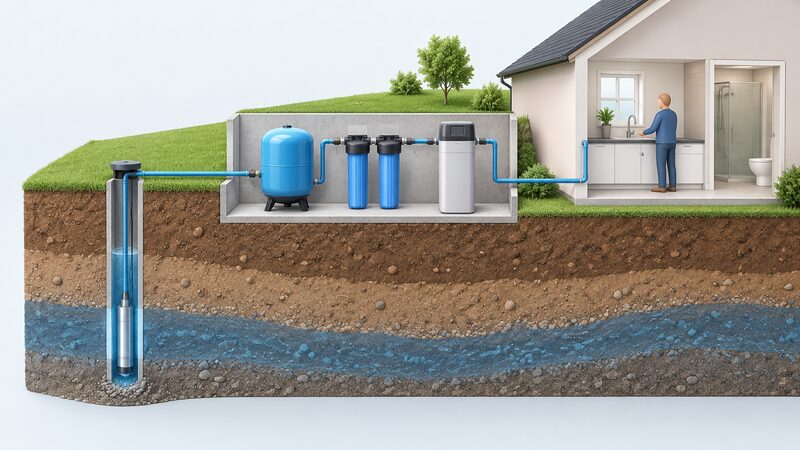
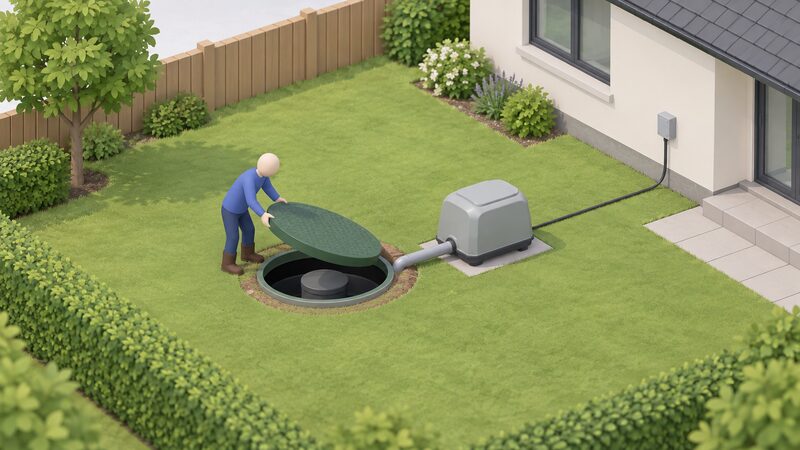
The energy cost of off-grid water and waste is the part that most directly affects a household's independence, because it is a load that runs whether or not the sun is shining. A private water supply needs a pump to lift water from a borehole or spring and to pressurise it for the house. A package treatment plant needs an air blower running continuously to aerate the effluent. A rainwater harvesting system needs a pump and, where the water is used for anything beyond garden irrigation, a treatment stage.
Those loads are small individually but constant. A pump that runs intermittently still draws a starting current each time it kicks in, and a treatment plant blower runs continuously. For a home sizing a battery, that continuous load sets a floor on usable capacity: the battery must cover the blower through the night and through cloudy spells, not just the evening peak.
The interaction with generation is where the design matters. A micro hydro plant is the one renewable technology that suits an off-grid water site particularly well. For houses with no mains connection but with access to a micro hydro site, a good hydro system can generate a steady, more reliable electricity supply than other renewable technologies at a lower cost13. That steadiness pairs naturally with a constant treatment load, because both are continuous rather than intermittent.
Water saving devices reduce the load at source. Many water companies give them away for free14. For an off-grid home, reducing water use reduces the volume that must be pumped, stored and treated, which reduces the energy the system draws. That is the cheapest form of independence available, because it removes load rather than adding generation.
Support and grants for off-grid homes

The grant landscape for off-grid homes changed in 2025. The Home Upgrade Grant scheme ended in March 2025, with off-grid homes previously supported by it now covered by the Warm Homes: Local Grant1. That is a material change for households that had been planning around the older scheme.
The Home Upgrade Grant covered England only15. In England, an uplift for measures delivered to off-gas premises will not apply16. That means off-gas homes do not receive the additional support that an uplift would have provided, even though they are the households most likely to need it.
The wider policy direction for off-gas-grid heating has also shifted. The UK Government has proposed delaying the ban on installing oil and LPG boilers, and new coal heating, for off-gas-grid homes from 2026 to 203517. The same consultation proposed exempting certain households from the phase out of fossil fuel boilers, including gas, in 203517. Those are proposals rather than settled law, and households should treat the dates as subject to change.
For households in park homes, and especially those using bottled gas, the issues are different again. Those who live in park homes and especially those using bottled gas may experience particular issues1. That is a distinct set of constraints from a rural home with a borehole and a treatment plant.
The Feed-in Tariff scheme, which supported small-scale renewable generation, was administered by the Gas and Electricity Markets Authority, whose day-to-day functions are performed by Ofgem, and covered technologies up to a total installed capacity of 5MW in England, Wales and Scotland3. The scheme is closed to new applicants, but its historical pattern is instructive: the highest proportion of micro installations and total capacity was focused around the South West, South East and East of England, with the lowest around Wales, the North East and London18. Off-grid homes cluster in the same rural areas that led on small-scale generation.
Where off-grid water and waste leave a household dependent
The independence an off-grid water and waste system delivers is real but partial, and it is worth stating the remaining dependencies plainly.
- A pump or blower that needs power. A private supply and a treatment plant both depend on electricity. If the generation and storage fail, the water and waste systems fail with them.
- A treatment process that needs servicing. A package treatment plant requires periodic desludging and maintenance, which means a contractor visit rather than a self-contained system.
- A refrigerant regime that needs certification. Heat pump equipment contains F-Gases, and handling them requires a certified person under retained Regulation 2015/20674.
- A quota system set nationally. The HFC quota is run by the Environment Agency for Great Britain, so the refrigerant market is not something a household controls2.
- A regulator for consumer disputes. The Energy Ombudsman handles disputes involving suppliers trading in Britain only, leaving Northern Ireland outside that route6.
The self-sufficiency ratio page sets out how to measure how much of a household's own demand its own systems actually meet, which is the honest way to describe a system that pumps its own water but still buys its own refrigerant.
"The Environment Agency also run the HFC quota system for the whole of Great Britain"
Sources18 cited
- Off-gas grid households briefing, House of Commons Library, 2026-09-17
- HFC phase-down reform de minimis assessment, Defra, 2025-09-02
- Guidance for FIT Generators V18, Ofgem, 2026-04-01
- F-Gas Handler regulated profession, UK Regulated Professions, 2026-09-17
- The UK's new product safety framework, UK Government, 2026-03-31
- Energy Ombudsman FAQs, Energy Ombudsman, 2026-09-19
- Raise a dispute: British Gas Trading, Energy Ombudsman, 2026-09-19
- Energy Company Obligation contacts and resources, Ofgem, 2026-09-17
- Boiler Upgrade Scheme property owner guidance, Ofgem, 2026-03-25
- Boiler Upgrade Scheme installer guidance, Ofgem, 2022-07-21
- NISEP list of schemes 2026-27, Utility Regulator Northern Ireland, 2026-04
- Complain about your energy supplier or network operator, Ofgem, 2026
- Hydro-electricity, Planning Portal, 2026
- Homes and energy, Manchester City Council, 2026-09-20
- Green Homes Grant LAD and HUG release, UK Government, 2025-07-31
- ECO4 and GBIS mid-scheme changes, Ofgem, 2025-04-07
- Delivering net zero for Scotland's buildings, Scottish Government, 2023-11-28
- Feed-in Tariffs Annual Report Scheme Year 13, Ofgem, 2023-12
 Going Off-Grid in the UKA whole-picture account of an off-grid UK home: electricity, heat, hot water, cooking, water and waste, and the seasonal management it demands.
 Is Off-Grid Living Legal?Can you legally live without mains gas or electricity in the UK?
 The Full Where Our Energy Comes From GuideWhere does the gas in your boiler and the electricity in your sockets actually come from?
 Off-Grid in a UK WinterHow does a home with no mains connection keep the lights on through the darkest, stillest weeks of a UK winter?
 The Full Statistics GuideHow many homes in the UK have solar panels, heat pumps or batteries?
 Cost of Energy IndependenceA heat pump and better insulation are the usual starting point, but what does the whole job really cost, and what help is there with the bill?