
In this guide
Micro hydro power is electricity generated from running water turning a turbine, at a scale small enough to serve a single property or a small group of them. Official guidance defines a micro hydro plant as one that generates less than 100 kilowatts, and notes that useful power may be produced from even a small stream1. The same guidance is blunt about where such schemes make sense: for houses with no mains connection but with access to a micro hydro site, a good hydro system can generate a steady, more reliable electricity supply than other renewable technologies at a lower cost1.
That combination of reliability and narrow suitability is the whole story of domestic hydro in the UK. A stream that flows all year gives a flatter output than wind or solar, which is why hydro is prized off grid. But the site requirements are geological and legal rather than financial, and most properties have neither the fall of water nor the right to take it. The viability of an installation depends on whether there is enough water flowing per second and the height, or head, that it falls from2.
What micro hydro power is, and what it is not
The engineering definition is a capacity threshold, not a description of the machinery. A micro hydro plant generates less than 100 kilowatts1. That is a wider band than the 50 kilowatt figure used elsewhere in the rules: microgeneration is defined in Northern Ireland legislation as use for the generation of electricity or the production of heat where the electricity capacity does not exceed 50 kilowatts5, and a parallel definition describes a microgeneration system as equipment that generates electricity6. Scottish guidance uses the same 50 kilowatt figure for electricity and 45 kilowatts thermal for heat7.
The distinction matters because a scheme between 50 kW and 100 kW is a micro hydro plant in the engineering sense but sits outside the microgeneration definitions that govern some permissions and support routes. For a single house, the practical band is far below either figure. Scottish guidance describes an increasing number of pico-hydro turbines, generally taking the form of run-of-river projects, generating up to 10 kW of electricity8. A domestic scheme is therefore usually a pico-hydro installation in all but name.
What micro hydro is not is a battery of any kind. It produces when the water flows, and the water flows whether or not the house needs power at that moment. Off grid, that surplus has to go somewhere: in off-grid applications the power is used for lighting and electrical appliances, and space and water heating can be supplied when available power exceeds demand1. On grid, the surplus is exported, which brings its own metering and payment arrangements.
Hydro is also not a new idea in the British landscape. Hydropower or hydroelectricity, generated from dams, sluices and mill wheels, was used for many years to generate electricity in a local area, and this method of generation generally disappeared with the introduction of the electricity grid2. What is being installed now is a return to a pre-grid pattern of local generation, using modern turbines and controls.
Head and flow: the two figures that decide everything
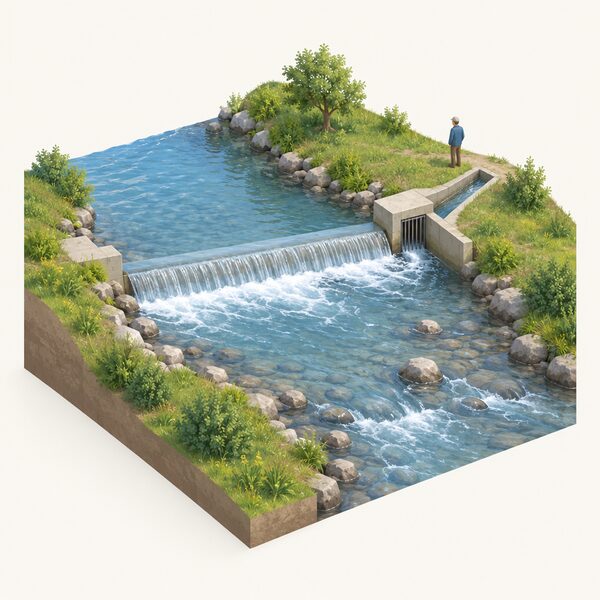
Every hydro scheme, from a 200 W pico unit to a community turbine, is sized from the same two measurements. The viability of the installation will depend on whether there is enough water flowing per second and the height or head that it falls from2. Flow is the volume passing a point in the stream each second; head is the vertical drop the water can be made to fall through. Power rises with both, so a modest flow with a large head can outperform a large flow with almost none.
The third requirement is environmental rather than technical. There should also be enough residual flow to maintain the water course2. A scheme cannot abstract the whole stream even where the abstraction is licensed, because the stretch below the intake has to remain a functioning watercourse. That residual flow is subtracted from the available flow before the turbine is sized, and on small streams it can take a large share of the total.
This is why site assessment comes before equipment choice, and why the assessment is a measurement exercise rather than a calculation from maps. Flow varies through the year, and a scheme sized on a winter spate will be oversized for the summer. The turbine type follows from the head and flow figures, not the other way round: Pelton, Turgo, crossflow, propeller and Archimedes screw machines each suit different combinations, and the choice is settled once the site has been measured. The same measurements feed into head and flow sizing and into the selection of a turbine type.
"The viability of the installation will depend on whether there is enough water flowing per second and the height or 'head' that it falls from."
What a run-of-river scheme is made of
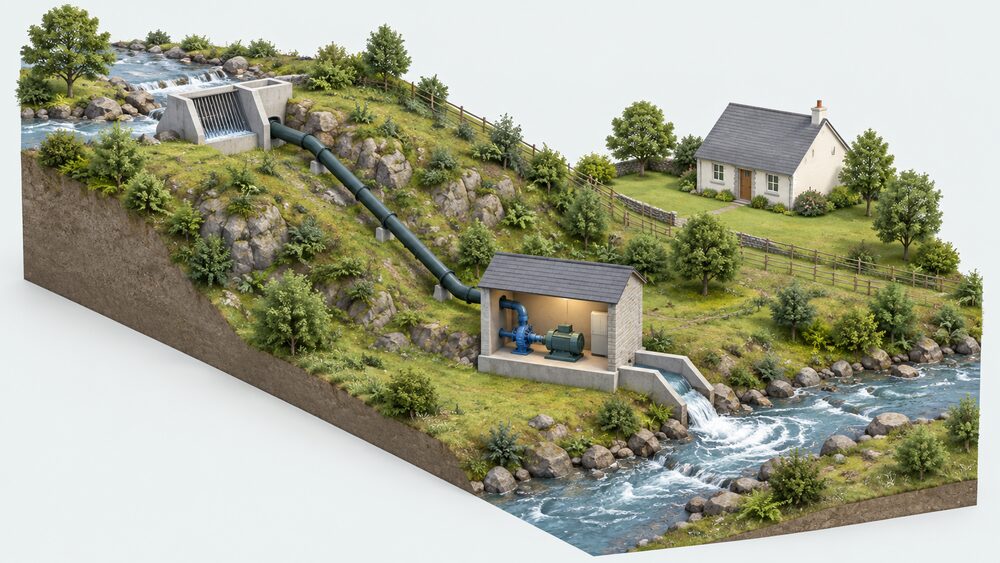
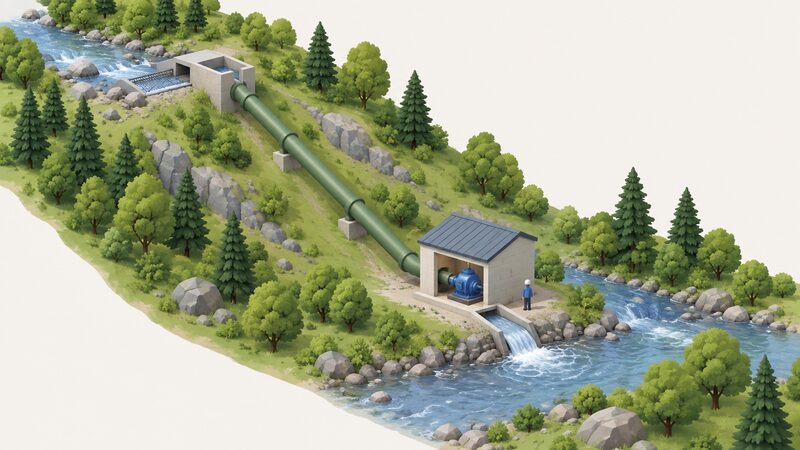
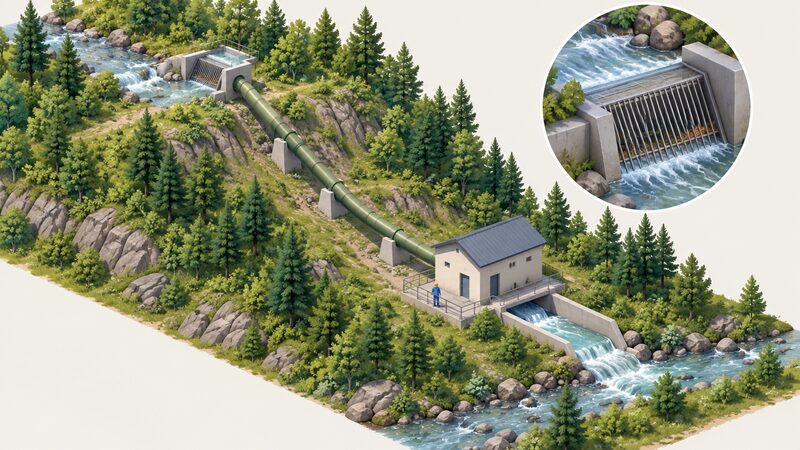
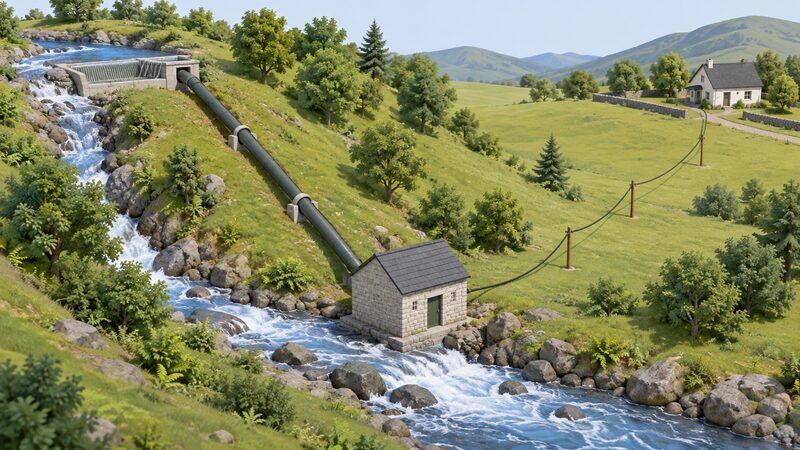
A run-of-river scheme does not store water behind a dam. It diverts a proportion of the stream's flow, drops it through a turbine and returns it to the channel downstream. The components are consistent across schemes, and each one has a function that a householder will have to live with.
- Intake and screen. Water is taken from the stream at a point where it can be diverted without scouring, and screened to keep debris and fish out of the pipeline.
- Penstock. The pipeline that carries water from the intake to the turbine, gaining head as it descends. Its length and diameter are set by the fall available and the flow to be carried.
- Turbine and generator house. The machine that converts the falling water into rotation, and the generator that turns that rotation into electricity.
- Tailrace. The channel that returns the water to the stream below the turbine.
- Controls and, off grid, storage. Governing equipment to match output to demand, and batteries or a dump load where there is no grid connection.
The environmental and licensing work sits alongside the civil engineering rather than after it. Various consents and licences are required for a hydro project2, and abstraction is the principal one, since taking water from a watercourse is a regulated activity. Fish passage and screening requirements attach to the intake, and the residual flow condition attaches to the abstraction. These are not formalities that can be resolved by choosing a smaller turbine: they apply to the scheme as a whole. The detail sits in abstraction licences and permits and in fish passage and environmental requirements.
What drives the output, and what limits it
Output is set by head, flow and the efficiency of the machine, and it varies through the year with rainfall and catchment behaviour. The reliability that makes hydro attractive off grid is a statement about steadiness relative to other renewables, not about constancy. A stream that runs all year still runs lower in a dry summer, and a scheme sized for average flow will spend part of the year below its rated output.
The comparison with other technologies is worth stating precisely, because it is often overstated. Small-scale turbines generate electricity from wind, and these depend on wind speed and location9. Solar varies with daylight and cloud. A stream fed by a catchment has a different pattern, which is why official guidance singles out hydro for off-grid houses with access to a site, describing a steady, more reliable supply than other renewable technologies at a lower cost1. That is a statement about suitable sites, and it does not transfer to sites without one.
There is a wider context in which domestic generation sits. Domestic energy demand has fallen by 19% since 2000, despite a 12% increase in the number of households and a 10% increase in population10. A household sizing a scheme today is therefore sizing against a lower demand baseline than a generation ago, and insulation reduces it further. Official guidance is explicit that a property should be properly insulated before installing renewable technologies2. Generation capacity spent heating a leaky building is capacity paid for twice.
The scale of what hydro contributes nationally puts domestic schemes in perspective. Over 90% of the UK's power from hydro is generated in Scotland4, and renewable sources supplied 29.3% of electricity generation for the UK as a whole in the period reported in 2019, against 25.6% for the rest of the UK excluding Scotland11. Domestic hydro is a rounding error in those totals. Its value is local and, off grid, absolute.
How it differs across the UK nations
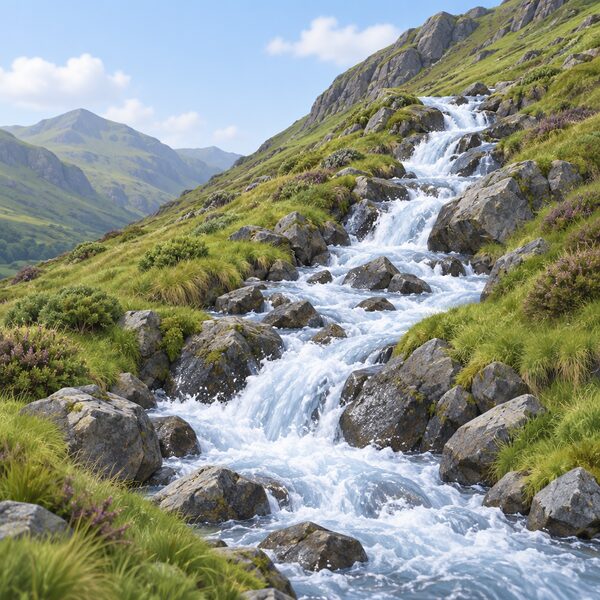
The resource is concentrated in Scotland, but the rules that govern a scheme are made in each nation, and they diverge in ways that matter to a householder.
| Nation | Position on small hydro |
|---|---|
| Scotland | Over 90% of UK hydro generation; pico-hydro run-of-river schemes generating up to 10 kW are increasingly common4 |
| England | Planning guidance for microgeneration is published for England, with the note that policy in Wales may differ12 |
| Wales | Building regulations for hydro electricity are published separately by the Welsh Government13 |
| Northern Ireland | Hydropower guidance and separate building control requirements are published by nidirect and Building Control NI2 |
The Scottish position is distinctive in two ways. First, the physical resource: the rainfall and topography that produce over 90% of UK hydro output4. Second, the policy attention: Scottish Government work has examined permitted development rights for microgeneration, listing micro-renewables as producing heat or energy from renewable sources such as solar, wind, biomass or by exchanging heat naturally present in the air or ground15, and a separate consultation listed solar panels, biomass, free-standing wind turbines and air source heat pumps among the developments under consideration16. Hydro's place in those lists is narrower than wind or solar, reflecting the site-specific consents it needs.
For England and Wales, the planning portal's microgeneration certification guidance carries the caveat that it relates to the planning regime for England and that policy in Wales may differ12. Welsh building regulations for hydro electricity are published by the Welsh Government13. In Northern Ireland, hydropower guidance sits with nidirect2 and energy conservation requirements with Building Control NI14. The practical consequence is that a householder establishing what consents apply should work from the guidance for their own nation rather than a UK-wide summary.
The rules: consents, building regulations and grid connection
The consent position for a hydro scheme is more involved than for most domestic renewables, because it involves water as well as electricity and construction. Various consents and licences are required for a hydro project2. Abstraction is the central one, and it is granted by the environmental regulator for the nation, with conditions on the volume that may be taken and the residual flow that must be left.
Building regulations apply to the construction and electrical side. Building regulations will normally apply to aspects of the work such as electrical installation13. The same principle appears in the guidance for micro-combined heat and power, where building regulations also apply to other aspects of the work such as electrical installation and plumbing work17. For a hydro scheme, that covers the turbine house, the wiring and the connection to the property's electrical installation.
Planning permission is a separate question from building regulations, and it turns on scale and siting. For comparison, planning permission is not normally needed when installing a micro-combined heat and power system in a house if the work is all internal19, and permitted development for wind turbines is conditional on compliance with the Microgeneration Certification Scheme Planning Standards or equivalent standards20. Hydro has no equivalent blanket permitted development right, because the intake, pipeline and tailrace are external works on or near a watercourse.
Grid connection brings its own requirements. The Smart Export Guarantee requires licensed electricity suppliers to offer export tariffs to anaerobic digestion, hydro, onshore wind and solar photovoltaic installations up to 5 megawatts, with installations located in Great Britain23. Micro-combined heat and power is supported up to 50 kilowatts23. The scheme's scope is confirmed in parliamentary research, which records the technologies supported as including solar photovoltaics, wind, micro-combined heat and power, hydropower and anaerobic digestion, up to 5 megawatts in capacity, or up to 50 kW for micro-CHP, with installations required to be located in Great Britain24. Northern Ireland is outside that territorial scope, so export payments there follow a different route.
The Feed-in Tariff, which preceded the Smart Export Guarantee, is closed to new applicants but its definitions still shape how installations are classified. Under that scheme, a micro installation was one with a declared net capacity of 50 kW or less25. Micro-CHP was defined as a technology that generates heat and electricity simultaneously, from the same energy source, normally natural gas26, and micro-CHP installations represented approximately 0.03 percent of total installed capacity under the scheme as at 31 March 201227. Those figures describe a scheme that has closed, and they are useful mainly for reading older documentation.
What micro hydro means for a household's energy independence
A hydro scheme changes the relationship between a property and the grid more completely than most domestic renewables, and it does so on terms the site dictates rather than the household.
Where there is no mains connection, the change is total. For houses with no mains connection but with access to a micro hydro site, a good hydro system can generate a steady, more reliable electricity supply than other renewable technologies at a lower cost1. The household stops depending on a supplier, a meter and a standing charge, and depends instead on its own catchment. That is a genuine independence, and it is the strongest case for the technology.
Where there is a mains connection, the independence is partial and worth describing honestly. The scheme reduces imported units and earns export payments under the Smart Export Guarantee23, but the property remains connected, remains reliant on the grid for the periods when the stream is low or the turbine is out of service, and remains reliant on a licensed supplier for the export tariff itself. Hydro does not remove the supplier; it changes the balance of the relationship.
The dependence that remains is worth naming. It includes the watercourse and its catchment, over which the household has no control and which is subject to the abstraction licence conditions and the residual flow requirement2. It includes the manufacturer and installer of the turbine and controls, for spares and service. It includes the environmental regulator and the planning authority, whose consents can be varied. And off grid, it includes whatever storage and governing equipment the scheme uses, since a turbine without a dump load or battery has nowhere to put surplus power.
The wider context is that microgeneration is increasingly used to produce energy and sell it back to the grid28, and that household demand has been falling for two decades10. A scheme sized today is therefore smaller than the same property would have needed in 2000. That is a favourable trend for anyone with a suitable stream, and it does not change the fact that suitability is the binding constraint. For a household weighing hydro against other options, the comparison pages on micro hydro versus micro wind and micro hydro versus solar PV set out the trade-offs, and the wider picture sits in microgeneration and energy independence.
Sources28 cited
- Hydro electricity, Planning Portal, 2026
- Hydropower, nidirect, 2026
- Householder permitted development rights guidance, Scottish Government, 2021
- Scottish Energy Strategy, Scottish Government, 2017
- Microgeneration (Northern Ireland) Regulations 2015, legislation.gov.uk, 2015
- Microgeneration (Northern Ireland) Regulations 2015 (PDF), legislation.gov.uk, 2015
- Scottish skills requirements consultation, Scottish Government, 2021
- Microgeneration planning advice, Scottish Government, 2013
- Sustainable home energy solutions, Planning Portal, 2024
- Future Insights Series 4, Ofgem, 2017
- Annual Energy Statement 2019, Scottish Government, 2019
- The Microgeneration Certification Scheme, Planning Portal, 2026
- Building regulations: hydro electricity, Welsh Government, 2026
- Energy conservation, Building Control NI
- Extending permitted development rights in Scotland, Scottish Government, 2019
- Permitted development rights sustainability appraisal, Scottish Government, 2019
- Micro-combined heat and power: building regulations, Planning Portal, 2026
- Building regulations: micro-combined heat and power, Welsh Government, 2026
- Micro-combined heat and power: planning permission, Planning Portal, 2026
- Building-mounted wind turbines: planning permission, Planning Portal, 2026
- Stand-alone wind turbines: planning permission, Planning Portal, 2026
- Planning permission: wind turbines, Welsh Government, 2026
- Smart Export Guarantee guidance for generators, Ofgem, 2019
- Research briefing on the Smart Export Guarantee, House of Commons Library
- Feed-in Tariffs guidance for renewable installations, Ofgem, 2021
- Feed-in Tariffs Annual Report, Scheme Year 13, Ofgem, 2023
- Feed-in Tariffs Annual Report 2011-2012, Ofgem, 2012
- Smart means more efficient, innovative market, Ofgem, 2015
 Abstraction Licences and PermitsTaking water from a stream to power a turbine needs permission, and where you live decides who grants it.
 Micro Hydro InstallationHow much water do you need, and how far does it have to fall, for a micro hydro system to be worth it?
 Microgeneration and IndependenceWhat can you use when solar cannot cover winter evenings, and does it really make you independent?
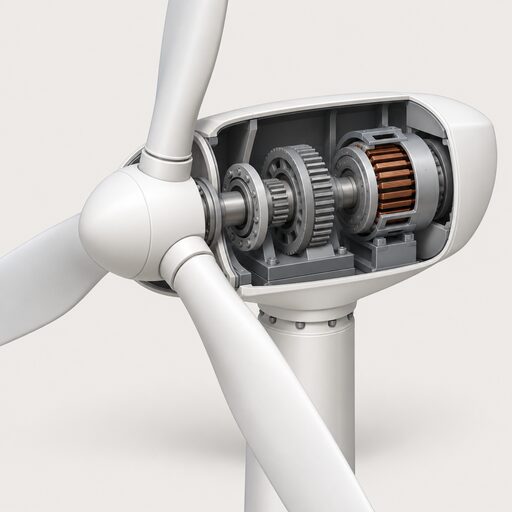 Domestic Wind TurbinesCan a wind turbine really power a home, and is your site windy enough?
 Microgeneration by Home TypeA stream running through your land, a windy exposed spot, or a gas boiler that runs almost all day: each points to a different technology.
 Wind Turbine Output and SizingHow much electricity a home wind turbine makes depends far more on your wind than on its size.