

In this answer
Short answer
A run-of-river hydro scheme does not run at full power for the whole year, and the figure that captures this is the load factor: the actual energy generated over a year divided by the theoretical maximum the scheme could produce if it ran flat out for every hour of the year1. For a domestic or community scheme on a British river, the practical expectation is a scheme that generates whenever the river is high enough, and stands still when it is not.
The reason is structural rather than mechanical. A run-of-river system uses the existing flow of the river and has no reservoir behind it, so it cannot bank water for a dry week2. Output is easy to predict but highly seasonal2. In theory a hydro system can generate 24 hours a day, which could provide all the electricity a property needs and more, without releasing any harmful CO2 or other pollutants into the atmosphere3. In practice the river decides.
That makes the load factor the single most useful number for anyone weighing up a site, because it converts a turbine's rated capacity into a realistic annual yield. It also sets the ceiling on what the scheme can do for a household's energy independence: a run-of-river scheme reduces imported electricity and can cover a property's demand outright in a good flow, but it remains dependent on the weather, on the grid for backup and export, and on a tariff or supplier to be paid for what it exports.
What a load factor tells you about a run-of-river scheme
Load factor and capacity factor are the same idea under two names. The official definition is the percentage of a project's maximum theoretical output that it achieves, calculated by dividing the actual energy generated over a year by its theoretical maximum capacity1. For a hydro scheme the denominator is the turbine's rated output multiplied by every hour in the year; the numerator is what the river actually delivered.
That distinction matters because a hydro turbine's nameplate figure is a peak, not a promise. A scheme rated at a given capacity will only reach that capacity when flow and head are both at the design point. The greater the height and the more water there is flowing through the turbine, the more electricity generated6. When the river drops below the design flow, the turbine still turns, but at a fraction of its rating, and the annual load factor records the shortfall.
For a household, the load factor is the bridge between a manufacturer's specification and a realistic view of self-sufficiency. A high figure means the scheme is working hard across the year and displacing more imported electricity; a low figure means long idle periods and a greater reliance on the grid or on storage. It is also the number that determines whether a scheme's output is worth the civil works, because the energy sold or offset is what repays the installation.
Two cautions apply. First, load factor says nothing about total yield on its own: a small turbine on a steady river can post a strong percentage while generating modest absolute energy. Second, it is a backward-looking measure. A figure from one year of operation reflects that year's rainfall, and a dry year will pull it down. Prospective owners are better served by treating it as a range than a fixed value.
Why run-of-river output follows the seasons

A run-of-river scheme is a direct expression of its catchment's hydrology. It uses the existing flow of the river, and it is entirely dependent on the strength of that river2. Rainfall, snowmelt and groundwater recharge drive flow up through autumn and winter and down through late spring and summer, so generation follows the same curve. Energy generated can be easy to predict, but will be highly seasonal2.
This is the central practical difference between hydro and most other home generation. A solar array has a predictable daily and seasonal profile that can be modelled from latitude and shading. A hydro scheme's profile depends on a specific river's behaviour, which is why the lowest level of the river matters more than its highest when judging feasibility2. A site that looks powerful in February may be a dry channel in August.
The seasonal swing has consequences beyond output. Savings will depend on the number of hours the turbine is able to run in a year, which in turn will depend on how often the water levels are high enough to supply the system3. A scheme sized for winter flows will spend part of the year at part load; one sized for summer flows will spill water it could have used in winter. Neither is wrong, but the load factor differs sharply between them.
"Energy generated can be easy to predict, but will be highly seasonal"
For energy independence, seasonality means a run-of-river scheme is a strong summer and winter contributor in wet periods and a weak one in dry ones. It reduces dependence on imports across the year but does not remove it, and a household that wants year-round cover will need either grid backup or storage sized for the low-flow months.
Typical load factors: what a scheme achieves in practice
The honest answer for a domestic or community scheme is that there is no single national figure, and the sources that describe run-of-river systems describe behaviour rather than a percentage. What they do establish is the shape of the year: a scheme that generates whenever the river is high enough, with long periods at part load and some periods at nothing.
The nearest thing to a benchmark in the official statistics is the performance of hydro within the Feed-in Tariff register, which records capacity rather than load factor. Hydro accounts for 4.14% of capacity by technology type over scheme lifetime5, a figure that has been stable across recent quarterly reports, with hydro contributing 39.6% of new capacity in one quarter of FIT Year 167. Those numbers describe the installed fleet, not how hard each scheme works, and they should not be read as a load factor.
Where a load factor can be estimated, it comes from the site itself. The standard estimating method is to multiply the flow rate in litres per second by the head in metres and by 10, then halve the result to allow for losses, which gives watts8. That gives instantaneous power at a given flow. Comparing it against the turbine's rating, and against how many hours a year the river sustains that flow, is what produces a load factor.
In practice, a run-of-river scheme on a good site will spend a meaningful part of the year at or near its design output and the rest below it. The independent guidance is explicit that a water turbine run at about 70% capacity produces output per kilowatt about seven times that of a PV array8. That comparison is about output per unit of installed capacity, not about hours at full power, and it illustrates why hydro is valued where a suitable river exists.
What limits a scheme's hours at full power
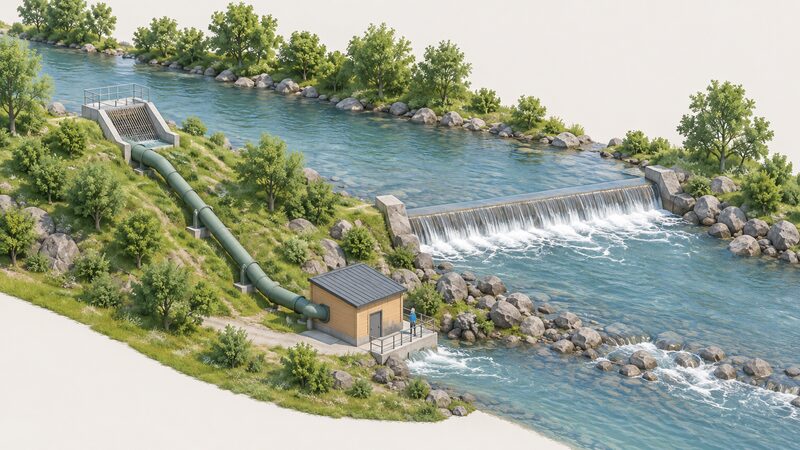
The first limit is the river. A run-of-river scheme has no storage, so it cannot run at full power when flow is below the design figure, and it will not run at all if the river goes dry due to drought2. Drought is one of the climate risks, alongside flooding, high winds and heat, that official guidance identifies as affecting the energy system9, so low-flow periods are a planning assumption rather than a rare event.
The second limit is the intake and screening. Screening the water intake minimises the risk of damage caused by debris carried downstream during floods6. That protection keeps the scheme running, but it also means the intake must be maintained, and a blocked screen reduces flow to the turbine. Floods themselves can exceed the turbine's design flow, forcing the scheme to spill water it cannot use.
The third limit is the connection. A generator's output has to be accommodated by the network, and the rules scale with capacity. Sites with a generation capacity greater than 30kW are required to have a half-hourly meter10, and larger installations face different accreditation routes: all installations using a FIT-eligible technology with a declared net capacity over 50kW up to a total installed capacity of 5MW, and anaerobic digestion and hydro installations of all capacities, apply to Ofgem for ROO-FIT accreditation11. These thresholds do not change the river's behaviour, but they shape what a scheme can be paid for and how it is metered.
Finally, there is the tariff context. The Feed-in Tariff is closed to new applicants, and the rate a generator receives varies based on factors such as the installation technology, total installed capacity, and the tariff period the installation falls into12. For small generators transferring from the Renewables Obligation, the eligibility period expires on 30 September 2029 for wind, hydro and anaerobic digestion13. A scheme's revenue therefore depends on when it was accredited as much as on how often it runs.
How run-of-river compares with reservoir hydro and wind
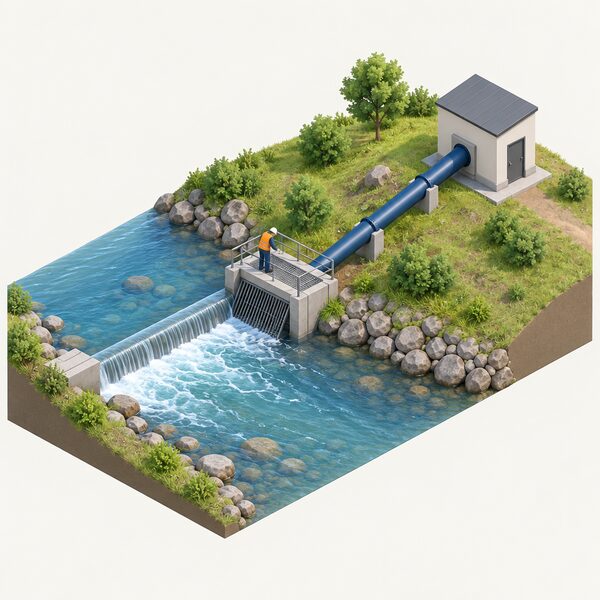
Reservoir hydro can store water and release it when demand or price is highest, which lifts its load factor and its value per unit. A run-of-river scheme cannot do this: it uses the existing flow of the river and takes what the catchment provides2. That is the trade for lower civil costs, fewer environmental consents and a simpler installation, and it is why run-of-river is the most typical arrangement for domestic or community systems2.
Against wind, the comparison is about predictability rather than peak output. Individual wind turbines vary in size and power output from a few hundred watts to two or three megawatts14, and their output depends on a resource that cannot be seen or measured from a map. Hydro's advantage is that flow can be gauged directly and generation is easy to predict, even though it is highly seasonal2. Hydro's disadvantage is that it needs a river with sufficient flow and head, which most properties do not have.
The official statistics put both technologies in context. Over scheme lifetime, hydro accounts for 4.14% of accredited capacity and wind 11.89%5, a split that has been consistent across recent quarterly reports, with hydro at 4.13% in an earlier edition15. Those shares reflect how many schemes of each type have been accredited, not how well they perform.
For a household, the choice between the two is usually made by the site rather than by preference. A property with a suitable river and head can achieve a steadier, more predictable contribution than a wind turbine of similar rating, because the resource is measurable in advance. A property without a river has no hydro option at all. Neither technology removes the need for a grid connection or storage, and both leave the household exposed to the weather in the year it actually experiences.
Sources15 cited
- Energy generation in Wales 2023, Welsh Government, 2025-03
- Hydropower for the home, uSwitch, 2026-01-06
- Hydro, Electricity North West, 2026-09-19
- Hydroelectricity, Energy Saving Trust, 2025-11-06
- Feed-in Tariffs Quarterly Report Issue 64, Ofgem, 2026-06-29
- Hydroelectricity, Home Energy Scotland, 2026-09-20
- Feed-in Tariffs Quarterly Report Issue 63, Ofgem, 2026-03-30
- Micro-hydro, Centre for Alternative Technology, 2025-07-01
- Well-adapted energy system, Climate Change Committee, 2026-09-19
- G98 Single Premises Summary Guide, Energy Networks Association, 2026-09-17
- Feed-in Tariff guidance for renewable installations, Ofgem, 2016-06-20
- Key terms explained: Feed-in Tariffs, Ofgem, 2026-09-17
- Feed-in Tariffs guidance for licensed electricity suppliers, Ofgem, 2023-04-03
- Wind, nidirect, 2026-05-18
- Feed-in Tariffs Quarterly Report Issue 57, Ofgem, 2024-09-30
 Micro Hydro Power for HomesA stream on your land that flows all year can make steady electricity, day and night, even when there is no sun or wind.
 Micro Hydro Head and FlowHead is the drop from the top of your water supply to the bottom, and flow is how much water comes down.
 Micro Hydro CostHow much does a micro hydro scheme cost to build and run, and what makes one worth it?
 Can a Home Be Self-Sufficient?Can a UK home really run on its own energy all year, or does the grid still do the heavy lifting in winter?
 Micro Hydro InstallationHow much water do you need, and how far does it have to fall, for a micro hydro system to be worth it?
 Heating Schedules and SetbackIs it cheaper to leave the heating on low all day, or set it to come on only when you need it?