
In this answer
Short answer
Whether a hydro turbine needs a formal environmental assessment depends on the scale of the scheme, the watercourse it sits on, and the planning regime of the nation where it is built. For any scheme beyond the very smallest, the answer is almost always yes: various consents and licences are required for a hydro project1, and an environmental assessment is frequently one of them.
The key threshold is set by the environmental impact assessment regulations. In Scotland, permitted development rights do not apply where an environmental impact assessment would be required under the Town and Country Planning (Environmental Impact Assessment) (Scotland) Regulations 20172. That means a scheme that triggers the EIA threshold loses any permitted development exemption it might otherwise have claimed, and must go through the full planning application route.
For a household, the practical consequence is that the consenting stage, not the turbine itself, is usually the longest and most uncertain part of a micro hydro project. A good hydro system can generate a steady, more reliable electricity supply than other renewable technologies at a lower cost for houses with no mains connection but with access to a micro hydro site3, but that reliability is earned through a licensing process that tests the scheme against the watercourse's ecological needs.
When an environmental assessment is and is not required
The starting point is whether the scheme falls within permitted development rights at all. In Scotland, permitted development rights do not apply where an environmental impact assessment would be required under the Town and Country Planning (Environmental Impact Assessment) (Scotland) Regulations 20172. This is a hard exclusion: if the EIA regulations bite, the permitted development route is closed.
For schemes below the EIA threshold, the position is more nuanced. Repairs, maintenance and minor improvements will not require an application6, which matters for existing mill structures and leats where work is genuinely minor. Internal alterations may not need planning permission7, though building regulations and other consents can still apply. Changes are not required on listed buildings or conservation areas where it would affect the character of the dwelling's appearance8, which is a protection for heritage structures rather than a route to development.
The distinction between building regulations and planning permission is important here. Planning permission governs the use and appearance of land and buildings; building regulations govern how structures are built and how services are installed. A hydro scheme can require one, both, or neither depending on its nature. The planning portal's guidance on the difference between the two is the reference point for households trying to work out which regime applies7.
Where a scheme does require planning permission, the local planning authority will determine whether an environmental statement is needed. The EIA regulations set out thresholds and criteria, and the authority can require an assessment for schemes below the threshold if it considers the environmental effects are likely to be significant. This is why pre-application discussion matters: it establishes early whether the authority views the site as sensitive.
The consents that apply to a small hydro scheme

A micro hydro scheme typically requires several separate consents, each from a different body. Various consents and licences are required for a hydro project1, and they do not all come from the planning authority.
The main categories are:
- Planning permission from the local planning authority, where the scheme is not permitted development or where the EIA exclusion applies.
- An abstraction licence from the environmental regulator, to take water from the watercourse.
- Land drainage or flood defence consent, where works affect a main river or floodplain.
- Listed building consent, where the scheme affects a listed structure. Central heating or other flues, solar panels, air con and heat recovery units and pipework may require listed building consent10, and consent is also likely to be needed for internal alterations in a listed building or designated area11.
- Building regulations approval, for the structural and electrical elements of the installation.
The Microgeneration Certification Scheme is relevant to the installation itself rather than the environmental assessment. Certification on this scheme shows your chosen contractor is competent to install and maintain low carbon technologies like heat pumps and solar panels12. For permitted development rights for wind turbines and air source heat pumps, those rights will only be accorded for equipment installed by an installer who has been certificated through the scheme using a certificated product13. Hydro schemes on watercourses will generally need planning permission regardless, but MCS certification remains the recognised competence standard for the installer.
The consents interact. An abstraction licence condition may require a fish pass, which is itself a structure requiring planning permission and possibly land drainage consent. A household that applies for one consent at a time will find the process longer than one that maps all the consents at the outset.
Abstraction licensing and the Environment Agency's role
The abstraction licence is the consent that most directly shapes what a hydro scheme can do. It sets the volume of water that can be taken, the conditions under which abstraction must stop, and the physical works required at the intake.
Regulations may provide for conditions about the areas in which the licence holder is authorised to use the powers5. In practice this means the licence defines not just how much water can be abstracted but where and under what circumstances the abstraction can take place. The licence is site-specific and is not transferable in the way a planning permission for a building is.
The environmental regulator's role is to protect the watercourse's ecological status. That translates into conditions on:
- Hands-off flow: the river flow below which abstraction must cease.
- Abstraction rate: the maximum volume per second that can be taken.
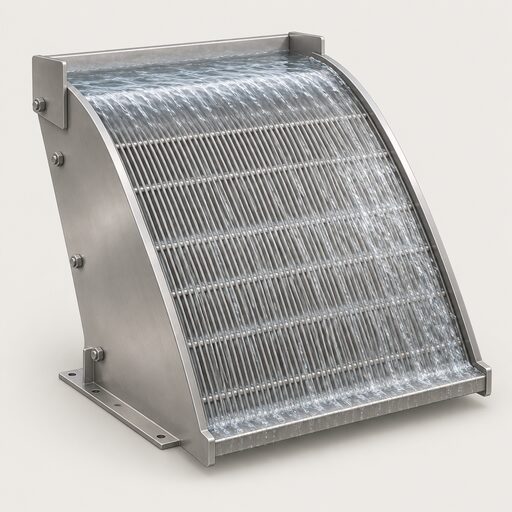
- Screening: the mesh size and approach velocity at the intake, to prevent fish entering the turbine.
- Fish passage: the provision of a pass or other means for migratory fish to move past the scheme.
These conditions are not negotiable in the way that a planning condition might be. They are set by the regulator based on the fishery and ecological interests in the watercourse, and a scheme that cannot meet them will not be licensed.
For a household, the hands-off flow condition is the single most important factor in estimating annual output. A run-of-river scheme does not store water; it generates when the river flows. If the licence requires abstraction to stop for several months of the year, the scheme's output is correspondingly reduced. The planning portal's hydro electricity guidance notes that useful power may be produced from even a small stream3, but the licence determines how much of the time that power is actually available.
Ecological surveys: fish, flow and protected species
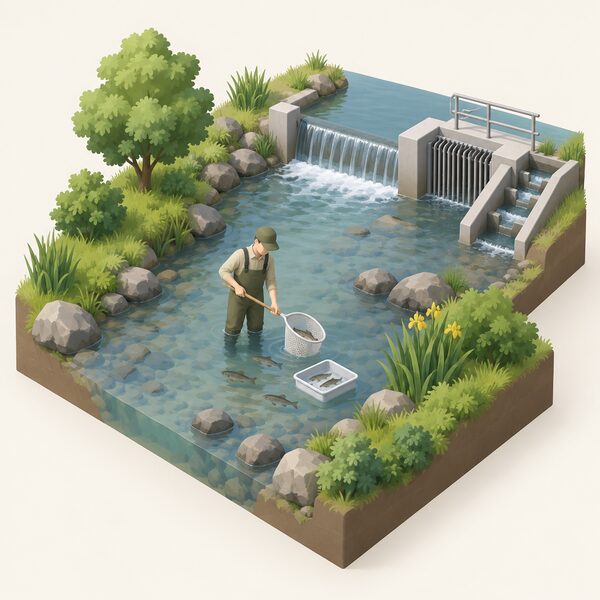
An ecological survey and/or a licence may be required where wildlife protections apply4. This is the point at which the environmental assessment moves from a planning question to a scientific one.
The surveys typically requested for a watercourse scheme fall into three groups:
- Fisheries surveys, to establish which species use the watercourse and at what life stages. These inform the fish pass and screening requirements.
- Hydrological surveys, to establish the flow regime across the year, including low-flow periods. These inform the hands-off flow condition.
- Protected species surveys, where the site or its banks may support otters, bats, water voles or other protected species.
The results of these surveys feed directly into the licence conditions and into the environmental statement if one is required. A scheme that commissions surveys early can design the intake and outfall to meet the conditions rather than retrofitting them after a refusal.
The ecological survey requirement is not limited to the turbine itself. Access tracks, cable routes, and any building or structure associated with the scheme can all trigger survey requirements if they affect protected habitats. The planning authority will normally set out its survey requirements in a scoping opinion, which is the formal mechanism for establishing what an environmental statement must cover.
"You may need: an ecological survey and/or a licence."
Cumulative effects and landscape considerations
A single micro hydro scheme on a tributary is unlikely to have significant cumulative effects. Several schemes on the same watercourse, or a scheme that is part of a wider development, can trigger a cumulative assessment.
The cumulative effects that regulators consider include:
- Combined abstraction: the total volume taken from a watercourse by all licensed schemes, against the flow available.
- Barrier effects: the combined effect of several intakes on migratory fish passage.
- Landscape and visual impact: the effect of the scheme's structures, access tracks and any associated buildings on the landscape character.
Environmental benefits such as reduced carbon footprint and reduced air pollution may be classed as material considerations, particularly on larger or complex cases14. This is a point in the applicant's favour: a scheme that demonstrably reduces carbon emissions can weigh in the planning balance, though it does not override ecological harm.
Landscape considerations are most acute where the scheme is in a designated area. In a conservation area or in a World Heritage site the flue should not be fitted on the principal or side elevation if it would be visible from a highway15, which illustrates the kind of visual sensitivity that designated areas attract. A hydro scheme's intake structure, outfall and any building to house the turbine will be assessed against similar criteria.
Operation and maintenance also feature in the assessment. Regular inspections and preventative maintenance, and vegetation management16 are the ongoing obligations that a scheme carries, and the environmental statement will normally set out how these will be managed over the scheme's life.
How the assessment process typically unfolds

The process follows a sequence, though the stages can overlap.
- Pre-application discussion with the local planning authority and the environmental regulator. This establishes whether an EIA is likely to be required and what surveys will be needed.
- Scoping opinion from the planning authority, setting out the matters an environmental statement must cover.
- Survey work, commissioned from qualified ecologists and hydrologists. This is often the longest stage.
- Environmental statement preparation, drawing together the survey results and assessing the likely significant effects.
- Application submission, including the environmental statement, the planning application, and the abstraction licence application.
- Determination, with the planning authority and regulator reaching decisions, often with conditions attached.
The assessment itself is only one part of the consenting process. The abstraction licence application runs alongside the planning application, and the two can inform each other. A planning authority may be reluctant to grant permission before the regulator has indicated what licence conditions it would impose, and the regulator may need the planning authority's view on the scheme's design before setting conditions.
If a planning application is rejected, you may wish to reapply using any recommendations provided by the Planning Officer, or appeal against the decision as a last resort14. For abstraction licences, refusal can be appealed through the regulator's own process. If a dispute arises with a company involved in the project, and you do not accept the offer, or the company does not make an offer, your dispute will move on to a full investigation17.
The practical reality is that a micro hydro scheme's consenting stage is measured in months, not weeks, and the environmental assessment is the part that most often determines the timeline. A household that treats the assessment as a formality rather than the core of the project will find the process harder than one that engages with it from the start.
Sources17 cited
- Hydropower, nidirect, 2026-09-17
- Permitted development rights: support for new homes consultation, Scottish Government, 2025-09-03
- Hydro electricity, Planning Portal, 2026
- Permitted development rights, Cornwall Council, 2026-09-17
- Draft Buildings (Heating and Energy Performance) and Heat Networks (Scotland) Bill, Scottish Government, 2025-11-18
- Do you need planning permission to install an outside flue, Planning Portal, 2026-09-17
- Difference between building regulations and planning permission, Planning Portal, 2026-09-17
- Minimum energy efficiency standards, Planning Portal, 2026
- The Microgeneration Certification Scheme, Planning Portal, 2026-09-17
- Getting consent for works to a listed building, North Northamptonshire Council, 2026-09-17
- Planning permission: micro combined heat and power, Welsh Government, 2026-09-17
- How heat pumps work: a guide for homeowners, NICEIC, 2025-09-17
- Planning permission: building-mounted wind turbines, Planning Portal, 2026-09-17
- Planning permission: electric vehicle charging, Planning Portal, 2026
- Planning permission: biomass fuelled appliances, Planning Portal, 2026
- Well-adapted energy system, Climate Change Committee, 2026-09-19
- Facilitated Complaints Resolution, Energy Ombudsman, 2026-09-20
 Small Wind Turbine StandardsA small wind turbine needs the right certificate before it can go up, and that affects whether you need planning permission and whether you can get paid for the electricity you send to the grid.
 Wind Turbine Planning in EnglandCan you put up a small wind turbine at home without asking the council first?
 Wind Turbine Planning in NIDo you need planning permission for a home wind turbine in Northern Ireland?
 Hydro Environmental RequirementsWhat does a micro hydro scheme need to do about fish, and who decides?
 Micro Hydro CostHow much does a micro hydro scheme cost to build and run, and what makes one worth it?
 Home Energy Planning Rules in NIDo you need planning permission for solar panels or a heat pump in Northern Ireland?