
In this answer
Short answer
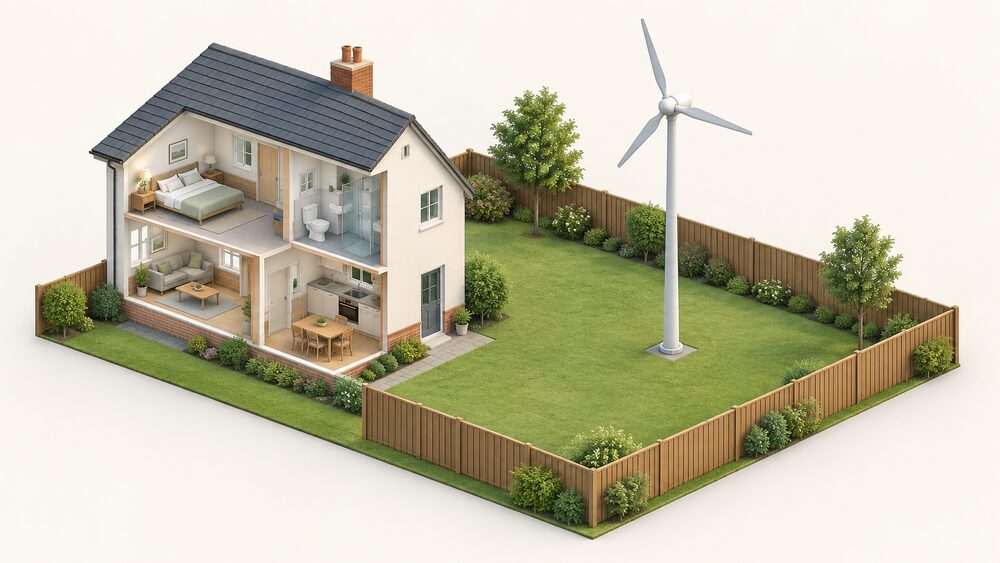
The distance a wind turbine must keep from a property boundary depends on how it is mounted. A stand-alone turbine must sit at least its own overall height, including blades, plus 10 per cent of that height away from any point along the boundary. A building-mounted turbine must keep every part, blades included, at least five metres from any boundary1.
Those two rules are permitted development conditions, not planning policy preferences. Meet them, along with the height, swept area and location limits that go with them, and a domestic turbine can be installed without a planning application. Miss them and the installation needs planning permission1.
The setback is measured to the curtilage, the plot of land around the dwellinghouse, not just the building. Scotland applies its own classes, with a five-metre curtilage boundary minimum for turbines on detached dwellinghouses3.
Stand-alone turbines: the height-plus-10% setback
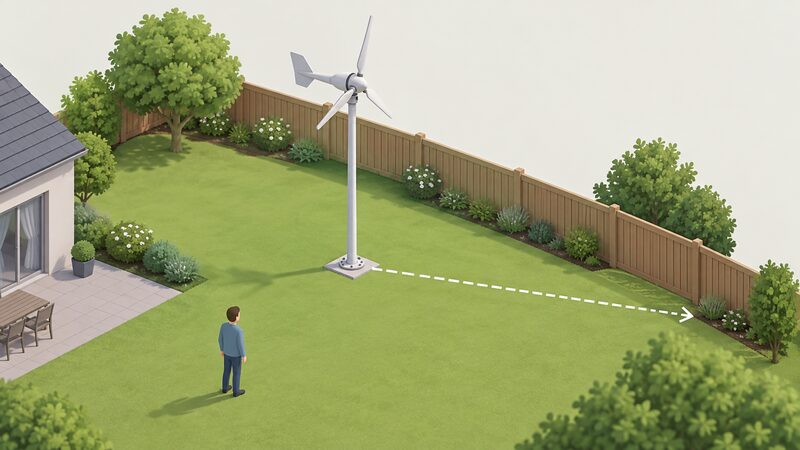
For a free-standing turbine, the boundary rule is a calculation rather than a fixed figure. An installation is not permitted if any part of the turbine, including blades but excluding guy lines, would be closer to any point along the property boundary than the overall height of the turbine plus 10 per cent of that height1.
The height used is the highest part of the turbine including blades, so the rotor tip at its top of sweep sets the figure. The turbine itself must not exceed 11.1 metres to the highest part including blades1. A machine at that maximum would therefore need clear distance from the boundary equal to its overall height plus 10 per cent of that height, though the exact figure follows the actual installed height rather than the cap.
The same principle appears in the Welsh legislation, which frames it as a distance equivalent to the overall height including blades plus 10 per cent of its height, measured from any point along the boundary of the curtilage6. Welsh guidance repeats the five-metre minimum blade clearance from ground level7.
The height-plus-10-per-cent approach replaced an older, much larger separation requirement in the Scottish system. A 2024 consultation noted that the current 100-metre separation distance between turbine and curtilage boundary was considered too restrictive, and proposed replacing it with a calculation of turbine height plus a safety factor such as 10 per cent8.
For a household, this rule is the practical constraint on a small plot. A turbine tall enough to catch useful wind needs a clear circle around it, and on a tight curtilage the arithmetic, not the machine, decides whether permitted development is available at all. Where the setback cannot be met, the route is a planning application rather than permitted development1.
Building-mounted turbines: the five-metre boundary rule
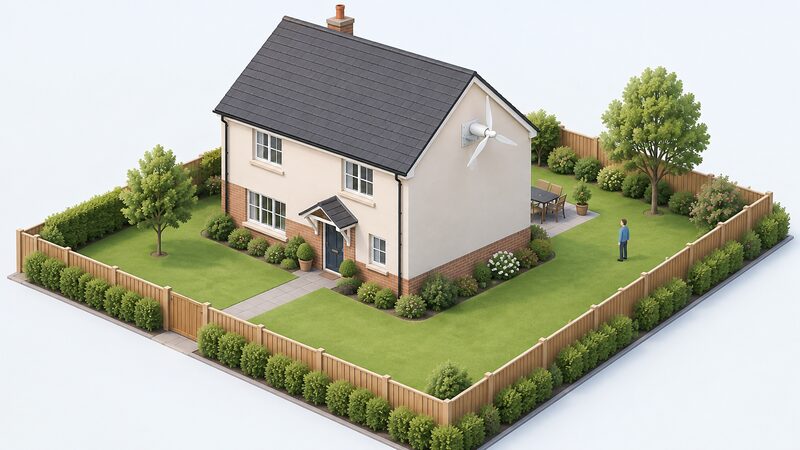
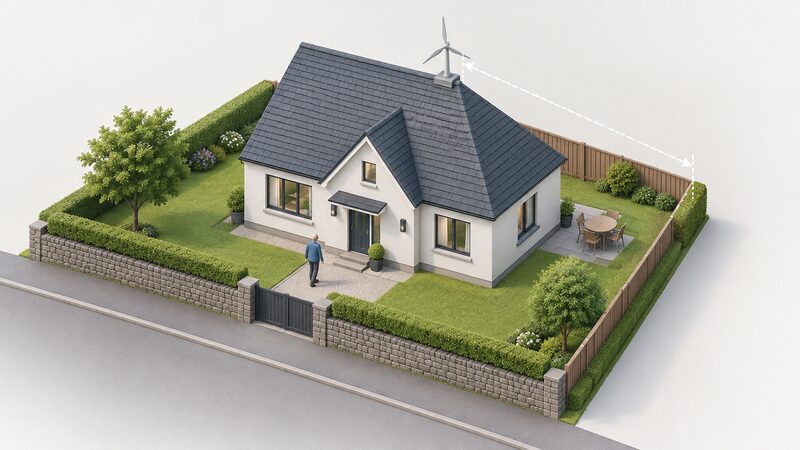
Building-mounted turbines work to a fixed distance rather than a calculation. No part of the turbine, including blades, may be within five metres of any boundary2. The same guidance sets a minimum of five metres between ground level and the lowest part of any blade, so the rotor must clear both the boundary and the ground2.
The height limits are tight. No part, blades included, may protrude more than three metres above the highest part of the roof, excluding the chimney, and the overall height must not exceed 15 metres including building, hub and blade, whichever is the lesser2. The swept area of any blade is capped at 3.8 square metres2.
Permitted development rights for building-mounted turbines apply only to detached houses, not blocks of flats, and to other detached buildings within the boundaries of a house or block of flats2. They do not apply within the curtilage of a listed building, a scheduled monument, or on designated land other than conservation areas, which includes national parks and the Broads, areas of outstanding natural beauty and World Heritage Sites2.
There is also a removal condition: the turbine must be removed as soon as reasonably practicable when no longer needed for microgeneration2. That condition sits alongside the siting rules rather than replacing them, and it means the installation is tied to its generating purpose for as long as it stands.
For a household, the five-metre rule is often the binding constraint on a roof or gable installation, because the swept area cap and the three-metre protrusion limit already keep the machine small. A turbine that meets the height and area limits but sits within five metres of a fence line falls outside permitted development regardless2.
Scotland: Class 6HC and the five-metre minimum for detached houses
Scotland runs its own permitted development classes for domestic wind turbines, introduced through the 2024 order that inserted Class 6HC3. Class 6HC covers the installation, alteration or replacement of a wind turbine on a detached dwellinghouse, one turbine only3.
The boundary rule mirrors the English building-mounted condition. Development is not permitted if any part of the wind turbine would be less than five metres from the boundary of the curtilage of the dwellinghouse, or less than five metres from ground level3. Scottish guidance states the same limit: no part of the turbine may be less than 5m from the boundary of the curtilage of the dwellinghouse4.
The other Class 6HC limits are a maximum swept area of four square metres, a maximum protrusion of three metres above the highest part of the roof excluding any chimney, and a limit of one turbine on the same dwellinghouse3. The class does not apply in a conservation area, a World Heritage Site, a site of special scientific interest, or a listed building or its curtilage3.
Free-standing turbines in Scotland sit under Class 6G. The blade tip height must not exceed 15 metres, the lowest part of the blade tip must be at least five metres from ground level, and the turbine must be at least 110 per cent of its blade tip height from the curtilage of another dwelling3. Scottish guidance confirms the 15-metre blade tip cap and the five-metre ground clearance4.
The 110 per cent figure is a neighbour separation, not a boundary setback, and it is worth keeping the two apart. A Scottish householder weighing a free-standing machine has to satisfy both the ground clearance and the distance from the neighbouring curtilage, while a building-mounted machine is governed by the five-metre curtilage boundary rule3.
Where a turbine falls short: losing permitted development
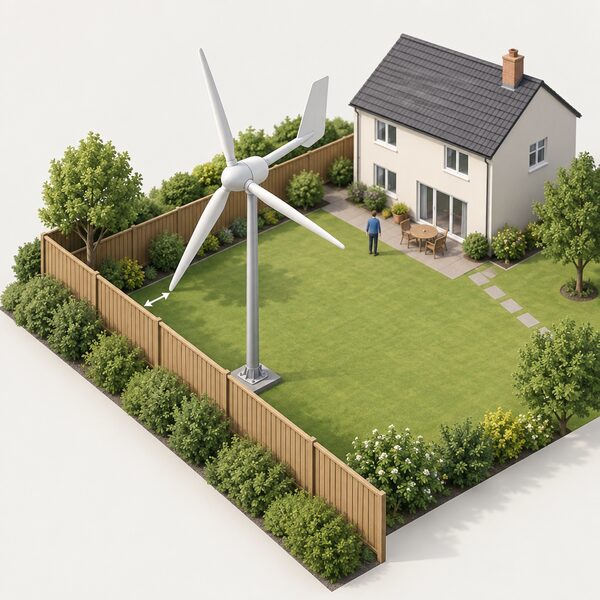
If a turbine breaches the boundary distance, the installation is not permitted development and a planning application is needed. The legislation is explicit: development is not permitted where any part of the wind turbine, including blades, would be positioned so that it would be within five metres of any boundary of the curtilage9. The stand-alone height-plus-10-per-cent rule operates the same way1.
Other conditions can remove permitted development even where the boundary distance is met. In conservation areas, a stand-alone turbine is not permitted if it would be nearer to any highway bounding the curtilage than the part of the house nearest to that highway1. Building-mounted rights do not apply within the curtilage of a listed building or a scheduled monument, or on designated land other than conservation areas2.
There is an interaction with other technologies worth noting. Class G permitted development rights for air source heat pumps are not available if a wind turbine is installed on the same building or within the curtilage of the dwellinghouse or block of flats12. A household considering both technologies therefore faces a choice under the current rules rather than a straightforward combination.
Building regulations are a separate matter. If the wind turbine is not attached to the house, only the electrical installation and connection are captured by the building regulations requirements13. That leaves the siting rules as the planning constraint and the wiring as the building standards constraint, with different routes and different evidence for each.
Where permitted development is lost, the practical consequence is an application with drawings, a site plan showing the boundary distances, and a decision period. The boundary arithmetic is the first thing to check, because it determines which route applies before any other consideration.
"any part of the wind turbine (including blades) would be positioned so that it would be within 5 metres of any boundary of the curtilage"
Sources13 cited
- Planning permission: stand-alone wind turbines, Planning Portal, 2026
- Planning permission: building-mounted wind turbines, Planning Portal, 2026
- The Town and Country Planning (Permitted Development and Miscellaneous Amendments) (Scotland) Order 2024, legislation.gov.uk, 2024
- Circular 1/2024: householder permitted development rights, Scottish Government, 2024
- The Town and Country Planning (General Permitted Development) (England) Order 2011, legislation.gov.uk, 2011
- The Town and Country Planning (General Permitted Development) (Wales) Order 2012, article 2, legislation.gov.uk, 2012
- Planning permission: wind turbines, Welsh Government
- Scottish Government review of permitted development rights: phase 3 consultation analysis, Scottish Government, 2024
- Class H: installation or alteration of a wind turbine on domestic premises, legislation.gov.uk, 2015
- The Town and Country Planning (General Permitted Development) (Scotland) Amendment Order 2023, legislation.gov.uk, 2023
- The Town and Country Planning (General Permitted Development) (Scotland) Order 1992, legislation.gov.uk, 2024
- Class G: installation of air source heat pumps on domestic premises, legislation.gov.uk, 2015
- Building regulations, Planning Portal, 2026
 Wind Turbine Planning in EnglandCan you put up a small wind turbine at home without asking the council first?
 Wind Turbine Planning ScotlandScotland lets some home wind turbines go ahead without planning permission, but only if they stay within strict size and distance limits.
 Wind Turbine Planning in WalesDo you need planning permission for a wind turbine at home in Wales?
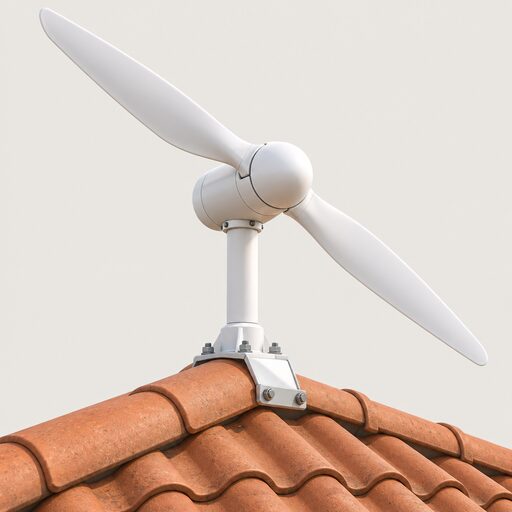 Building-Mounted Wind TurbinesWill a wind turbine on your roof actually make enough electricity to be worth it?
 Turbine Noise and NeighboursHow close can a wind turbine be to a neighbour's house before it needs planning permission?
 Wind Turbine Planning in NIDo you need planning permission for a home wind turbine in Northern Ireland?