In this guide
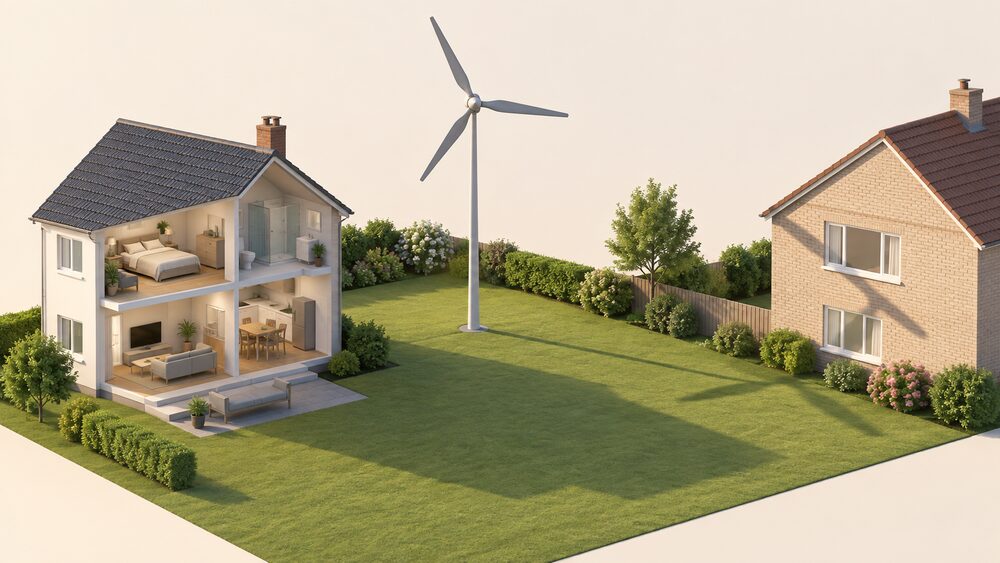
Noise and visual disturbance are the two effects that decide whether a domestic wind turbine can go up without a planning application, and both are controlled mainly through distance. In England, a building-mounted turbine is not permitted development if any part of it, including the blades, is within 5 metres of any boundary of the curtilage, and a stand alone turbine must stand back from every point on the boundary by at least its own overall height including blades plus 10 per cent of that height1. In Scotland and Wales, a free-standing turbine must be at least 110 per cent of its blade tip height from the curtilage of another dwelling4.
The sound itself is not regulated by a decibel figure written into the permitted development classes. Instead the turbine must comply with the MCS Planning Standards, now cited in legislation as MCS 020 b, Wind Turbine Sound Calculation (For Permitted Development Installations)3. That calculation is made at an assessment position one metre outside the centre of any door or window to a habitable room of a neighbouring property7. If the installation cannot meet the standard, or any of the other limits, the route is a full planning application rather than a quiet installation.
Shadow flicker, the moving shadow thrown by turning blades across a window, is not given a numerical limit in the domestic permitted development conditions. What the conditions do require is that blades are made of non-reflective materials, that the lowest part of any blade is at least 5 metres above ground level, and that the turbine is sited, so far as practicable, to minimise its effect on the external appearance of the building and on the amenity of the area3.
What a small turbine actually sounds like
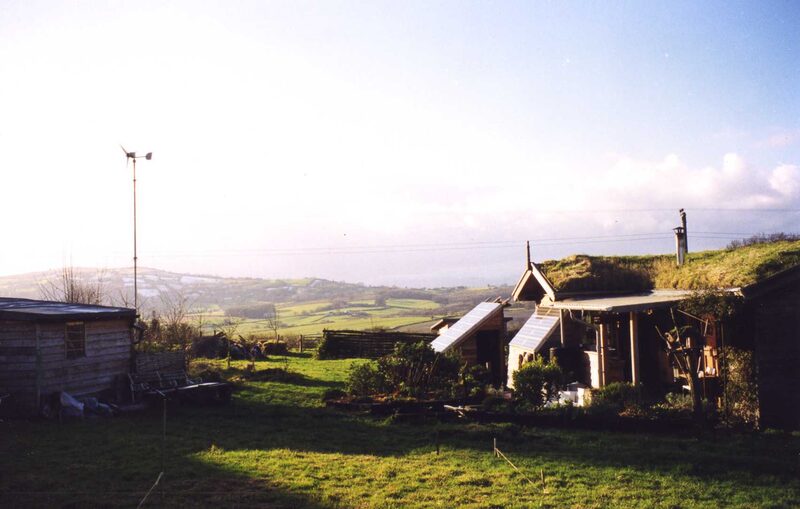
There is no published domestic decibel rating that applies across small wind turbines, because the sound a household hears depends on the machine, the wind speed, the mounting and the distance. Manufacturers of the smallest battery-charging machines describe them in qualitative terms: the Rutland 914i Windcharger is described by its maker as a virtually silent wind turbine, a claim about that product and not a measured level at a neighbour's window9.
Scale matters more than the label. Individual turbines range from a few hundred watts up to two or three megawatts, and a typical domestic system is 2.5 to six kilowatts depending on the location and size of the house10. Machines sold for a single property may generate up to 10 kW11, while the smallest units generate around 100 W and simply charge a battery, with larger domestic and business units spanning 0.6 to 50 kW12. The bigger the rotor and the higher the tip speed, the more sound power there is to travel.
Mounting is the other variable. A turbine fixed to a house transmits vibration as well as airborne sound: turbines can resonate in the wind and produce vibrations which can damage the structure of the building13. Installation detail matters too. Guidance for the Clifton area of Bristol notes that care in installing a turbine will ensure there are not loose elements such as cables which could give rise to wind noises, and that associated equipment such as inverters are located internally14.
Context sets what will be noticed. Building-mounted turbines in built-up urban areas are reported to be far less effective owing to lower wind speeds12, and domestic wind turbines generally are not suitable in a built-up area15. A turbine that produces little power in a sheltered garden still produces sound, which is the worst combination for neighbour relations.
Noise and why separation distance matters
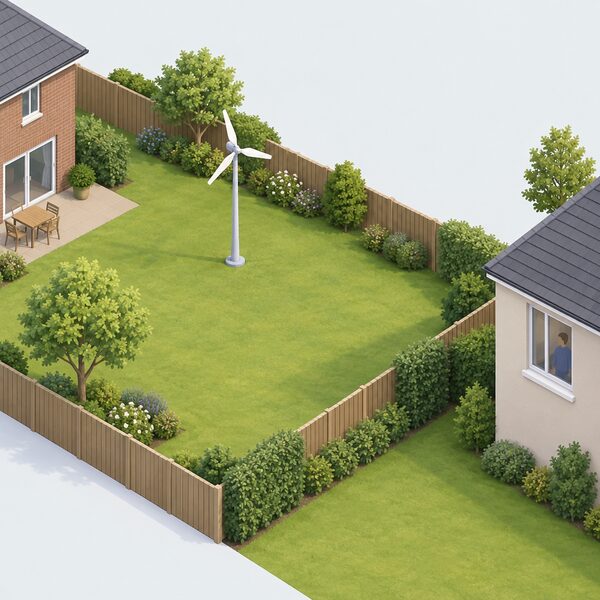
The clearest published illustration of how distance works comes from the Scottish Government's phase 3 permitted development review. A respondent gave an example that, for a turbine with a sound power level of 85 decibels, reducing the separation distance from 100 m to 16.5 m would increase the noise for the receiver from 34 dB to around 50 dB8. Two figures in one example show the whole principle: sound power at the source is fixed by the machine, but what arrives at a neighbouring window is governed by how far away it is.
For scale, published comparison levels put a library at 35 dB, a business office at 65 dB, heavy traffic at 90 dB and a quiet forest at 15 dB16. A received level of 34 dB therefore sits around library quiet; around 50 dB sits between the two everyday reference points and is a level a household would notice in a quiet rural setting at night.
The example arose because the Scottish proposals would replace the current 100 m separation distance between turbine and curtilage boundary with a calculation of the turbine height plus a specified safety factor, for example height plus 10 per cent8. Consultation responses split: some held that the current 100 m separation distance is too restrictive, while the proposed reduction, potentially to 16.5 m, was seen as excessive8. Responses on the separate proposal of a 5 m distance to the curtilage boundary for turbines attached to a dwelling included both that it is too low and too high18.
That disagreement is the practical point for a household. A setback written as a multiple of turbine height scales with the machine, but it does not guarantee a particular received sound level, because it takes no account of the turbine's sound power. The sound calculation under MCS 020 b, carried out at the neighbour's window, is the part of the regime that does address the level itself7.
Shadow flicker and reflection: what the rules control
Shadow flicker is the intermittent shadow cast when a rotating blade passes between low sun and a window. The domestic permitted development classes in England do not set a flicker limit, a sun-angle calculation or a shadow separation distance. The controls that bear on the effect are indirect and are written into the conditions:
- Blades must be made of non-reflective materials, which addresses glint and flashing reflections from the rotor3.
- The distance between ground level and the lowest part of any blade must not be less than 5 metres, which lifts the rotor above most ground-floor windows and garden space1.
- The swept area of any blade must be no more than 3.8 square metres, capping the size of the moving object1.
- The turbine must be sited, so far as is practicable, to minimise its effect on the external appearance of the building and its effect on the amenity of the area1.
That last condition is the one a local planning authority can point to when a turbine is placed where a shadow will sweep a neighbour's living room. It is a siting duty, not a measurement, and it is judged case by case. Where a turbine falls outside permitted development and a full application is made, the authority assesses amenity effects in the round and neighbours can comment.
Siting for output tends to reduce the problem as well. Turbines should ideally be located on a hilltop or raised structure, away from obstructions like trees or other buildings19, and a site should have no major obstacles nearby such as buildings, trees or hills likely to reduce the wind speed or increase turbulence10. Open, exposed, well separated positions are both the productive ones and the ones least likely to throw a moving shadow onto a habitable room.
Permitted development: the limits a turbine must meet
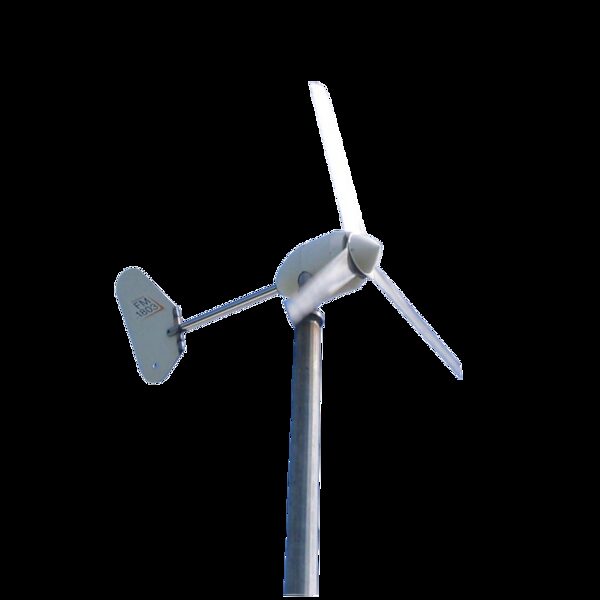
In England, installing a domestic wind turbine without a planning application is possible in some cases, so long as specified limits and conditions are met20. Every limit must be satisfied; failing one returns the project to a full application.
| Limit or condition | Building-mounted (England) | Stand alone (England) |
|---|---|---|
| Height above roof | No more than 3 m above the highest part of the roof, excluding the chimney2 | Not applicable |
| Overall height | 15 m, whichever is the lesser with the roof limit2 | 11.1 m including blades1 |
| Boundary setback | No part including blades within 5 m of any boundary2 | Overall height including blades plus 10 per cent of that height, from any point on the boundary1 |
| Blade clearance above ground | Not less than 5 m2 | Not less than 5 m1 |
| Swept area | No more than 3.8 m²2 | No more than 3.8 m²1 |
| Number | Only the first installation of any wind turbine; more than one on the same building or in the curtilage is not permitted3 | Only the first installation1 |
| Sound standard | MCS Planning Standards (MCS 020) or equivalent2 | MCS 020 or equivalent1 |
| Blade materials | Non-reflective2 | Non-reflective1 |
Two further conditions catch households out. A turbine is only permitted development if there is no existing air source heat pump at the property, and additional wind turbines or heat pumps at the same property require an application for planning permission1. The English class also excludes a wind turbine where a stand-alone wind turbine is already installed within the curtilage3. A stand alone installation must not be sited on safeguarded land, and where the building is a block of flats it must consist wholly of flats rather than also containing commercial premises1.
There is also an end-of-life condition: the turbine must be removed as soon as reasonably practicable when no longer needed for microgeneration1.
Siting rules that protect neighbours: setbacks, blade clearance and non-reflective blades
The setback rules do the heavy lifting. The English class states that development is not permitted where any part of the wind turbine, including blades, would be positioned within 5 metres of any boundary of the curtilage, or where the distance between ground level and the lowest part of any blade would be less than 5 metres3. The same 5 metre boundary wording appears in earlier English legislation21. For a stand alone machine the setback is proportionate: in Wales the rule is that no part, including blades but excluding guy lines, may be less than the overall height including blades plus 10 per cent of that height from any point along the boundary of the curtilage5.
Scotland expresses the neighbour protection differently. For a wind turbine on a detached dwellinghouse, no part may be less than 5 metres from the boundary of the curtilage of the dwellinghouse, no part may be less than 5 metres from ground level, and no part may protrude more than 3 metres above the highest part of the roof excluding the chimney4. For a free-standing turbine, the blade tip height must not exceed 15 metres, the lowest blade tip must be at least 5 metres above ground, and the turbine must be not less than 110 per cent of its blade tip height from the curtilage of another dwelling4. Scottish proposals for dwelling-mounted turbines also used a 5 metre minimum ground clearance for blade tips17.
Non-reflective blades are a condition in both the English legislation and the guidance for building-mounted and stand alone turbines3. The purpose is visual: a matt rotor does not throw the intermittent glint that a glossy one can produce in low sun.
Building regulations are a separate consent from planning. They will normally apply to a wind turbine attached to a house, because the size, weight and force exerted on fixed points would be considerable, and they also apply to other aspects of the work such as electrical installation24. Structural fixing quality is directly relevant to noise, since a poorly fixed mast transmits vibration into the fabric a neighbour shares or lives beside.
The MCS 020 Planning Standard: what compliance means
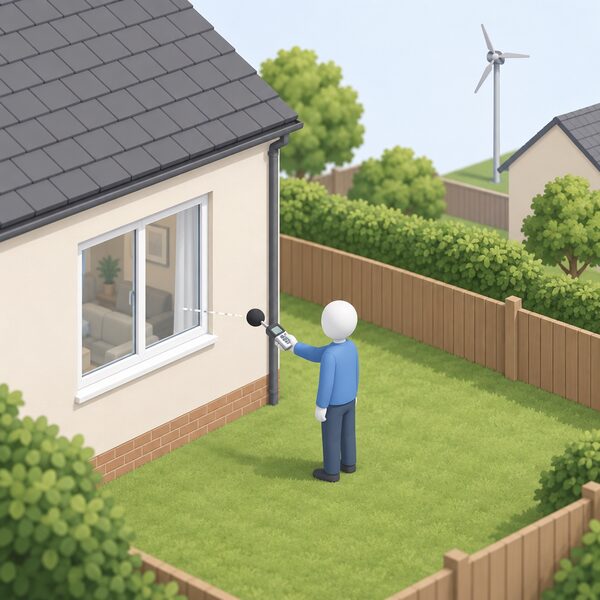
The English class states that development is not permitted unless the wind turbine complies with the MCS Planning Standards or equivalent standards3. Legislation defines those as the standards specified in the Microgeneration Certification Scheme for air source heat pumps and for small and micro wind turbines, the wind document being MCS 020 b, Wind Turbine Sound Calculation (For Permitted Development Installations)25. The 2025 amending instrument replaced the earlier reference to MCS 006 with that MCS 020 b title6. Separately, micro and small wind turbines are certified under MCS 00619, so a household may see both references: one is the product certification scheme, the other the sound calculation used for permitted development.
What the standard fixes is where sound is judged. The assessment position is one metre external to the centre point of any door or window to a habitable room of a neighbouring property, measured perpendicular to the plane of that door or window7. The calculation is therefore about the neighbour's exposure, not a reading taken at the turbine.
Scottish and Welsh rules point at the same family of documents. Scottish guidance for turbines on detached dwellinghouses and for free-standing turbines requires compliance with the relevant MCS planning standards for wind turbines or equivalent standards4, and the Scottish proposals for wall or roof-mounted domestic turbines listed compliance with MCS 020 planning standards as a condition8.
The standard is not costless in practice. A Welsh Government report on noise and permitted development found that the noise assessment prescribed in MCS 020 presents an obstacle to installations proceeding26. The most recent Welsh consultation response notes that the revised MCS 020(a) features a revised acoustic assessment methodology, supports installations closer to property boundaries subject to acoustic compliance, and improved installer guidance on noise assessments27, though that document is the air source heat pump part of the standard rather than the wind calculation.
Where permitted development runs out and a full application is needed
An application to the local planning authority is required in every case that falls outside the class28. In practice that covers:
- Any second turbine, or a turbine at a property that already has an air source heat pump1.
- Any turbine exceeding the height, swept area, blade clearance or boundary setback limits1.
- Turbines within the curtilage of a listed building, on a scheduled monument, or on designated land other than conservation areas1.
- In conservation areas in England, a building-mounted turbine on a wall or roof slope fronting a highway, or a stand alone turbine sited nearer to a highway bounding the curtilage than the house itself2.
- Any turbine which cannot demonstrate compliance with MCS 020 or an equivalent standard3.
Scotland adds a prior approval step for free-standing turbines under Class 6G: before beginning development the developer must apply to the planning authority for approval of the design and size and for a determination as to whether prior approval is required for siting and external appearance29. Earlier Scottish policy work on dwelling-mounted turbines set out the same logic on sound, with a noise threshold and assessment methodology provided through the microgeneration certification scheme and noisier installations requiring planning permission.
England, Wales, Scotland and Northern Ireland: where the rules differ

Planning Portal guidance on stand alone and building-mounted turbines relates to the planning regime for England, and states that the policy in Wales may differ1.
| Nation | Position on domestic turbines |
|---|---|
| England | Permitted development possible for a first turbine meeting all Class H limits, including the 5 m boundary rule for building-mounted machines and 11.1 m maximum height for stand alone1 |
| Wales | Welsh guidance states a planning application is necessary to install a building-mounted turbine; stand alone turbines are subject to the height plus 10 per cent setback and MCS Planning Standards30 |
| Scotland | Classes 6G and 6HC allow turbines on detached dwellinghouses and free-standing turbines subject to 5 m boundary and ground clearance, 15 m blade tip height and 110 per cent of blade tip height from another dwelling, with prior approval for free-standing machines4 |
| Northern Ireland | Planning approval is needed for small-scale wind turbines10 |
Independent guidance summarises the practical effect: in Wales and Northern Ireland planning permission must be obtained before installing a wind turbine, while for England and Scotland the rules are more complex and in some specific situations permission may not be needed31. One commentary on Wales notes that homeowners do not currently need to apply for permission where there is only one turbine and it meets certain criteria, but are required to minimise its effect on the amenity of the area32. Where accounts differ in this way, the legislation and national guidance for the relevant nation govern. Residents in all British nations will usually need to apply for planning permission before starting installation work12.
The Welsh report on permitted development also recorded that there is no evidence supporting the need for the 3 m rule to limit the adverse impact of noise26, an indication that the numerical separation rules are policy judgements rather than acoustic derivations.
Talking to the local planning authority before installing
The standing advice from the Planning Portal is to always check with the local planning authority about planning issues before a system is installed28. The local planning authority is usually the planning department of the local council, and it is the first point of contact for queries about a particular case33. Local authorities may charge a fee for pre-application advice1.
Two practical constraints are worth knowing before making contact. Local planning authorities face resourcing issues for roles which assist planners, such as ecologists and drainage engineers, and the government has announced that it will recruit 300 new planners34. Response times vary accordingly.
Evidence about the site strengthens any conversation. The Energy Saving Trust position is that a site should have an annual average wind speed of five metres per second or more, and that ideally a professional assessment of local wind speed should be carried out for a full year at the exact location before proceeding10. A shorter alternative reported is installing an anemometer in the intended location for at least three months12. An installer can assess the property and recommend a suitably sized turbine31.
What this means for a household's independence
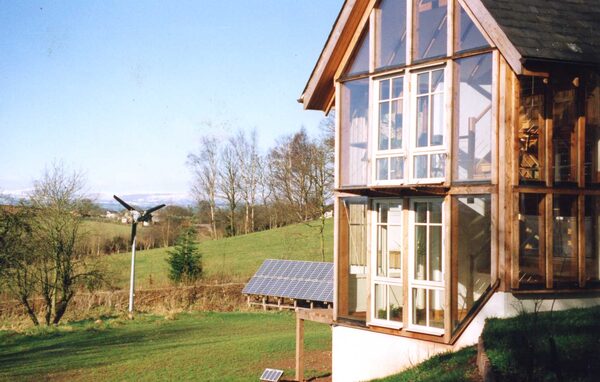
A domestic turbine that meets the permitted development limits is a genuine step toward generating on site: a machine of a few kilowatts, up to around 10 kW for a single property11, producing power without a supplier's involvement. Its limits are equally plain. The permission regime, not the technology, decides where it can stand, and the constraints that protect neighbours also constrain output: a 3.8 square metre swept area cap, an 11.1 metre height cap on a stand alone machine in England, and a setback that grows with the machine1.
The neighbour rules bite hardest where independence is most sought. A property that wants both a wind turbine and an air source heat pump cannot have both under permitted development, whichever is installed second requiring an application1. Built-up sites, where grid dependence is highest, are where domestic turbines are least suitable15 and least effective12. The scale of domestic uptake reflects that: the Feed-in Tariff scheme recorded 7,546 wind installations35.
Dependence also remains on the planning system itself, on an installer's sound calculation under a scheme standard, and where the turbine is grid connected, on the network operator and the property's supply arrangements. None of those is removed by the turbine. Further detail on the national regimes is set out under wind turbine planning permission in England, Scotland, Wales and Northern Ireland, with related pages on boundary distances, shadow flicker distance, ETSU-R-97 noise assessment and siting and wind speed within microgeneration beyond solar.
Sources35 cited
- Planning permission for stand alone wind turbines, Planning Portal, 2026
- Planning permission for building-mounted wind turbines, Planning Portal, 2026
- Class H: installation or alteration of a wind turbine on domestic premises, legislation.gov.uk, 2026
- Circular 1/2024: householder permitted development rights, Scottish Government, 28 May 2024
- The Town and Country Planning (General Permitted Development) (Amendment) (Wales) Order 2012, article 2, legislation.gov.uk, 2012
- The Town and Country Planning (General Permitted Development etc.) (Amendment) Order 2025, legislation.gov.uk, 6 May 2025
- MCS 020 Planning Standards, Issue 1.2, MCS, 2025
- Permitted development rights review phase 3: analysis of consultation responses, Scottish Government, 28 March 2024
- Rutland 914i Windcharger product page, Marlec, 2021
- Wind: small-scale wind turbines, nidirect, 18 May 2026
- Wind power and the distribution network, Electricity North West, 2026
- Domestic wind turbines guide, Uswitch, 6 January 2026
- Wind power information sheet, Centre for Alternative Technology, 27 June 2025
- Clifton Local Listed Building Consent Order guidance, Bristol City Council, February 2025
- Generating renewable electricity at home, Energy Saving Trust, 11 December 2025
- Acoustics jargon buster: decibel comparisons, MIMA, 2026
- Permitted development rights review phase 3: consultation, Scottish Government, 31 May 2023
- Permitted development rights review phase 3: consultation analysis, Scottish Government, 28 March 2024
- Small wind turbines for consumers, MCS, 18 August 2026
- Wind turbines: planning permission introduction, Planning Portal, 2026
- The Town and Country Planning (General Permitted Development) (Amendment) (England) Order 2011, legislation.gov.uk, 30 August 2011
- The Town and Country Planning (General Permitted Development) (Scotland) Amendment Order 2024, legislation.gov.uk, 24 May 2024
- General Permitted Development (Scotland) Order, Class 6G, legislation.gov.uk, 24 May 2024
- Wind turbines: building regulations, Planning Portal, 2026
- GPDO Schedule 2, Part 14: interpretation of MCS Planning Standards, legislation.gov.uk, 2026
- Air source heat pump noise and permitted development rights in Wales: phase 1 report, Welsh Government, 13 December 2023
- Changes to permitted development rights: summary of responses, Welsh Government, December 2025
- Wind turbines: planning permission, Planning Portal, 2026
- Householder permitted development rights guidance (updated 2021), Scottish Government, April 2021
- Planning permission: wind turbines, Welsh Government, 2026
- Wind turbines advice, Energy Saving Trust, 20 May 2026
- What could the next Senedd do on heat pump planning, Nesta, 26 January 2026
- What is planning permission, Planning Portal, 2026
- Reforming the planning system, POSTnote 736, Parliamentary Office of Science and Technology, 6 January 2025
- Feed-in Tariffs annual report, scheme year 13, Ofgem, December 2023
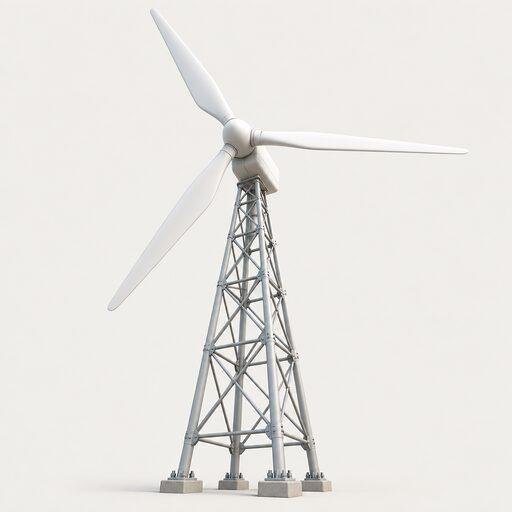 Wind Turbine Planning ScotlandScotland lets some home wind turbines go ahead without planning permission, but only if they stay within strict size and distance limits.
 Wind Turbine Planning in WalesDo you need planning permission for a wind turbine at home in Wales?
 Wind Turbine Planning in NIDo you need planning permission for a home wind turbine in Northern Ireland?
 Wind Turbine Planning in EnglandCan you put up a small wind turbine at home without asking the council first?
 Home Energy Planning Rules in NIDo you need planning permission for solar panels or a heat pump in Northern Ireland?
 Turbine Siting and Wind SpeedIs my garden windy enough for a home wind turbine?