

In this answer
Short answer
Shadow flicker from a wind turbine is generally treated as ceasing beyond about 10 rotor diameters. That is the working rule: take the diameter of the circle the blades sweep, multiply by ten, and beyond that distance the moving shadow is too diffuse and too brief to be a nuisance at a window. A machine with a 2 metre rotor therefore has a flicker reach of roughly 20 metres; a 10 metre rotor reaches about 100 metres.
The rule is a rule of thumb rather than a statutory figure. What planning law actually does is set separation distances, boundary setbacks and blade clearances that keep turbines far enough from homes that flicker is unlikely to arise in the first place. In England, a free-standing domestic turbine under permitted development must sit at least the overall height of the turbine plus 10 per cent of its height from any point along the property boundary1. In Scotland, a free-standing turbine in a dwelling curtilage must be no less than 100 metres from the curtilage of another dwelling2.
Flicker is a daylight phenomenon. It needs a direct beam of sun, a rotor between the sun and a window, and a viewer behind that window. Remove any one of the three and there is no flicker. That is why the effect is intermittent, seasonal and highly site-specific, and why the distance question has a geometric answer rather than a fixed one.
What shadow flicker is and when it occurs
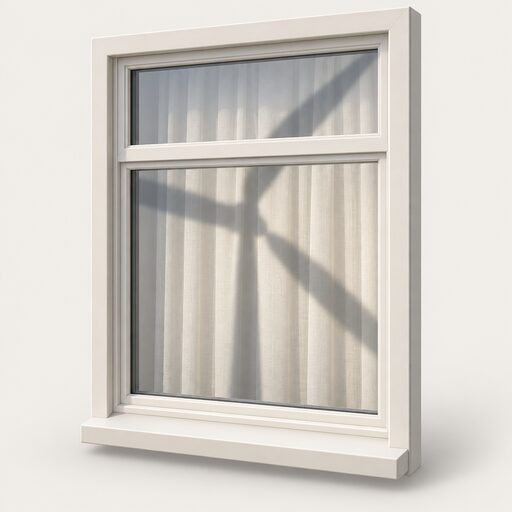
Shadow flicker is the repeated interruption of sunlight reaching a window as the blades of a turning turbine pass between the sun and the glass. The viewer sees the light dim and brighten in step with the rotor, typically a few times a second on a fast machine. It is not a shadow in the ordinary sense of a dark patch on the ground; it is a modulation of light at a fixed point, which is why it is noticed indoors at a window rather than outdoors in a field.
Three conditions must coincide. There must be direct sun, so the sky must be clear enough for a beam to reach the rotor. The rotor must be turning, which requires wind. And the geometry must line up, with the sun low enough in the sky and the turbine oriented so that its blades sweep across the line of sight between sun and window. Wind turbines usually begin generating electricity at wind speeds of around 6 to 9 mph, and an optimum wind speed of around five metres per second is the figure used for siting guidance3. Below the cut-in speed the rotor is largely still, and a still rotor casts a steady shadow rather than a flickering one.
The effect is therefore episodic. It occurs at particular times of day in particular seasons, when the sun is at the right azimuth and elevation, and it stops when the wind drops or the cloud comes in. A household close to a turbine may see nothing for weeks and then a short period of flicker in the shoulder months when the sun tracks low across the sky.
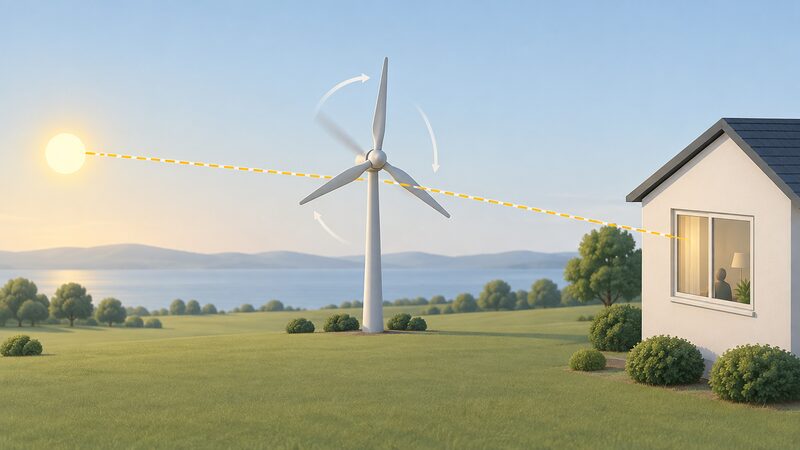
How far away flicker stops: beyond 10 rotor diameters
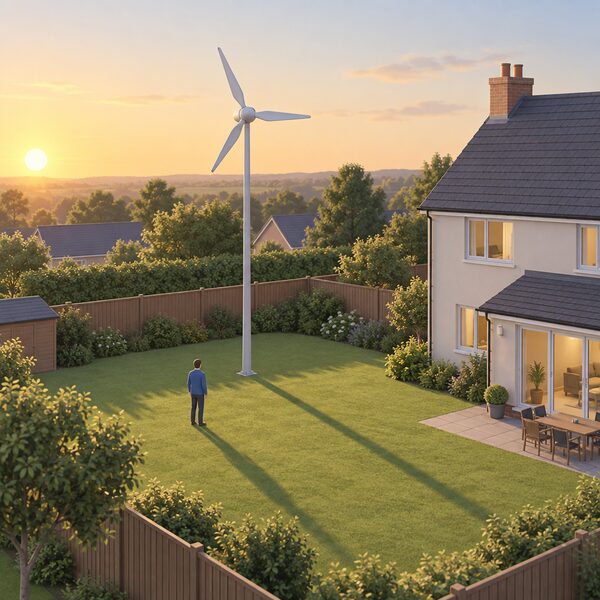
The 10 rotor diameter figure is the practical answer to the distance question. It scales with the machine, not with the site, which is why a small domestic turbine and a large commercial one have very different reaches. Rotor area rises with the square of diameter, so a rotor with a 10 metre diameter captures one hundred times as much wind as one with a one metre diameter5. The shadow it casts scales in the same way: a bigger rotor throws a bigger, sharper shadow further.
For domestic machines the numbers stay modest. Small wind turbines are usually between two and eight metres high, and individual turbines vary in size and power output from a few hundred watts to two or three megawatts6. A permitted development free-standing turbine in England is capped at a blade tip height of 15 metres, with the lowest part of the blade at least 5 metres from the ground8. A rotor of that class produces a flicker reach measured in tens of metres, not hundreds.
The rule is a screening tool, not a guarantee. It tells a householder roughly how far to look, and it tells a planner when a flicker assessment is worth commissioning. Where a turbine sits within about ten rotor diameters of a dwelling, the geometry deserves checking; beyond that, the shadow is generally too weak and too brief to register.
| Rule | Requirement |
|---|---|
| Lowest blade clearance above ground | not less than 5 m5 |
| Maximum blade tip height (free-standing turbine) | 15 m6 |
| Distance from the curtilage boundary | overall height including blades, plus 10% of that height8 |
Why the effect depends on sun angle, season and turbine orientation
Distance alone does not determine whether flicker occurs. The sun's elevation and azimuth decide where a shadow falls and when, and both change through the day and through the year. The sun sits lower in the sky during winter, so it may not hit a surface as directly as it does in the summer9. For flicker the consequence is the opposite of what that implies for solar panels: a low winter sun throws a long shadow across the ground, so a turbine that never troubles a window in midsummer can reach it in December.
Orientation matters as much. A turbine yaws into the wind, so the plane of the rotor turns with the wind direction. Flicker at a given window therefore depends on the wind blowing from a particular quarter at a particular time of day in a particular season. That combination is why flicker is described in hours per year rather than as a constant condition, and why two houses the same distance from the same turbine can have very different experiences.
Site exposure shapes the picture too. Wind systems work best in exposed, windy locations and are less suitable for built-up or sheltered areas10. An exposed site has more hours of rotor movement, so more opportunities for the geometry to line up, but it also tends to be a site with fewer close neighbours. A sheltered urban site has less rotor movement but tighter spacing between turbine and window.
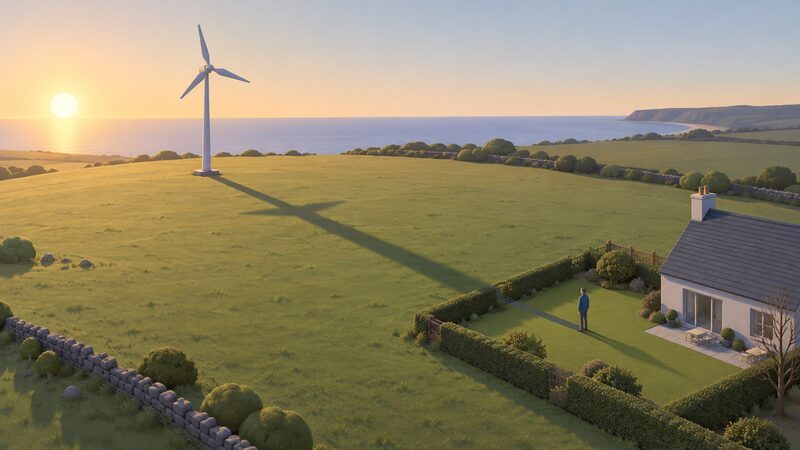
How planning rules assess and limit flicker near homes
Planning rules approach flicker indirectly, through separation distances and clearances that keep turbines away from the windows they might affect. The figures differ across the four nations, and the differences matter to anyone weighing up an installation.
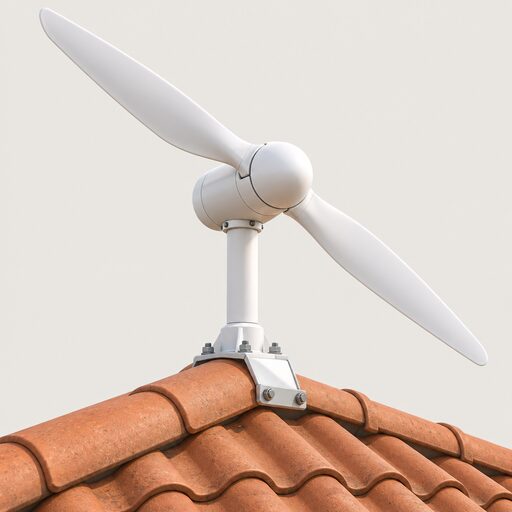
In England, permitted development for a stand-alone turbine requires that no part of the turbine, including blades, sits closer to any point along the property boundary than the overall height of the turbine plus 10 per cent of its height1. The lowest part of any blade must be at least 5 metres above ground level1. A building-mounted turbine must keep every part, blades included, at least five metres from any boundary, must not protrude more than three metres above the highest part of the roof excluding the chimney, and must keep the lowest blade part at least five metres above ground11. Class H of the 2015 order adds that any part within 5 metres of a curtilage boundary is not permitted, and that the turbine must be removed as soon as reasonably practicable when no longer needed12.
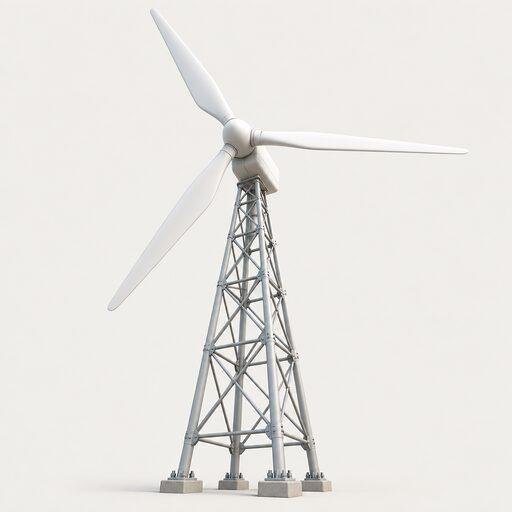
Scotland takes a different approach. A free-standing turbine in a dwelling curtilage under Class 6G must be no less than 100 metres from the curtilage of another dwelling, with the lowest blade tip at least 5 metres from ground level13. A turbine on a detached dwellinghouse must keep every part at least 5 metres from the curtilage boundary, with no part protruding more than 3 metres above the highest part of the roof excluding the chimney8. Scottish consultation responses on a proposed 5 metre curtilage boundary distance included views that it was both too low and too high14.
Wales sets its own figures. A stand-alone turbine is not permitted if the distance between ground level and the lowest part of any blade would be less than 5 metres, or if any part would sit closer to the curtilage boundary than the overall height plus 10 per cent of that height15. In Conservation Areas, permitted development for a stand-alone turbine is restricted where the machine would be visible from a highway bounding the curtilage15.
Northern Ireland guidance points to a minimum annual average wind speed of five metres per second for a site where a turbine should be considered, and notes that individual turbines vary in size and output from a few hundred watts to two or three megawatts6. Building regulations capture only the electrical installation and connection where the turbine is not attached to the house17.
What flicker means for householders living near a proposed turbine
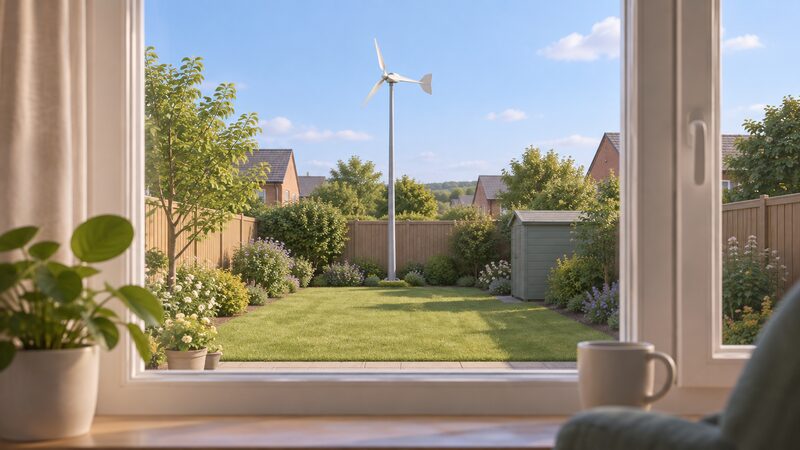
For a household near a proposed turbine, the practical questions are how often flicker would occur, for how long, and at what times of year. The distance rule gives a first screen: within about ten rotor diameters, the geometry is worth examining; beyond it, the effect is unlikely to be significant. For a domestic machine the distances involved are small enough that the answer usually turns on the position of the nearest window relative to the prevailing wind and the seasonal sun path.
The planning system offers the main route for a householder with concerns. Flicker is treated as an amenity matter, assessed through the planning application and controlled through conditions where a scheme is large enough to warrant modelling. For permitted development, the separation distances and clearances in the legislation do the work instead. In Scotland, the 100 metre separation from another dwelling's curtilage is the most explicit protection of the four nations2.
Maintenance and removal matter too. Turbines have moving parts and require regular servicing3, and permitted development for a domestic turbine requires removal as soon as reasonably practicable when it is no longer needed12. A household concerned about an existing installation should raise it with the local planning authority, which sets and enforces conditions. Where the concern is a safety matter near power lines rather than flicker, network operators ask people to stay at least 10 metres away from equipment and call 10518.
For energy independence, a domestic turbine reduces reliance on imported gas and grid electricity, and the government's stated aim is a major acceleration of homegrown power4. What it does not remove is dependence on the wind itself, on the grid for backup and export, and on a maintenance regime. Flicker is one of the local costs of that trade, and the distance rules exist to keep it away from the neighbours who did not choose the machine.
Sources18 cited
- Planning permission: stand-alone wind turbines, Planning Portal
- Review of permitted development rights: analysis of responses, Scottish Government, 2024-03-28
- Wind power, Electricity North West
- How does wind energy work?, Power NI, 2026-04-09
- Wind power, Centre for Alternative Technology, 2025-06-27
- Wind, nidirect, 2026-05-18
- Microgeneration energy guide, Uswitch, 2026-06-08
- Householder permitted development rights, Scottish Government, 2024-05-28
- Do solar panels work in winter?, Uswitch, 2026-09-15
- Wind turbines, Energy Saving Trust, 2026-05-20
- Planning permission: building-mounted wind turbines, Planning Portal
- Class H: installation of wind turbine on domestic premises, legislation.gov.uk
- The Town and Country Planning (Permitted Development) (Scotland) Amendment Order 2024, legislation.gov.uk, 2024-05-24
- Major acceleration of homegrown power, GOV.UK
- Planning permission: wind turbines, Welsh Government
- The Town and Country Planning (General Permitted Development) (Wales) Order 2012, legislation.gov.uk, 2012
- Wind turbines: building regulations, Planning Portal
- Cut trees and bushes, UK Power Networks, 2026-09-17
 Turbine Noise and NeighboursHow close can a wind turbine be to a neighbour's house before it needs planning permission?
 Turbine Siting and Wind SpeedIs my garden windy enough for a home wind turbine?
 Domestic Wind TurbinesCan a wind turbine really power a home, and is your site windy enough?
 Wind Turbine Output and SizingHow much electricity a home wind turbine makes depends far more on your wind than on its size.
 Building-Mounted Wind TurbinesWill a wind turbine on your roof actually make enough electricity to be worth it?
 Wind Turbine Planning ScotlandScotland lets some home wind turbines go ahead without planning permission, but only if they stay within strict size and distance limits.