
In this answer
Short answer
ETSU-R-97 is the assessment method that planning authorities across the UK use to judge noise from wind turbines. It sets a daytime limit derived from background noise at nearby dwellings, with the lower figures applying in quiet rural areas where background noise is low. The limits are written into planning conditions, and compliance is measured against them after construction.
The method matters to any householder within earshot of a proposed turbine or wind farm, because it determines whether the development is judged acceptable and what the operator must do if noise exceeds the permitted level. It also shapes the permitted development rules for a single domestic turbine, where the installer is responsible for ensuring the installation meets permitted development noise standards at the time of installation1.
This page explains what ETSU-R-97 is, how the limits are set, how background noise is measured, what amplitude modulation means and how enforcement works. It is a planning and assessment framework rather than a product standard, and it sits alongside the separate rules that govern domestic wind turbine siting and permitted development.
What ETSU-R-97 is and where it applies
ETSU-R-97 is the technical basis for assessing wind turbine noise in the UK planning system. It was produced for the assessment of wind farms, and its limits are the figures planning authorities use when writing noise conditions into a consent. The method covers the relationship between wind speed and noise, the measurement of background noise at nearby dwellings, and the derivation of limits that a development must not exceed.
The framework applies most directly to wind farm applications, where a noise assessment is a standard part of the environmental information submitted with a planning application. For a single domestic turbine, the position is different. Domestic installations under permitted development are governed by the General Permitted Development Order, which sets height, clearance and boundary rules rather than an ETSU-R-97 assessment. The installer is responsible for ensuring that the installation meets permitted development noise standards at the time of installation1.
Where a domestic turbine falls outside permitted development, a full planning application is needed, and the local planning authority may apply ETSU-R-97 limits as a condition. The same method is used in Wales, Scotland and Northern Ireland, though the permitted development rules differ between the four nations. In Wales, for example, planning permission for wind turbines is handled under the Welsh planning system2, and in Northern Ireland the rules are set out separately3.
The practical effect is that ETSU-R-97 is the reference point for wind farm noise, while domestic turbines are more often governed by the permitted development regime. A householder near a proposed wind farm will see the limits applied to the development as a whole; a householder installing a single turbine will more often be dealing with the boundary and height rules.
The noise limits: background plus 5 dB(A) by day and a fixed figure by night
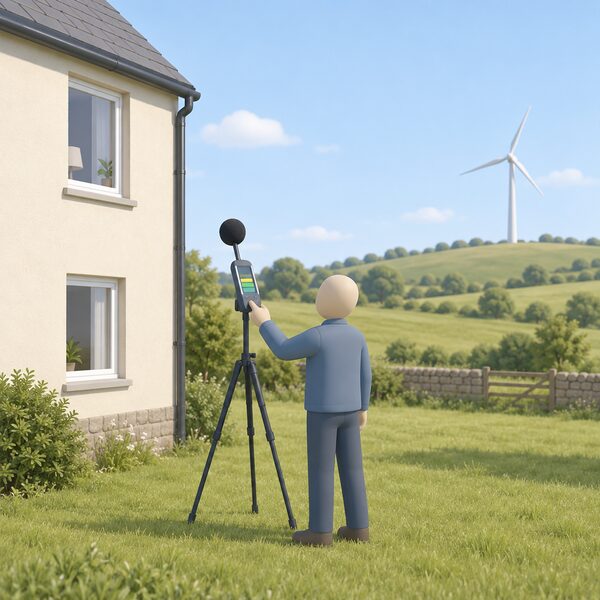
The two headline figures are a daytime limit derived from background noise and a fixed night-time limit, both measured at nearby dwellings. The daytime range reflects the fact that the limit is derived from background noise in most cases, with the lower end applying in quiet rural areas and the upper end in areas with more existing background sound.
The night-time limit is a fixed figure rather than one derived from background noise. Background levels at night are typically very low, and a background-plus-margin approach would produce an unworkably tight limit, so the method uses a single fixed figure instead. This means the night-time limit applies regardless of how quiet the surrounding area is.
For context, the German immission guideline values for purely residential areas set a night limit of 35 dB(A)4, which is stricter than the ETSU-R-97 night figure. The UK indoor noise limit is given as 37.7 dBA4. These comparisons show that the ETSU-R-97 limits sit within a range of European practice rather than at either extreme.
The limits are not a measure of what a turbine emits at source. They are the levels permitted at the receptor, which is normally the nearest habitable room of a dwelling. That distinction matters because distance, terrain and atmospheric conditions all affect how source noise translates into received noise at a property.
| Limit | Level | Basis |
|---|---|---|
| Daytime | Background plus 5 dB(A) or the fixed floor | Greater of background plus 5 dB(A) or the fixed floor |
| Night-time | Fixed figure | Fixed figure |
| German residential night guideline | 35 dB(A) | Comparison figure4 |
| UK indoor noise limit | 37.7 dBA | Comparison figure4 |
How limits are set: background noise and the fixed limit choice
The daytime limit is set by measuring background noise at locations representative of nearby dwellings and correlating it with wind speed. The resulting relationship produces a background noise level for each wind speed, and the limit is the greater of that background level plus 5 dB(A) or the fixed floor. The fixed floor prevents the limit from becoming unreasonably tight in very quiet areas.
The choice between the lower and upper end of the daytime range depends on the character of the area. A quiet rural location with low background noise will tend towards the lower figure, while a location with more existing sound will tend towards the upper figure. The assessment therefore produces a limit that varies with wind speed rather than a single number for all conditions.
The night-time limit is handled differently. Because background noise at night is typically very low, the method uses a fixed figure rather than a background-derived one. This avoids a situation where the permitted level would fall below what a turbine can realistically achieve.
The background-plus-margin approach is not unique to wind. For air source heat pumps, official guidance lists existing background noise levels, the characteristics of the noise, noise levels at all operating modes including defrost cycles, the distance between the unit and neighbouring properties, and noise barriers or mitigation measures as assessment factors5. The same principles of background, character and distance apply to wind turbine assessment.
The result is a limit that is specific to the site and the wind conditions. Two identical turbines in different locations can face different permitted levels, because the background noise against which they are judged is different.
Amplitude modulation and the ETSU-R-97 penalty

Amplitude modulation is the cyclical rise and fall in noise as a blade passes the tower, heard as a thumping or swishing sound. Where it is present, a penalty is added to the measured level before comparison with the limit. The penalty makes the effective permitted level stricter, so a turbine that would otherwise comply can fail once the correction is applied.
The reason for the penalty is that amplitude modulation is more noticeable and more annoying than steady noise at the same average level. A simple average would understate the impact, so the method adds a correction to account for the character of the sound. The size of the penalty depends on the assessment, and the presence of the characteristic is established by measurement.
The penalty is one of the ways the method distinguishes between noise that is merely present and noise that is intrusive. A turbine operating within the numerical limit can still fail if the noise has a character that the method treats as more disturbing. This is why the assessment looks at the nature of the sound, not just its level.
For domestic installations, the permitted development rules take a different approach. They set boundary and height limits rather than an amplitude modulation penalty, and the installer is responsible for ensuring the installation meets permitted development noise standards at the time of installation1. A householder considering a domestic turbine should look at the siting rules as well as the noise figures.
How wind turbine noise is measured and assessed in practice
An ETSU-R-97 assessment begins with background noise measurement at locations representative of nearby dwellings. Measurements are typically taken over several weeks and correlated with wind speed at hub height, so that the background level for each wind speed is known. The assessment then derives the daytime limit from that relationship and applies the fixed night-time figure.
The measurement locations are chosen to represent the dwellings most likely to be affected. The assessment considers the distance between the turbine and those dwellings, the terrain between them, and the wind conditions that produce the highest noise levels. The result is a set of limits that apply at the receptor rather than at the turbine.
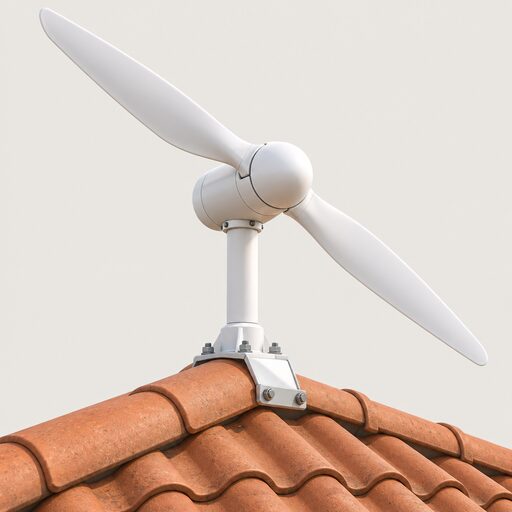
For domestic permitted development, the rules are more prescriptive. A stand alone wind turbine must be set back from the boundary by a distance equivalent to its overall height including blades plus 10 per cent of its height, measured from any point along the property boundary6. The highest part of the turbine including blades must not exceed 11.1 metres6. A building-mounted turbine must not protrude more than three metres above the highest part of the roof excluding the chimney, and no part may exceed 15 metres in height including the building, hub and blade7.
The clearance rules also apply. The distance between ground level and the lowest part of any blade must not be less than five metres8. Any part of the turbine including blades must not be within five metres of any boundary of the curtilage8. Only one turbine is permitted on the same building or within the curtilage8.
| Rule | Domestic permitted development limit |
|---|---|
| Stand alone height | 11.1 metres including blades6 |
| Stand alone boundary setback | Overall height plus 10 per cent6 |
| Building-mounted roof protrusion | Three metres above the highest part of the roof7 |
| Building-mounted overall height | 15 metres including building, hub and blade7 |
| Blade ground clearance | Not less than five metres8 |
| Boundary distance | Not within five metres of any boundary8 |
| Number of turbines | One per building or curtilage8 |
What the limits mean for householders near a proposed wind farm

For a householder near a proposed wind farm, the ETSU-R-97 limits determine whether the development is judged acceptable and what the operator must do if noise exceeds the permitted level. The limits apply at the dwelling, so the assessment is specific to the property and its surroundings. A householder can expect the assessment to consider background noise at their location and the distance to the nearest turbine.
The daytime limit derived from background noise and the fixed night-time limit are the figures that matter. If the predicted noise at the dwelling exceeds those levels, the development may need mitigation or may not be consented. If it is consented with conditions, the operator must comply with those conditions once the turbines are built.
For a householder installing a domestic turbine, the position is different. The permitted development rules set height, clearance and boundary limits rather than an ETSU-R-97 assessment, and the installer is responsible for ensuring the installation meets permitted development noise standards at the time of installation1. Building regulations will normally apply to a turbine attached to a house9.
The limits also interact with the wider question of energy independence. A domestic turbine reduces reliance on the grid, but it does not remove it, and the noise rules are part of what determines whether a turbine can be installed at all. A householder weighing up a turbine should consider the siting rules, the wind speed at the site, and the noise limits together.
Who enforces ETSU-R-97 noise conditions after a wind farm is built
The local planning authority enforces noise conditions through the planning system. A breach of a planning condition is a planning enforcement matter, and the authority can take action if the operator fails to comply. The remedy is through the planning system rather than a fixed penalty regime.
For domestic permitted development installations, the installer is responsible for ensuring the installation meets permitted development noise standards at the time of installation1. This places the responsibility on the installer rather than on the householder alone, and it means the noise position should be established before the turbine is commissioned.
Building regulations will normally apply to a wind turbine attached to a house9. This is a separate consent from planning permission, and it covers the structural and electrical aspects of the installation. A householder should expect both planning and building regulations to be relevant to a domestic turbine.
The enforcement position for a wind farm is that the operator must comply with the conditions attached to the consent. If noise exceeds the permitted level, the local planning authority can require the operator to take action. The assessment method provides the framework for determining whether a breach has occurred, and the conditions set out what the operator must do.
Sources9 cited
- The Microgeneration Certification Scheme, Planning Portal, 2026
- Planning permission for wind turbines in Wales, Welsh Government, 2026
- Wind energy in Northern Ireland, nidirect, 2026
- Air source heat pump noise and permitted development rights in Wales, Welsh Government, 2024
- Air source heat pumps, Bracknell Forest Council, 2026
- Planning permission for stand alone wind turbines, Planning Portal, 2026
- Planning permission for building-mounted wind turbines, Planning Portal, 2026
- Class H: installation of wind turbine on domestic premises, legislation.gov.uk, 2026
- Building regulations for wind turbines, Planning Portal, 2026
 Turbine Noise and NeighboursHow close can a wind turbine be to a neighbour's house before it needs planning permission?
 Air Conditioning NoiseHow loud will an air conditioner be inside your home, and how much noise will the outdoor unit make for you and your neighbours?
 Building-Mounted Wind TurbinesWill a wind turbine on your roof actually make enough electricity to be worth it?
 Domestic Wind TurbinesCan a wind turbine really power a home, and is your site windy enough?
 MCS 020 Noise AssessmentWill your air source heat pump be too noisy for next door?
 Wind Turbine Output and SizingHow much electricity a home wind turbine makes depends far more on your wind than on its size.