
In this guide
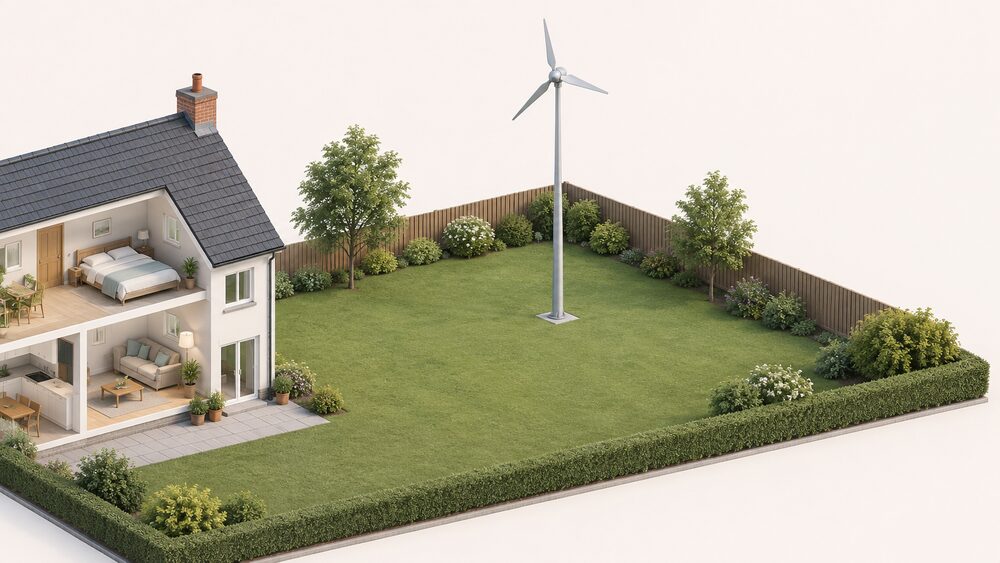
In England a domestic wind turbine can sometimes be installed without an application for planning permission, under permitted development rights, so long as every specified limit and condition is met1. For a stand-alone turbine in the grounds of a house, the highest part, including blades, must not exceed 11.1 metres, the swept area of any blade must be no more than 3.8 square metres, and no part of the turbine may be closer to any point along the property boundary than its own overall height plus ten per cent of that height2. For a building-mounted turbine, no part may protrude more than three metres above the highest part of the roof excluding the chimney, the whole installation must not exceed 15 metres including building, hub and blade, whichever is the lesser, and no part including blades may be within five metres of any boundary3.
Both types share a set of further conditions: at least five metres between ground level and the lowest part of any blade, compliance with the Microgeneration Certification Scheme Planning Standards (MCS 020) or equivalent standards, non-reflective blade materials, siting that minimises the effect on the appearance of the building and the amenity of the area, and removal as soon as reasonably practicable when no longer needed for microgeneration2. Only the first installation of any wind turbine is permitted development, and only where there is no existing air source heat pump at the property2.
These rights fall away entirely within the curtilage of a listed building, on a scheduled monument, and on designated land other than conservation areas, which includes national parks and the Broads, Areas of Outstanding Natural Beauty and World Heritage Sites2. They can also be withdrawn locally by an Article 4 direction4. Where the limits and conditions are not met, or the rights have been removed, an application for householder or full planning permission is required5, and development carried out without the necessary permission may lead to enforcement action6.
Permitted development in England: when no application is needed
Permitted development is the mechanism by which certain works are granted planning permission nationally, so that no application has to be made to the council. Planning guidance for England states that under permitted development rights it is in some cases possible to install domestic wind turbines without the need for an application, provided specified limits and conditions are met1. The installation, alteration or replacement of a stand-alone turbine within the boundaries of a dwellinghouse can be permitted development only where all the listed limits and conditions are satisfied7.
The rights sit in Class H of the householder permitted development order, which covers the installation, alteration or replacement of a wind turbine on domestic premises8. Class H is drafted as a list of circumstances in which development is not permitted, so a single breach, one blade too long, one metre too close to the fence, removes the right for the whole installation rather than just the offending element.
Two structural points shape everything that follows. First, the rights are property-wide, not building-by-building: only the first installation of any wind turbine is permitted development, and additional wind turbines at the same property require a planning application2. Second, the guidance is explicit that it is an introductory guide and not a definitive source of legal information, that it is based on national rules and that additional local rules may also apply1. Independent commentary describes England as having a number of stringent conditions that have to be met when installing a wind turbine9.
For the household, the practical meaning is that permitted development removes a cost and a delay but not the technical or neighbourly constraints. A turbine that fits inside these limits is a small machine. Anything larger is a planning application, with all that implies.
Stand-alone turbines: the 11.1 metre height limit and the setback rule
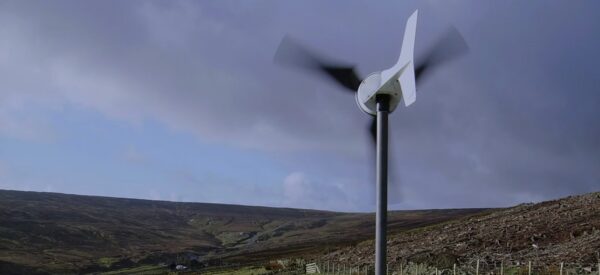
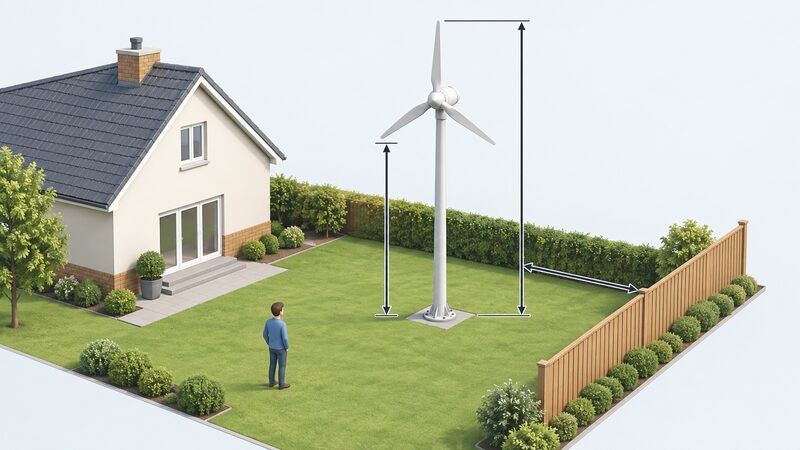
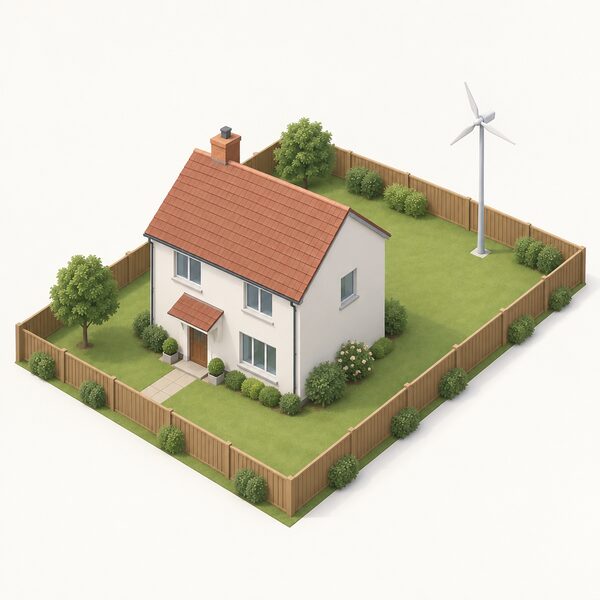
A stand-alone turbine is one that is not mounted on a building, sited within the boundaries of a house or a block of flats. Official guidance for England sets the ceiling plainly: the highest part of the stand-alone wind turbine must not exceed 11.1 metres2. That measurement is to the highest part of the turbine, blades included, so it is blade-tip height at the top of rotation rather than hub height.
The setback rule is proportional rather than fixed. An installation is not permitted if any part of the turbine, including blades, would be positioned closer to any point along the property boundary than a distance equivalent to the overall height of the turbine including blades, plus ten per cent of that height2. Independent guidance describes the same rule as the turbine needing to be at least 1.1 times its own height away from the edge of the property10. In effect the turbine must be able to fall in any direction without reaching the boundary, with a margin. On a narrow or shallow plot this test, not the height limit, is usually what rules a turbine out.
Three further dimensional conditions apply. The swept area of any stand-alone turbine blade must be no more than 3.8 square metres2. The distance between ground level and the lowest part of any blade must not be less than five metres2. And the installation must not be sited on safeguarded land2.
| Condition | Stand-alone turbine, England |
|---|---|
| Maximum height to highest part including blades | 11.1 m2 |
| Minimum distance from any point on the boundary | Overall height including blades, plus 10 per cent of its height2 |
| Maximum swept area of any blade | 3.8 m²2 |
| Blade materials | Non-reflective materials on blades2 |
| Land exclusion | Must not be sited on safeguarded land2 |
| End of life | Removed as soon as reasonably practicable when no longer needed for microgeneration2 |
In conservation areas there is an extra restriction: a stand-alone turbine is not permitted where it would be nearer to any highway bounding the curtilage than the part of the house or block of flats nearest to that highway2. Where the property is a block of flats, the block must consist wholly of flats and should not also contain commercial premises2. Related guidance on how far a turbine must sit from a boundary and on siting and wind speed covers the practical consequences of these setbacks.
Building-mounted turbines: roof protrusion and the five metre boundary
Rights for building-mounted turbines in England are narrower again. They apply only to installations on detached houses, not blocks of flats, and to other detached buildings within the boundaries of a house or a block of flats3. A terrace or a semi-detached house therefore has no permitted development right for a roof or wall-mounted machine.
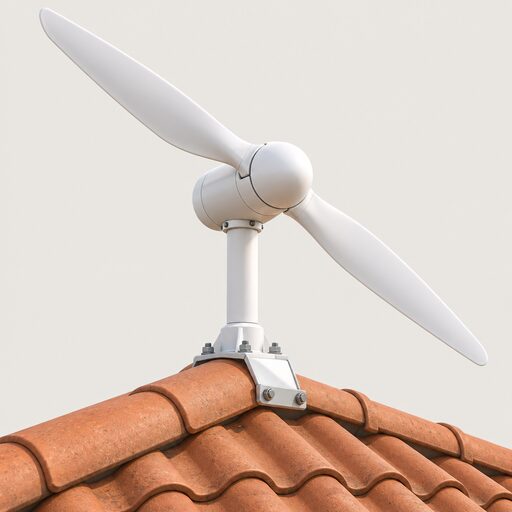
On height, no part including blades should protrude more than three metres above the highest part of the roof, excluding the chimney, and the overall height including building, hub and blade must not exceed 15 metres, whichever is the lesser3. The legislation expresses the same pair of tests as two circumstances in which development is not permitted, taking whichever is the lesser8. On a two-storey house it is almost always the three metre roof protrusion figure that binds.
The boundary condition is a flat distance rather than a proportion: no part of the building-mounted turbine, including blades, must be within five metres of any boundary3, and the legislation gives the same figure measured to any boundary of the curtilage8. Ground clearance to the lowest part of any blade must again be not less than five metres3, and the swept area of any blade must be no more than 3.8 square metres3. The installation must not be sited on safeguarded land3. In conservation areas, an installation is not permitted if the turbine is on a wall or roof slope which fronts a highway3.
Planning permission and building regulations are separate consents: satisfying one says nothing about the other. Further detail sits on building regulations for wind turbines and on roof and building-mounted turbines.
Conditions that apply to both types: MCS standards, materials and removal
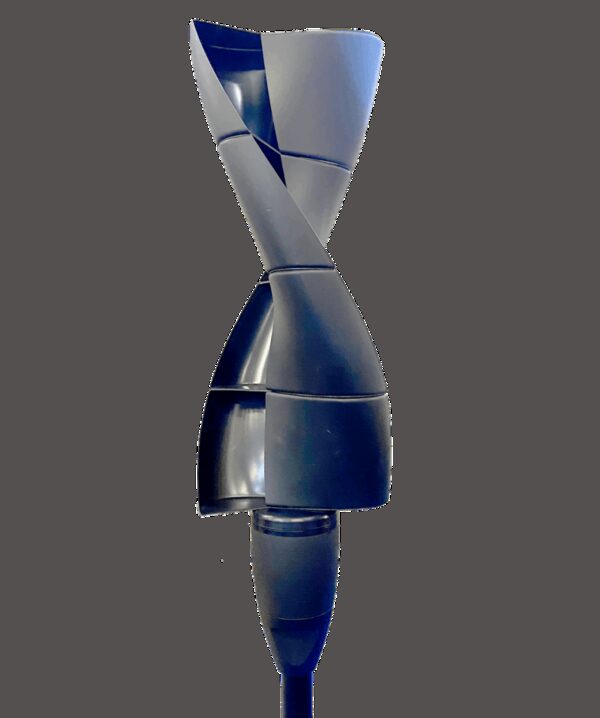
Four conditions attach regardless of whether the turbine stands on a pole or on a building.
- Certified standards. Development is not permitted by Class H unless the wind turbine complies with the MCS Planning Standards or equivalent standards8. The guidance for England names the standard for both stand-alone and building-mounted turbines as the Microgeneration Certification Scheme Planning Standards, MCS 020, or equivalent standards2. In legislation, MCS Planning Standards are defined as the product and installation standards for air source heat pumps and wind turbines specified in Microgeneration Certification Scheme MCS 020(a) and MCS 020(b) respectively12. The scheme itself includes clear standards to support the installation of wind turbines and air source heat pumps13, and MCS states that a new system will be designed and installed in accordance with MCS Standards14.
- Non-reflective blades. The turbine must use non-reflective materials on blades2. The condition addresses glint and flicker from moving surfaces as much as appearance.
- Siting for amenity. It must be sited, so far as is practicable, to minimise its effect on the external appearance of the building and its effect on the amenity of the area2. This is a judgement rather than a measurement, and it is the condition most likely to be argued over after the event.
- Removal when redundant. It must be removed as soon as reasonably practicable when no longer needed for microgeneration2. A disused mast left standing is a breach of the condition on which the original permission rested.
The MCS condition has a bearing on independence. A householder relying on permitted development is, in practice, tied to equipment and an installation route that can demonstrate compliance with a private certification scheme's standards, not simply to any machine that fits the dimensions. Pages on MCS certification for wind and hydro, small wind turbine standards and the question of whether an MCS certified installer is required go further into that.
One turbine only, and not alongside an air source heat pump
The single condition that catches most households is the interaction with heat pumps. In England, only the first installation of any wind turbine would be permitted development, and only if there is no existing air source heat pump at the property; additional wind turbines or air source heat pumps at the same property require an application for planning permission3.
The bar operates in both directions. Class G, the heat pump class, states that development is not permitted where a wind turbine is installed on the same building or within the curtilage of the dwellinghouse or block of flats, or where a stand-alone wind turbine is installed within the curtilage15. Council guidance puts it bluntly: an air source heat pump cannot be installed under permitted development if there is already a wind turbine16, and heat pump development is permitted only if there is no existing wind turbine on a building or within the curtilage of that property17.
"Only the first installation of any wind turbine would be permitted development, and only if there is no existing air source heat pump at the property."
For a household pursuing both electricity generation and low-carbon heat, this is a real constraint: one of the two will need planning permission. It is a sequencing question as much as a planning one, because whichever is installed second falls outside permitted development. Wales has taken a similar approach, with development still not permitted for an air source heat pump where a stand-alone wind turbine is already installed within the curtilage of the dwellinghouse18. The comparison with heat pumps is drawn out further on micro-CHP versus an air source heat pump.
Where permitted development does not apply
Permitted development rights for both stand-alone and building-mounted turbines do not apply to a turbine within the curtilage of a listed building, within a site designated as a scheduled monument, or on designated land other than conservation areas2. Designated land for this purpose includes national parks and the Broads, Areas of Outstanding Natural Beauty, and World Heritage Sites2. Guidance also lists sites of special scientific interest among the areas where the rights do not apply7.
Conservation areas are treated differently from other designated land: the rights survive, but with the added restrictions already noted. A stand-alone turbine is not permitted where it would be nearer to a bounding highway than the nearest part of the house2, and a building-mounted turbine is not permitted on a wall or roof slope which fronts a highway3. The logic is the protection of the public view.
Permitted development does not apply to flats, caravans or other buildings4. For building-mounted turbines the rights reach only detached houses and other detached buildings within the boundaries of a house or a block of flats3.
- Listed buildings: rights do not apply within the curtilage. Where a property is listed, listed building consent is usually needed even where planning permission is not required19, a point set out for heat pumps but reflecting the general rule. Further reading: listed building consent for microgeneration.
- Scheduled monuments: excluded2.
- National parks, the Broads, AONBs, World Heritage Sites: excluded as designated land2.
- Conservation areas: rights retained, with highway-facing restrictions2.
- Safeguarded land: installation must not be sited there2.
Official guidance on biomass flues makes the general point that where a building is listed or in a designated area, even where permitted development rights exist, it is advisable to check with the local planning authority before work is done20.
Article 4 directions: when the council has withdrawn the rights
A local planning authority is allowed to remove permitted development rights in some or all of its area by issuing what is known as an Article 4 direction21. Directions are made when the character of an area of acknowledged importance would be threatened, and they are most common in conservation areas22. One council describes having Article 4 directions in place for specific conservation areas that control some building works4. Rights may equally be removed by a planning condition attached to an earlier permission, for example on a newer estate23.
The effect is narrow and specific rather than blanket. Each Article 4 direction is clear about precisely which permitted development rights have been removed, and for which properties24. A direction can cover a single property or a whole area25. Where one applies, a planning application is needed for works that normally would not need one23.
Article 4 directions can remove specified permitted development rights related to operational development or change of use6. A wind turbine is operational development, so a direction drawn to cover external alterations or microgeneration in a conservation area can remove the Class H right even where the turbine would sit comfortably inside every dimensional limit.
Finding out is straightforward. Official guidance states that a solicitor should have informed a buyer whether an article 4 direction exists when the property was purchased, but that the position can be checked with the local planning authority where there is doubt26. Because directions are local instruments, their existence is not visible from the national rules, and the dimensions in the earlier sections of this page tell a householder nothing about whether a direction applies.
Checking with the local planning authority before installation

Official guidance is direct on process: always check with the local planning authority about planning issues before a system is installed1. The local planning authority is usually the planning department of the local council, and where there are queries about a particular case, the first thing to do is to contact it25. MCS advises the same: before installing a turbine it is a good idea to check with the local council on the necessary planning permissions14.
Several points can only be settled locally. Whether an Article 4 direction or a planning condition applies. Whether the site falls within designated land or the curtilage of a listed building. Whether the boundary setback, measured from any point along the property boundary, is actually achieved on the plot. And whether there is already a heat pump or a turbine recorded at the property.
Councils commonly offer a pre-application or formal "do I need planning permission" service, and guidance notes repeatedly that local authorities may charge a fee for pre-application advice2. Fees are set locally: as an example, Somerset's "Do I Need Planning Permission?" service cost £66.50 as of August 202528. Some authorities publish free technical advice notes on their own websites covering particular installation types29. Separately, wind speed matters as much as consent: guidance for Northern Ireland advises that, ideally, a professional assessment of local wind speed should be carried out for a full year at the exact location where the turbine is planned, before proceeding30. That point is developed on how long to measure wind before installing a turbine.
Applying when permitted development is not available
Where the limits and conditions are not met, or permitted development rights have been removed in the area, an application for householder or full planning permission is required5. Development does not in all instances require a planning application, but where it does and the application is not made, enforcement may follow6. If permitted development rights do not apply, planning permission will be required31.
The application route for work to a single dwellinghouse is householder planning consent. Statutory fees are set nationally; by way of comparison within the same fee schedule, work falling under prior approval, for example a larger rear extension, carries a £249 fee32. Fees for pre-application advice sit outside that schedule and are set by each authority2.
Planning permission is only one of the consents involved. Building regulations will normally apply to a turbine attached to the house and to the electrical installation11, and in Scotland's system the equivalent point is that development within permitted development criteria still requires non-planning consents such as a building warrant33. Grid connection is a further, separate process, covered on G98 and G99 for wind, hydro and CHP.
For independence, the honest position is this: permitted development decides only whether a form has to be filled in. It does not remove the household's dependence on a distribution network operator for an export connection, on a certified installer for MCS compliance, or on the local authority for the interpretation of the amenity and removal conditions. A turbine within the England limits is a small machine, and the pages on output and sizing and cost set out what that means in kilowatt hours and pounds. Wind turbines qualify for a lower rate of VAT in Great Britain only34.
England, Wales, Scotland and Northern Ireland compared
Planning is devolved, and the guidance for England carries the standing caveat that it relates to the planning regime for England and that the policy in Wales may differ1.
| Nation | Position on domestic turbines |
|---|---|
| England | Class H permitted development: 11.1 m stand-alone height, 3 m roof protrusion and 15 m overall for building-mounted, 3.8 m² swept area, 5 m ground clearance, MCS 020 or equivalent2 |
| Wales | Homeowners do not need to apply for planning permission to install a wind turbine provided there is only one and it meets certain criteria, but are required to minimise its effect on the amenity of the area35. A planning application is necessary for a building-mounted turbine, as permitted development rights do not apply to turbines mounted on a dwellinghouse or a building within its curtilage7 |
| Scotland | Free-standing turbine blade tip height must not exceed 15 m and the lowest part of the blade must be at least 5 m from ground level; rights for turbines on dwellinghouses apply solely to detached dwellinghouses36 |
| Northern Ireland | Planning approval is needed30; a turbine supplier states permission is usually needed, with applications to the local council's planning department, though small domestic turbines may sometimes be considered under permitted development37 |
The clearest divergence is Wales on building-mounted turbines, where the permitted development route is simply not available and an application to the local planning authority is necessary7. Scotland's free-standing limit of 15 metres to blade tip is higher than England's 11.1 metres36, but Scotland pairs it with a prior notification step: for a free-standing turbine in the curtilage of a dwelling, the developer must apply to the planning authority for a determination as to whether prior approval will be required as to the siting, design, size and external appearance of the proposed turbine38. Scotland's exclusions also list conservation areas, World Heritage Sites, sites of special scientific interest, sites of archaeological interest and the curtilage of listed buildings36, and Scottish rights carry the same MCS Planning Standards requirement38.
Independent guidance summarises the pattern as Wales and Northern Ireland requiring planning permission before a turbine is installed, while for England and Scotland the rules are more complex and in some specific situations permission may not be needed40. Separate pages set out the rules for Scotland, Wales and Northern Ireland, and the wider technology context sits on the microgeneration pillar.

Sources40 cited
- Wind turbines: planning guidance, Planning Portal, 2026-09-17
- Planning permission for stand alone wind turbines, Planning Portal, 2026-09-17
- Planning permission for building-mounted wind turbines, Planning Portal, 2026-09-17
- What is permitted development, Wandsworth Council, 2026-09-17
- Roof alterations and planning permission, Planning Portal, 2026-09-17
- When is permission required, GOV.UK, 2014-03-06
- Planning permission: wind turbines, Welsh Government, 2026-09-17
- Class H: installation or alteration etc of wind turbine on domestic premises, legislation.gov.uk, 2026-09-17
- Wind turbines for the home, Uswitch, 2026-01-06
- Renewable energy FAQs, Electricity North West, 2023-02-23
- Wind turbines and building regulations, Planning Portal, 2026
- The Town and Country Planning (General Permitted Development) (Wales) Order amendment 2026, legislation.gov.uk, 2026-03-10
- The Microgeneration Certification Scheme, Planning Portal, 2026-09-17
- Small wind turbines, MCS, 2026-08-18
- Class G: installation or alteration etc of air source heat pumps on domestic premises, legislation.gov.uk, 2026-09-17
- Air source heat pumps: planning advice, Cornwall Council, 2026-09-17
- Planning permission for an air source heat pump, Planning Portal, 2026-09-17
- Changes to permitted development rights in Wales from 1 June 2026, MCS, 2026-05-22
- Air source heat pumps, Westmorland and Furness Council, 2026-09-17
- Biomass fuelled appliances: planning permission, Planning Portal, 2026
- Permitted development rights for householders: technical guidance, GOV.UK, 2026-09-17
- Permitted development rights, Planning Portal, 2026-09-17
- Do I need planning permission?, Cornwall Council, 2026-09-09
- Planning and listed building consent requirements, West Northamptonshire Council, 2023-12-14
- What is planning permission, Planning Portal, 2026-09-17
- Planning permission: external walls, Welsh Government, 2026-09-17
- Electrics: planning permission, Planning Portal, 2026-09-17
- Planning and solar, Frome Town Council, 2025-08
- Pre-planning advice for electric vehicle charging, Planning Portal, 2026
- Wind, nidirect, 2026-05-18
- Solar photovoltaic panels, Bromley Council, 2026-09-17
- Householder planning consent, Planning Portal, 2026-09-17
- Permitted development rights: non-domestic solar panels and domestic air source heat pumps consultation, Scottish Government, 2015-06
- Tax on shopping: energy saving products, GOV.UK, 2026-09-17
- What could the next Senedd do on heat pump planning, Nesta, 2026-01-26
- Circular 1/2024: householder permitted development rights, page 6, Scottish Government, 2024-05-28
- How does wind energy work, Power NI, 2026-04-09
- The Town and Country Planning (General Permitted Development) (Scotland) Amendment Order 2024, legislation.gov.uk, 2024-05-24
- Policy note to SSI 2024/102, legislation.gov.uk, 2024-03
- Wind turbines, Energy Saving Trust, 2026-05-20
 Wind Turbine Planning in WalesDo you need planning permission for a wind turbine at home in Wales?
 Wind Turbine Planning in NIDo you need planning permission for a home wind turbine in Northern Ireland?
 Wind Turbine Planning ScotlandScotland lets some home wind turbines go ahead without planning permission, but only if they stay within strict size and distance limits.
 Building-Mounted Wind TurbinesWill a wind turbine on your roof actually make enough electricity to be worth it?
 Permitted Development by HomeCan you put up solar panels or a heat pump without asking the council?
 Planning Permission EnglandMost homes in England can have solar panels fitted without planning permission, but does yours count as one of the exceptions?