
In this guide
Two numbers decide whether a micro hydro scheme is worth building, and neither is the size of the turbine. They are head, the difference in height between the water at the top of the system and the bottom, and flow, how much water is flowing through the system. Energy Saving Trust puts it plainly: a suitable site needs a water source with a combination of the two1. nidirect frames the same test as a question of viability, depending on whether there is enough water flowing per second and the height or head that it falls from2.
Everything else in a scheme, the turbine type, the penstock diameter, the generator, the inverter, follows from those two measurements. A micro hydro plant is defined as one generating less than 100 kilowatts3, and within that band Energy Saving Trust states that small hydroelectricity systems can produce enough electricity for all electrical appliances and lighting in a home1. That is a statement about what a well-sited scheme can do, not a promise attached to the category. Output is set by the site.
The order of work matters as much as the arithmetic. Head and flow are measured first, on the watercourse, at the driest time of year. The residual flow that must be left in the channel is deducted next. Only then is a design flow fixed, and only then does it make sense to talk about a turbine. nidirect adds a step before any of it: a property should be properly insulated before renewable technologies are installed2.
Head and flow: the two numbers that decide whether a scheme works
The viability test is not a matter of opinion or of the manufacturer's specification sheet. nidirect states that the viability of the installation will depend on whether there is enough water flowing per second and the height or head that it falls from2. Energy Saving Trust sets out the same two variables as the site requirement, defining flow as how much water is flowing through the system and head as the difference in height between the water at the top of the system and the bottom1.
What makes these two numbers decisive is that they are properties of the land, not of the equipment. A household can choose a different turbine, a larger penstock or a better generator, but it cannot buy more head or more flow. The site sets the ceiling, and the design work is about getting as close to that ceiling as the watercourse and its consents allow.
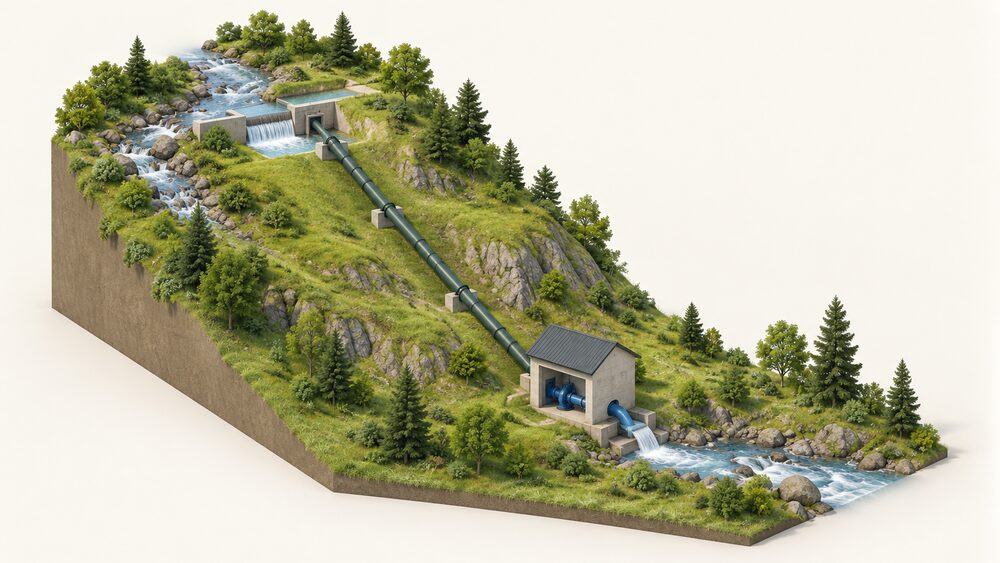
The two also trade against each other. A site with a large fall over a short distance can work on a modest flow, because the same water is used repeatedly down the drop. A site on flat ground with a wide, slow river needs a large volume of water to compensate for the small fall. This is why two schemes of identical nominal output can look nothing alike: one may be a small turbine at the foot of a steep hillside, the other a large machine in a low weir.
For a household, the practical consequence is that the survey comes before the shopping. Head and flow are measured on site, over time, and the resulting figures determine whether a scheme is viable at all, what it can generate, and what consents it will need. The Planning Portal notes that useful power may be produced from even a small stream3, which is encouraging but not a substitute for measurement: a small stream with good head is a different proposition from a small stream on the flat.
What head means and how to measure it
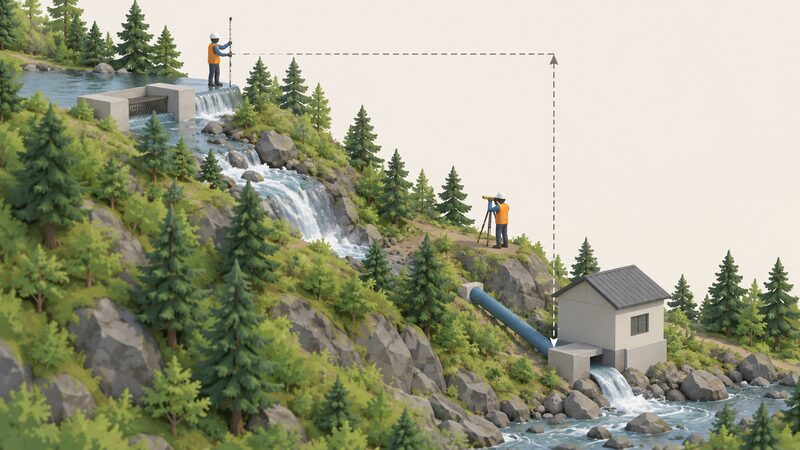
Head is the vertical drop the water falls through, and Energy Saving Trust defines it as the difference in height between the water at the top of the system and the bottom1. The definition is worth reading carefully, because it is not the same as the drop between two convenient points on the bank. It is measured between the water level at the intake, where water leaves the watercourse, and the water level at the outfall, where it returns.
Two versions of the figure matter. Gross head is the full drop available between those two points. Net head is what remains after the water has travelled through the intake, the channel or penstock, the bends, valves and fittings, and the turbine itself. Every one of those stages costs a little height, and it is net head, not gross head, that sets output. A scheme designed on gross head will underperform, because the losses are real and permanent.
Measurement in practice is a survey task. The reliable approach is to establish the vertical difference between the intake and the outfall using a level, whether optical, laser or a water-filled hose, rather than pacing out a distance and estimating a gradient. On a steep site the drop may be concentrated over a short run; on a gentler one it is spread over a long channel, and the losses in that channel grow with its length.
Head also determines which turbine family suits the site, which is a separate question from output. The hydro turbine types page sets out how Pelton, Turgo, crossflow, propeller and Archimedean screw machines divide the head and flow ranges between them, and the Pelton turbine head requirement and crossflow turbine head and flow pages deal with two of those families in detail.
What flow means and how to measure it

Flow is how much water is flowing through the system, in Energy Saving Trust's definition1. It is a rate, not a volume: the question is how much water passes a point each second, and it changes hour by hour and week by week with rainfall, snowmelt and abstraction upstream.
The measurement that matters is the low flow, not the average. A scheme is sized on what the watercourse can spare in a dry spell, because a turbine that is starved in August produces nothing in August, however well it performed in March. A single spot reading taken on a wet day tells a household almost nothing about the annual output of a scheme.
Flow is commonly established by a gauging method: measuring the cross-section of the channel and the velocity of the water through it, or by a dilution or weir method where the channel suits one. Whatever method is used, the result is a figure in cubic metres per second, and it is that figure, minus the residual flow, that becomes the design flow.
Flow also varies by nation and by catchment in ways that no general figure captures. The run-of-river load factor page deals with how much of the year a scheme actually runs at full power, which is the practical expression of a flow that rises and falls. For a household, the honest position is that flow must be measured on the specific watercourse, over a full range of conditions, before any output figure can be trusted.
The residual flow requirement: leaving enough for the water course
A hydro scheme does not take all the water. nidirect states that there should also be enough residual flow to maintain the water course2. That single sentence carries two consequences: it is a condition of the consent to abstract, and it reduces the flow available for generation.
Residual flow is the water left in the channel after the scheme has taken its share. It exists to keep the watercourse alive: to maintain the physical shape of the bed and banks, to keep water moving for fish and invertebrates, and to preserve the interests of anyone downstream who also has a right to the water. It is not a courtesy, and it is not negotiable after the scheme is built.
For sizing, the arithmetic is a subtraction. Design flow is the flow available at the intake, less the residual flow that must be passed down the channel. A scheme sized on the total flow rather than the surplus will be over-committed, and in dry conditions it will either breach its consent or stop generating. Both outcomes are worse than a smaller turbine.
The residual flow figure is set through the abstraction licensing process, and it differs between the nations. In Scotland, the water abstractions, water intake structures such as dams or weirs, and the outfall structures required for a micro hydro scheme require prior authorisation from SEPA under the Water Environment (Controlled Activities) (Scotland) Regulations 20114. The hydro abstraction licences and permits page covers the licensing route, and the hydro environmental requirements page covers screening and fish passage, which are the other conditions that commonly attach to a consent.
How head and flow combine to give potential output
Output is a product, not a sum. The power available from a watercourse rises with the head the water falls through and with the flow it carries, and the two multiply rather than add. That is why a site with modest flow and excellent head can outperform a site with abundant flow and almost no fall, and why a small improvement in either figure changes the result.
The theoretical figure is then reduced by system efficiency. No turbine, generator, drive or inverter converts all the energy in the falling water into usable electricity; each stage takes a share. The practical output of a scheme is therefore the theoretical power multiplied by an efficiency figure that reflects the whole chain, from the intake to the meter. This is why a scheme's real output is always below the arithmetic of head times flow, and why the gap widens with a poorly matched turbine or a long, lossy penstock.
Metering the result follows the same conventions as other renewable installations. Ofgem guidance on metering for payment states that heat and electricity meters should be in kilowatt hours (kWh), megawatt hours (MWh), or a combination of both, and that gas and oil meters are read in cubic metres or litres5. A hydro scheme's output is electrical, so it is measured and reported in kilowatt hours.
For a household, the useful discipline is to work the calculation in one direction only. Measure net head and design flow, apply a realistic efficiency, and see what the site can produce. Then compare that figure with the household's own consumption. If the site's output is smaller than the load, the scheme is a contribution rather than a supply, and the micro hydro turbine output page deals with what that means in practice.
| Input | What it is | Where it comes from |
|---|---|---|
| Gross head | Full vertical drop between intake and outfall | Site survey |
| Net head | Gross head less losses in channel, penstock and fittings | Site survey and design |
| Total flow | Water passing the intake per second | Gauging, at low flow |
| Residual flow | Water that must remain in the watercourse | Abstraction consent2 |
| Design flow | Total flow less residual flow | Subtraction |
| System efficiency | Share of theoretical power delivered as electricity | Turbine, drive, generator and inverter specification |
Why the grid ended local hydro, and why small schemes are returning
Small hydro is not a new idea being introduced to the British landscape. nidirect records that hydropower or hydroelectricity, generated from dams, sluices and mill wheels, was used for many years to generate electricity in a local area, and that this method of generation generally disappeared with the introduction of the electricity grid2. The mills and the wheels did not fail; the grid simply made central generation cheaper and more convenient than maintaining a private plant.
The same grid is now the reason small schemes are returning, in two distinct settings. The first is the off-grid property. The Planning Portal states that for houses with no mains connection but with access to a micro hydro site, a good hydro system can generate a steady, more reliable electricity supply than other renewable technologies at a lower cost3. That is a strong claim for a specific circumstance: a site with head and flow, and a connection that does not exist or is prohibitively expensive to bring in.
The second setting is the grid-connected rural property, where a scheme offsets imported electricity rather than replacing a connection. Here the economics depend on the site and on the arrangements for export, which are covered on the exporting electricity from wind, hydro and CHP page and, for the closed support scheme, on the Feed-in Tariff for wind, hydro and micro-CHP page.
The Planning Portal also notes that in off-grid applications the power is used for lighting and electrical appliances, and that space and water heating can be supplied when available power exceeds demand3. That last condition is the honest limit: heating is a large load, and a hydro scheme covers it only in the periods when generation is above the household's other demand. The micro hydro space and water heating page deals with that balance directly.
Consents and licences you need before building

nidirect states that various consents and licences are required for a hydro project2. The list is not short, and it is best treated as a sequence rather than a set of parallel tasks, because some consents depend on others.
The abstraction consent comes first in most cases, because it fixes the residual flow and therefore the design flow. In Scotland, the water abstractions, water intake structures such as dams or weirs, and the outfall structures required for a micro hydro scheme require prior authorisation from SEPA under the Water Environment (Controlled Activities) (Scotland) Regulations 20114. The hydro abstraction licence page covers the application in detail.
Planning permission and grid connection follow. Ofgem's guidance on preliminary accreditation for renewable installations lists the documents required as planning permission, a grid connection agreement, and licences and consents, the last of these marked as applying to hydro only6. That list is a useful checklist of what a scheme must have in hand before it can be accredited.
Certification of the installer and equipment is a separate requirement, and it attaches to permitted development rights rather than to the scheme itself. The Planning Portal states that one of the limits of permitted development rights for wind turbines and air source heat pumps is that equipment must be installed by an installer who has been certificated through the Microgeneration Certification Scheme using a certificated product7. The MCS certification for wind and hydro installations page sets out what that means for a hydro project.
Where a building is listed or sits in a designated area, the position tightens further. Planning Portal guidance on micro-combined heat and power states that if the building is listed or in a designated area, even where permitted development rights apply, it is advisable to check with the local planning authority before a flue is fitted, and that consent is likely to be needed for internal alterations8. The same caution applies to the plant and pipework of a hydro scheme, and the listed building consent for microgeneration page covers the consent route.
Preparing the property first: insulation before installation
nidirect is direct on the order of work: a property should be properly insulated before installing renewable technologies2. The same wording appears in Northern Ireland's ventilation guidance, which states that a property should be properly insulated before installing renewable technologies9. This is not a general exhortation to save energy; it is a statement about how generation capacity should be spent.
The reasoning is arithmetic. A hydro scheme's output is capped by the site, and that cap cannot be raised later by buying a better machine. Every unit of demand removed by insulation is a unit the scheme no longer has to cover, which raises the share of the household's load that the turbine serves. Insulating after installation leaves the same turbine serving a larger load, and the shortfall is met from the grid or a generator.
Insulation is also the measure that attracts support. The Affordable Warmth Scheme in Northern Ireland lists its Priority 1 measures as installation or topping up of loft insulation to 300mm, roof, loft and eaves ventilation, providing a hot water cylinder jacket, providing cavity wall insulation where suitable, draught proofing doors and windows, and the removal and replacement of ineffective cavity wall insulation10. Those are the measures that reduce demand before a generator is sized.
Where insulation work is grant-funded, the paperwork has its own requirements. Ofgem's ECO4 delivery guidance states that the installer, operative or assessor, and either the occupier or landlord must sign the pre-existing loft declaration regarding the presence of loft insulation in the property before installation of any loft measures11. That declaration is a condition of the funding, not an optional record.
Building regulations bear on the same work. Approved Document L: Volume 1 sets out requirements for primary storage systems, stating that they should meet the insulation requirements of the Hot Water Association's Performance Specification for Thermal Stores12. Where a scheme includes a thermal store, that specification applies. The micro hydro installation and maintenance page covers the plant side of the same preparation.
Sources12 cited
- Hydroelectricity, Energy Saving Trust, 2025
- Hydropower, nidirect, 2026
- Hydro electricity, Planning Portal, 2026
- Microgeneration planning advice, Scottish Government, 2013
- Metering for payment, Ofgem, 2022
- Feed-in Tariff guidance for renewable installations, Ofgem, 2016
- The Microgeneration Certification Scheme, Planning Portal, 2026
- Micro-combined heat and power: planning permission, Planning Portal, 2026
- Ventilation systems, nidirect, 2026
- Affordable Warmth Scheme, Northern Ireland Housing Executive, 2026
- ECO4 delivery guidance, Ofgem, 2025
- Building regulations Approved Document L Volume 1, Welsh Government, 2026
 Micro Hydro InstallationHow much water do you need, and how far does it have to fall, for a micro hydro system to be worth it?
 Micro Hydro Power for HomesA stream on your land that flows all year can make steady electricity, day and night, even when there is no sun or wind.
 Micro Hydro CostHow much does a micro hydro scheme cost to build and run, and what makes one worth it?
 Sizing and Heat LossHow do installers work out what size heat pump your home needs, and why can a unit that is too big cost more to run than one that is slightly small?
 Buffer Tanks and VolumisersA buffer tank adds water volume to a heat pump system, but plenty of homes do not need one.
 Hydro Environmental RequirementsWhat does a micro hydro scheme need to do about fish, and who decides?