
In this guide
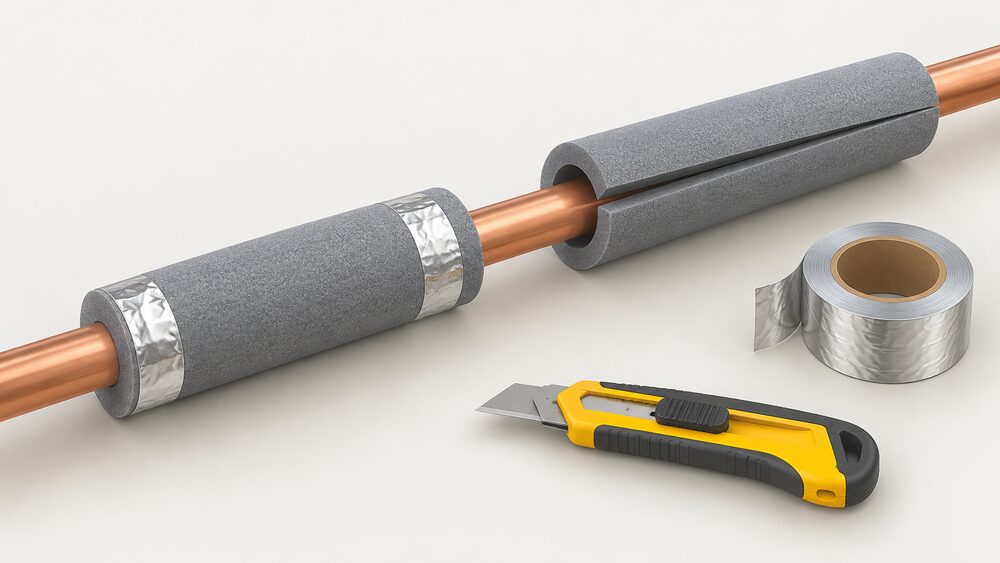
Pipe insulation is the cheapest fabric measure in a home and the one most often left out. It takes the form of a foam tube with a slit in the side, which slips around a pipe without tools or fixings, and it is sold in DIY stores alongside hot water cylinder jackets1. Its job is narrow but real: it slows heat loss from hot pipework and it reduces the risk of cold pipework freezing when the temperature goes below zero2.
The saving is modest. For a typical gas heated three bedroom semi detached house, pipe insulation saves around £6 a year on the energy bill, and the same figure is given for Northern Ireland, where the comparison home is oil heated2. That is not a reason to skip it. The work is inexpensive, it protects against a burst pipe in a loft or garage, and it is one of the few measures a household can complete in an afternoon without touching the structure of the building.
What it does for energy independence is limited and worth stating plainly. Lagging pipework reduces the heat a household buys from a supplier, and it reduces the chance that a frozen condensate or supply pipe leaves the home without heating or water in a cold snap. It does not remove the gas connection, the electricity supply or the boiler, and it does not generate anything. It is a small, permanent reduction in demand rather than a step away from the grid.
What pipe insulation is and what it does
In the context of home heating, insulation is material that helps prevent heat in the home from escaping1. Pipe insulation applies that principle to the pipework itself. A hot water pipe running through a cold loft loses heat along its whole length, and that heat has been paid for. A cold water pipe in the same loft gains nothing from being cold, but it is exposed to air that drops below zero in winter, and water freezing inside it expands and splits the pipe2.
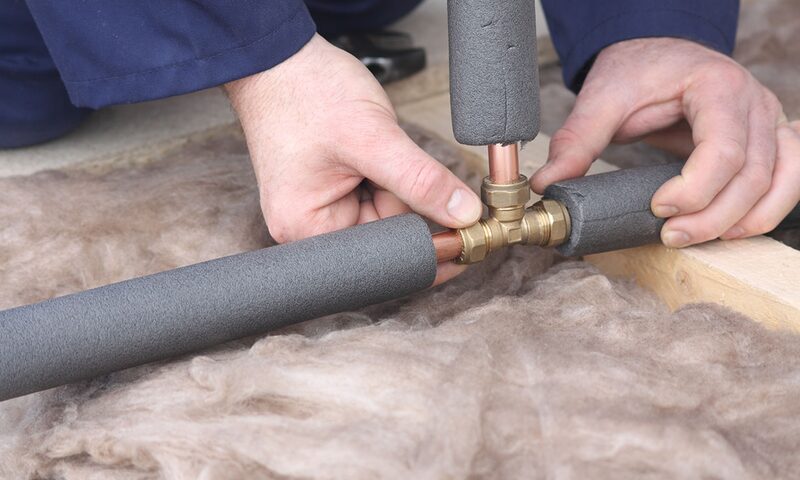
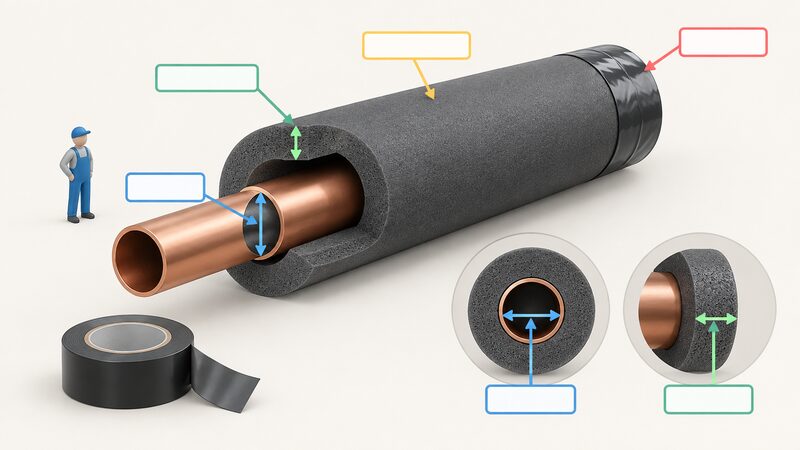
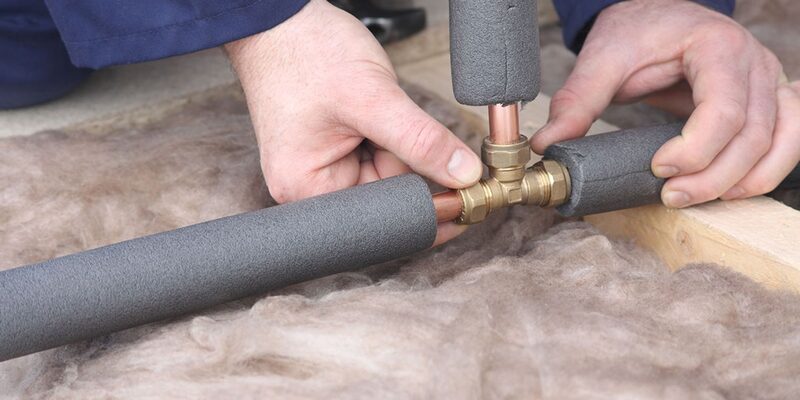
The material is simple. Pipe insulation typically takes the form of a foam tube with a slit in the side, which slips around the pipes1. Pipes can be insulated using foam tubes that cover the exposed pipes between the hot water tank and boiler7. The tube is closed cell foam in most domestic products, sold in lengths and in a range of bores, and it is cut to length with a knife.
Building guidance treats pipe insulation as part of the heating system rather than as a standalone measure. In Wales, as part of the provision or extension of a heating or hot water service, reasonable provision would be demonstrated by insulating pipes, ducts and vessels8. That framing matters: pipe lagging is expected when a heating system is installed or extended, not only when a household decides to improve efficiency.
The wider insulation family works the same way. Insulation is found in lofts or cavity walls, lining buildings, and comes in various types such as fiberglass, cellulose, polystyrene and wool1. Pipe lagging is the smallest member of that family, and the one with the shortest payback in labour terms.
The savings: around £6 a year, and more for longer runs
The published saving for pipe insulation is around £6 a year for a typical gas heated three bedroom semi detached house, with the same £6 figure given for Northern Ireland where the comparison home is oil heated2. That is the only figure UK guidance puts on the measure, and it is worth being honest about its size. It is roughly the cost of the material every two to three years.
The figure is an average, and the range around it is driven by three things. The first is the length of uninsulated run: a cylinder and boiler in a garage with twenty metres of pipe between them loses far more than a cylinder in an airing cupboard with two metres. The second is the temperature difference the pipe sees. A hot flow pipe in a loft loses heat continuously through the heating season, while a pipe inside the thermal envelope of the house loses heat into a space that is already heated. The third is the thickness and conductivity of the lagging fitted, which is why the building guidance sets minimum thicknesses rather than leaving it to judgement.
The saving is also not the whole value. A frozen condensate pipe stops a condensing boiler working, and a frozen supply pipe in a loft can flood a ceiling when it thaws. Independent guidance lists outdoor pipes, the condensate waste pipe and uninsulated areas like the loft, basement or garage as the places that are important to insulate2. The avoided cost of a plumber and a repair is not in the £6 figure and is not quantified in UK guidance, but it is the reason most households lag pipes at all.
For a household thinking about independence, the honest reading is that pipe insulation shaves a small amount off a bill that still comes from a supplier. It does not change the fuel, the boiler or the connection. It reduces waste, and it reduces the chance of a winter failure, and those are the two things it does.
Where pipes need insulating: lofts, garages, basements and outdoor runs
The rule of thumb is that any pipe outside the heated envelope of the home is a candidate. Independent guidance names outdoor pipes, the condensate waste pipe, and uninsulated areas like the loft, basement or garage2. A pipe running through a heated room is losing heat into a space the household is already paying to warm, so the loss is not wasted in the same way. A pipe in a loft is losing heat to outside air.
The qualifying locations for VAT relief give a useful map of what counts as insulation work on pipework: walls, floors, ceilings, roofs or lofts, water tanks, pipes or other plumbing fittings9. The legislation behind that guidance names insulation for walls, floors, ceilings, roofs or lofts or for water tanks, pipes or other plumbing fittings10. Pipework sits in the same category as the tank it serves.
Lofts are the most common location, and they bring a complication. Building regulations need adequate ventilation when installing loft insulation, and the advice is to check with local building control11. Installing insulation to a loft area requires an application for approval under the Building Regulations12. Where a roof has no ceiling, the insulation can be placed between the rafters and ventilation maintained13. Pipe lagging in a loft is usually done at the same time as the loft insulation itself, and official guidance recommends lagging pipes at the same time for optimum efficiency12.
Garages and basements are simpler because there is rarely a ventilation requirement to satisfy, but they are colder, so the case for lagging is stronger. Outdoor runs need the ends sealed properly and the lagging protected from UV and water, which is where the material choice starts to matter.
Foam, rubber or wool: choosing the material
Pipe insulation is made from different materials, including polyethylene foam, rubber and foil tape2. Polyethylene and rubber pipe insulation do a similar job2. That is the whole of the published comparison, and it is enough to make the choice practical rather than technical: the material matters less than the fit, the thickness and the seal at each end.
Polyethylene foam is the common DIY product, sold as slit tubes in grey or white. It is cheap, easy to cut and adequate for indoor pipework. Rubber insulation is denser and more flexible, which helps on bends and tight runs, and it is often chosen for condensate pipes and outdoor work where the lagging needs to stay in place. Foil tape is listed alongside the two foams as a pipe insulation material, and it is the usual way of sealing joints and ends2.
The wider insulation market offers other materials, but they are not sold as pipe lagging in the domestic sizes. Insulation types include fiberglass, cellulose, polystyrene and wool1. Cavity wall insulation uses mineral wool, EPS bead and PU foam15. Internal wall insulation in traditional buildings prefers vapour permeable, capillary active and hygroscopic materials fitted against a prepared wall with no residual impermeable finishes16. None of that transfers directly to a 15mm heating pipe, but it explains why the language of vapour permeability appears in retrofit advice: the principle is that materials should not trap moisture against the fabric.
For pipework, the practical hierarchy is fit first, thickness second, material third. A correctly sized polyethylene tube, sealed at both ends, outperforms a loose rubber sleeve that lets cold air in at the joints.
Thickness, bore size and R-value: getting the fit right
Two measurements decide whether lagging works. The bore is the width of the holes cut into the centre of the insulation tubes, and it must match the pipe2. The wall thickness is the depth of foam around the pipe, and UK guidance sets minimums by pipe diameter and by the thermal conductivity of the insulation.
The figures differ between the nations and between documents, and the differences are worth setting out rather than smoothing over.
| Source | Pipe internal diameter | Minimum insulation thickness | Conductivity assumed |
|---|---|---|---|
| Approved Document L, England4 | Up to 25mm | 20mm | 0.035W/m.K or better |
| Approved Document L, England4 | Over 25mm up to 100mm | 24mm | 0.035W/m.K or better |
| Approved Document L, Wales17 | Up to 25mm | 20mm | 0.035W/m.K or better |
| Approved Document L, Wales17 | Over 25mm up to 100mm | 24mm | 0.035W/m.K or better |
| Scottish technical handbook5 | Up to 50mm | 15mm | 0.025W/(m·K) or better |
| England, low conductivity table4 | Up to 10mm | 5mm | 0.025W/(m·K) or better |
| England, low conductivity table4 | Up to 25mm | 10mm | 0.025W/(m·K) or better |
| England, low conductivity table4 | Up to 50mm | 15mm | 0.025W/(m·K) or better |
| England, low conductivity table4 | Up to 100mm | 20mm | 0.025W/(m·K) or better |
The pattern is that a better insulating material needs less thickness. Where the conductivity is 0.025W/(m·K) rather than 0.035W/m.K, the required thickness falls. A household fitting lagging to a domestic heating system is unlikely to be held to either figure, but an installer working to building control will need to know which applies.
Independent guidance takes a simpler line: for the best results, choose the thickest insulation that will fit around your pipe2. The insulation must also fit into the spaces around the pipes and bends2. Where complete insulation is not possible, official guidance for existing buildings says insulation should be fitted as for new systems as far as is reasonably practicable18.
Insulating the hot water cylinder and tank
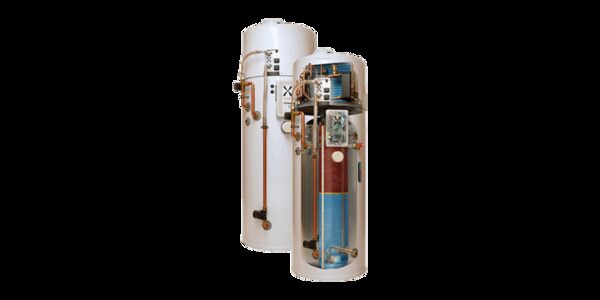
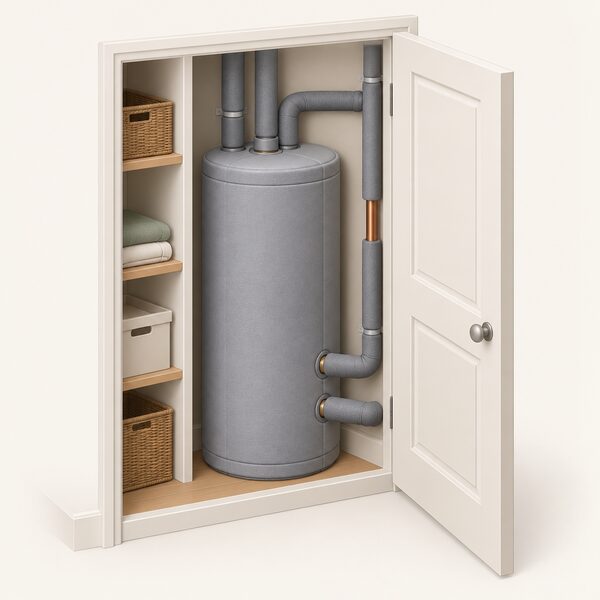
A hot water cylinder is a stored heat battery, and an unlagged one loses heat continuously. Independent guidance is specific about the standard: check the jacket thickness, and it should be at least 80mm thick2. Many cylinders built before the 1990s have a thin spray foam coating or a loose jacket well below that figure, and a replacement jacket is one of the cheapest measures available.
Pipe insulation and hot water cylinder jackets are sold at DIY stores1. Pipes can be insulated using foam tubes that cover the exposed pipes between the hot water tank and boiler7. The cylinder and the pipework around it are treated as one job, because the pipes are the path by which the stored heat leaves the cylinder.
In Northern Ireland, the duty sits with the landlord in the private rented sector. In a property rented to tenants, the landlord should make sure roof spaces are insulated, replace draughty ill fitting windows and doors, draught proof external doors and windows but not in rooms containing an open flue gas appliance, insulate exposed water pipes, and fit the hot water tank with a good quality insulation jacket11. That is a clear statement that cylinder jackets and pipe lagging are part of the fitness standard for rented homes in Northern Ireland, not optional improvements.
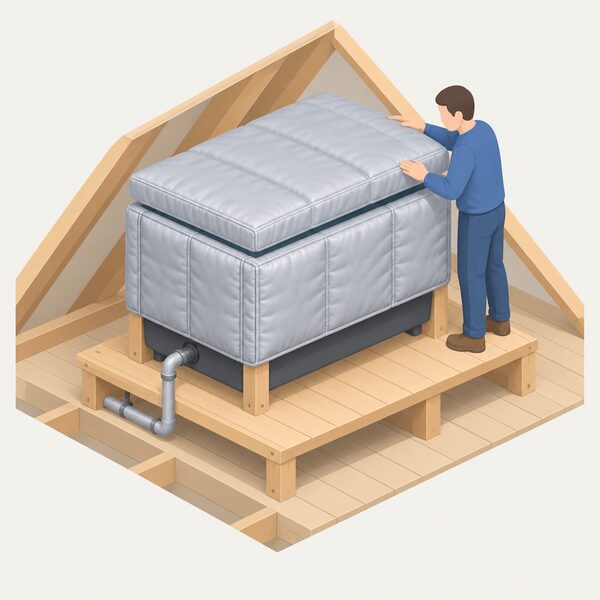
Loft tanks are the other half of the job. A cold water tank in a loft holds a large volume of water in the coldest part of the house, and the tank itself and the pipes around it are the runs most exposed to freezing. The qualifying locations for VAT relief name water tanks, pipes and other plumbing fittings together9, and the legislation names insulation for water tanks, pipes or other plumbing fittings10. The tank should be insulated on its sides and top, with the base left open where the space below is heated, so that rising warmth keeps the water moving.
Protecting condensate pipes from freezing
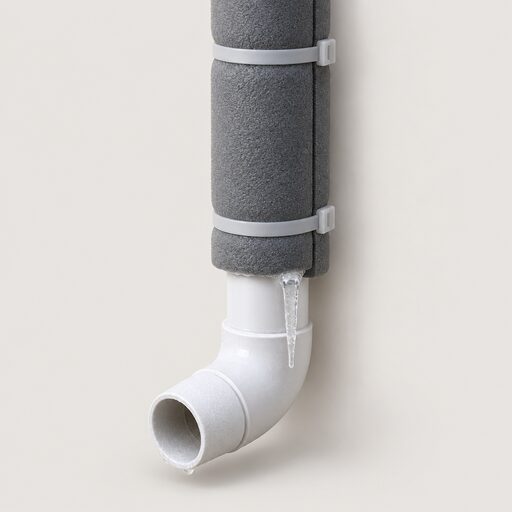
A condensing boiler produces acidic water as a by-product of combustion, and that water leaves through a condensate pipe, usually a plastic run to a drain. In winter the pipe is the most common cause of a boiler shutting down, because the condensate freezes inside it and the boiler locks out.
Independent guidance describes wrapping the condensate pipe in foam pipe insulation as the most energy-efficient way to protect it19. The other remedies listed are moving the pipe inside, replacing it with a wider diameter pipe, and retrofitting manufacturer antifreeze19. The order matters: moving the pipe inside removes the exposure entirely, a wider pipe takes longer to block, and lagging slows the freeze without preventing it in a long cold spell.
If a condensate pipe does freeze, the thaw method is to hold a hot water bottle, warm cloth or microwaveable heat pack around the frozen part, or pour hot but not boiling water over it, then reset the boiler if needed19. Boiling water on a plastic pipe risks cracking it, and the guidance is explicit about the temperature.
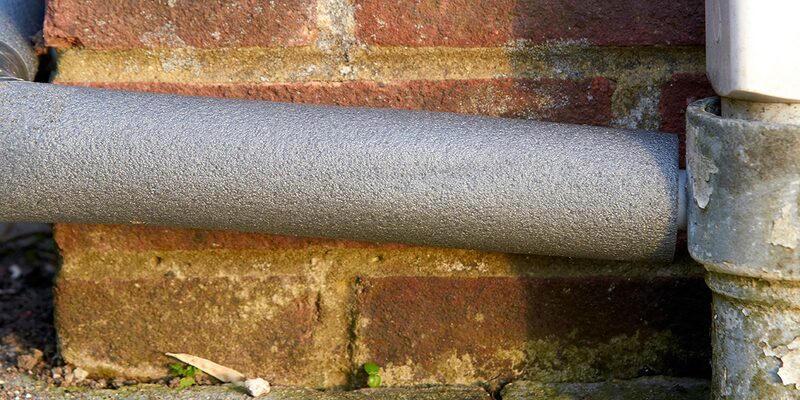
The same logic applies to any outdoor pipe run. If the temperature goes below zero, pipes are at risk of freezing2. Lagging reduces the risk, and sealing each end of the insulation with tape is what makes the lagging effective at protecting the pipes from freezing temperatures2. An open ended tube lets cold air straight to the pipe surface.
For a household, the condensate pipe is the single most valuable metre of lagging in the house. A frozen condensate pipe means no heating and no hot water until it thaws, and the fix is a length of foam tube and a roll of tape.
Fitting it yourself: preparation, taping and sealing
The work is within reach of most households. Choose the correct size from a DIY store and then slip it around the pipes7. No fixings, no tools beyond a knife and tape, and no need to drain the system.
The sequence is straightforward:
- Turn off the heating and hot water so the pipes are not hot enough to burn2.
- Measure the outside diameter of each pipe and buy lagging with a matching bore2.
- Cut the tube to length, open the slit and slip it around the pipe7.
- Push the lagging into place around bends, leaving no bare pipe at joints2.
- Secure and seal each end of the insulation with tape2.
- Tape along the slit where the tube has been opened, so the lagging stays closed.
Sealing is the step most often skipped and the one that decides whether the lagging works. Independent guidance states that to make sure the insulation is effective at protecting the pipes from freezing temperatures, each end of the insulation should be secured and sealed with tape2. On a hot pipe, an unsealed end lets warm air escape and cold air enter; on a cold pipe, it lets cold air reach the surface directly.
For renters, the measure is unusually well suited. Pipe insulation typically takes the form of a foam tube with a slit in the side, which slips around the pipes, and if you are renting and cannot make permanent changes, you can remove the insulation and bring it with you when it is time to move1. Nothing is fixed to the fabric of the building, so no consent is needed and nothing is left behind.
Cost, VAT and grants
The material cost is low. It can cost as little as £15 to fit your own foam insulation around exposed hot water pipes3. That is a DIY figure for a typical exposed run, and it is the reason the measure is often bundled into a wider job rather than quoted separately.
VAT is where the rules get more detailed than most households expect. Insulation is on the list of energy saving materials that qualify for relief, and the guidance names insulation on walls, floors, ceilings and lofts20. The legislation names insulation for water tanks, pipes or other plumbing fittings10. Energy saving materials installed in residential accommodation and certain charitable buildings are subject to VAT relief at 0% until 31 March 20276.
The 0% rate applies to installation. Where energy saving materials are supplied only, without installation, they are standard rated21. Where they are installed in a dwelling and the materials are not over 60% of the cost of the installation, the reduced rate of 5% applies21. The published example is an installer charging £1,000 excluding VAT for an installation, of which £400 is materials and £600 is labour; the materials are 40% of the total, so the installer can charge the reduced 5% rate on the whole installation cost, which is 5% of £1,000, or £5022.
| Situation | VAT treatment | Source |
|---|---|---|
| Energy saving materials installed in residential accommodation | 0% until 31 March 2027 | 6 |
| Installation where materials are not over 60% of the total cost | 5% on the total supply | 21 |
| Materials supplied only, not installed | Standard rate | 21 |
| Example: £1,000 installation, £400 materials, £600 labour | 5% of £1,000 = £50 | 22 |
Grants for pipework specifically are rare, but pipework appears in wider insulation schemes. In Northern Ireland, the Help to Insulate scheme, the Keep Warm Discount Scheme and Efficiency Plus Insulation Cashback offer a grant of 40% towards the cost of cavity wall insulation and or loft insulation, up to £650 maximum grant per insulation measure and up to £1,000 maximum grant for cavity wall insulation by extraction and refill, with a fully funded additional measure of a hot water tank jacket24. A hot water cylinder jacket is therefore available at no cost through those schemes for eligible households.
In England, a Home Improvement loan lists pipework among eligible works under the insulation category, alongside cavity wall, duct, roof, room in roof, loft and loft hatch, rafter, draught proofing and sealing improvements, hot water cylinders and underfloor insulation25. The Great British Insulation Scheme has closed to applications, and its delivery guidance set minimum insulation thicknesses for the measures it funded, from 160mm for mineral fibre down to 80mm for phenolic board depending on the U-value change26. Pipework was not one of its headline measures.
How pipe insulation fits the wider retrofit
Pipe lagging is rarely the reason a household starts a retrofit, but it is almost always part of one. Official guidance recommends lagging pipes at the same time as loft insulation for optimum efficiency12, and the two jobs share the same access, the same trip into the loft and the same afternoon.
The order of works matters. Fabric measures that reduce demand come before changes to the heating system, because a smaller heat load needs a smaller heat source. Insulation quality and heat load determine the performance and running costs of a heat pump, and heat pumps can work in older buildings where the heat emitters are adequate28. Pipe lagging contributes to that heat load figure, though its share is small compared with loft, wall and floor insulation.
There is a practical link to heat pumps that is worth stating. A well insulated cylinder and pipework reduce standing losses, which matters more when the heat source is a heat pump running at lower flow temperatures than a gas boiler. The same lagging that saves £6 a year on a gas bill reduces the work a heat pump has to do to keep a cylinder at temperature.
The wider retrofit context also carries a caution. Ofgem wrote to 65,000 households potentially affected by poor quality solid wall insulation fitted under ECO and GBIS since 202229. That is a reminder that insulation work is not automatically good work, and that the quality of installation matters as much as the specification. Pipe lagging is low risk by comparison, because it is visible, removable and does not affect the structure of the building, but the same principle applies: the fit and the seal decide whether it performs.
For a household's energy independence, pipe insulation is a small, permanent reduction in waste. It does not remove the gas connection or the electricity supply, and it does not generate anything. What it does is reduce the heat a household buys, protect the pipework that keeps the heating and water running in a cold snap, and cost little enough that the decision is easy. The dependence that remains is the same as before: the boiler, the fuel and the supplier.
Sources29 cited
- Insulation and energy saving: what is insulation, Smart Energy GB, 2026
- Insulating tanks and radiators, Energy Saving Trust, 2025
- Five top tips from Which? to cut your energy bills, Welsh Government Climate Action, 2026
- Approved Document L, Conservation of Fuel and Power, Volume 1: Dwellings, HM Government, 2023
- Building Standards Technical Handbook 2022: 6.4 Insulation of pipes, ducts and vessels, Scottish Government, 2022
- VAT rates on different goods and services, GOV.UK, 2026
- Stay warm in winter: five areas to add insulation in your home, Energy Saving Trust, 2025
- Building regulations: other insulation, Welsh Government, 2026
- VAT energy saving materials and grant funded heating supplies: VENSAV3040, HM Revenue and Customs, 2026
- Value Added Tax Act 1994, Schedule 7A, Part 2, Chapter 2, legislation.gov.uk, 2026
- Checking your home is fit to live in, nidirect, 2026
- Loft insulation, Planning Portal, 2026
- Building regulations: roof, further information for conversion projects, Welsh Government, 2026
- Planning permission for insulation, Planning Portal, 2026
- ECO4 new measures and products guidance v3.0, Ofgem, 2026
- Guide to the conversion of traditional buildings, Scottish Government, 2026
- Building Regulations Approved Document L Volume 1 2026, Welsh Government, 2026
- Area Based Scheme: information released annex, Scottish Government, 2024
- Boiler maintenance guide, Uswitch, 2026
- Tax on shopping: energy saving products, GOV.UK, 2026
- VAT rates on goods and services, HM Revenue and Customs, 2026
- VAT: energy saving materials for consumers, HM Revenue and Customs, 2026
- Draft VAT guidance on changes to energy saving materials, HM Revenue and Customs, 2019
- NISEP List of Schemes 2026-27, Utility Regulator Northern Ireland, 2026
- Eligible and non-eligible works, Cornwall Council, 2025
- Great British Insulation Scheme: government response, Department for Energy Security and Net Zero, 2023
- Great British Insulation Scheme Delivery Guidance, Ofgem, 2023
- Building regulations: new roofs, thermal resistance and insulation, Planning Portal, 2026
- Building regulations energy efficiency for extensions, Planning Portal, 2026
 Prevent Frozen PipesMeasures that reduce freezing risk in lofts, garages and outbuildings, and the steps to take when a pipe has already frozen or burst.
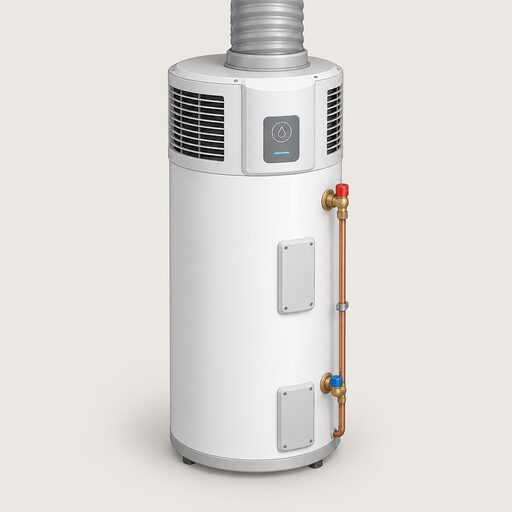 Hot Water Heat PumpsA hot water heat pump heats only the water in your cylinder, using air instead of a boiler flame.
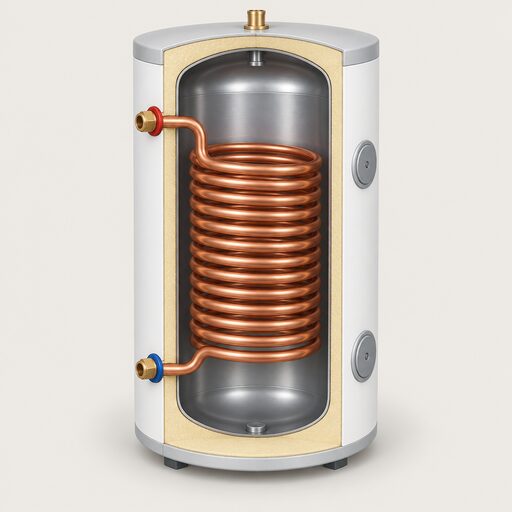 Hot Water CylindersA heat pump needs a cylinder to store hot water, so swapping a combi means getting one.
 Using a Heat Pump for CoolingCan a heat pump cool your home in summer as well as heat it in winter?
 Hot Water CylindersWhich hot water cylinder suits your home, and what is the real difference between a vented one, an unvented one and a thermal store?
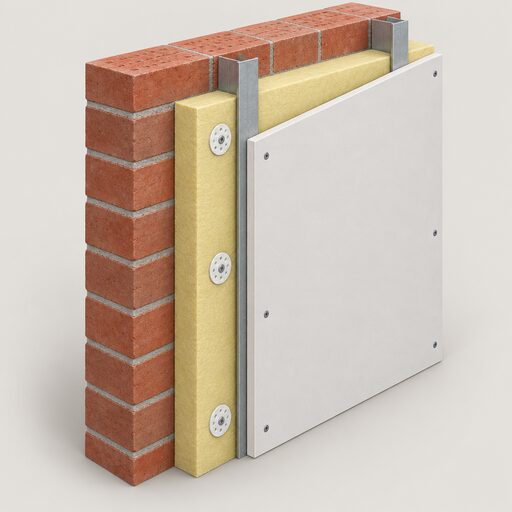 Solid Wall InsulationSolid walls lose far more heat than cavity walls, so what can actually be done about it?