
In this guide
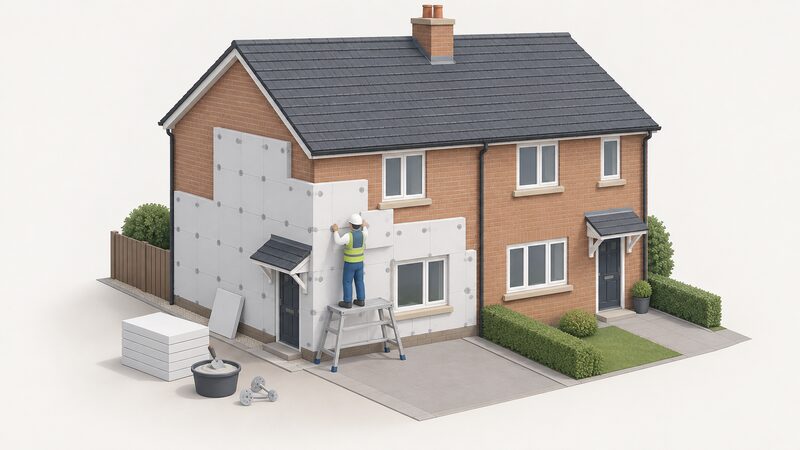
External wall insulation is the measure most likely to need consent, because it changes the outside of the building. Welsh Government guidance sets the clearest single rule: external wall insulation can be added without planning permission provided it is no more than 16cm thick, and insulation projecting more than 16cm requires permission1. The same guidance states that permission is required regardless of thickness in a conservation area, national park, area of outstanding natural beauty or World Heritage Site2.
Internal wall insulation sits at the other end of the scale. Planning permission is not normally required for fitting insulation where there is no change in external appearance3, and internal wall insulation is classed as not development4. Installing internal wall insulation in homes in conservation areas does not require planning permission4. The complications come from Article 4 directions, which remove permitted development rights, and from listed buildings, where consent is a separate regime.
This page sets out what falls within permitted development, where the protected-area rules bite, how Article 4 directions change the position for walls, windows and solar panels, and how a householder can establish the position for a specific address before work starts.
When external wall insulation needs planning permission: the 16cm rule and protected areas
The 16cm figure is the threshold that decides most cases. Welsh Government guidance states that external wall insulation must not project more than 16cm from the external wall of the property, and that insulation projecting greater than 16cm will require planning permission2. The same guidance confirms that external wall insulation can be added without requiring planning permission provided it is no more than 16cm thick7. A second condition sits alongside the thickness limit: the insulation must not exceed the roofline8.
Outside protected areas, external wall cladding may be carried out without having to apply for planning permission provided the materials are of a similar appearance to those used in the construction of the house2. That appearance condition matters as much as the thickness. A render or cladding finish that matches the existing wall is treated differently from one that changes the character of the elevation.
In protected areas the thickness rule stops applying as a route to permitted development. If a property sits in a conservation area, a national park, an area of outstanding natural beauty or a World Heritage Site, planning permission is required for external wall insulation2. Council guidance for the Cotswolds states the same position in plain terms: planning permission is required for external wall insulation in a dwelling in an area of outstanding natural beauty or a conservation area4. Bath and North East Somerset's permitted development checklist records that external solid wall insulation is not permitted development where the dwelling is in a conservation area, an area of outstanding natural beauty or the World Heritage Site8.
There is a separate building regulations trigger that catches some projects. Where 25 per cent or more of an external wall is re-rendered, re-clad, re-plastered, re-lined internally or rebuilt, the regulations would normally apply and the thermal insulation would normally have to be improved9. That is a building standards matter rather than a planning one, but it often arrives at the same moment as the planning question.
Permitted development: what you can do without applying

Permitted development rights are the general grant of planning permission that removes the need to apply for many minor works10. Local authority guidance describes them as allowing some building works and changes of use to be carried out without having to make an application for planning permission11, and Cornwall Council puts it as being able to make certain types of minor changes to a house without applying for planning permission12.
For the fabric measures on this page, the position breaks down by element:
- Cavity wall insulation: planning permission is not required8.
- Internal solid wall insulation: planning permission is not required8.
- External solid wall insulation: permitted development applies to the installation under Part 1, Class A, subject to the thickness and protected-area conditions8.
- Floor insulation: planning permission is not required to install floor insulation, whether for solid floors or suspended floors8.
- Ceiling-level loft insulation: not a planning issue and never requires planning permission8.
- Repairs and maintenance: no application is needed for repairs, maintenance or minor improvements such as painting the house13.
The distinction that runs through all of this is between work that changes external appearance and work that does not. Planning permission is not normally required for fitting insulation where there is no change in external appearance3. Once the outside of the building changes, the permitted development route depends on the material matching the existing construction and on the property not sitting in a protected area.
Article 4 directions: when permitted development rights are removed
An Article 4 direction is the mechanism a council uses to take away permitted development rights for a defined area or a defined description of property. Wandsworth Council states that the council can take away these permitted development rights using an Article 4 Direction14. Government guidance describes the effect as removing specified permitted development rights related to operational development or change of use, so that a particular development cannot be carried out under permitted development and therefore needs a planning application5.
The scope is deliberately narrow. Each Article 4 Direction will be clear about precisely which permitted development rights have been removed, and for which properties15. A direction can be put in place on buildings or parts of buildings to add further controls for features particularly important to the historic and architectural interest of the area15. It cannot be used to restrict changes between uses in the same use class of the Use Classes Order5.
Article 4 directions are most common in conservation areas16, and a number of conservation areas also have directions which further restrict permitted development rights15. They are not universal even within a district: Wirral Council notes that there is only one conservation area in Wirral to have an Article 4 Direction, and that is Bromborough Pool17.
Two timing rules matter. A direction can remove permitted development rights with temporary or permanent effect, and can remain in place permanently once it has been confirmed5. Where a direction is made with immediate effect, it must be confirmed by the local planning authority within six months of coming into effect to remain in force5. And a direction cannot prevent development which has been commenced, or which has already been carried out5.
For a householder, the practical consequence is that the same extension or cladding job can be permitted development on one street and require a full application on the next. The direction, not the general rules, decides.
Conservation areas, national parks and other protected locations
Protected landscape and heritage designations override the general permitted development position for anything that changes the outside of a building. Welsh Government guidance states that if a property is in a conservation area, a national park, an area of outstanding natural beauty or a World Heritage Site, certain types of work require planning permission7. Roof extensions fall into the same category: planning permission is required in a conservation area, national park, area of outstanding natural beauty or World Heritage Site7.
For external walls specifically, the requirement is stated twice in the same guidance: permission is required for external wall insulation in those areas2, and permission is required before cladding the outside of a house with stone, artificial stone, pebble dash, render, timber, plastic or tiles2. The list of materials is worth reading closely, because it covers most of the finishes used in retrofit work.
Scotland has its own householder permitted development regime, set out in Circular 1/2024. Within it, planning permission is needed for gates, fences, walls or other means of enclosure in conservation areas, and in the curtilage of listed buildings18. That is a boundary rather than a wall insulation rule, but it illustrates how conservation area status pulls ordinary works into the planning system.
The South Downs National Park Authority directs householders to the question of whether planning permission is needed before work begins19, and Cornwall Council's guidance covers the same ground for a county with extensive protected coastline and designated landscape12. The pattern across all of them is consistent: designation changes the answer, and the answer depends on the specific designation that applies to the address.
Listed buildings: planning permission and listed building consent
Listed buildings are governed by two separate consents, and both can be needed for the same job. Council guidance states that planning permission and listed building consent are required for external and internal wall insulation in listed buildings or their curtilage4. Listed buildings will require listed building consent for any significant work20.
Listed building consent is required for internal and external alterations, including the removal of partition walls, fireplaces, new flues and vents21, and for introducing new materials to the property, such as insulation21. External works, including decorative alterations, require listed building consent22. The use of modern materials such as plasterboard, insulation, damp proofing or timber treatment is likely to require consent15.
The element-by-element position is set out in Bath and North East Somerset's checklist:
| Measure | Listed building consent |
|---|---|
| External solid wall insulation | Required8 |
| Internal solid wall insulation | Required8 |
| Cavity wall insulation | Necessary where relevant8 |
| Floor insulation, solid and suspended floors | Required8 |
| Rafter and roof-level insulation | May not be necessary if installed with no disturbance of the external fabric and minimal intervention to the internal fabric8 |
Any external alterations to the roof of a listed building will require listed building consent8, and new roofing materials require consent23. Insertion of roof lights requires listed building consent22. Replacement windows and internal works such as secondary glazing also require listed building consent23.
Where a building is listed or in a conservation area, the guidance is to consult the local planning authority3. Consent is assessed against the building's special architectural or historic interest, which is why the same insulation system can be acceptable in one listed building and refused in another.
Internal wall insulation: when permission is not required
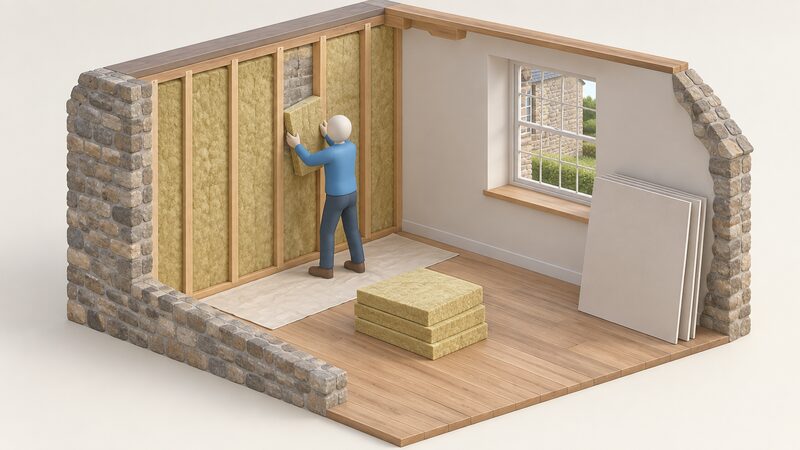
Internal wall insulation is the least constrained of the wall measures. Planning permission is not normally required for fitting insulation where there is no change in external appearance3. Cotswold District Council records internal wall insulation as not development for a dwelling in an area of outstanding natural beauty, a conservation area, or a dwelling subject to an Article 4 Direction4. Brighton and Hove City Council states that installing internal wall insulation in homes in conservation areas does not require planning permission4.
The reason is straightforward: internal work does not alter the external appearance of the building, and the planning system is concerned with the external effect. That holds even where the property is in a protected area, because the designation protects the character of the area as seen from outside.
Two exceptions remain. In a listed building, internal insulation will usually need listed building consent24, and planning permission and listed building consent are both required for internal wall insulation in a listed building or its curtilage4. And where an Article 4 direction has removed permitted development rights, the direction's own wording decides what is caught; each direction is clear about precisely which rights have been removed and for which properties15.
There is also a practical point about the condition of the building rather than the planning rules. Government guidance on poor quality wall insulation notes that householders may be affected if they had internal wall insulation or external wall insulation fitted through certain schemes, and that if internal wall insulation was fitted, no action should be required25. All properties which had external wall insulation installed will be offered a home check25. That is a remediation matter, not a consent one, but it is relevant to anyone considering internal insulation on a solid wall.
Loft conversions and roof lights under permitted development
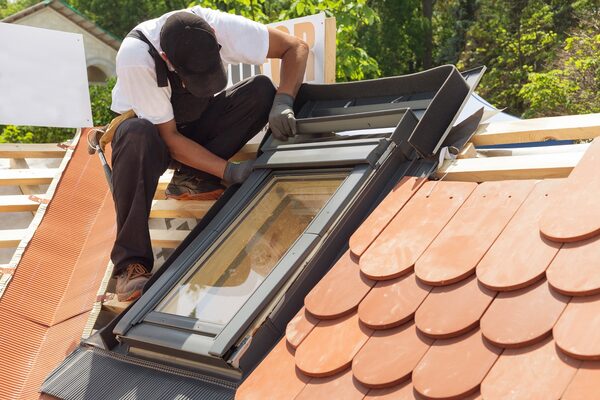
Loft conversions and roof lights are householder planning consent projects, and permitted development covers many of them without an application26. Householder planning consent is the route used for loft conversions26, and permitted development does not require planning permission but may need prior approval26.
Roof lights carry their own restrictions. Roof lights are not permitted in conservation areas, national parks, areas of outstanding natural beauty or World Heritage Sites6. Planning permission is required if the roof light would result in the provision of a roof terrace, whether or not it would otherwise be permitted6.
For listed buildings, the insertion of roof lights requires listed building consent22, and new roofing materials require consent23. Rafter and roof-level insulation may not need consent if it is installed with no disturbance of the external fabric and minimal intervention to the internal fabric, but any external alterations to the roof will require listed building consent8. Planning permission is required for rafter and roof-level insulation if there is any change to the external appearance or dimensions of the roof8.
The pattern is the same as for walls: work that stays inside the envelope is treated lightly, and work that changes the roofscape is treated as development. A roof light in a conservation area is the clearest example, because it is visible from outside and the permitted development route is closed regardless of size.
How to check whether your property is affected before you start
The check is a sequence, and it is worth running in order before any work is commissioned.
- Establish the designation. Find out whether the property is in a conservation area, national park, area of outstanding natural beauty or World Heritage Site, and whether it is listed. Solar panel guidance from Brighton and Hove sets out the same three questions: whether the property is in a conservation area, subject to an Article 4 direction, or a listed building27.
- Check for an Article 4 direction. A solicitor should have informed a buyer whether an Article 4 direction exists when the property was purchased, but the local planning authority can be checked if there is uncertainty2. Wirral Council notes that where the local planning authority has issued an Article 4 direction covering the area in which the property is located, an application for planning permission will be required17.
- Read the direction. Each Article 4 Direction will be clear about precisely which permitted development rights have been removed, and for which properties15. The direction, not a general summary, is the operative document.
- Check the material and the thickness. Outside protected areas, cladding may be carried out without applying for planning permission provided the materials are of a similar appearance to those used in the construction of the house2, and external wall insulation must not project more than 16cm2.
- Check the building regulations trigger. Where 25 per cent or more of an external wall is re-rendered, re-clad, re-plastered, re-lined internally or rebuilt, the thermal insulation would normally have to be improved9.
Article 4 directions also reach solar panels, which matters for any household planning fabric work and generation together. Southampton City Council states that planning permission may be required for buildings in conservation areas covered by Article 4 directions which remove permitted development rights for roof alterations28. Rother District Council states that where an Article 4 direction removes permitted development rights for solar panel installations, an application must be made29. Swindon Borough Council names the Railway Village area and Bishopstone Conservation Area as places where Article 4 directions apply and planning permission is required to install solar panels17. Camden's guidance lists Belsize, Hampstead and Swiss Cottage conservation areas and specific properties on Frognal Way as Article 4 areas removing permitted development rights for roof alterations, with the answer for a conservation area and Article 4 area given as maybe30.
Outside those areas the position is simpler. Brighton and Hove records that for a property not in a conservation area, Article 4 area or listed building, no application is needed and permitted development rights apply27. York Council states that planning permission is required when installing solar panels or other equipment on a wall fronting a highway within a conservation area31. Lambeth Council notes that installing solar panels and equipment on residential buildings and land may be permitted development with no need to apply to the council32.
For replacement windows, the same logic applies. Planning permission for replacement windows may be required where an Article 4 Direction removes permitted development rights for external alterations to a single dwelling house23. Planning permission may be required if the Article 4 Direction places restrictions on the replacement of windows or doors4. Where no direction applies and the property is not listed, replacement glazing follows the building regulations route rather than the planning one, which is covered in replacement window rules and listed building consent for windows.
What this means for a household's energy independence

Planning consent is a gate on the fabric measures that reduce a home's dependence on bought energy, and the gate is unevenly distributed. A household outside any designation can add external wall insulation up to 16cm thick, insulate internally, insulate floors and top up a loft without a planning application1. A household in a conservation area, national park, area of outstanding natural beauty or World Heritage Site needs permission for the same external work2, and a household under an Article 4 direction may need permission for work that its neighbours can do as of right14.
The dependence that remains is procedural rather than technical. The measures themselves reduce heat loss and therefore the energy a home must buy, which is the substance of energy independence. But the ability to install them depends on a designation that the householder did not choose and cannot change, and on a direction that a council can make, confirm and keep in place permanently5. A direction cannot catch work already commenced or carried out5, which is the one piece of timing a householder controls.
For listed buildings the position is firmer still. Planning permission and listed building consent are both required for external and internal wall insulation4, and consent is required for introducing new materials such as insulation21. That is a real constraint on what a listed home can do to its fabric, and it is not something a different product or a thicker board resolves.
The practical route through all of it is the same: establish the designation, check for an Article 4 direction with the local planning authority2, read the direction itself15, and confirm the thickness, material and building regulations position before work is ordered. The wider context for these measures sits in solid wall insulation, internal vs external wall insulation and cladding in a conservation area, with the full picture in the home insulation and glazing guide.
Sources33 cited
- Planning permission: insulation, Welsh Government, 2026-09-17
- Planning permission: external walls, Welsh Government, 2026-09-17
- Insulation, Planning Portal, 2026-09-17
- Improving energy saving and sustainability in conservation areas and listed buildings, Brighton and Hove City Council, 2026-09-17
- When is permission required, Ministry of Housing, Communities and Local Government, 2014-03-06
- Planning permission: roof, Welsh Government, 2026-09-17
- Planning: a guide for householders, Welsh Government, 2020-05
- Permitted development checklist, Bath and North East Somerset Council, 2015-01
- External walls: building regulations, Planning Portal, 2026
- The Planning (General Permitted Development) Order (Northern Ireland) 2015, legislation.gov.uk, 2015
- Do I need planning permission, South Downs National Park Authority, 2026-08-10
- Do I need planning permission, Cornwall Council, 2026-09-09
- External walls: planning permission, Planning Portal, 2026
- What is permitted development, Wandsworth Council, 2026-09-17
- Planning and listed building consent requirements, West Northamptonshire Council, 2023-12-14
- Planning permission: flue, chimney or soil and vent pipe, Welsh Government, 2026-09-17
- Solar panels, Wirral Council, 2026-09-17
- Is permission needed for installing new roof tiles, Planning Portal, 2026-09-17
- Renewable energy: solar panels and heat pumps, Rother District Council, 2026-09-17
- Retrofit and energy efficiency: permitted development, Cotswold District Council, 2026-09-17
- When consent is required, Buckinghamshire Council, 2026-09-17
- Getting consent for works to a listed building, North Northamptonshire Council, 2026-09-17
- Planning frequently asked questions, London Borough of Hammersmith and Fulham, 2026-09-17
- Making alterations to a listed building, Bristol City Council, 2026-09-17
- What to do if you have poor quality wall insulation, Ministry of Housing, Communities and Local Government, 2025-01-23
- Householder planning consent, Planning Portal, 2026-09-17
- Installing solar panels at your home, Brighton and Hove City Council, 2026-09-17
- Solar Together domestic planning guidance, Southampton City Council, 2026-09-17
- Solar panels guidance, City of York Council, 2026-09-17
- Householder permitted development rights, Scottish Government, 2024-05-28
- Solar Together planning guidance, domestic, London Borough of Camden, 2022-02
- Solar panels, Lambeth Council, 2026-09-17
- Domestic private rented property minimum energy efficiency standard: landlord guidance, Department for Energy Security and Net Zero, 2017-10-01
 Building Regs Part L InsulationAdding insulation or replacing windows?
 Insulating a Listed BuildingCan you insulate a listed building, and do you need permission first?
 Listed Buildings and AreasYour home is listed or sits in a conservation area, so do you need permission before adding solar panels, insulation or a heat pump?
 Insulation Safety and FireWill insulation catch fire, and is it safe to have in your walls?
 Building Regulations EnglandAdding a heat pump, solar panels or an extension usually needs building regulations approval, and it is separate from planning permission.
 Permitted Development by HomeCan you put up solar panels or a heat pump without asking the council?