In this guide
Almost every insulation product sold for UK homes belongs to one of four families. Mineral wool, made as glass wool or rock wool, is the cheap, non-combustible default for lofts, stud walls and cavities. Rigid boards, chiefly polyisocyanurate (PIR) and phenolic, buy the same thermal resistance in less thickness. Polystyrene, as expanded (EPS) board or blown bead, fills cavities and sits under floors. Natural fibres, including wood fibre, sheep's wool, hemp, cork and recycled cellulose, are chosen where moisture needs to move through the construction. Spray polyurethane foam sits apart: it is used in UK roofs, but it carries risks the others do not. Ofgem's own scheme guidance lists the main cavity materials as mineral wool (glass or rock wool), EPS bead and polyurethane foam1.
The number that separates them is thermal conductivity, or lambda, in watts per metre kelvin. The lower it is, the thinner the layer needed for a given result. Mineral wool and most natural fibres sit in the high 0.03s to low 0.04s: the Centre for Alternative Technology notes wool-type insulation around 0.038 to 0.054 W/m.K for sheep's wool and 0.038 to 0.060 W/m.K for hemp, while plastic foams reach about 0.02 to 0.025 W/mK, aerogel about 0.015 W/mK and sealed vacuum panels 0.007 W/mK2. In practice that means roughly 270 mm of mineral wool in a loft against a far thinner board for the same effect, and a much higher price per square metre for the thin option.
For a household's energy independence the point is blunt: insulation is the only measure here that reduces demand permanently with no fuel, no supplier, no tariff and no app. It has no running cost and nothing to fail. What it does not do is generate anything, and the dependence that remains is on the installer's workmanship, on the product being right for the wall, and on ventilation being maintained once the fabric is tightened.
How insulation works: still air, held still
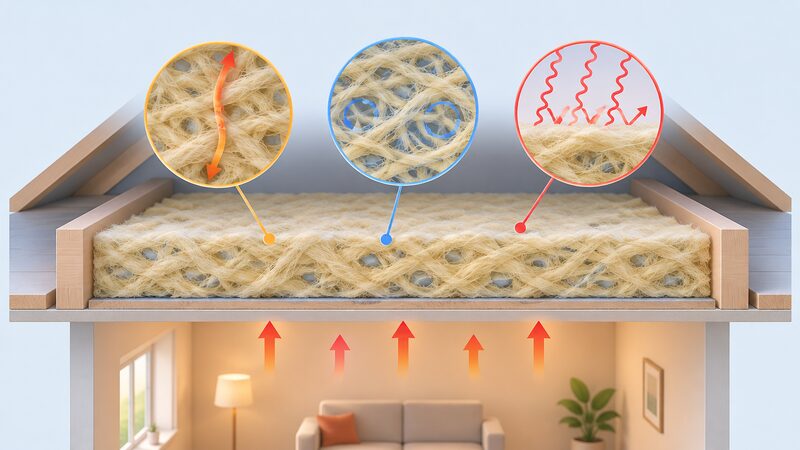
All of these materials do the same job by the same physics. Insulation is simply material that helps prevent heat in the home from escaping9. Loft insulation acts as a blanket, trapping heat rising from the house below5. The mechanism in a fibrous material is described by the mineral wool industry body as the prevention of convection by the entrapment of air in the material's open-cell, woolly matrix, with conduction reduced because there is very little solid material, and radiative heat transfer reduced by a physical barrier6. One stone wool maker puts the same idea more simply: air trapped among the stone wool fibres acts as a barrier, slowing the transfer of heat between the inside and outside of the building3.
Rigid foams work by holding gas in closed cells rather than air in an open matrix, which is why they achieve lower lambda values. EPS is described by its makers as reducing the transfer of heat through a building's walls and floors, and phenolic board as doing the same through walls, roofs, floors and other structural components10.
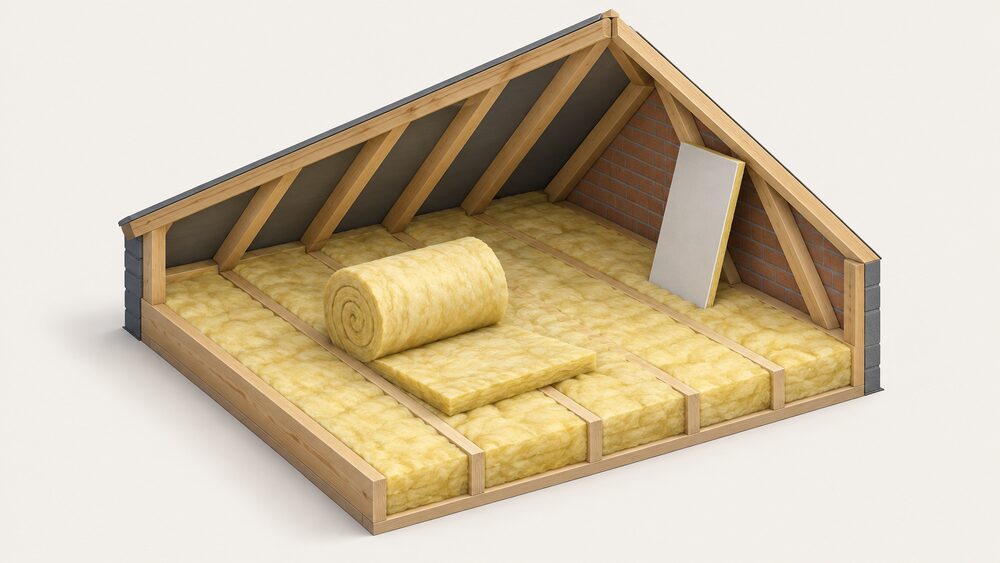
The consequence matters more than the mechanism. Compressing a fibrous material squeezes out the air that does the work, so loft boards laid straight onto mineral wool reduce its insulating properties12. Gaps matter as much as thickness: in a timber frame wall, where cutting is required the compressible insulation is cut slightly oversize and friction fitted between the studs to prevent cold air penetrating through the joints13.
Thermal conductivity: what the lambda numbers mean
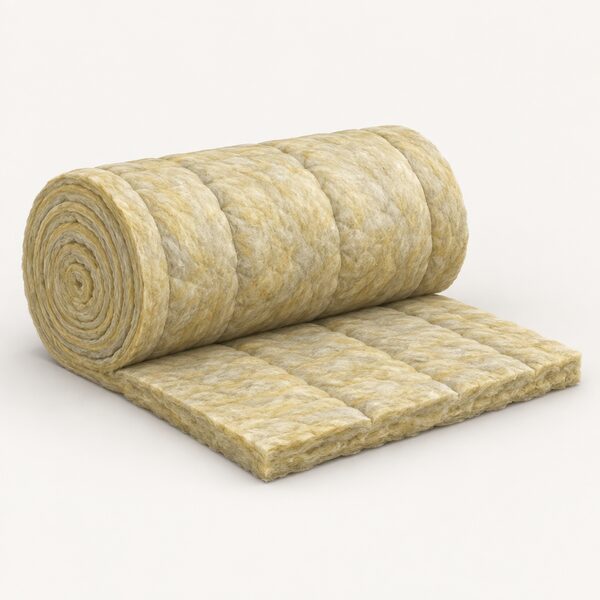
Lambda is a property of the material; U-value is a property of the whole build-up. The spread of lambda values across the families explains almost every trade-off on this page.
| Material family | Thermal conductivity (lambda) | Source type |
|---|---|---|
| Sealed vacuum panels | 0.007 W/mK | independent2 |
| Aerogel blanket | about 0.015 W/mK | independent2 |
| Plastic foams (some types) | about 0.02 to 0.025 W/mK | independent2 |
| Modern foam insulation | 0.022 W/mK | press guidance14 |
| Cavity products in scheme guidance | under 0.028, and 0.029 to 0.034 W/mK bands | official15 |
| RdSAP assessment values | 0.025, 0.03 and 0.04 W/m·K | independent16 |
| Sheep's wool | 0.038 to 0.054 W/m.K | independent17 |
| Hemp | 0.038 to 0.060 W/m.K | independent17 |
Two things follow. First, the natural fibres and mineral wool are close enough to each other that the choice between them is rarely about thermal performance; it is about moisture, fire, cost and handling. Second, the gap between a 0.04 quilt and a 0.022 foam is roughly a factor of two, so a board can do in about half the depth what a quilt does at full depth. That is why Ofgem's cavity guidance bands products by conductivity rather than by name: a 100 mm cavity takes whatever fits, and the band determines the result15.
Where a target is fixed by regulation, the material simply sets the thickness. Suspended underfloor insulation under scheme rules is to achieve a U-value of at least 0.25 W/m2K1. For the arithmetic behind these figures, see U-values and R-values explained.
Mineral wool: the low-cost, non-combustible default
Mineral wool, sold as glass wool or rock wool, is the material most UK homes already contain. The industry body describes the product range as loose granular material for blown cavity wall insulation, slabs for walls, rolls for loft insulation, and pre-formed faced pipe sections, ceiling tiles and acoustic panels18. It is available as roll, batt, mattress or blown8.
Its selling points are consistent across independent sources. It is non-combustible and A1/A2 Euroclass fire rated, and because of that non-combustibility it can be used in the external walls of all buildings across the UK nations8. The Energy Saving Trust describes standard loft insulation with mineral wool as the cheapest, easiest and most efficient option for most people20. On environment, the body reports that it uses recycled material, has zero ozone depletion potential and zero global warming potential, and rates A+ to B in the BRE Green Guide21. It also has well documented acoustic benefits, which is why it appears in separating walls, partition walls and separating floors as well as in lofts22.
Moisture behaviour is the contested point. The industry body states that in a correctly built cavity liquid water is not transmitted to the inner leaf when the appropriate glass wool product is used with correct installation, and that the risk of condensation is negligible21. A multifoil manufacturer states the opposite case for a failure scenario:
"mineral wool insulation will not dry out when it becomes wet and will need replacing."
Both can hold: the material tolerates vapour but does not recover from saturation. That is the practical reason wetted loft or cavity wool is usually stripped rather than dried. Related reading: cavity wall insulation problems and ROCKWOOL stone wool insulation.
PIR and phenolic boards: the thinnest route to a target U-value
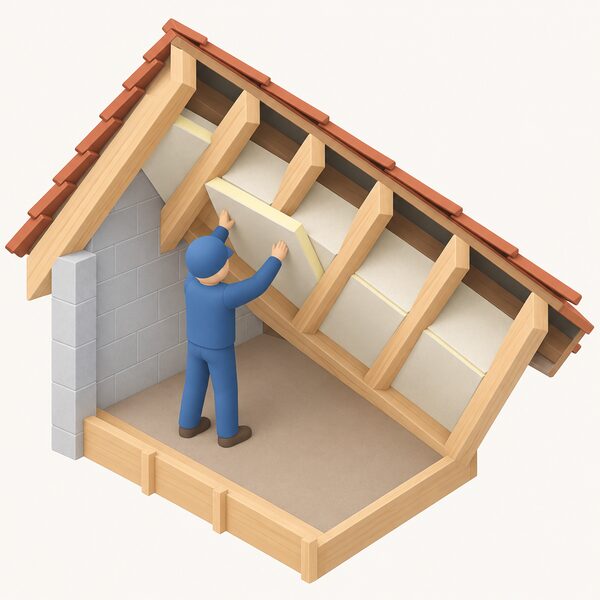
Rigid boards earn their price where depth is limited. Unilin states that PIR has a low thermal conductivity that delivers enhanced thermal performance and allows significantly thinner installations compared with alternative materials such as mineral wool, and that PIR allows a target of R = 4.5 m2K/W to be reached even though the insulation is a thin board24. Recticel states that thinner PIR boards can achieve the same insulation levels as thicker alternatives25. PIR is described by Unilin as an upgrade to PUR, which was the earlier popular option26. Which? rates PIR as having the best thermal efficiency of the board types it covers, and notes that PUR board is lighter and cheaper than PIR with slightly less thermal efficiency27.
Where boards win in practice:
- Rafter-level roof work, where insulation fitted below the rafters enables low U-values even with shallow rafters28.
- Flat roofs, where PIR boards are among the most widely specified solutions24.
- Stud walls, where Which? considers PIR boards likely to be the better option27.
- Floors, where a PIR floor board is used to hit a set thermal resistance in a shallow build-up.
On moisture, the makers' claims are consistent with each other: a closed-cell structure that resists moisture absorption, described as suiting humid or wet environments and helping prevent mould, rot and long-term degradation, with dimensional stability and low moisture absorption helping the board hold performance over the long term25. On fire, Recticel states PIR forms a protective char layer when exposed to flames, and Which? describes PIR as a rigid foam board that is durable with a high fire safety value25. These are maker and reviewer characterisations, not the non-combustible A1/A2 classification that mineral wool carries8.
The board's limitation is that it must be cut accurately and sealed. An unsealed joint in a rigid board is a straight air path in a way that an oversized friction-fitted quilt is not.
Spray foam: where it fits and where it fails
Spray polyurethane foam can be sprayed on the inside of roofs, in walls and floors, and comes in open-cell and closed-cell forms, both usually made from polyurethane and filled with bubbles of gas or air29. The Commons Library notes that open cell foam does not provide the same level of insulation as it is not as dense31. Which? reports that 100 mm of spray foam is equivalent to around 170 mm of mineral wool loft insulation, that some types are waterproof but also breathable which can suit homes in flood-prone areas, and that it can be used in a number of ECO-eligible applications to fill voids and gaps32. It is mainly professionally installed but is also available as a do-it-yourself measure33.
The problems are better documented than the benefits. Citizens Advice lists high cost compared to other forms of insulation, reduced ventilation causing condensation and dampness, covering up roof problems, difficulty of removal, lowering property value, and difficulty getting a mortgage with some lenders29. It adds plainly that mineral wool insulation may be cheaper and better at insulating29. The Energy Saving Trust notes that timbers coated in foam are more difficult to replace, as are tiles or slates where there is no roofing felt or other layer between foam and tiles20. Which? states it should not be used in listed buildings or houses with thatched roofs32. Government fire testing work has specifically examined retrofitted spray applied closed and open-cell polymeric insulation to the underside of roofs of dwelling properties34.
Natural and bio-based fibres
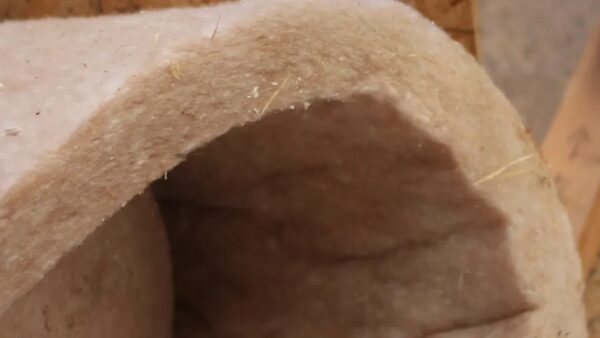
The natural family covers sheep's wool, cellulose, cork, wood fibre and hemp, some of it recycled from waste paper or textiles2. Recycled PET also appears, in loose-fill, roll and rigid board form17. One roof system maker describes bio-based materials made from natural plant fibres that store carbon throughout their lifetime35, and wood fibre is described as recyclable and compostable with good thermal insulation and sound absorption36.
The case for these materials is rarely thermal, since sheep's wool at 0.038 to 0.054 W/m.K and hemp at 0.038 to 0.060 W/m.K overlap with mineral wool17. It is about vapour. Scottish Government guidance on converting traditional buildings states that vapour permeable, capillary active and hygroscopic materials can safely absorb, transfer and desorb moisture, and can be used to reduce moisture build-up risk without the need for cavities37. The Centre for Sustainable Energy recommends vapour open materials such as sheep's wool and wood fibre boards for timber floors in older, traditional properties38. The Centre for Alternative Technology is more careful: breathable insulants such as wood fibre or cork may reduce risks in internal wall insulation, but very careful detailing is still required.
Cost is the usual barrier. Sheep's wool is reported at around £18 to £25 per m2, one of the most expensive options, while cellulose is around £9 to £12 per m2, one of the most competitively priced eco-insulations, though still described as up to twice the cost of mineral wool or rigid foam17. Cork is not widely produced in the UK, which makes it up to ten times the price of equivalent mineral wool products17. Further reading: retrofitting traditional and pre-1919 buildings.
Fire, moisture and durability compared
| Property | Mineral wool | PIR board | Spray foam | Natural fibre |
|---|---|---|---|---|
| Fire | Non-combustible, Euroclass A1/A28 | Forms a protective char layer; "high fire safety value"25 | Subject of government roof fire testing34 | Not stated in available guidance |
| Moisture | Liquid water not transmitted to inner leaf when correctly specified and installed; will need replacing if saturated21 | Closed cell, highly resistant to moisture and water absorption25 | Some types waterproof but breathable32 | Vapour permeable; can absorb, transfer and desorb moisture37 |
| Durability | Stone wool stated to maintain performance for the lifetime of a building; does not deteriorate over time | Dimensional stability said to hold performance long term25 | Coated timbers harder to replace; difficult to remove20 | Wood fibre recyclable and compostable36 |
Selection criteria used in the trade go well beyond lambda: tensile strength, thermal expansion and stability, reaction to fire, resistance to oils, liquids, gas fumes, acids and alkalis, density and weight, impact resistance, vapour resistivity and resistance to moisture. Products come as rigid boards, batts, loose injected fill and quilts depending on the application. Where gas appliances are involved, Welsh guidance on heat producing appliances specifies an air space of at least 75 mm, or a shield of non-combustible material such as insulating board with a fire-resistant surface, between the appliance and combustible fabric. See also insulation safety: fire, cladding and handling.
Cost: from about £10 per square metre to over £100
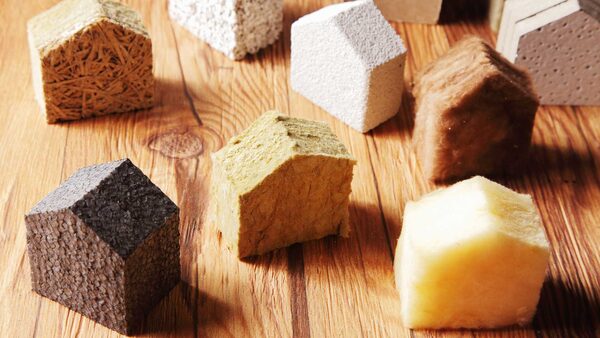
The clearest comparison comes from government analysis of 2024 capital costs of materials: approximately £10 per m2 for fibreglass and polystyrene, £15 per m2 for PIR board and mineral wool, £20 or more per m2 for sheep wool and polyurethane foam, and often over £100 per m2 for an aerogel blanket7. The same analysis puts whole-measure installed costs from £950 for loft insulation to over £12,000 for external solid wall insulation on a typical three-bedroom semi-detached house7.
Retail and installer figures sit around those. Loft insulation rolls are quoted at £10 to £37 per m2 for materials only in a professional install39, and mineral wool at 100 mm is put at around £13 by one supplier40. For solid walls the independent sources disagree: one guide gives around £15,000 for whole-property external wall insulation and another gives an average of £12,000, and the documents are not reconciled41. Both are quoted for professional installation.
Thickness and the regulations
Material choice sets thickness, and thickness is where regulation bites. Official guidance for a pitched roof of a dwelling describes new or additional loft insulation of at least 250 mm of mineral fibre or cellulose fibre quilt laid between and across the ceiling joists, or loose fill, or the equivalent5. Independent advice bodies commonly quote 270 mm as the recommended depth for mineral wool, the most common material4. The Planning Portal states that the thickness of insulation required will vary depending on the material chosen and the manufacturer's specification, and that installing insulation to a loft area as part of extension work requires an application for approval under the Building Regulations5.
Two further rules apply whatever the material. Building Regulations require that the insulation material used is suitable for the wall construction concerned, which is Welsh Government's phrasing and the reason cavity suitability surveys exist42. And nidirect states that Building Regulations need adequate ventilation when installing loft insulation, and that local building control should be consulted43. Because 270 mm is usually deeper than the joists, boarding straight over the top is not possible without a raised deck32. See loft insulation thickness and Building Regulations Part L.
Handling, dust and personal protection
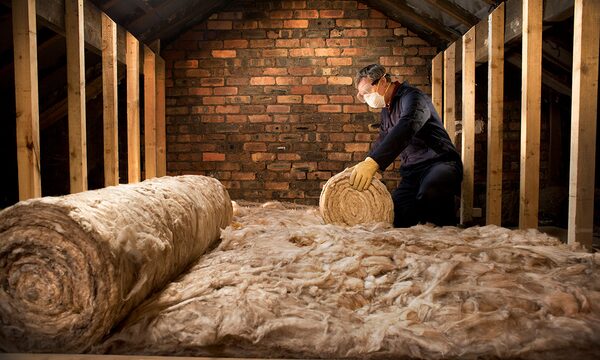
Mineral wool's health position is settled by the industry body's own statements. It reports that mineral wool has been shown to be free of any suspicion of causing any form of malignant or non-malignant respiratory disease in workers or the general public, that manufactured fibre diameter and length are greater than 3 microns and 200 microns respectively, and that the material is not classified as a carcinogen in the EU44. Asked directly whether mineral wool is carcinogenic, the answer given is "No"19.
That does not make the work pleasant. Which? advises that a face mask, goggles and gloves are normally needed as a minimum for do-it-yourself blanket insulation45, and a stone wool maker recommends long sleeves, gloves and a mask when fitting insulation in a loft for comfort46. Handling is otherwise straightforward: the material is described as easy to fit with a simple installation process, supplied in a form to suit any project21. In timber frame walls it is usually supplied to fit tightly between standard stud widths without the need for on-site cutting, and is self supporting13. For the do-it-yourself route generally, see low-cost and DIY insulation measures.
Environmental credentials and lifetime carbon
Insulation is unusual in that its operational saving dwarfs its embodied impact, but the materials differ. Mineral wool is reported by its industry body to use recycled material, to have zero ODP and GWP, and to rate A+ to B in the BRE Green Guide, with lower embodied energy than most non-mineral wool products, especially where low density products are used21. Water used in manufacture is generally in a closed circuit system47. A stone wool maker states that over its lifetime stone wool insulation can save 100 times the carbon used in its production, and that stone wool can be recycled without degrading its quality48.
On the board side, Recticel states that PIR boards contribute to reduced carbon emissions through improved energy efficiency and can often be recycled at the end of their lifecycle25. On the natural side, bio-based plant fibre systems are described as storing carbon throughout their lifetime35, and wood fibre as recyclable and compostable36. Which? notes that greener board options include cork, straw and wood fibre45.
At scheme scale the savings are recorded in tonnes: Northern Ireland's Thermal Comfort 2 programme reported a reduction of 3,152 tonnes in lifetime carbon emissions in 2023/24, and innovative schemes 1,264 tC in 2024/25.
What the choice means for a self-sufficient home
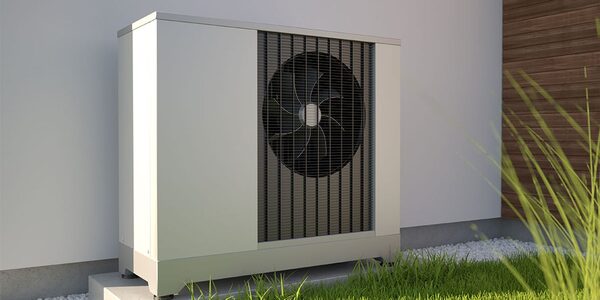
No insulation material generates energy. What it does is cut the load the rest of the house has to meet, permanently and without a bill. That matters most where a home is moving to electric heat: a heat pump sized to a poorly insulated fabric is larger, dearer and harder to run, which is covered in what insulation a heat pump needs.
The dependencies that remain are real. Products must be certified and suited to the construction, which is a manufacturer and certification dependence rather than a supplier one, and is set out in insulation product standards, certification and guarantees. Tightening the fabric without attending to air change moves moisture problems indoors: insulation, double glazing and draught-proofing all save energy but also trap moisture inside, which is why ventilation is a regulatory condition of loft work43 and the subject of condensation, damp and mould after insulation. And the workmanship risk is not theoretical: Ofgem wrote to 65,000 households in August 2026 about potentially poor-quality solid wall insulation fitted under ECO and GBIS since 2022, covered in the ECO4 and GBIS insulation failures.
Material choice is generally a question of constraint rather than preference: depth available, whether the construction needs to breathe, what the fire rules require for that wall, and what the budget will carry. The wider context sits on the insulation and glazing pillar.
Sources48 cited
- ECO4 New Measures and Products Guidance v3.0, Ofgem, 2026-03-26
- Understanding insulation, Centre for Alternative Technology, 2023-12-10
- Why stone wool: thermal performance, ROCKWOOL, 2026-09-20
- Loft insulation advice, Centre for Sustainable Energy, 2025-10
- Building regulations for ceilings and floors, Planning Portal, 2026
- About mineral wool, MIMA, 2026-09-20
- Energy Innovation Needs Assessment: heat and buildings, GOV.UK, 2025-06
- Mineral wool roof insulation applications, MIMA, 2026-09-20
- Insulation and energy saving: what is insulation, Smart Energy GB, 2026-03-16
- How does EPS work?, Unilin Insulation, 2026-08-31
- How does phenolic insulation work?, Unilin Insulation, 2026-06-18
- Loft insulation costs and savings, Which?, 2026-05-05
- Timber frame wall insulation, MIMA, 2026-09-20
- Thermodynamics without maths, part 2, Heat Geek, 2026-09-17
- Great British Insulation Scheme delivery guidance, Ofgem, 2023-08-31
- RdSAP10 specification, BRE, 2024-02-12
- Cellulose vs hemp vs cork insulation, Uswitch, 2025-11-21
- What is mineral wool, MIMA, 2026-09-20
- Mineral wool FAQs, MIMA, 2026-09-20
- Spray foam insulation, Energy Saving Trust, 2024-12-05
- Masonry cavity wall insulation, MIMA, 2026-09-20
- Party wall bypass and Part E, MIMA, 2026-09-20
- How to know if you're a victim of bad insulation, SuperFOIL, 2022-04-29
- Where can you use PIR insulation?, Unilin Insulation, 2026-06-18
- Benefits of PIR insulation, Recticel Insulation, 2026
- What is PIR insulation?, Unilin Insulation, 2026-06-18
- How to buy insulation boards, Which?, 2026-05-26
- Roof insulation at rafter level, MIMA, 2026-09-20
- Make sure your home is energy efficient, Citizens Advice, 2026-09-19
- Save energy at home, Citizens Advice Wales, 2026-09-17
- Spray foam insulation and mortgages, House of Commons Library, 2026-09-20
- Spray foam insulation, Which?, 2026-05-26
- Roof insulation, Which?, 2026-05-05
- Fire safety: spray foam roof insulation, fire testing summary, GOV.UK, 2025-12-22
- Warmshell roof insulation, Lime Green, 2026-09-20
- Best insulation for suspended floors, Q-Bot, 2026-09-15
- Guide to conversion of traditional buildings, Scottish Government, 2026-08-10
- Floor insulation advice, Centre for Sustainable Energy, 2025-08
- DIY vs professional home insulation, Uswitch, 2025-11-07
- The ultimate guide to loft insulation, OVO Energy, 2021-11-07
- Home insulation guide, Uswitch, 2026-09-16
- Building regulations: cavity wall insulation, Welsh Government, 2026-09-17
- Loft insulation, nidirect, 2026-09-02
- Mineral wool health and safety, MIMA, 2026-09-20
- Installing blanket insulation, Which?, 2026-05-26
- ROCKWOOL FAQs, ROCKWOOL, 2026-09-20
- Mineral wool sustainability, MIMA, 2026-09-20
- Energy renovation, ROCKWOOL Group, 2026-09-20
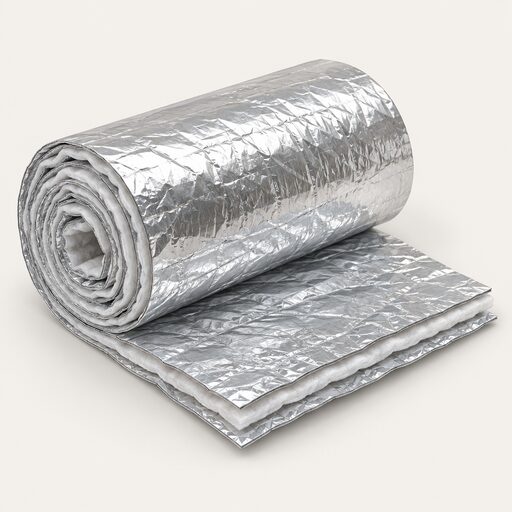 Multifoil InsulationDoes thin foil insulation really keep a home warm, and how does it compare with thick rolls of wool or rigid boards?
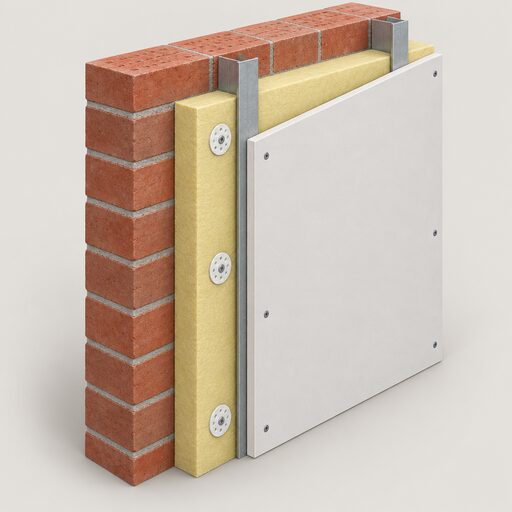 Solid Wall InsulationSolid walls lose far more heat than cavity walls, so what can actually be done about it?
 Retrofitting Pre-1919 BuildingsOlder homes with solid walls need different insulation from modern houses, and getting it wrong can trap damp inside.
 External Doors and U-ValuesWhich front door keeps the heat in best, and how much does it really matter?
 Floor InsulationHow much warmth escapes through the floor, and is it worth insulating?
 Insulating Pipes and CylindersInsulating pipes and hot water cylinders is cheap and quick, but what does it actually save, and is it worth the bother?