In this guide
Thermafleece is a British-made natural fibre insulation built around sheep's wool, sold for lofts, floors, timber frame walls and internal linings. The maker describes it as "a British-made, sustainable insulation rich in British sheep's wool"1, and the wool comes from hardy hill and mountain sheep in England, Scotland and Wales, shorn annually in the spring1. It has been used in projects across the UK for over 25 years1.
The composition is three-quarters British sheep's wool and a quarter recycled polyester2. That blend is deliberate: the polyester binder holds the fibres in a uniform matrix so the material keeps its shape and does not slump over time3. It is a vapour-open, breathable product rather than a sealed board, and it is treated with a borax-based fire retardant that also protects against wool-eating insects4.
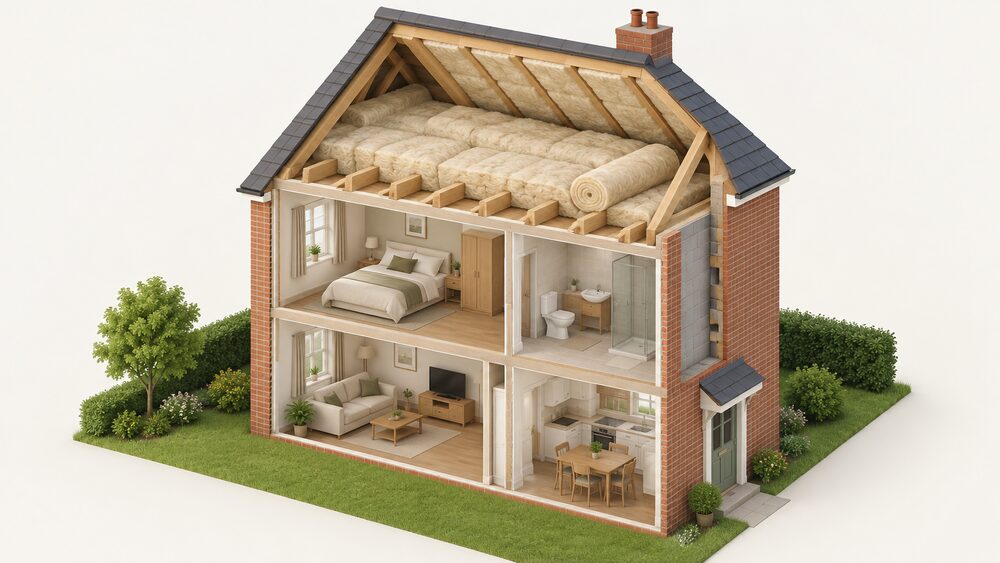
For a household, the appeal is a natural, low-carbon material that buffers moisture and can be handled without the irritation associated with mineral fibre. The limits are just as clear. It cannot go into a brick and block cavity wall4, it is rated Euroclass E rather than non-combustible4, and it costs more than the mineral wool most lofts are filled with5. It keeps a home on the same grid and the same heating system; what it changes is the fabric, not the fuel.
What Thermafleece is and where the wool comes from
Thermafleece is a natural fibre insulation made in Britain and sold as rolls and slabs for retrofits and new build. The wool is sourced from hardy hill and mountain sheep in England, Scotland and Wales, which run free on fells and are shorn each spring1. The maker frames the material as a way of turning a low-value fleece into a long-life building product, and states that the carbon captured in wool remains stored for decades while the sheep regrow their fleece after shearing3.
The range is small and clearly divided. CosyWool is the roll product, described as easy to install between and over joists, making it suitable for lofts and floors3. UltraWool is a denser slab designed for use where space is limited, friction fitting between studs and rafters and delivering what the maker calls premium thermal and acoustic performance1. Both contain 75% British wool, 15% recycled polyester lofting agent and 10% polyester binder1.
That composition places Thermafleece in a different category from the two materials it is usually compared with. Mineral wool, the default for UK lofts and cavities, is non-combustible and A1 or A2-s1, d0 rated, uses recycled material and is supplied to fit standard stud widths without on-site cutting6. Cellulose, the other natural option, is made from around 85% recycled newspaper and is usually treated with boric acid and ammonium sulphate to make it flame-retardant and resistant to mould and pests5. Wool sits between them: renewable and breathable like cellulose, sold in rolls and slabs like mineral wool, and priced above both.
Composition and how it is made
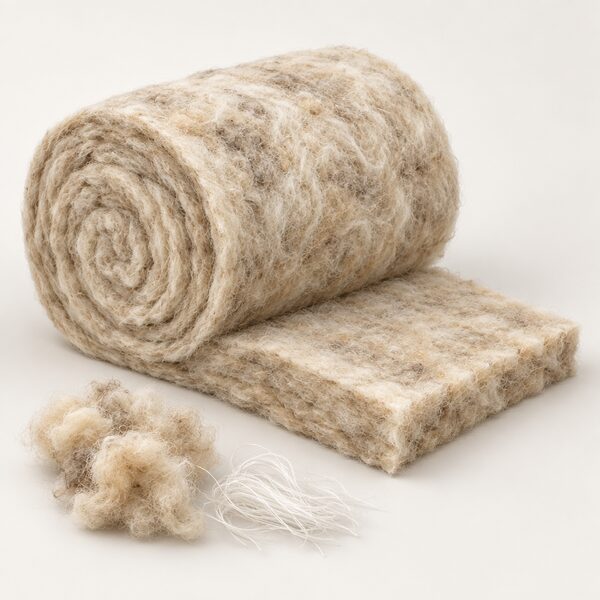
The wool arrives at the plant as fleece and is processed into a uniform batt. The maker's description is that the wool fibres are opened and thermally bonded to create a uniform matrix that ensures structural stability3. The polyester component is not a filler: the binder ensures the insulation maintains its shape and structural stability, preventing it from slumping over time1. That matters in a loft, where a material that settles leaves cold bridges at the joists and a thinner layer than the specification assumes.
The 75/15/10 split is the figure to hold on to. CosyWool and UltraWool both contain 75% British wool, 15% recycled polyester lofting agent and 10% polyester binder1. The maker's broader description of the product as three-quarters British sheep's wool and a quarter recycled polyester is the same blend rounded2. The recycled content in the polyester is the only recycled fraction; the wool itself is a by-product of sheep farming rather than a recycled input.
Compared with the alternatives, the material profile is mixed. Mineral wool uses recycled material and carries a BRE Green Guide rating of A+ to B, and in timber frame walls it is non-combustible with zero ozone depletion and global warming potential6. Cellulose is roughly 85% recycled newspaper5. Wool's environmental case rests on renewability, the carbon stored in the fibre, and the fact that it regrows after shearing3, not on recycled content.
Breathability and humidity buffering: what truly breathable means
The maker's central claim is that breathability is more than vapour openness. In its own words, "Truly breathable insulation requires more than being vapour open; it must also be able to buffer moisture"3. The distinction is between a material that lets vapour pass through and one that absorbs and releases it, smoothing peaks in humidity rather than transmitting them straight to a cold surface.
Thermafleece is described as actively buffering humidity to reduce the risk of condensation, naturally absorbing indoor pollutants such as formaldehyde, and carrying a lower carbon footprint than mineral fibre1. The maker also states that wool can absorb and release any moisture in the air without losing its thermal qualities, and that it is far more breathable than synthetic loft insulation2.
"It can absorb and release any moisture in the air without losing its thermal qualities."
The practical benefit is in older and timber-framed buildings, where trapping moisture inside a wall or floor build-up causes rot. Independent guidance for older, traditional properties recommends vapour open insulation materials such as sheep's wool and wood fibre boards for timber floors10. The same logic applies to timber frame walls and to internal linings on solid masonry.
There is a limit, and the maker states it. It is critical to keep humidity levels below 70 to 80% relative humidity4. Wool buffers normal indoor moisture; it is not a solution for a persistently damp structure. Where a wall is unavoidably damp, official guidance on traditional buildings notes that internal wall insulation does not represent best practice in building conservation but can be useful in that specific case11. Buffering is a performance characteristic, not a remedy for a defect.
Fire performance: Euroclass E and where mineral fibre is still needed
Thermafleece is Euroclass E rated and treated with a borax-based fire retardant4. It passes the EN 11925 ignitability test and complies with British Standard BS 5803-4 for flammability and resistance to smouldering4. The maker also states plainly that sheep wool is not flammable2.
Euroclass E is a real rating, but it is not the same as non-combustible. Mineral wool achieves a Euroclass Reaction to Fire classification of either A1 or A2-s1, d0, is non-combustible, and provides in-built fire protection that contributes to the fire safety of buildings8. In timber frame walls and separating floors, that non-combustibility helps compliance with Part B6. The maker of Thermafleece acknowledges the gap directly: mineral fibre remains necessary where non-combustible fire ratings are necessary1.
| Property | Thermafleece wool | Mineral wool |
|---|---|---|
| Euroclass reaction to fire | Euroclass E4 | A1 or A2-s1, d08 |
| Combustibility | Not flammable, borax retardant2 | Non-combustible12 |
| Standards | EN 11925, BS 5803-44 | Helps compliance with Part B13 |
| Environmental rating | Lower carbon footprint than mineral fibre1 | BRE Green Guide A+ to B9 |
The consequence for a household is that wool is not a like-for-like substitute in every position. In a loft at joist level, in a timber floor, or between studs in a partition, the fire question is usually about the surface lining rather than the insulation itself. In a compartment wall, a flat roof build-up or any element where a non-combustible rating is required, mineral wool remains the material the regulations expect. The choice is set by the element, not by preference.
Moth, insect and pest resistance without synthetic biocides
Wool's reputation for attracting moths is the objection most householders raise, and the maker addresses it head on. The borax fire retardant in the wool ensures the insulation is not susceptible to clothes moth attacks without needing synthetic biocides14. Because the wool is pre-treated, no additional on-site chemical treatments are required14. The treatment is stable and intended to provide lifetime protection under normal dry service conditions4.
Borax, or sodium borate, is the active ingredient, and the maker describes it as providing essential protection against wool-eating insects while remaining safe for protected species such as bats1. It does not off-gas or act as a repellent, so it will not irritate or intoxicate bees in close proximity14. That combination is what makes the product usable in roof spaces where bats roost, which is a common constraint in older rural properties.
On the other insects householders ask about, the maker's position is measured rather than absolute. Thermafleece does not attract or repel ants and wasps, and while ants may occasionally nest in the voids of any porous insulation, the product presents no unique risk14. Cluster flies may overwinter in lofts because the temperature is mild, but they do not feed on or damage the wool14. A faint sheepy scent from some batches may briefly attract flies, and this dissipates quickly once the material is aired and installed14. Rodent risk is described as no greater than standard mineral fibre insulation14.
Where it fits and where it does not
The clearest exclusion is cavity walls. Thermafleece cannot be installed in the void within brick and block or block and block cavity walls due to the high risk of waterlogging from driving rain4. That is a material property, not a marketing choice: wool holds water, and a cavity exposed to wind-driven rain is the one place it should not sit.
Cavity insulation is a regulated activity in any case. Official guidance states that if insulation is inserted into a cavity wall, the appropriate requirements will be applied to ensure the insulation material is suitable, and the cavity can be fully filled or partially filled, with the manufacturer consulted before proceeding9. Independent guidance sets out where cavity wall insulation should not be installed at all: poor maintenance or structural issues such as cracks, evidence of rising or penetrating damp, dirty cavities or wall ties and builder's rubble, exposed locations with extreme weather and driving rain, or overflowing and blocked guttering, where no remedial action is appropriate13.
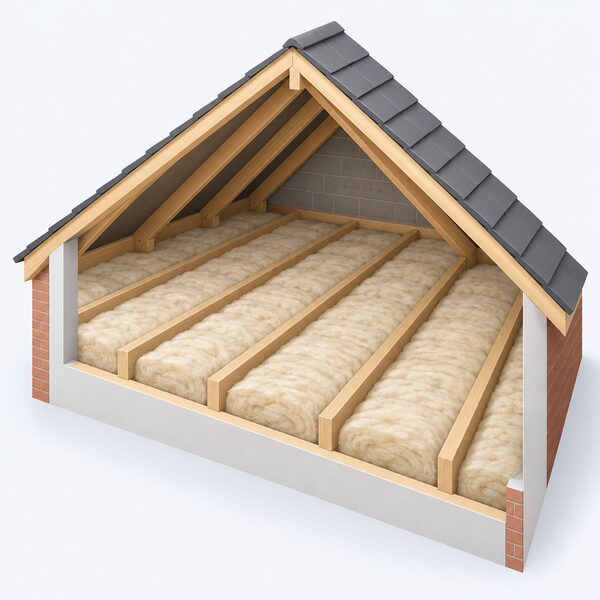
Where wool does fit is the list of vapour-open positions. CosyWool is designed for lofts and floors, installed between and over joists3. UltraWool friction fits between studs and rafters where space is limited1. Independent guidance recommends vapour open materials such as sheep's wool and wood fibre boards for timber floors in older, traditional properties10. Internal wall insulation on a timber stud frame is another established use: a case study in Eryri fitted 100mm of wool insulation between the studs16.
Recessed lights are the detail that catches people out. For lights that cannot be covered, insulation must be kept at least 75mm away, and a fire hood should be installed4. Lights marked IC-F or IC can be covered by insulation4. Independent guidance on loft insulation makes the same point more broadly: leave gaps around electrical components such as wiring, fuse boxes or ceiling lights17. Electrical cables should not run through insulation where possible, and where they do they must be sufficiently rated to handle the thermal environment4.
Installing it yourself: cutting, thickness and handling
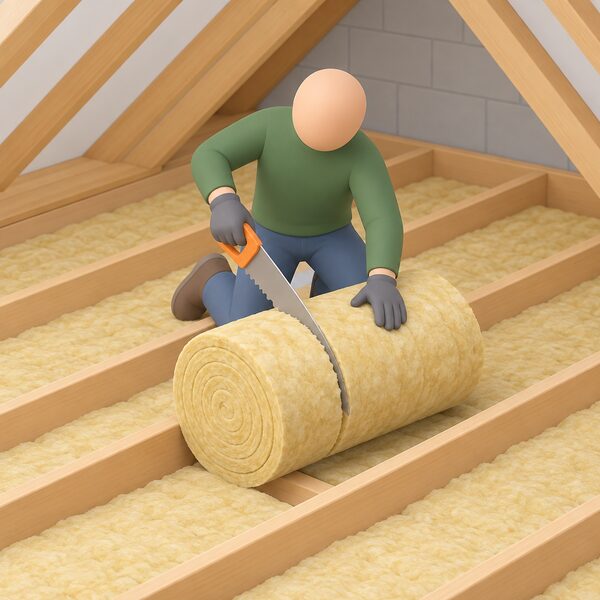
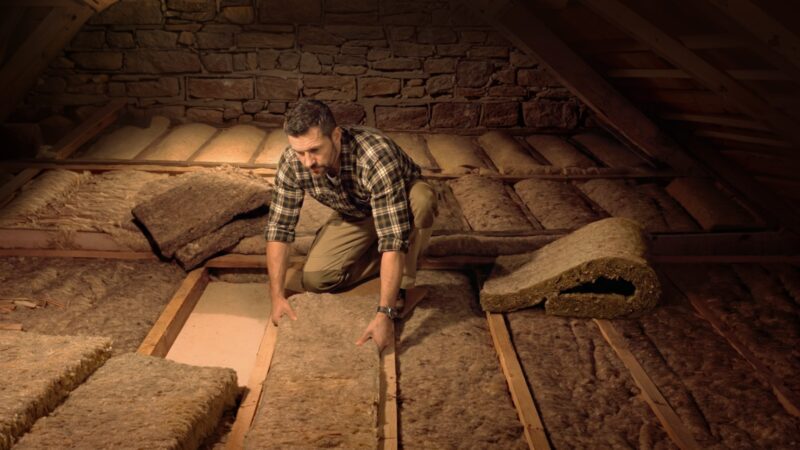
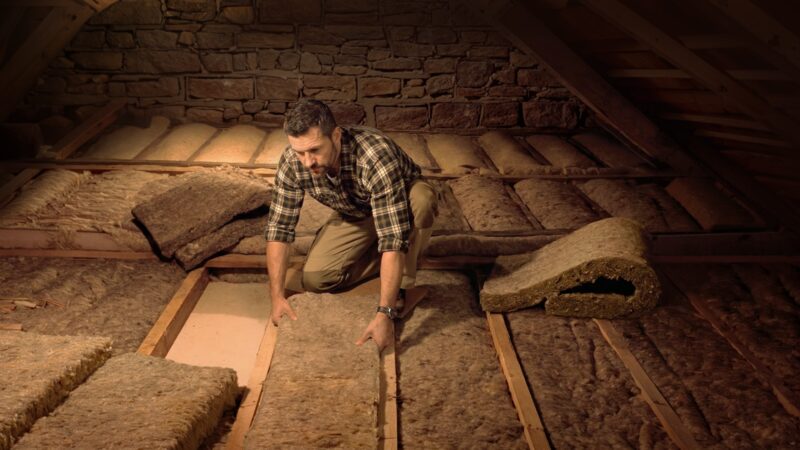
Thermafleece is a DIY-friendly material in the sense that it needs no specialist equipment and no wet trades. The maker's cutting method is the roll and cut technique: tightly roll a length of insulation, typically up to 2.5m, and cut it with a sharp scalloped edge knife or an insulation saw1. Rolling compresses the batt so the cut runs straight through many layers at once, which is faster than cutting each piece flat.
Thickness is the specification that decides performance. The maker recommends laying Thermafleece at least 240mm thick2. For context, mineral wool loft insulation meets current Building Regulations at just 300mm, and a typical specification for a terraced house loft is glass mineral wool quilt laid over and between the joists at 300mm7. Wool's thermal conductivity is slightly poorer than mineral wool's, which is why the recommended wool depth is close to the mineral wool figure despite the different material.
Density matters as much as depth. Independent guidance on wool insulation notes that thermal conductivity worsens as the material is more densely packed, and advises aiming for no more than 40 kg/m³5. Over-compressing a roll to fit a shallow joist depth therefore works against the insulation rather than for it. The UltraWool slab exists for the opposite case, where a denser product is needed to fit a constrained space1.
Handling is straightforward. Wool is a natural fibre and does not carry the skin and respiratory irritation associated with mineral fibre, though the usual precautions for working in a loft apply. The material is supplied in a wide range of sizes to suit any project3, and the maker offers U-value calculations and condensation risk analysis through an online request form, which is useful where a build-up is unusual or a building is older1.
Cost, availability and support
There is no published list price for Thermafleece by the square metre. The maker's own guidance is that a household should expect to pay about £100 for a pack of 2 or 3 rolls, available in varying thicknesses and widths2. Independent guidance puts wool insulation among the most expensive options at around £18 to £25/m²5. Both figures are quoted prices and the VAT position is not stated, so they should be read as indicative rather than as confirmed totals.
| Measure | Figure | Source |
|---|---|---|
| Thermafleece pack (2 or 3 rolls) | about £100 | 2 |
| Wool insulation per m² | around £18 to £25/m² | 5 |
| Loft insulation roll, 100mm, covers 8.3m² | around £20 | 18 |
| Foam pipe insulation, DIY fitted | as little as £15 | 19 |
The comparison with mineral wool is stark at the roll level: a 100mm mineral wool roll covering 8.3m² costs around £20, against a wool pack at about £1002. The maker's counter-argument is longevity and payback. It states that a £1,000 Thermafleece attic space roof lining can recoup its cost in three years and then save money2. That is a maker's claim about a specific installation, not a general payback figure, and it depends on the starting condition of the roof and the price of energy.
For larger fabric work, the maker cites organisational figures of around £11,000 for external wall insulation and around £7,500 for internal wall insulation2. Those are whole-system costs, not wool costs, and they show the scale at which insulation spending usually sits. At the small end, low-cost measures remain the cheapest wins: fitting foam insulation around exposed hot water pipes can cost as little as £1519.
Support is direct from the maker. Thermafleece offers U-value calculations and condensation risk analysis through an online request form1, and the website carries an information and advice section, a safety and technical questions page and product pages for the range1. The product carries a customer rating of 5 from 34 reviews on the maker's own site1. Nationwide delivery is offered through the maker's online shop.
The independence question
A wool-insulated home is still a grid-connected home. Thermafleece changes the fabric of the building, not the fuel: the heating system, the electricity supply and the gas or heat pump connection all remain as they were. What the material does for independence is reduce the demand that has to be met, and do so with a product whose supply chain is British. The wool comes from hill and mountain sheep in England, Scotland and Wales1, and the material is made in Britain1.
The dependence that remains is on the manufacturer for a specialist product. Thermafleece is a single-brand material with no commodity equivalent, so a household specifying it is tied to that maker's range, sizes and lead times. That is a different kind of dependence from the grid, but it is real. Mineral wool, by contrast, is made by multiple manufacturers and stocked widely.
There is also a maintenance dependence on dryness. The borax treatment provides lifetime protection under normal dry service conditions4, and humidity must stay below 70 to 80% relative humidity4. If the insulation gets wet, the maker's guidance is to remove it and let the area dry completely before replacing it with new, dry material4. A leak, a blocked gutter or a failed flashing therefore means replacement rather than drying out, which is a cost a mineral wool loft would not incur in the same way.
For a household weighing the choice, the position is that wool suits vapour-open positions in older and timber-framed buildings, where its moisture buffering earns its keep, and where the fire strategy does not require a non-combustible material. It does not suit cavity walls, it is not a substitute for mineral wool where an A1 or A2 rating is required, and it costs several times as much per roll. The insulation materials comparison sets out how it sits against the alternatives, and sheep's wool insulation in older homes covers the retrofit case in more detail.
Sources20 cited
- Information and advice, Thermafleece, 2026
- Insulate with British sheep wool, Thermafleece, 2026
- Why wool, Thermafleece, 2026
- Safety and technical FAQs, Thermafleece, 2026
- Cellulose vs hemp vs cork, Uswitch, 2025
- Timber frame wall insulation, MIMA, 2026
- Loft insulation at joist level, MIMA, 2026
- Mineral wool FAQs, MIMA, 2026
- Masonry cavity wall insulation, MIMA, 2026
- Floor insulation advice, Centre for Sustainable Energy, 2025
- Guide to the conversion of traditional buildings, Scottish Government, 2026
- The 4 benefits of mineral wool, MIMA, 2026
- Cavity wall insulation advice, Centre for Sustainable Energy, 2025
- Wildlife safety and interaction, Thermafleece, 2026
- Building regulations: external walls, Welsh Government, 2026
- Advice on improving energy efficiency, Eryri National Park, 2022
- Five things I wouldn't do as an insulation expert, Which?, 2025
- Loft insulation costs and savings, Which?, 2026
- Five top tips to cut your energy bills, Welsh Government, 2026
- 10 ways to save on energy bills, Which?, 2026