
In this answer
Short answer
A hot water cylinder jacket is one of the cheapest measures in a home energy plan, and the published savings are large relative to the outlay. Independent guidance puts the saving at around £70 a year for a jacket costing around £161, and at £40 a year for a jacket fitted to an uninsulated cylinder2. The Energy Saving Trust gives £45 a year in Great Britain and £35 a year in Northern Ireland3.
The spread is not disagreement so much as different starting points. A bare copper cylinder gains most; a cylinder already wrapped in 25mm of factory foam gains less, but still enough to justify the work. Adding an 80mm British Standard jacket to a tank with 25mm foam built in saves £45 a year in GB and £35 a year in NI4, and topping up a loose 25mm jacket gives the same figures5.
The cost side is small. Official guidance puts a tank jacket at as little as £15, taking minutes to install6, and a government cost table lists increasing hot water cylinder insulation at £15 to £307. The Energy Saving Trust gives £30 in Northern Ireland4. Payback is therefore measured in months, not years.
Why cylinders lose heat, and what a jacket changes
A hot water cylinder is a store of heat sitting in a cool space, and it loses energy continuously through its surface. Adding insulation to water tanks and pipes reduces the amount of heat lost, so less money is spent heating water up and hot water stays hotter for longer10. That is the whole mechanism: the cylinder is not made more efficient, it is simply allowed to cool more slowly between draws.
The scale of the loss is what makes the measure worthwhile. Independent guidance states that insulating a hot water cylinder reduces heat loss by up to 75%1, and the same figure appears in guidance on reducing home heat loss3. A jacket therefore does not just trim a bill; it changes how much of the energy put into the cylinder is still there an hour later.
Pipework matters alongside the cylinder. Independent guidance advises an insulating jacket for the hot water tank and lagging to pipes together11, and states that lagging hot water pipes can save over 10% of yearly hot water heating usage on top of the tank jacket saving12. A cylinder jacket fitted while the pipes above it stay bare leaves a meaningful part of the loss in place.
For a household's energy independence, this is a modest but real shift. The cylinder is heated by a boiler, an immersion heater or a heat pump, all of which draw on gas, electricity or a supplier. Insulation reduces the quantity of that bought energy needed to deliver the same hot water, which lowers exposure to price and to supply. It does not remove the dependence: the cylinder still needs a heat source, and the heat source still needs a fuel or a grid connection.
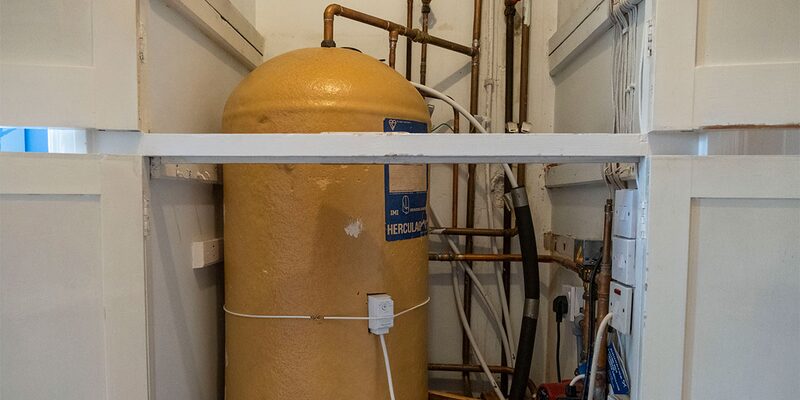
Savings by starting point: bare, spray foam or a loose 25mm jacket
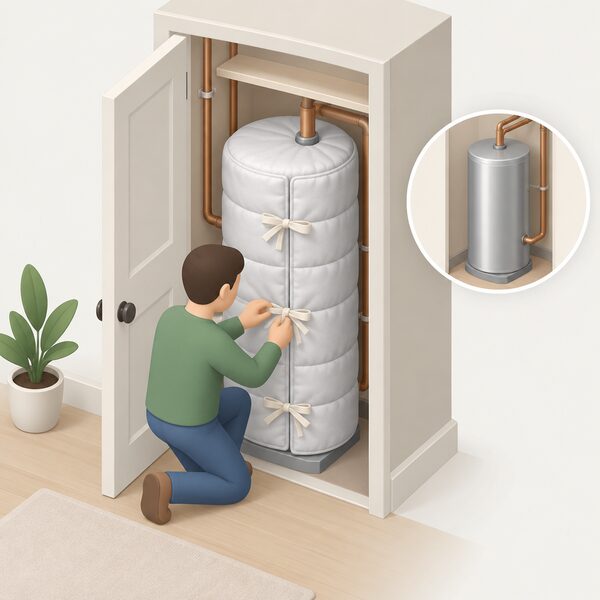
The saving depends almost entirely on what is already on the cylinder. A bare metal cylinder with no covering has the most to gain, and National Energy Action describes an additional jacket of at least 80mm as the measure for uninsulated or bare metal cylinders13. Guidance for a jacket on an uninsulated cylinder gives £40 a year2, and a new jacket on an old cylinder is described as easy to fit with the same £40 a year saving14.
A cylinder with 25mm of factory foam is the common case in homes of a certain age. Adding an 80mm British Standard jacket over it saves £45 a year in GB and £35 a year in NI4. Topping up a loose 25mm jacket gives the same figures5. Guidance aimed at improving an EPC rating gives £35 a year for increasing insulation to a British Standard jacket 80mm thick from thin spray foam or a loose 25mm jacket8.
Spray foam is a different proposition. It is offered by some makers as an optional extra on copper cylinders where requested15, and high density injection foam cased around the store is the main insulation method on some unvented products16. Spray foam applied to a roof, rather than a cylinder, carries its own complications: independent guidance gives a guide price of around £20 to £50 per square metre, lower for a thin stabilisation layer and higher for a thicker insulating layer17, and removal is put at £40 per square metre8. That is a separate subject from a cylinder jacket and a much larger cost.
Cost, payback and the thickness that matters
A jacket is cheap enough that the argument is rarely about whether to fit one. Official guidance puts a tank jacket at as little as £15, taking minutes to install, and credits it with saving £20 on heating and 150kg of carbon6. A government cost table lists increasing hot water cylinder insulation at £15 to £307. The Energy Saving Trust gives £30 in Northern Ireland4.
Those low figures assume a self-fit jacket. A 2012 official consultation noted that the estimated £15 cost of having a cylinder jacket fitted is misleading because the actual cost would be £15 plus £12017, and separately listed hot water cylinder insulation at £15 installation cost in a typical house17. The distinction is between the price of the jacket and the price of paying someone to fit it. A jacket is a wrap secured with ties, so the labour is short, but a household that does not fit its own should expect a quoted price rather than the shelf price.
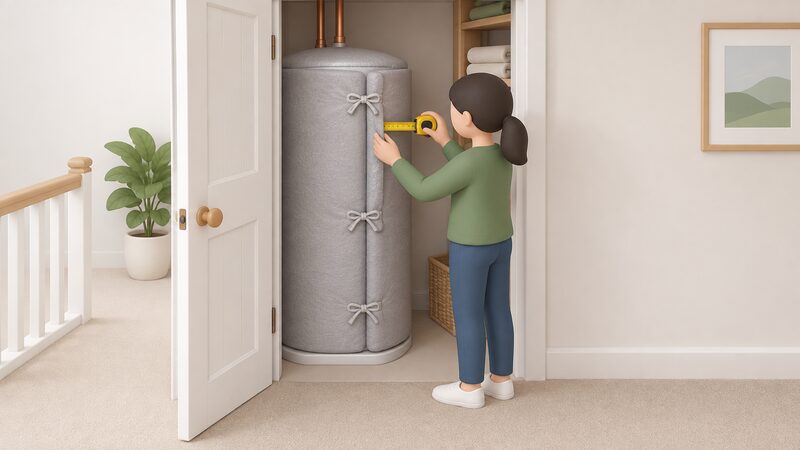
Thickness is the variable that decides the saving. Independent guidance recommends buying a new jacket with a recommended thickness of 80mm14, states that a jacket should be 80mm thick12, and advises that cylinder insulation should be at least 80mm thick, with a jacket to be considered if it is not8. National Energy Action gives at least 80mm for an additional jacket13. The £40 a year figure is given specifically for a British Standard Kitemark-marked jacket 80mm thick18.
Below that, a jacket still helps but delivers less. The conflict between a 25mm foam covering and a 12mm loose jacket as the typical existing insulation is not resolved in the available documents, and the two are treated together in the £35 a year figure for upgrading from thin spray foam or a loose 25mm jacket8. The practical reading is that anything thinner than 80mm is a starting point to improve on, not a finished job.
Cylinders with built-in insulation, thermal stores and heat pumps
Modern cylinders arrive insulated, which changes what a jacket can add. Unvented cylinders use high density injection foam, cased to maintain the temperature of the store for the maximum period and to give a finish that is easy to clean16. Some makers offer spray foam insulation on copper cylinders where requested15. Where the factory covering is already thick, an additional jacket has little to do.
The performance gap between old and new stores is wide. Independent guidance states that water in a modern insulated hot water cistern can stay warm for up to two days, and could perform much better even compared to an old-fashioned tank with a jacket19. That is a statement about the cylinder itself, not about the jacket, and it is the reason a replacement cylinder can outperform an insulated old one.
Thermal stores take the principle further. The Thermino range is stated by its maker to have heat loss less than a quarter of that of a conventional hot water cylinder20. That is a maker's figure for its own product and should be read as such, but it illustrates the direction of travel: better insulation at the store, less standing loss, less reheating.
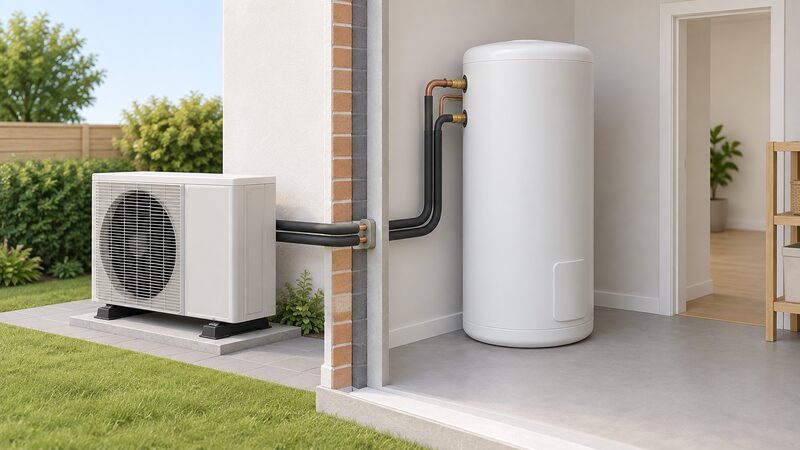
Heat pumps make cylinder insulation more important, not less. Official guidance states that to provide hot water, heat pumps require a water storage cylinder, similar to older generations of gas boiler systems21. A maker states that unvented indirect cylinders are generally considered the better match for heat pumps, as they deliver mains pressure hot water and work efficiently at lower flow temperatures22. Vented cylinders include an immersion heater as a reliable backup heating option23, and a built-in thermostat helps maintain water temperature at desired levels23. Pre-plumbed cylinders can be supplied with an insulating jacket for the cold water storage tank as an option24.
The thermostat, the temperature and the limits of a jacket
Insulation slows heat loss; it does not set the temperature, and the temperature is where the safety rules sit. Independent guidance states that if a home has any kind of boiler with a hot water cylinder that stores water for later use, a minimum water temperature of 60°C applies9. Guidance for renters puts it plainly: do not go below 60°C, because the water needs to be that hot to kill all harmful bacteria in the tank25. Age UK warns that the cylinder thermostat should not drop below the set figure because it can cause bacteria to grow in the tank22.
Cylinder settings are not a household adjustment. Independent guidance states that if a home has a hot water cylinder that stores water, the settings need to be set by a boiler engineer and kept hot enough to avoid the build-up of bacteria in the storage tank26. A jacket does not change that requirement, and wrapping a cylinder more thickly does not license a lower stored temperature.
What a jacket does for independence is narrow and honest. It reduces the standing loss from a store that is already heated, so less fuel is bought to keep the same water hot. It does not generate anything, does not store energy in a useful sense, and does not reduce the number of times the boiler or immersion runs to serve a draw of hot water. The dependence on a fuel, a supplier and a working heat source remains.
The measure also sits inside a wider order of work. Insulating a cylinder is a low-cost item that belongs with the other quick measures before larger spending, and it pairs naturally with pipe lagging and with checking that the cylinder thermostat is set correctly by an engineer. For a household working through a plan, it is one of the few measures where the cost is measured in tens of pounds and the saving in tens of pounds a year, which is why it appears near the top of most advice lists.
"Adding an 80mm British Standard jacket to a tank with 25mm foam built in can save £45 a year in GB (£35 a year in NI)"
Sources26 cited
- What are the best energy saving tips for households in the UK?, British Gas Energy Trust, 2026-04-21
- How to bleed a radiator, Uswitch, 2026-09-04
- Reducing home heat loss, Energy Saving Trust, 2026-05-20
- Insulating tanks and radiators, Energy Saving Trust, 2025-11-03
- Energy saving tips for the home, Confused.com, 2025-10-14
- Home and business grants, schemes and advice, East Herts Council, 2026-09-17
- Domestic private rented property minimum energy efficiency standard, GOV.UK, 2017-10-01
- Tips to improve the EPC rating of your home, Energy Saving Trust, 2026-08-03
- One simple way to adjust your boiler to lower your heating bill, Which?, 2025-09-29
- Five areas to add insulation in your home, Energy Saving Trust, 2025-02-07
- Quick tips to save energy, Energy Saving Trust, 2026-08-21
- Energy saving tips for winter, Centre for Sustainable Energy, 2025-12-10
- Preparing for winter, National Energy Action, 2025-10-14
- Free energy saving tips, Uswitch, 2025-10-14
- Vented vs unvented hot water cylinder, McDonald Water Storage, 2024-08-14
- Unvented cylinders, McDonald Water Storage, 2024-08-14
- Minor consequential improvements, Part L Building Regulations, Parliament, 2012-12
- Energy efficiency, Consumer Council for Northern Ireland, 2026-09-20
- Hot water, Uswitch, 2025-01-31
- Thermino range, Sunamp, 2026
- What impact can heat pumps have in domestic heating today, GOV.UK, 2023-11-21
- How to use your heating controls, Age UK, 2026-03-23
- Vented cylinders guide, Newark Cylinders, 2024-05-20
- Pre-plumbed storage tank cylinder, McDonald Water Storage, 2023-03-10
- Energy saving advice for renters, Centre for Sustainable Energy, 2026-08
- Make your home more energy efficient in one weekend, Which?, 2026-08-28
 Roof InsulationHow much heat escapes through your roof, how thick the insulation should be, what it costs and what it saves?
 Insulating Pipes and CylindersInsulating pipes and hot water cylinders is cheap and quick, but what does it actually save, and is it worth the bother?
 Changing Habits SavingsWhat the evidence says behavioural change saves: around £90 to £120 a year for one degree off the thermostat, £100 to £110 a year for using a full set of heating controls, and £304 to £351 a year for a bundle of small changes.
 How Much Does a Heat Pump CostA heat pump usually costs around eleven thousand pounds installed, though quotes vary a lot depending on your home.
 Do Smart Controls Save Money?Do smart heating controls really cut your bills, and by how much?
 Insulation Savings and PaybackHow much can you really save by adding insulation, and does it depend on your home, your heating and how you use it?