
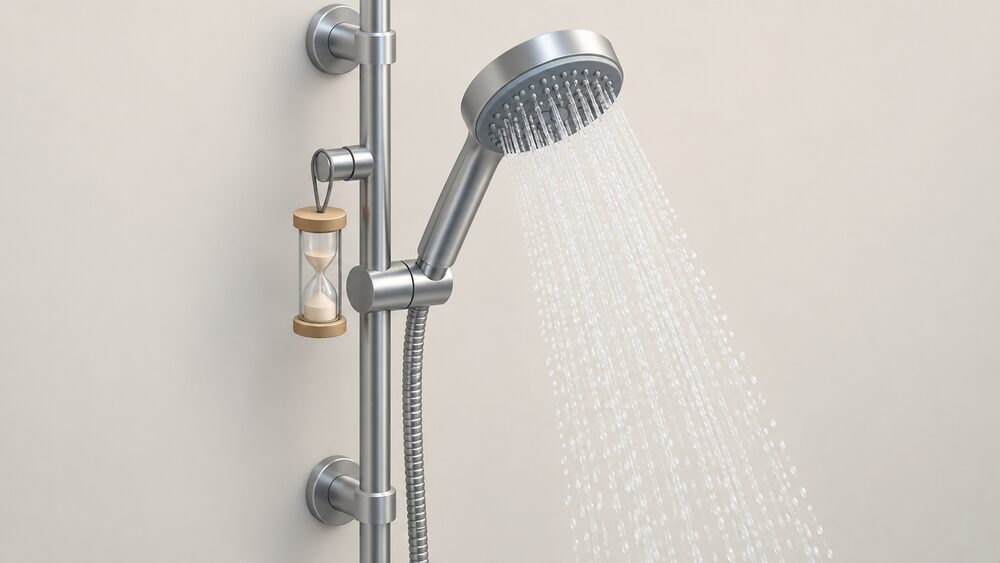
In this answer
Short answer
Swapping one bath a week for a four-minute shower saves £10 a year on energy bills in Great Britain and £9 a year in Northern Ireland, according to the Energy Saving Trust1. Confused.com gives the same pair of figures, £10 in Great Britain and £9 in Northern Ireland2. The saving is modest because it is one bath a week, not every wash.
The larger figure comes from changing every shower. Keeping shower time to four minutes saves a typical household £70 a year on energy bills in Consumer Council guidance3, and £45 a year in Great Britain and £45 a year in Northern Ireland in Energy Saving Trust guidance1. Uswitch statistics put the same measure at up to £60 a year in Great Britain and £65 in Northern Ireland4. The spread runs from £10 to around £115 a year depending on what is being replaced and how many showers are involved5.
Water is the other half of the story. Replacing one bath a week with a four-minute shower saves 4,000 litres of water a year, and cutting every shower to four minutes saves 17,000 litres a year6. Where the property has a water meter, that water saving arrives on the water bill as well as the energy bill7.
The savings at a glance: from £10 to around £115 a year
The range is wide because the measures being compared are not the same. At the bottom, replacing one bath a week with a four-minute shower saves £10 a year in Great Britain and £9 in Northern Ireland1. Cadent Gas gives £9 a year for the average household swapping a bath for a shower once a week9, and Uswitch gives £10 a year for the same swap10.
In the middle, cutting every shower to four minutes saves a typical household £70 a year on energy bills in Consumer Council guidance3, £60 a year in Uswitch guidance11, and around £60 a year in Fischer Future Heat's guidance5. Energy Saving Trust guidance gives £45 a year in Great Britain and £45 a year in Northern Ireland for a four-minute shower1, and its quick tips page gives £45 a year in Great Britain12. Uswitch statistics give up to £60 a year in Great Britain and £65 in Northern Ireland4. Northern Powergrid's Take Charge programme gives £65 a year13.
At the top, the Centre for Sustainable Energy gives £115 a year for taking four-minute showers14. That figure sits well above the others and is not broken down by household size or starting shower length, so it should be read as the upper end of a wide range rather than a typical outcome.
What they agree on is direction. Shorter showers reduce both the energy used to heat water and the water itself, and the saving scales with how many showers are changed.
Water saved: 4,000 litres from one bath swap, up to 17,000 litres a year
Water is where the four-minute shower is most clearly ahead of the bath. A short shower can use about a third of the amount of water needed for a bath, according to Age UK15. Power NI's guidance puts a standard shower at around 40% of the water needed for a bath16. Sero gives a five-minute shower as using a third of the water of a bath17.
The volume figures follow from that. Replacing one bath per week with a four-minute shower saves 4,000 litres of water a year, and a four-minute shower saves 17,000 litres a year where every shower is changed6. A low-flow shower head can save up to 90 litres of water in a 10-minute shower by regulating the flow rate or mixing air with the water to maintain pressure18.
The water saving only reaches the household budget where water is metered. British Gas Energy Trust states that showering for four minutes saves money on both the energy bill and the water bill if the property has a water meter7. Without a meter, the water itself is charged at a flat rate and only the heating energy is saved. Cadent Gas puts the metered water saving at around £75 a year for a typical household sticking to four-minute showers, alongside £60 on energy bills9.
For a household's independence, this is a small but real shift: less water drawn, less water heated, and a lower standing demand on the network. It does not remove dependence on the water supplier or the energy supplier, and it does not change the standing charges that make up a large part of a metered water bill.
What changes the size of your saving: heating fuel, water metering and household size
Three things move the number more than anything else.
The fuel used to heat water. Around one fifth of a household's energy use goes on heating water for showers, baths, laundry and washing up19. A household heating water with gas and one heating it with electricity pay different rates for the same hot water, so the same four-minute shower produces a different cash saving in each. No separate saving figure by fuel is published, so the published savings should be read as averages across households.
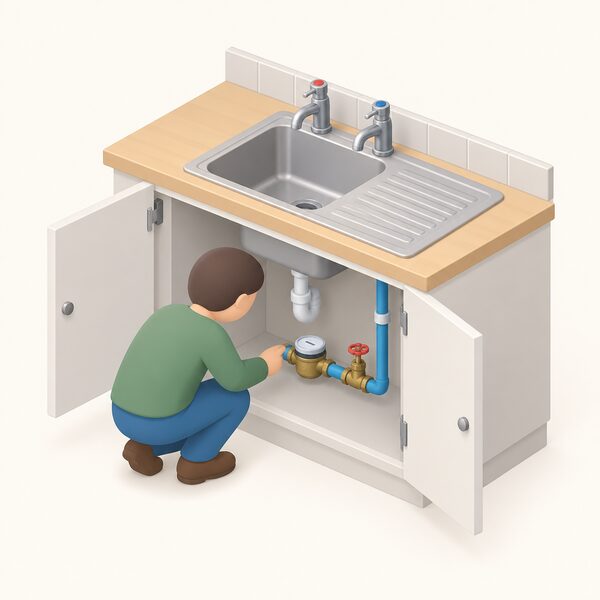
Whether water is metered. A meter turns the water saving into a bill saving. British Gas Energy Trust ties the four-minute shower saving on the water bill directly to having a meter7. Cadent Gas gives around £75 a year on metered water bills for a typical household9. Without a meter, that element is absent.
Household size. More showers means more saving. Home Energy Scotland gives £30 a year for a four-person household in Great Britain from spending one minute less in the shower19. E.ON Next gives up to £65 a year on the energy bill where everyone in the household showers for four minutes20. ScottishPower gives £70 a year for a typical household shortening shower time to four minutes21.
The savings also combine with other measures. Turning down the thermostat, lowering a combi boiler temperature and taking four-minute showers together could save as much as £340 a year11. That combined figure is not a shower saving on its own, but it shows where the shower sits in a wider plan. Households working through a sequence of measures may find it useful to look at no-cost and low-cost ways to cut energy use first and at how habits fit alongside physical work in how much changing habits can save.
Does a power shower use more water than a bath?
Yes, and by a wide margin. Plymouth Energy Community states that a power shower uses twice as much water as a bath22. Uswitch gives typical power shower consumption as four to five litres per minute8. A standard shower, by contrast, uses around 40% of the water needed for a bath16.
That means the four-minute rule does not deliver a water saving in a home with a power shower. A power shower uses twice as much water as a bath23, and its typical consumption is four to five litres per minute24, so the comparison with a bath depends entirely on the bath's volume and the power shower's actual flow rate. The direction of the evidence is clear: a power shower removes the advantage a standard shower has.
For households with a power shower, the practical levers are the flow rate and the duration together. A water-saving shower head reduces usage by regulating the flow rate or mixing air with the water to maintain pressure18. Smart Energy GB gives the same mechanism25. Reducing the flow rate on a power shower is a plumbing question rather than a behavioural one, and no figure is published for the saving from doing so.
Timing it right: the four-minute rule and how to keep to it
The four-minute target is widely repeated. Confused.com advises reducing shower time to four minutes2. British Gas Energy Trust gives four minutes as the point at which both energy and water bills benefit where there is a meter7. EcoFlow gives four or five minutes23. British Gas Energy Trust's research page advises swapping baths for showers and keeping showers to around four minutes24.
The gap between the target and actual behaviour is the real obstacle. Uswitch research suggests people spend an average of around 7 to 10 minutes in the shower8. That is roughly double the target, so most of the saving is available without any new equipment.
Practical measures from the guidance:
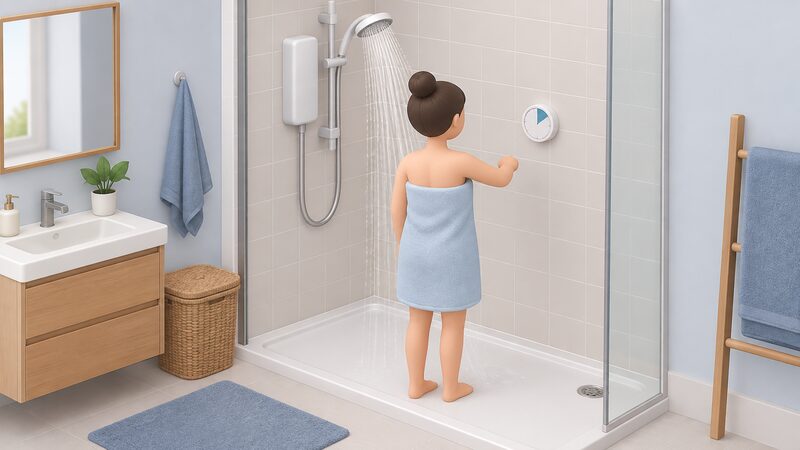
- Keep shower time to four minutes, using a timer if needed13.
- Set an electric shower to the lowest comfortable temperature and check for an eco setting18.
- Fit a water-saving shower head, which regulates flow or mixes air with the water18.
- Run an extractor fan for at least 15 minutes after a shower or bath to control moisture26.
The last point matters for the fabric of the home. Shorter, cooler showers reduce the moisture load, but ventilation still has to run. Energy Saving Trust guidance on damp and condensation gives the 15-minute figure26.
Beyond the shower itself, the wider household measures that support these savings are heating controls used effectively, timers, lower boiler temperatures, loft insulation and draught-proofing27. Households on time-of-use tariffs should note that shifting use away from peak hours, typically 4pm to 7pm, is what makes those tariffs pay28. The ivie Flex & Save scheme requires at least a 10% reduction in usual energy usage for at least 30 minutes29. None of these is a shower measure, but they sit in the same habit-change territory.
For a household's energy independence, the four-minute shower is a small, repeatable reduction in demand that requires no equipment, no installer and no supplier. What it does not do is remove dependence on the grid, the gas network or the water supplier. It lowers the bill attached to that dependence, and it does so fastest in households that are metered for water and heating water with the more expensive fuel.
Sources29 cited
- Top energy saving ideas for your home improvement project, Energy Saving Trust, 2026-08-03
- Energy saving tips for the home, Confused.com, 2026-07-06
- Save energy and money, Consumer Council, 2026-09-20
- Energy saving statistics, Uswitch, 2025-07-16
- Daily energy saving habits to cut bills and save money, Fischer Future Heat, 2026-08-14
- Top tips to save energy and money in the bathroom, Energy Saving Trust, 2026-04-27
- Energy savings tips, British Gas Energy Trust, 2026-02-27
- Hot water, Uswitch, 2025-01-31
- Energy efficiency, Cadent Gas, 2026-09-20
- Free energy saving tips, Uswitch, 2025-10-14
- How to use a smart meter to save money, Smart Energy GB, 2026-04-24
- Quick tips to save energy, Energy Saving Trust, 2026-08-21
- Energy tips to help you save, Electricity North West, 2026-09-19
- Tips for lower energy bills, Centre for Sustainable Energy, 2024-02-29
- Energy saving tips, Age UK, 2026-04-02
- Code of practice on efficient use of electricity, Power NI, 2026-09-20
- Saving energy with Team Sero, Sero, 2022-10-21
- Water efficient shower heads, Smart Energy GB, 2026-04-22
- Water: always worth saving, Home Energy Scotland, 2026-07
- Your energy saving A to Z, E.ON Next, 2024-01-15
- Cost of living, ScottishPower, 2022-05-05
- Save water, save energy, Plymouth Energy Community, 2026-09-20
- How to reduce your electricity bill in the UK, EcoFlow, 2025-05-30
- What are the best energy saving tips for households in the UK?, British Gas Energy Trust, 2026-04-21
- 10 effective and easy ways to save water at home, Smart Energy GB, 2026-08-17
- Fixing damp and condensation, Energy Saving Trust, 2026-05-22
- Get prepared, National Energy Action, 2026-06-02
- Air source heat pump costs and savings, Which?, 2026-04-14
- ivie Flex and Save, ivie, 2024-09-30
 Changing Habits SavingsWhat the evidence says behavioural change saves: around £90 to £120 a year for one degree off the thermostat, £100 to £110 a year for using a full set of heating controls, and £304 to £351 a year for a bundle of small changes.
 Do Smart Controls Save Money?Do smart heating controls really cut your bills, and by how much?
 How Much Does a Heat Pump CostA heat pump usually costs around eleven thousand pounds installed, though quotes vary a lot depending on your home.
 Whole-House Retrofit CostsA whole-house retrofit can cost anywhere from a few thousand pounds to over fifty thousand, so what you actually pay depends on how much work your home needs.
 Solar Panel CostsA typical UK home pays somewhere between four and eleven thousand pounds for solar panels fitted, with most landing in the middle.
 Roof InsulationHow much heat escapes through your roof, how thick the insulation should be, what it costs and what it saves?