
In this answer
Short answer
A washing machine costs about £64 a year to run on average, based on four washes a week, or 208 cycles a year1. That average hides a wide spread: the cheapest machine tested costs £27 a year and the most expensive £1191. A 7kg machine used 220 times a year typically costs between £25 and £352. Older figures put the average at £593 and £654, so the direction of travel is broadly flat once the unit rate is accounted for.
The single biggest variable is not the machine but the programme. Washing at 30°C rather than 40°C cuts the cost by 38%, according to Which? tests5. A 0.7kWh cycle costs about 18p on a standard tariff6, while a 2kW machine run for a full hour uses 2kWh, about 52p at 26p per kWh7. Washer-dryers sit in a different league: over £200 a year on average5, with an average of £216 and a range from £141 to £3151.
For a household, the washing machine is a modest but constant draw, and one of the few appliance costs that responds directly to behaviour rather than to spending. It is also a load that can be shifted: running it during a free electricity window, or when solar generation is high, changes what it costs without changing what it does.
Annual running cost: £25 to £120 depending on the machine and how you use it
The annual figure is a product of two things: what one cycle costs, and how many cycles a year the household runs. The average household uses its washing machine four times a week, which is 208 times a year1. Multiply that by a typical 18p cycle and the arithmetic lands close to the £64 average1. A household running 270 cycles a year, as some estimates assume, would sit higher8.
The machine itself sets the floor and ceiling. Which? testing puts the cheapest-to-run washing machine at £27 a year and the most expensive at £1191. That gap of £92 is not explained by purchase price: cheaper appliances can cost more to run over their life, a point Which? has warned about directly3. The energy label is the guide here, because it reports consumption per cycle under standard conditions rather than under a household's own habits.
The range quoted by makers is wider still. One maker guidance figure puts annual cost at about £50 to £100 depending on usage habits and appliance type9. That is consistent with the tested range once hot washes and heavy use are included.
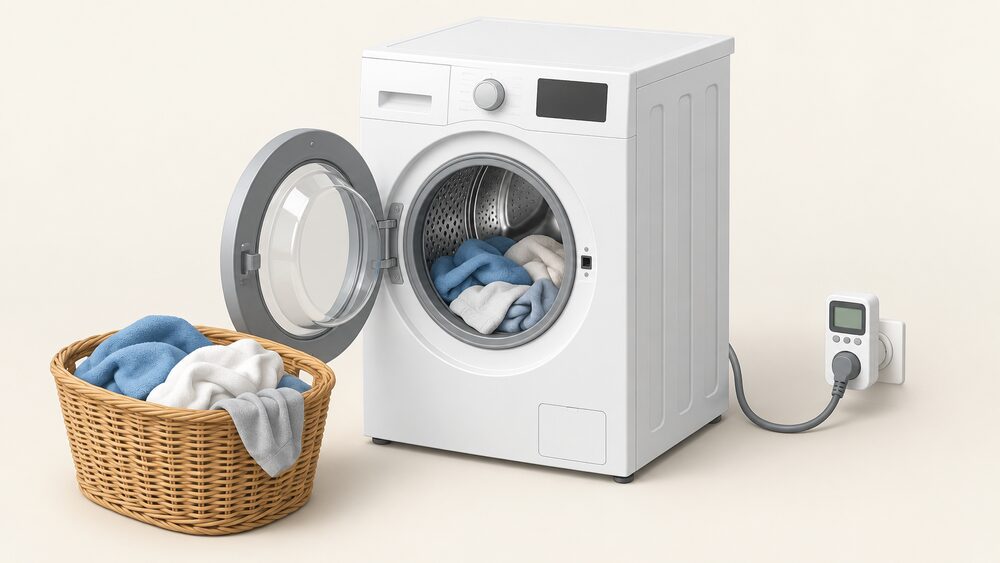
For a household, this is the first appliance cost worth measuring rather than guessing. A plug-in energy monitor or a smart meter reading gives the real per-cycle figure for the actual machine, and the annual total follows from the number of washes. That measurement is also the baseline for judging whether a replacement machine would pay back, which is the same logic set out in appliance upgrade savings.
Cost per cycle: from pence to over £1
Per-cycle cost is where the spread is widest, because it depends on the programme, the load size and the machine's efficiency. A standard 0.7kWh cycle costs about 18p on a standard tariff6. A 2kW machine run for a full hour uses 2kWh, which is about 52p at 26p per kWh7. The upper end of the range comes from long, hot cycles and from drying.
The comparison with other appliances puts the washing machine in context. A dishwasher cycle costs about 19p on average10, and an A-rated dishwasher just 13p11. A tumble dryer, by contrast, costs between 46p and £1.29 for a one-hour cycle9. That is the figure that explains why washer-dryers are so much more expensive to run than washing machines: the drying function, not the washing function, carries the cost.
| Appliance | Cost per cycle | Basis |
|---|---|---|
| Washing machine | about 18p | 0.7kWh cycle, standard tariff6 |
| Washing machine (2kW, one hour) | about 52p | 2kWh at 26p per kWh7 |
| Dishwasher | about 19p | average cycle10 |
| A-rated dishwasher | 13p | A-rated model11 |
| Tumble dryer | 46p to £1.29 | one-hour cycle9 |
The practical point is that a household can move its own cost per cycle a long way without changing the machine. A shorter programme, a fuller load and a lower temperature all reduce the kWh drawn per wash. The half-load question is covered separately in half load washing machine.
Washer-dryers: over £200 a year on average
Washer-dryers are the priciest appliances to run, costing over £200 per year on average, according to Which? testing5. The detailed figures put the average at £216 a year, with the cheapest tested at £141 and the most expensive at £3151. That is roughly three times the cost of an average washing machine1.
The reason is straightforward: a washer-dryer performs two energy-intensive jobs. Drying clothes with heat is expensive, and a tumble dryer cycle alone costs between 46p and £1.29 an hour9. A household that uses the drying function regularly will sit near the top of the washer-dryer range; one that uses it occasionally will sit nearer the bottom.
There is also an efficiency dimension within drying itself. A-rated dryers can cost half as much to run as a C-rated model12. That is a large enough difference to matter over the life of the appliance, and it is visible on the energy label before purchase.
For a household weighing up a washer-dryer against a separate washing machine and a drying method, the running cost is the deciding factor rather than the purchase price. Air drying and outdoor drying carry no running cost at all, which is covered in tumble dryer vs air drying. Where a washer-dryer is the only practical option, for a flat without outdoor space, the cost is real but manageable if the drying function is used selectively.
How many washes does the average household do per year?
The standard assumption is four washes a week, or 208 a year1. Some estimates use a higher figure of around 270 cycles per home8. The difference matters: at 18p a cycle, 208 washes cost about £37 and 270 washes about £49, before any adjustment for temperature or programme.
The number of washes is the variable a household controls most directly. Reducing washing machine use by one run per week is a standard recommendation13, and the saving compounds with a lower wash temperature. Doing one fewer load a week and washing at 30°C saves £26 a year in GB and £32 in NI14. A separate estimate puts the saving from one fewer wash a week plus a drop from 40°C to 30°C at around £30 a year15.
The regional difference between GB and NI figures recurs across the sources and reflects different electricity prices rather than different behaviour. Where a household is in Northern Ireland, the NI figure applies; elsewhere in the UK, the GB figure does.
For a household, the useful step is to count actual weekly washes for a fortnight and multiply. That gives a personal annual figure rather than a national average, and it is the number that makes a replacement decision meaningful. The wider context of which appliances draw most in a home is set out in which appliances use most electricity.
Is it cheaper to wash at 30°C or 40°C?
Washing at 30°C rather than 40°C cuts the cost by 38%, according to Which? tests5. That figure is repeated across independent guidance16, and it is one of the most consistent numbers in the appliance literature. Over a year, washing clothes at 30°C uses around 40% less electricity than washing at higher temperatures18.
The saving is not marginal. A 30°C wash could save over a third of the energy used compared with higher temperatures19, and the same reduction is described as up to 38% compared with a 40°C wash20. Most detergents are formulated to work at lower temperatures, so the change does not normally require a different product21.
"Doing your laundry at 30ºC (rather than 40ºC) cuts the cost by 38%, according to our tests."
Lower temperatures use less energy, and awareness of the advantages of turning to 30°C has grown2. The recommended setting across independent guidance is 30°C or the eco setting21, and 30°C or cooler is the common formulation23. A 30°C wash remains effective for normal loads; heavily soiled items and hygiene-critical loads are the exception where a hotter cycle is used.
For a household, this is the single highest-return change available on laundry, and it costs nothing to make. It also stacks with running fewer cycles: the two measures together produce the £26 to £32 annual saving quoted above14.
How to cut the running cost of your washing machine
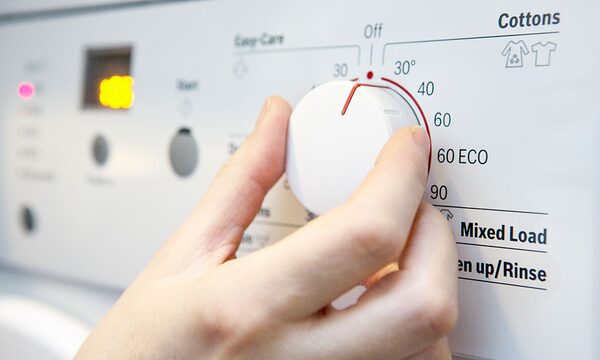
The measures that reduce laundry running cost are behavioural first and mechanical second. Reducing washing machine use by one run per week is the starting point13, and washing at 30°C instead of higher temperatures is the second13. Together they produce the £26 a year saving in GB and £32 in NI14, or around £30 a year on a separate estimate15. Using the machine more efficiently, such as doing a 30-degree wash, could save around £28 a year24.
Running full loads rather than partial ones is the third measure, and it is the same principle that applies to dishwashers: reducing dishwasher use by one run per week saves £14 a year24, and a separate estimate puts the saving from one fewer dishwasher run a week at £11 a year25. The pattern is consistent: fewer, fuller, cooler cycles.
Shifting when the machine runs is the fourth measure, and it depends on the tariff. A washing machine cycle of 0.712kWh cost 18p during a free electricity window in the April to June 2026 period26. For a household on a time-of-use tariff, or with solar generation, running the machine in the middle of the day or during a free window changes the effective cost without changing the cycle.
For a household, the sequence is: measure the current cost, cut the temperature, cut the number of runs, then shift the timing to whatever tariff or generation is available. The first two are free and immediate. The third depends on the tariff and on whether the household has solar or a battery, which is the subject of solar battery or heat pump.
How can I work out my own washing machine's running cost?
The calculation is three numbers multiplied: energy per cycle in kWh, the unit rate in pence per kWh, and cycles per year. A 0.7kWh cycle at 18p, run 208 times, gives about £37 a year1. A 2kW machine run for an hour uses 2kWh, which is about 52p at 26p per kWh7, and 208 such cycles would cost far more.
The energy label gives the per-cycle consumption under standard conditions. The weighted water consumption of a household washing machine is defined in the EU energy labelling regulation, rounded to the nearest integer in litres12. That regulation is the source of the standard test conditions behind the label figures, which is why label consumption and real-world consumption can differ.
For a household wanting its own figure rather than a label figure, a plug-in energy monitor on the machine for a week gives the real per-cycle kWh, and a smart meter gives the whole-home picture. The general method for estimating appliance use is set out in baseline your energy use.
The limits of the calculation are worth stating. Unit rates change, and the figures here are tied to the dates given. A household on a time-of-use tariff has more than one unit rate, so the same cycle costs different amounts at different times. And the annual total depends on the number of washes, which is a behaviour rather than a specification. The calculation is a planning tool, not a bill.
Sources26 cited
- How much your appliances cost to run, Which?, 2026-10-01
- How to save energy when using your washing machine, Energy Saving Trust, 2025-08-27
- Beware cheap appliances that cost you twice as much in the long run, Which?, 2024-03-05
- Which? warns against buying cheap appliances that rack up huge energy bills, Which?, 2023-11-09
- Five top tips from Which? to cut your energy bills, Welsh Government, 2026-03-18
- The price cap: why every time you turn on this one household appliance will cost you 10p more than your neighbour, Uswitch, 2026-04-22
- How to estimate your energy use, Which?, 2026-08-03
- Average electricity usage UK, Bluetti Power, 2023-02-06
- What appliances use more electricity, Smart Energy GB, 2026-03-16
- Washing up or dishwasher, Uswitch, 2025-01-13
- Top five energy consuming home appliances, Energy Saving Trust, 2026-08-03
- EU energy labelling regulation, Annex IV, legislation.gov.uk, 2019-03-11
- How to save energy and money if you rent your home, Energy Saving Trust, 2025-11-14
- Top five tips to save energy in the kitchen, Energy Saving Trust, 2026-05-20
- Appliances: how much do yours cost to run, Confused.com, 2025-12-18
- 10 ways to save on energy bills, Which?, 2026-08-27
- Make your home more energy efficient in one weekend, Which?, 2026-08-28
- Energy saving tips, Age UK, 2026-04-02
- 10 ways to go green with electricity, Electrical Safety First, 2026-09-19
- Ultimate energy saving tips guide, Smart Energy GB, 2026-04-24
- Preparing for winter, National Energy Action, 2025-10-14
- Top energy savings tips, National Energy Action, 2026-07-13
- Energy saving laundry tips, Smart Energy GB, 2026-08-17
- Energy efficiency, Consumer Council for Northern Ireland, 2026
- Reducing your energy usage, SGN, 2025-10-14
- Households can get eight hours of free electricity over the early May bank holiday weekend, Uswitch, 2026-03
 Appliance Running CostsWorking out what your appliances cost to run comes down to two things: how much power they use and what you pay per unit of electricity.
 How Much Does a Heat Pump CostA heat pump usually costs around eleven thousand pounds installed, though quotes vary a lot depending on your home.
 Domestic Wind Turbine CostA home wind turbine usually costs between nine thousand and nineteen thousand pounds, but the real price depends on its size and how it is mounted.
 Do Smart Controls Save Money?Do smart heating controls really cut your bills, and by how much?
 Home Battery CostA home battery usually costs between one and a half and ten thousand pounds fitted, depending on size.
 Running CostsA portable air conditioner costs roughly twenty to forty pence for every hour it runs, while a fixed unit uses far less electricity for the same cooling.