
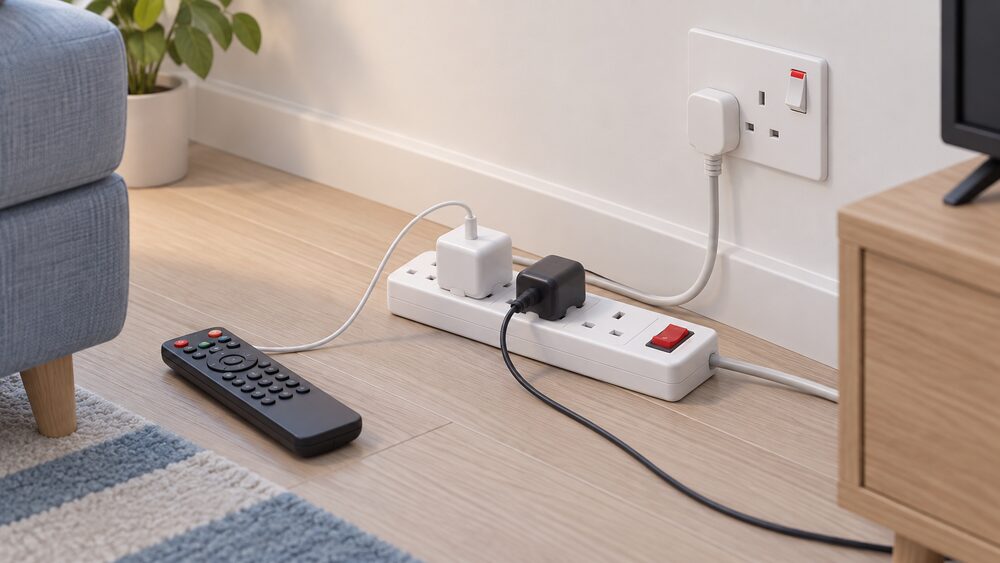
In this answer
Short answer
Switching appliances off standby saves the average household around £45 a year in Great Britain and £55 a year in Northern Ireland, according to the Energy Saving Trust1. The same figures appear across the Trust's guidance, including its kitchen tips and its quick-tips hub, and the Northern Ireland figure is repeated by the Consumer Council2.
The saving is not a single device. It is the sum of many small draws: televisions, broadband routers, set-top boxes, games consoles and chargers, each using a little power while switched off but still plugged in. A Go.Compare Energy study reported by NICEIC put the annual cost of a television left on standby for 20 hours a day at £9.50, which shows how the household total accumulates across a dozen or so devices5.
What the measure does for a household's energy independence is modest but real. It reduces the electricity a home must buy, and it needs no installer, no permission and no capital. What it does not do is remove dependence on the grid or on a supplier: the home still draws power for everything else, and the saving is measured in pounds avoided rather than energy generated. It is a behavioural measure, and it sits alongside the wider set of no-cost steps covered in quick wins and no-cost measures.
What switching off standby saves: around £45 a year in GB, £55 in NI
The headline figure is consistent across the Energy Saving Trust's own pages. Its Christmas energy tips state that switching devices off standby all year round could save £45 in GB and £55 in NI a year off electricity bills1. Its home improvement guidance repeats the same pair, and its quick-tips hub gives the same numbers again2. The kitchen tips page frames it as dependent on the appliances a household has: £45 a year in GB and £55 in NI by switching all devices in the home off standby4.
Other organisations quote the same range. The Consumer Council for Northern Ireland gives around £55 per year for switching off standby mode on devices, which is the NI figure rather than the GB one8. British Gas Energy Trust says switching appliances off at the wall instead of leaving them on standby could save up to £45 a year9. Cadent gives £45 per year for switching appliances off standby mode, covering consumer electronics, lights and chargers left on standby or not in use10.
The gap between GB and NI is not explained in the guidance, but it reflects the different electricity markets and tariff structures in the two jurisdictions. Northern Ireland has its own supplier market and its own price regulation, so a saving expressed in pounds will differ even where the underlying kilowatt hours are similar.
Two lower figures appear in the material. The Centre for Sustainable Energy advises renters that a typical household can save up to £40 a year just by remembering to turn off appliances left on standby6. Ideal Heating, a boiler manufacturer, gives £30 a year for turning appliances off rather than leaving them on standby, in guidance dated July 202011. The £30 figure is older and comes from a maker rather than an official or independent body, and it predates the price rises of the intervening years.
Why appliances left on standby still draw power
Standby electricity is the energy appliances and electronic devices use while switched off but still plugged in5. Smart Energy GB defines standby mode as a low-power state that an appliance, still plugged into the power source, can enter when not being actively used7. The device is not off in the sense of drawing nothing; it is waiting for a signal, a remote control command or a timer.
That waiting state exists for a reason. Some satellite and digital TV recorders need to be left plugged in so they can keep track of programmes scheduled for recording7. Fridges and freezers need permanent power for a different reason: their contents. The Energy Saving Trust states plainly that it does not advise switching off fridges or freezers, because they need to stay switched on to prevent their contents from spoiling2.
The draw is not confined to the appliance itself. Homey notes that power adapters often draw power even when the device itself is not actively being used12. A charger left in a live socket is a small continuous load. Smart bulbs behave the same way: a smart bulb uses some standby power all the time whether it is on or off, so it can react to a signal from a phone, smart speaker or other controller13.
Storage heaters are a separate case again. They usually draw electricity from the grid overnight at a cheaper rate and disperse heat at a low and slow level through the day, and they rely on the heat stored overnight, so planning ahead is essential14. They are not standby devices, but they illustrate the same principle: some loads are designed to run when the household is not watching them.
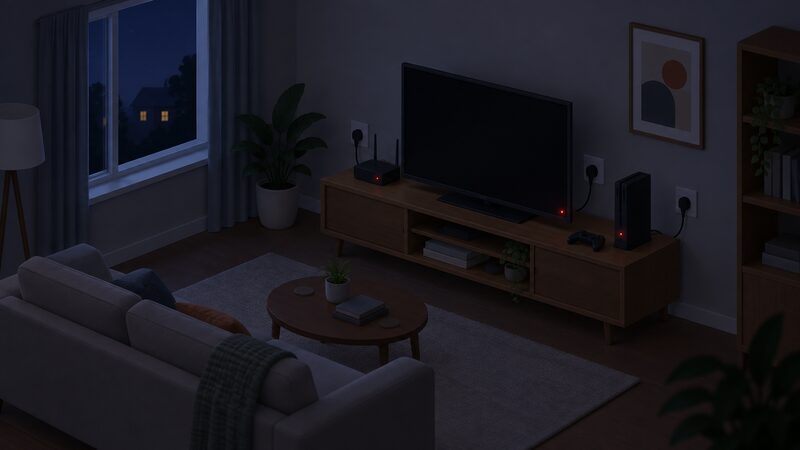
Which appliances cost the most on standby
The NICEIC report on vampire devices gives the clearest breakdown, based on a Go.Compare Energy study estimating the annual costs of leaving 11 popular devices on standby for 20 hours per day5. Televisions come out at £9.50 a year. The study covers the usual set: televisions, broadband routers, set-top boxes, games consoles and similar consumer electronics.
The Centre for Sustainable Energy's myth-busting page gives the household total as £45 a year for leaving TVs, broadband routers, set-top boxes, games consoles and other appliances on standby16. That list is effectively the ranking: the devices that are always connected, always listening for a signal, and rarely switched off at the wall.
Two claims in the material are worth treating with caution. A 2022 study published by CREDS describes a claim that switching off electrical items on standby can save £147 a year as a large over-estimate17. That figure is roughly three times the Energy Saving Trust number and should not be used. Separately, a Northern Powergrid page aimed at customers on its extra care register states "SAVE £55 A YEAR just by turning your appliances off standby mode"18. That is the Northern Ireland figure applied to a page covering northern England, and it is higher than the GB figure the Energy Saving Trust gives.
How to switch off standby across the home
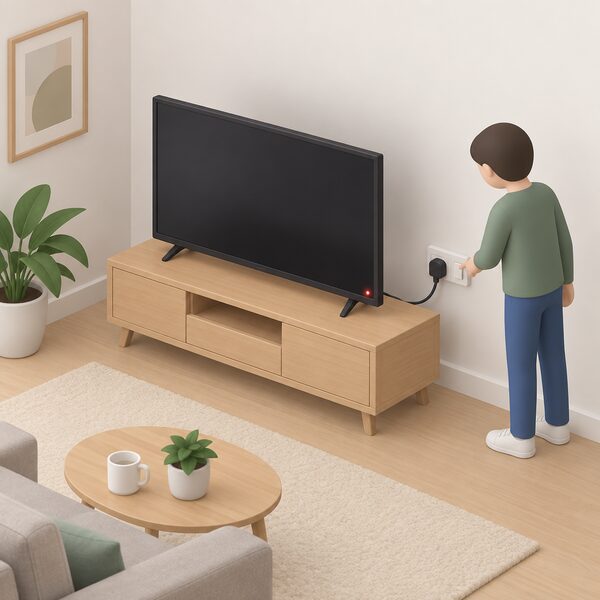
The practical method is a walk round the home, not a single switch. The Energy Saving Trust's home improvement guidance describes saving around £45 a year in GB and £55 in NI just by turning appliances off standby mode, and its kitchen tips list dishwashers, microwaves and washing machines among the products that do not need to be on 24/72.
A room-by-room approach works because the devices cluster. Living rooms hold televisions, set-top boxes and games consoles. Home offices hold routers, monitors and chargers. Kitchens hold microwaves, dishwashers and washing machines. Bedrooms hold chargers and, increasingly, smart speakers.
Homey's guidance suggests grouping devices onto smart plugs and creating flows to cut their power completely at night or when the household is away12. That is a maker's method for its own system, but the principle applies to any timer or switched extension lead.
Two safety rules override the savings. The first concerns fridges and freezers, which should stay on2. The second concerns gas. Confused.com's gas safety guidance states that in a suspected gas leak no electrical switches should be operated, including flicking a light switch on or off, because they could create a spark19. Standby savings are irrelevant in that situation.
"Don't operate any electrical switches. This includes flicking on a light switch or turning one off, because they could create a spark."
Does standby saving justify smart plugs and timers
A smart plug can help reduce standby power if it fully cuts power to an appliance that would otherwise use more standby electricity than the smart plug itself uses20. That condition is the whole argument. A smart plug stays in standby mode so it can respond to commands, which means it always uses a small amount of electricity, even when the connected device is switched off20. The Centre for Sustainable Energy puts it directly: a smart plug only saves electricity if it stops the household using more power than the plug itself uses20.
NICEIC notes that many smart plugs enable automatic cutting of power to appliances in standby mode, which is the useful function5. The limitation is scheduling. Centre for Sustainable Energy guidance states that appliances such as tumble driers, washing machines and dishwashers often do not start their cycles just when power is delivered, so a smart plug would only be able to monitor power consumption rather than control the cycle21.
Smart bulbs carry a similar trade-off. A smart bulb uses some standby power all the time whether it is on or off, so it can react to a signal from a phone, smart speaker or other controller13. A household replacing a conventional bulb with a smart bulb adds a permanent small load in exchange for control.
The arithmetic is therefore device-specific. Where a television, games console or set-top box draws more in standby than the plug draws to stay connected, the plug pays. Where the appliance is already low-draw, or where the plug cannot control the cycle, it does not.
Is it better to unplug appliances or switch them off at the socket?
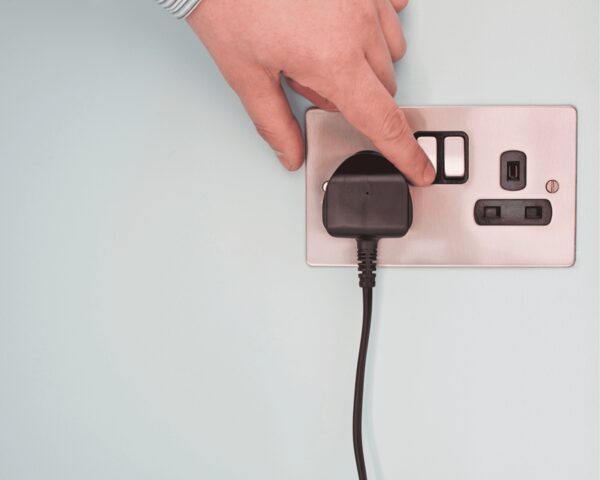
Switching off at the socket is sufficient for almost everything. The Energy Saving Trust states that almost all electrical appliances can be turned off at the plug without upsetting their programming3. Smart Energy GB gives the same assurance: almost all electrical appliances can be turned off at the plug without affecting their settings7.
Unplugging adds nothing beyond what the switch achieves, except in two situations. A socket without a switch needs the plug removed to break the circuit. A charger left in a live socket continues to draw a small current even with no device attached, as Homey notes of power adapters generally12.
The exceptions are the appliances that need permanent power. Fridges and freezers should stay on2. Some satellite and digital TV recorders may need to be left plugged in so they can keep track of programmes scheduled for recording7. Storage heaters rely on overnight charging and need planning rather than switching15.
Do phone and laptop chargers use electricity when left plugged in?
Chargers are a small but persistent load. Homey notes that many power adapters draw power even when the device itself is not actively being used12. The Centre for Sustainable Energy advises renters not to leave a mobile phone on charge all night, because phones only need two or three hours6.
There is a safety dimension as well as a cost one. North Wales Fire and Rescue Service advises against charging devices overnight when anyone is asleep, or leaving them on charge when the home is empty22. That guidance concerns lithium ion battery fire risk, and it applies regardless of the electricity cost.
The practical position is that chargers are worth unplugging or switching off, but they are not where the bulk of the £45 sits. The always-connected entertainment and networking devices are.
How standby fits into a wider set of household savings
Standby is one line in a household budget, and it is worth seeing it against the others. Standing charges are the fixed part of a bill, covering the costs of providing a home with gas and electricity, including network connection, meter readings, maintenance and government initiatives23. Those charges apply whether or not a household uses any electricity, so they set a floor that standby savings cannot touch.
Tariff structure changes what a kilowatt hour saved is worth. A tracker tariff with a discount on the unit rate produces higher savings for higher usage, and vice versa, while a cap tracker with a discount on the standing charge suits lower-consumption households better than a tracker where the discount is on the unit rate24. Zero standing charge tariffs are best suited to households that use little gas or electricity, and to properties left empty for long periods such as holiday homes25.
Savings estimates themselves are modelled, not measured. Uswitch calculates savings as the difference between the estimated annual cost of a household's current plan, based on the latest price cap rates for a standard variable tariff, and the plan it could switch to, using estimated annual usage26. That is why a standby figure quoted by one organisation can differ from another's: the underlying usage assumptions and the price period differ.
For a household working through a plan, standby sits in the behavioural tier. It costs nothing, it needs no assessment, and it can be done today. It does not replace insulation, heating controls or a whole house plan, and it does not generate anything. What it does is reduce the electricity a home must buy, which is the first and cheapest form of energy independence available to any household, rented or owned.
Sources26 cited
- Christmas energy saving tips, Energy Saving Trust, 2026-05-20
- Top energy saving ideas for your home improvement project, Energy Saving Trust, 2026-08-03
- Quick tips to save energy, Energy Saving Trust, 2026-08-21
- Top five tips to save energy in the kitchen, Energy Saving Trust, 2026-05-20
- Standby power: the hidden costs of vampire devices, NICEIC, 2026-01-28
- Energy saving advice for renters, Centre for Sustainable Energy, 2026-08
- Switching appliances off standby, Smart Energy GB, 2026-04-22
- Energy efficiency, Consumer Council for Northern Ireland, 2026
- What are the best energy saving tips for households in the UK?, British Gas Energy Trust, 2026-04-21
- Energy efficiency, Cadent Gas, 2026-09-20
- 15 easy ways to save money in your home, Ideal Heating, 2020-07-06
- AC vs DC home power explained, Homey, 2026-09-20
- Smart homes and lower carbon footprint, Energy Saving Trust, 2026-01-21
- The best heating for your home, Which?, 2025-09-22
- A guide to using electric storage heater controls, Energy Saving Trust, 2026-05-21
- Energy saving myths, Centre for Sustainable Energy, 2026-07
- The energy price crisis: issues for energy use, CREDS, 2022
- Energy tips to help you save, Electricity North West, 2026-09-19
- What to do if you smell gas: safety tips, Confused.com, 2025-09-08
- What are smart plugs and do energy saving plugs work?, Smart Energy GB, 2026-08-19
- Smart plugs, Centre for Sustainable Energy, 2025-10
- Lithium ion batteries, North Wales Fire and Rescue Service, 2026
- Energy standing charges, Uswitch, 2026-08-26
- What is a tracker tariff?, Uswitch, 2026-06-26
- Gas and electricity standing charges, Confused.com, 2026-07-06
- Energy personal projection, Uswitch, 2026-05-29
 Changing Habits SavingsWhat the evidence says behavioural change saves: around £90 to £120 a year for one degree off the thermostat, £100 to £110 a year for using a full set of heating controls, and £304 to £351 a year for a bundle of small changes.
 Home Battery CostA home battery usually costs between one and a half and ten thousand pounds fitted, depending on size.
 Do Smart Controls Save Money?Do smart heating controls really cut your bills, and by how much?
 Portable Power Station CostHow much does a portable power station cost in the UK, and what does the money actually buy?
 Portable Power Station SizeHow big a portable power station does a home actually need, and how long will it keep things running in a power cut?
 Cost of Energy IndependenceA heat pump and better insulation are the usual starting point, but what does the whole job really cost, and what help is there with the bill?