
In this answer
Short answer
The half load programme is a fallback, not a saving. It exists so that a small wash does not waste a full drum of water, but the machine still heats water and still runs a cycle, so the energy saving is far smaller than the name suggests. Around 90% of a washing machine's energy expenditure goes on heating the water1, and that cost is set by the temperature selected, not by how full the drum is.
The guidance is consistent: wait until there is a full load, and use the half load programme only when a half load is unavoidable1. Washing machines, dishwashers and tumble dryers account for 14% of a typical energy bill, making them the most energy-hungry appliances in the home after heating2. Reducing washing machine use by one run per week is one of the named habits3, and the Energy Saving Trust recommends reducing by one load a week4.
For a household working through no-cost and low-cost measures, the washing machine is one of the few appliances where a change of habit costs nothing and shows up on the meter. What it does not do is remove the dependence on the grid, the supplier or the tariff: the saving is a smaller bill, not a step towards independence.
When the half load programme makes sense
The half load programme is worth selecting in one situation: when a half load is unavoidable and the machine offers the option. The Energy Saving Trust's wording is direct: trying to avoid washing half loads whenever possible is a good rule of thumb, but if it is unavoidable, the half load programme should be used1. That is a fallback, not a routine.
The reason it is a fallback rather than a strategy is that the machine's biggest cost is heating water, and a half load still heats water. Around 90% of a washing machine's energy expenditure is spent on heating the water1, a figure repeated across independent guidance7. The half load setting reduces the volume of water on many models, but it does not halve the heating, because the drum, the pipework and the wash chamber all still need to reach the selected temperature.
Where the programme earns its place is in households that cannot accumulate a full load: a single person, a household with a uniform or workwear cycle that cannot wait, or a home with a small drum. In those cases the alternative is not a full load, it is a half load on a full-load programme, which uses the same water and energy as a full wash for half the clothing. Selecting the half load option is the lesser of the two.
The same logic applies to the dishwasher, where the guidance is blunter: only run it when it is full, because a half load uses the same amount of energy7. The washing machine's half load programme is a partial exception because it does reduce water on some models, but the principle holds.
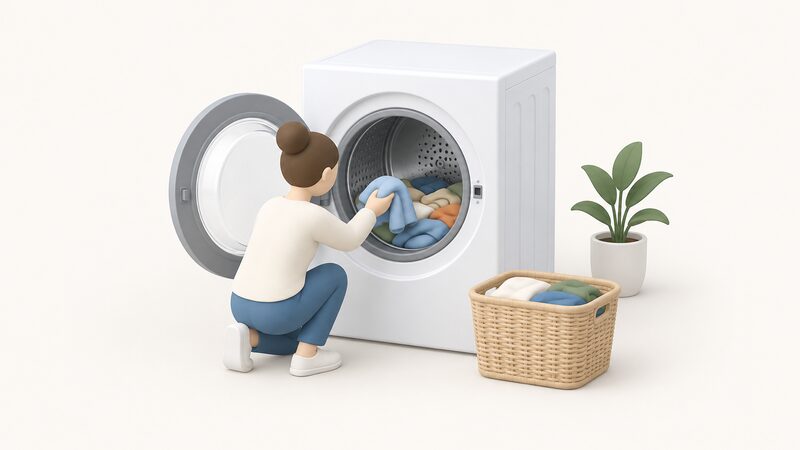
Half load versus full load: water, energy and cost
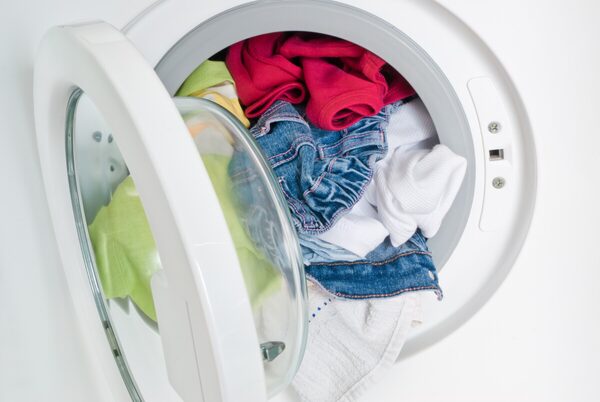
The comparison is not close. A full load at a low temperature uses less energy per item of clothing than two half loads at the same temperature, because the heating happens once instead of twice. The Energy Saving Trust recommends reducing by one load a week4, and reducing washing machine use by one run per week is the same advice in a different form3.
The figures that drive the comparison are the temperature and the machine's rated consumption. A washing machine example in consumer guidance uses 0.63 kWh per use8. A worked example from Which? puts a 2,000 watt (2kW) machine run for an hour at 2kWh, costing 52p at 26p per kWh9. The gap between those two figures is the gap between a modern eco cycle and an old machine on a hot wash, and it is far larger than the gap between a half load and a full load on the same machine.
Water use is the other half of the picture. Modern UK washing machines commonly use around 40 to 60 litres per cycle, depending on the model, drum size and programme6. A half load programme reduces that volume on models that adjust the fill, but the reduction is a fraction of the cycle, not half of it, because the machine still fills, rinses and spins.
| Measure | Full load | Half load |
|---|---|---|
| Water heated | One drum | One drum, smaller fill on some models |
| Energy for heating | Once per cycle | Once per cycle |
| Cost per item washed | Lower | Higher |
| Guidance | Wait until full1 | Use only if unavoidable1 |
The cost of a single cycle is modest in isolation. A dishwasher cycle is put at 25p in one worked example10, and a washing machine cycle at 52p in another9. The point is not the size of one cycle but the number of them: two half loads a week instead of one full load doubles the heating events for the same laundry.
Where the half load programme falls short
The half load programme falls short in three ways. First, it does not halve the energy, because the heating load is not proportional to the drum contents. Second, it does not halve the water on every model, because the fill is set by the programme and the drum size rather than by the weight of the load. Third, it encourages a habit that the guidance names as a problem: repeated half-load washes5.
The habit point matters more than the engineering. Waiting until there is a full load, avoiding repeated half-load washes and re-wearing lightly used clothes where appropriate are the behaviours the guidance groups together5. A household that runs a half load programme three times a week is using more energy than one that runs two full loads, even though each individual cycle looks efficient.
There is also a cleaning caveat at the other end of the scale. Overloading the drum is a mistake in the opposite direction: while full loads are better than half loads, an excessively full load will require more work from the machine5. The guidance suggests leaving a hand's span width at the top of the drum for better performance1. That is the practical band: full enough to justify a cycle, loose enough for the clothes to move.
"Avoid overloading the drum. While full loads are better than half loads, an excessively full load will require more work"
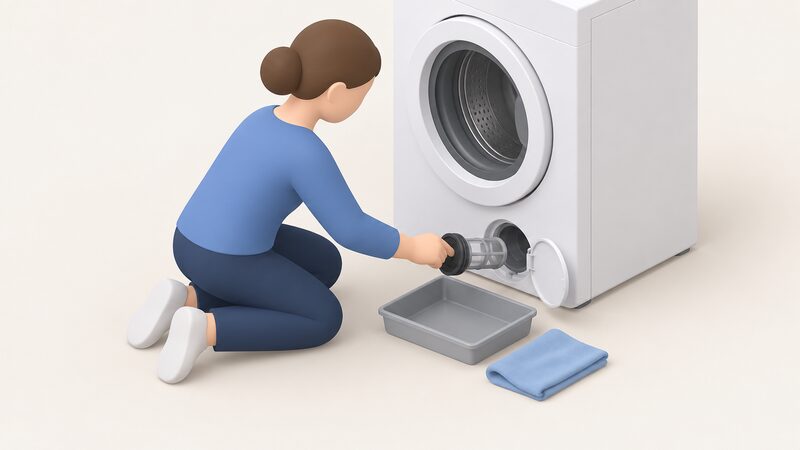
Maintenance is part of the same picture. Avoiding overloading, regularly cleaning the filter and using descaling solutions to reduce limescale buildup are the steps named alongside load guidance5. A machine scaled up in a hard water area will use more energy to reach temperature, which erodes the benefit of any load-size choice.
Temperature matters more than load size
If the goal is a lower bill, the temperature dial does more work than the load selector. Lower temperatures use less energy1, and washing at 30°C instead of higher temperatures is the standard recommendation12. Official guidance for Northern Ireland puts it plainly: washing clothes at 30 degrees can be just as effective for a normally soiled load13.
The saving is quantified in one place. Washing loads at 30 degrees or cooler could save £12 in Great Britain and £15 in Northern Ireland a year14. That is a modest figure, and it is the only published saving attached to the temperature change in this guidance, so it should be read as an illustration rather than a promise.
The same recommendation appears across the advice bodies, which is unusual and worth noting. Setting the machine to 30°C instead of higher temperature cycles will still get clothes clean but uses less energy15. Washing at 30°C or using eco-cycles where fitted is the recommendation from Smart Energy GB16. British Gas Energy Trust says where possible, wash at 30°C17. The Northern Ireland advice line recommends 30°C or the eco setting18. The pattern is consistent across England, Scotland, Wales and Northern Ireland, and no source in this set recommends a higher temperature for a normally soiled load.
The mechanism is the same one that makes the half load programme disappointing: heating water is the cost. Lower temperatures use less energy1, and up to 60% of the energy used to heat water during laundry can be saved by washing at lower temperatures16. That is a far larger lever than load size.
| Setting | What it changes | Relative effect |
|---|---|---|
| 30°C instead of 40°C or 60°C | Water heating | Lower temperatures use less energy1 |
| Eco cycle | Cycle length, temperature profile | Recommended where fitted16 |
| Half load programme | Water volume on some models | Smaller than the temperature effect1 |
Alternatives when the drum cannot be filled
Where a full load is not achievable, the options are to change the cycle, change the drying, or change the timing. The first is the eco or short cycle: using the Eco setting or a short cycle and waiting until it is full before running a cycle is the dishwasher guidance2, and the same logic applies to the washing machine, where washing at a lower temperature and avoiding only washing half loads are named together2.
The second is drying. Running an extra spin cycle before hanging clothes out to dry removes as much water as possible and reduces drying time, though it uses a little more energy19. The savings from air drying are framed around drying usual laundry outside for just three months of the year instead of using a tumble dryer4. For a household with a tumble dryer, that is a larger saving than any load-size choice on the washer.
The third is timing, and it is where a household can shift cost without shifting consumption. Time-of-use tariffs such as Economy 10 offer different rates at different periods20, and a washing machine is one of the appliances that can be run inside a cheaper window. That does not reduce the energy used, but it changes what the energy costs, and it is the one lever that connects laundry habits to a household's wider energy plan.
For households that cannot fill a drum at all, the practical answer is a smaller machine or a service wash, not a half load programme run three times a week. The Consumer Council's Appliance Cost Checker Tool allows use per week to be selected for large goods like washing machines21, which is a way to see the annual cost of the habit before changing it.
The brands and machines sold in the UK
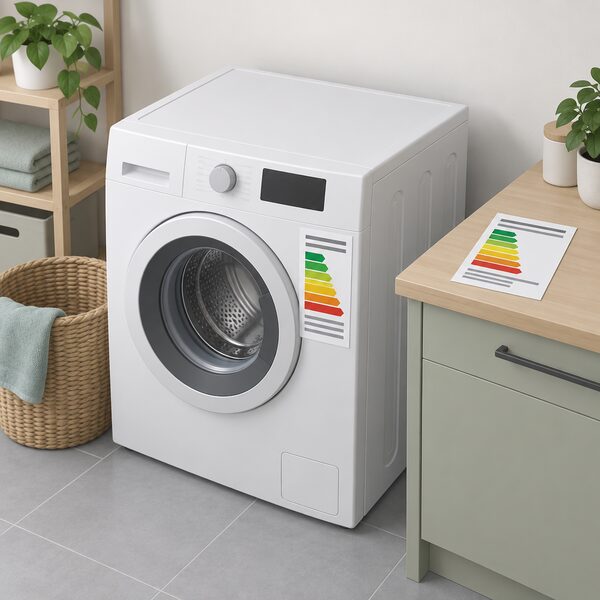
The half load programme is a feature of the machine, not a brand. Which? tests washing machines on the 40°C cottons programme because that is most commonly used by its members, rather than the 60°C cottons programme which makes up 60% of EU Energy Label tests23. That matters when comparing machines: a model that performs well on the label programme may behave differently on the cycle a household actually uses.
Under the EU energy labelling rules that still apply in the UK for the relevant models, the parameters for the eco 40-60 programme are measured at the rated capacity, at half of the rated capacity and, where relevant, at a quarter of the rated capacity24. In other words, the half load performance of a machine is a measured quantity on the label, not a marketing claim. The weighted energy figure is calculated in kWh per cycle and rounded to three decimal places24, and the weighted remaining moisture content after washing is expressed as a percentage and rounded to the nearest whole percent24. For machines with a rated capacity of 3 kg or lower, the weighting factor for the small capacity case is zero24.
That regulatory detail is the reason the half load programme exists at all: it is a tested configuration, and the label reflects it. It is also the reason a household can compare two machines on their half load figures without running either.
What this means for a household's energy independence
A washing machine is a grid appliance. It draws electricity from the supplier, at the tariff the household has signed up to, and the only levers are how much it draws, when it draws it and what temperature it heats to. The half load programme touches the first of those only lightly.
The habits that do move the number are the ones the guidance repeats: full loads, 30°C, eco cycles where fitted, air drying where possible, and one fewer run a week1. Together they reduce consumption and cost, and they require no purchase. What they do not do is remove the dependence on the grid, the supplier or the price of electricity.
For a household working towards planning for energy independence, laundry is a behaviour measure rather than an infrastructure one. It belongs with the behaviour change and household habits work, and it is best done before spending on appliances, because the habit determines whether a new machine's efficiency is realised. A household that runs half loads three times a week will not see the benefit of an efficient machine.
The wider point is that the half load programme is a small answer to a small question. The larger questions, how the home is heated, how it is insulated, and where its electricity comes from, are where independence is actually built. Laundry habits are the cheapest place to start and the least consequential place to finish.
Sources24 cited
- How to save energy when using your washing machine, Energy Saving Trust, 2025-08-27
- Top five energy consuming home appliances, Energy Saving Trust, 2026-08-03
- How to save energy and money if you rent your home, Energy Saving Trust, 2025-11-14
- Top five tips to save energy in the kitchen, Energy Saving Trust, 2026-05-20
- Washing machine energy saving tips, Smart Energy GB, 2026-08-17
- Energy saving laundry tips, Smart Energy GB, 2026-08-17
- 10 ways to go green with electricity, Electrical Safety First, 2026-09-19
- Understanding energy bills, StepChange, 2026-09-20
- How to estimate your energy use, Which?, 2026-08-03
- Households can get eight hours of free electricity over the early May bank holiday weekend, Uswitch, 2026-03
- Home appliances, Energy Saving Trust, 2026-05-20
- Energy efficiency tips, nidirect, 2026-09-17
- Christmas energy saving tips, Energy Saving Trust, 2026-05-20
- Energy tips to help you save, Electricity North West, 2026-09-19
- Reducing your energy usage, SGN, 2026
- Avoid using the dryer, Smart Energy GB, 2026-04-22
- Energy savings tips, British Gas Energy Trust, 2026-02-27
- NI top energy saving tips, National Energy Action, 2026-09-07
- Making the most of your solar PV panels, Centre for Sustainable Energy, 2026-08
- Economy 10, Uswitch, 2025-12-08
- Appliance cost checker tool, Consumer Council, 2026
- Recycling electricals and batteries, Electrical Safety First, 2026-09-17
- 10 ways to save on energy bills, Which?, 2026-08-27
- Ecodesign requirements for household washing machines and washer-dryers, Annex IV, legislation.gov.uk, 2019-03-11
 Heating Schedules and SetbackIs it cheaper to leave the heating on low all day, or set it to come on only when you need it?
 Cooling and Heat PumpsCan an air conditioner heat your home as well as cool it?
 System Design and BalancingWhy do some radiators stay cold while others get too hot, and what does balancing actually do?
 Load Compensation and ModulationA boiler that only switches on and off wastes money, because it runs too hot to work at its best.
 Electric BoilersHow electric flow boilers heat a conventional wet system, what they cost to buy and run, where they suit UK homes, and why point-of-use efficiency near 99% does not translate into cheap heating at the meter.
 Heat Pump Electricity TariffsA heat pump tariff gives you cheaper electricity for part of the day, so running your heating costs less than on a standard rate.