
In this answer
Short answer
A heating programmer is the time control in a central heating system: it decides when the heating and hot water come on and go off, while a room thermostat decides whether the boiler actually runs during those periods. The Energy Saving Trust lists a programmer, at least one room thermostat and thermostatic radiator valves as the minimum core controls for a central heating system1. Home Energy Scotland adds a cylinder thermostat where the system has a hot water cylinder2.
Setting one well is mostly about matching on periods to the hours the home is occupied, and letting the thermostat and TRVs do the rest. The evidence points one way on the constant-versus-timed question: leaving heating on continuously typically uses more fuel, and the most energy-efficient approach is generally to programme the heating to come on when it is needed most3. Heat pumps are the exception, where longer running with a setback temperature is the recommended pattern4.
What a heating programmer does
A programmer controls when the heating comes on and off1. That is its whole job, and it is a different job from the one a thermostat performs. A timer lets you control when your heating or hot water turns on and off each day, so that the central heating and hot water run to a pattern rather than continuously7. Digital electric storage heaters use the same principle: a programmer or timer lets you set specific times for when the heating comes on and off8.
The term overlaps with others in common use. A heating programmer is essentially another term for a programmable thermostat, and in that form it allows precise control of heating levels through the home, room by room, by time of day9. A programmable room thermostat combines time and temperature controls in a single unit and can set different temperatures for different times of the day1. Where a separate programmer and a separate room thermostat are fitted, the pair is recognised as a distinct control measure in its own right: the ECO4 measures table lists "Programmer & room thermostat" as measure C5, abbreviated P&RT10.
For a household, the significance is straightforward. The programmer is the part of the system that stops the boiler firing for hours when nobody is home, and it is the control most often left on a factory default. It does not reduce the heat a room needs to reach a given temperature; it reduces the hours in which the system is willing to supply that heat. That is the whole basis of the saving, and it is why the timing pattern matters more than the brand of the unit.
Programmer, thermostat and TRV: how the controls work together
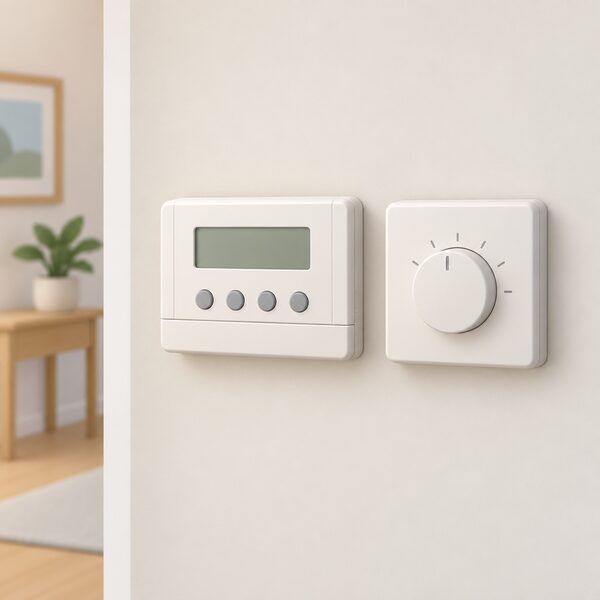
The three controls do different jobs and depend on each other. The Energy Saving Trust's minimum set for a central heating system is a programmer as the time control, at least one room thermostat, and thermostatic radiator valves1. Home Energy Scotland's recommended set is a time-controlled programmer, at least one room thermostat, TRVs if there are radiators, and a cylinder thermostat if the system has a hot water cylinder2. Cadent describes a full set of heating controls as a programmer, thermostatic radiator valves and a room thermostat11.
The division of labour is what makes the combination work. The programmer opens a window of time. Within that window, the room thermostat measures air temperature and stops the boiler when the setpoint is reached, restarting it as the room cools. TRVs then trim individual rooms, so bedrooms and rarely used rooms do not reach the same temperature as the living room. A programmable room thermostat collapses the first two into one unit, setting different temperatures for different times of day1.
Heat pump systems follow the same logic with different hardware. They are typically controlled by the end user through weather compensation or an internal temperature control such as a room thermostat, together with a timer or programmer to control space heating12. Weather compensation adjusts the flow temperature to the outdoor temperature rather than switching the system on and off sharply, which is why the programmer's role on a heat pump is to define occupied and unoccupied periods rather than to drive short bursts of heat.
Where a home has a hot water cylinder, the programmer usually has two channels, and the cylinder thermostat takes over from the programmer once reheating starts. That arrangement is covered in more detail under hot water controls, and the wider control set is set out in the heating controls pillar guide.
Setting on and off times to suit your lifestyle
A central heating programmer allows the appliance to come on at different times to suit your lifestyle, saving wasted energy and fuel consumption13. In practice that means identifying the hours the home is occupied and warm, and setting the on periods to cover them with a margin for the building to heat up.
The common pattern is two periods a day, and there is a published method for testing whether that beats running constantly. It involves leaving the heating on constantly for a week, followed by a week of programming the heating to come on twice a day, taking meter readings at the start and end of each week3. That comparison is worth running in a well-insulated home, because the answer depends on the building rather than on a general rule.
Some controls allow more than two periods. The Ideal Halo thermostat supports 6 heating schedules per day, which the maker describes as giving the flexibility to set additional on periods with a lower setpoint14. That is useful for households with varied occupancy, such as shift workers, where a single morning and evening block does not match the week.
For storage heaters, the timing question is different again. Modern storage heaters generally come with improved heating controls, including an automatic charge control, thermostat and programmer16, and many also feature a thermostat and timer through a programmer or mobile app17. The charge period is tied to the off-peak window rather than to occupancy, so the programmer's job is to manage release of stored heat through the day. That is covered further under storage heater controls.
Where the energy savings come from
The saving from a programmer comes from not heating an empty house, and the size of it depends on how much of the day the previous pattern was heating one. The wider context is that 1 in 4 pounds spent on heating is wasted6, and a broken heating system pushes households onto portable electric heaters, which cost more to use than fixed heating18.
The controls around the programmer contribute their own savings. In tests at Salford Energy House on air source heat pump systems, trimming scenarios using TRVs resulted in space heating energy savings of between 6 and 8%5. Central heating programmers can help increase the efficiency of a heating system, and options now include wireless programmers13. For homes replacing old electric heaters with an air source heat pump, one installer reports potential reductions of around 40% in heating costs19.
Hot water is a separate and often overlooked draw. A typical hot water system can waste as much energy as a Passivhaus actually needs for heating20, which is why the cylinder thermostat and the HW channel matter as much as the heating schedule. On the appliance side, 90% of a washing machine's energy is spent heating the water, so lower-temperature cycles reduce the load the hot water system carries21.
For a household, the independence argument is modest but real. A programmer is a local, non-networked control: it keeps working without an app, a hub, a broadband connection or a manufacturer's cloud service. It does not reduce dependence on gas or grid electricity, and it does not generate anything. What it does is put the timing decision in the household's hands rather than leaving it to a default, and that decision survives a change of supplier or tariff. The wider picture is set out under heating controls and energy independence.
Programmer settings for heat pumps and low-temperature systems
Heat pumps reward a different timing strategy from boilers. Guidance is to keep the heat pump on for longer periods, using a setback to lower the temperature when occupants are out or asleep4. Short on periods suit a boiler that can raise flow temperature quickly; a heat pump works most efficiently at lower flow temperatures over longer runs, so frequent stop-start scheduling works against it.
The installer's settings matter more than the schedule. The installer should set the heat pump to work as efficiently as possible and leave an information pack with instructions on common settings4, and should set the heating curve when the heat pump is first fitted4. The person carrying out the work should be suitably competent22. Where a grant is involved, the installer applies on the householder's behalf through Ofgem, with quotes obtained through the MCS find a heat pump installer tool or the energy supplier23.
"Your installer should set your heat pump's heating curve when you first get it."
Design rules sit behind the settings. Heat pumps should be selected to meet the full space heating requirement at the design condition chosen for heat loss calculations24. Most current models work fine down to about -25°C, while some advanced cold-climate heat pumps work in temperatures as low as -35°C21. Heat pumps also have a heating boost setting that can give a little boost of energy when the temperature is particularly low, using a little more electricity21. The Heat Pump Ready Programme aims to reduce lifetime costs of domestic heat pumps25.
For a household, the practical implication is that the programmer should define occupied and unoccupied periods, and the heat pump's own controls should handle flow temperature. Setting a heat pump to short bursts, as a boiler programmer would, tends to raise running costs rather than lower them. More on this sits under weather compensation and heating schedules and setback.
Common mistakes that waste energy

The most common mistake is leaving the programmer on a pattern that heats an empty house, which is the behaviour the constant-versus-timed test is designed to expose3. The second is treating the programmer as the only control: without a room thermostat and TRVs, the system has no way to stop heating a room that has reached temperature1.
A third is letting a fault run. Portable electric heaters cost more to use than fixed heating, so a broken system should be fixed rather than worked around18. A fourth is ignoring hot water: a typical hot water system can waste as much energy as a Passivhaus actually needs for heating20, and 90% of a washing machine's energy goes on heating water21.
A fifth is expecting a programmer to fix a heat loss problem. Heat loss calculations are a known weak point: heating engineers fitting a heat pump often lack confidence in previous heat loss calculations households might have done, and so have to do their own during installation27. Underfloor heating with a heat pump needs larger pipes, pipes placed closer together, and good insulation under the pipes to reduce heat loss28. Controls cannot compensate for a building that loses heat faster than the system can replace it.
Finally, the schedule itself needs revisiting. A pattern set for a previous household, or for a working week that has since changed, will keep running until someone edits it. On the Halo Lite RF the schedule is altered in the timed heating schedule section of the main menu, and overrides are selected separately by choosing how long to override the schedule for15. Keeping the two distinct, a temporary boost and a permanent change, avoids the common outcome where a household overrides every day instead of editing the schedule once.
Sources28 cited
- Thermostats and heating controls, Energy Saving Trust, 2026-02-10
- Thermostats and heating controls, Home Energy Scotland, 2026-09-20
- Heat the whole house or one room, Uswitch, 2026-08-20
- How to ensure a heat pump runs efficiently, Energy Saving Trust, 2026-05-19
- BEAMA air source heat pump TRV Salford Energy House test, BEAMA, 2026-04
- About fuel poverty, End Fuel Poverty Coalition, 2026-04-20
- How to use your heating controls, Age UK, 2026-03-23
- A guide to using electric storage heater controls, Energy Saving Trust, 2026-05-21
- Heating controller comfort guide, Netatmo, 2026-09-20
- ECO4 measures table v4.0, Ofgem, 2025-07-29
- Energy efficiency, Cadent Gas, 2026-09-20
- Your home guide to heat pumps, OFTEC, 2026-09-17
- Saving energy, Vokera, 2026-09-17
- Using your Halo thermostat, Ideal Heating, 2026-09-17
- Halo Lite RF quick start guide, Ideal Heating, 2026-09-17
- Electric storage heaters, Energy Saving Trust, 2026-05-20
- Night storage heaters, Centre for Sustainable Energy, 2025-10
- Make sure your home is energy efficient, Citizens Advice, 2026-09-19
- Heating systems, AgilityEco, 2026-09-20
- The importance of hot water system design in the Passivhaus, AECB, 2024-11-12
- Heat pump fact check, Energy Saving Trust, 2026-07-01
- Approved Document L, Volume 1: Dwellings, HM Government, 2026
- Heat pump, GOV.UK, 2026-09-10
- Approved Document L, Conservation of fuel and power, Volume 1: Dwellings, HM Government, 2026-09-17
- Information about the Heat Pump Ready Programme, GOV.UK, 2026-05-11
- Radio teleswitch, Energy Networks Association, 2025-01
- Getting a heat pump should be a small step, not a giant leap, Nesta, 2024-12-12
- Energy saving upgrades for home renovation, Energy Saving Trust, 2026-05-05
 Heating Schedules and SetbackIs it cheaper to leave the heating on low all day, or set it to come on only when you need it?
 Controls and Time-of-Use TariffsCheaper electricity at night only saves money if your heating actually uses it then.
 Programmers, Timers and SwitchesWhat a heating programmer does, how single, twin and three-channel units differ, how programmers fit alongside room thermostats and TRVs, and how time control relates to smart meters, time-of-use tariffs and smart controls.
 Heat Pump Electricity TariffsA heat pump tariff gives you cheaper electricity for part of the day, so running your heating costs less than on a standard rate.
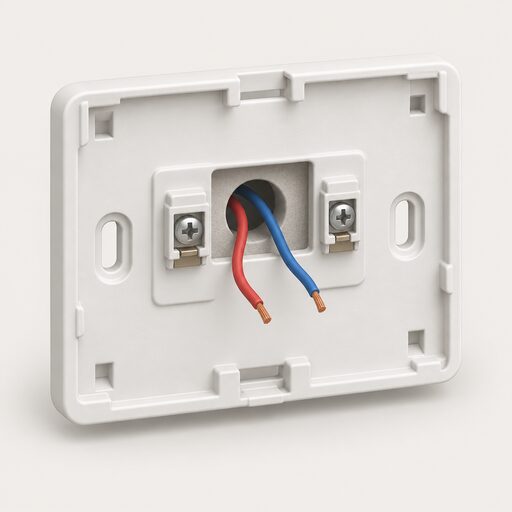 Installing Heating ControlsSwapping a thermostat or programmer looks simple, but which jobs can you safely do yourself and which need a registered installer?
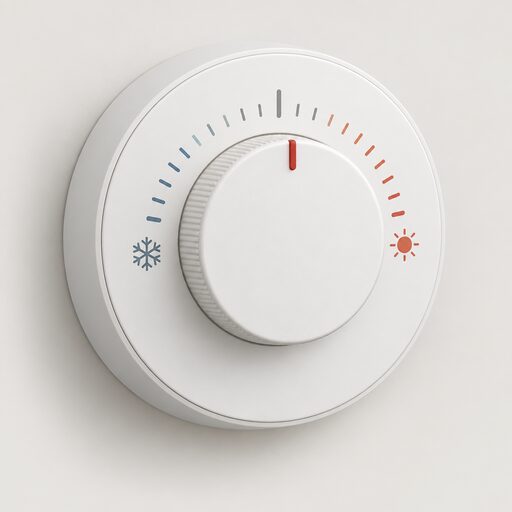 Controls and Smart OperationWhy does a heat pump need different controls from a boiler, and what does weather compensation actually do?