
In this answer
Short answer
Several free services exist to tell a household when electricity is cheap and when it is expensive, and they do different jobs. The National Grid ESO app, the Baking Forecast and Equiwatt are named as services that can help identify the best and worst times to use electricity1. None of them sells electricity. They read the grid, or your meter, and tell you when running a heavy appliance does least harm to your bill or your carbon.
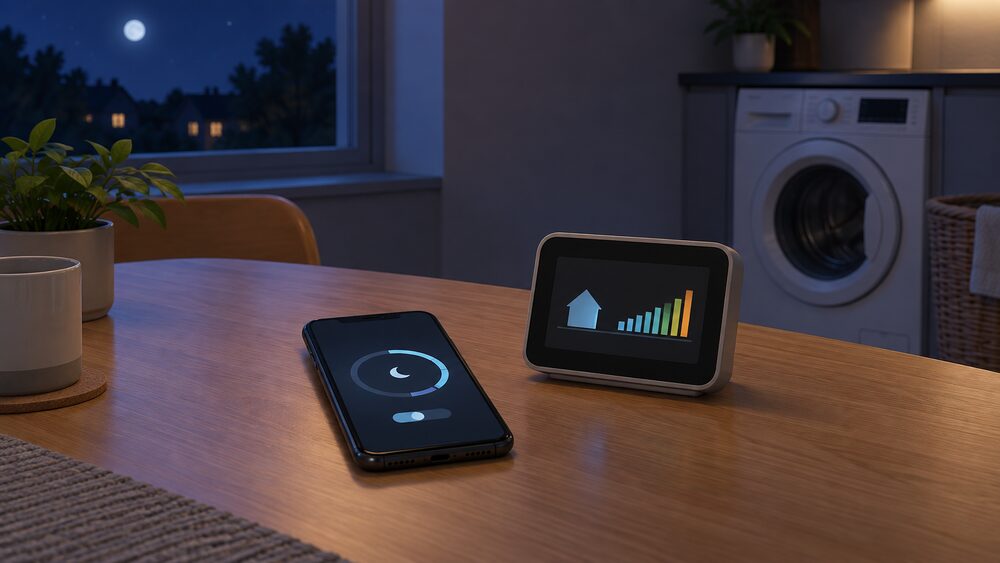
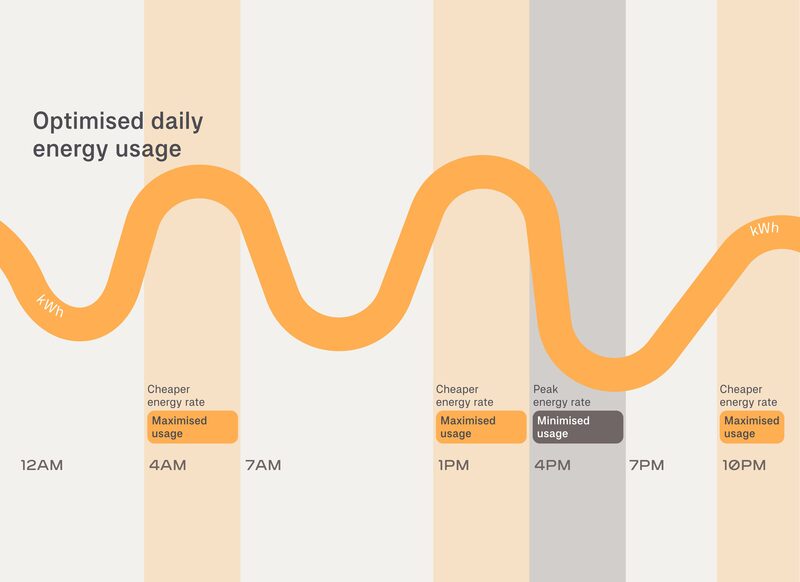
Timing matters because a time-of-use tariff charges different rates depending on the time of day, cheaper when demand is low, usually overnight, and more expensive when demand is high, typically early evening2. The same structure appears across the guidance: cheaper electricity at certain times of the day, usually during off-peak hours3, and a cheaper overnight charging window on tariffs built for electric vehicles4.
What the apps cannot do is change your tariff or your meter. They flag windows, and in some cases schedule a car or a battery into them. The saving comes from moving load, not from the app itself: to benefit from a smart time-of-use tariff, a household must be able to move its electricity use to off-peak periods5.
What these apps do and why timing matters
The grid does not hold a single price or a single carbon intensity through the day. A time-of-use tariff passes that variation to the household, offering cheaper electricity during off-peak hours, like at night, when demand is low10. The same principle sits behind smart charging tariffs, which make it cheaper to use electricity at night, or at times of low electricity demand11.
An app's job is to make that variation visible at the moment a decision is made. Some do it by forecasting the grid: the Baking Forecast and the National Grid ESO app flag good and bad windows before you press start. Others do it by reading your own consumption. The ivie app breaks down your energy usage by activity, so you can see which areas of the home are the most energy-hungry, and offers personalised energy-saving challenges and estimated savings for your bills12. A later description of the same app says it can break down your energy use into different categories, such as heating and cooking, and give personalised suggestions on how to reduce your energy use13.
There is a third layer, where the app stops advising and starts acting. Apps and thermostats are available that automatically optimise a heat pump's schedule with your energy tariff14. That is the point at which timing stops being a habit and becomes automation.
For a household's independence, the effect is modest but real. Shifting load does not reduce the total energy a home imports, and it does not disconnect anything from the grid. It reduces what that imported energy costs, and it reduces the carbon attached to it. The dependence that remains is on the grid, on a supplier, and on the app and the meter that connect the two.
The main apps: National Grid ESO, Baking Forecast and Equiwatt
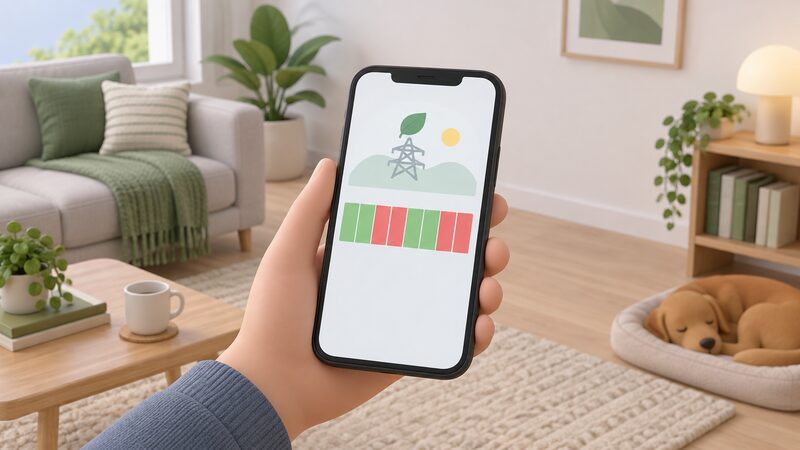
Three services are named together as the free tools that help identify the best and worst times to use electricity: the National Grid ESO app, the Baking Forecast and Equiwatt1. They are not the same kind of thing, and it helps to separate them.
The National Grid ESO app comes from the system operator itself. National Grid ESO stands for Electricity System Operator15, and it is responsible for ensuring there is enough power to meet demand16. Its published demand protection steps include encouraging additional generation, asking heavy industrial users to limit demand, paying customers to shift appliance use, and reducing voltage across the country by a small indiscernible percentage16. The app is the household-facing edge of that work.
Equiwatt is a commercial service rather than a grid body. It describes itself as a UK based climate technology company that helps households to earn rewards for reducing their peak time energy usage and carbon emissions via a free app6. The app uses electricity smart meters and smart technology to enable users to earn rewards for being part of a community-powered Virtual Power Plant6. The rewards are the product; the reduction in peak use is what earns them.
The Baking Forecast is the simplest of the three. It is a forecast, not a meter reader: it tells you when the grid is relatively clean or dirty so that a wash, a charge or a dishwasher run can be placed in the better window. It does not know what you used, and it does not pay anything.
How the apps identify the best and worst times to use electricity
Two different signals sit behind these recommendations, and they do not always agree.
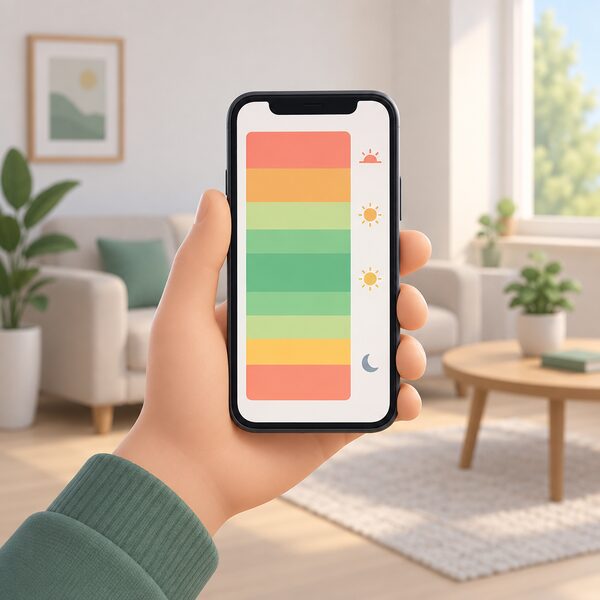
The first is price. On a time-of-use tariff, prices vary throughout the day, usually with a cheaper overnight charging window4. A time of use tariff helps you get cheaper electricity at off-peak times17, and the cheaper periods are usually during off-peak hours3. An app that knows your tariff can show those windows directly.
The second is grid condition. The system operator's own levers, from encouraging additional generation to paying customers to shift appliance use, exist because supply and demand can tighten16. A forecast app reads that condition and translates it into a simple good or bad signal. The Demand Flexibility Service, developed by National Grid ESO, is the formal version of the same idea: it offers rewards for customers who use less electricity during certain periods, available to households with a smart meter7. Its stated purpose is to make it easier for homes and businesses to take part in the electricity market and be rewarded for shifting when they use electricity18.
In practice, the two signals usually point the same way, because the grid is dirtier and more expensive when demand is high. They can diverge on a windy night or a still one. Where they do, the price signal governs the bill and the carbon signal governs the emissions, and a household has to decide which it is optimising for.
Dynamic time-of-use tariffs sharpen this. They suit people who can shift electricity use at short notice to take advantage of cheaper rates when demand is low19. That is a narrower group than the one served by a fixed overnight window.
Smart tariffs and apps: what Octopus Power Pack adds
Supplier apps are a different category from the free grid-forecast tools. They are free to download9, but they only work for that supplier's customers, and they carry that supplier's tariff logic.
Octopus's smart EV tariffs work via an app which customers can download20. The control model is unusual: customers can select the time they need their car by and the amount of charge they need, and Octopus's systems will charge at the cheapest times20. The household sets a deadline and a quantity; the supplier decides when the power flows. That is a genuine transfer of control, and it is worth being clear that it is a transfer: the scheduling decision sits with the supplier's systems, not with the household.
Octopus also offers the Octopus Home Mini, which uses wi-fi to transmit your usage and costs to your app and online account in a few seconds21. That is the data layer that makes any of this visible in near real time.
Hardware compatibility matters here. The Wallbox Pulsar Max is described as able to make the most of the Intelligent tariff from Octopus, although it is not yet compatible with OVO's equivalent22. A charger that works with one supplier's smart tariff may not work with another's, which is a constraint on switching.
Octopus Power Pack, launched in 2024, was the country's first vehicle-to-grid tariff and works with only one charger. That is a narrow base, and it illustrates the general point: the more sophisticated the tariff, the more it depends on specific hardware and a specific supplier's app.
Using timing apps alongside home batteries and solar
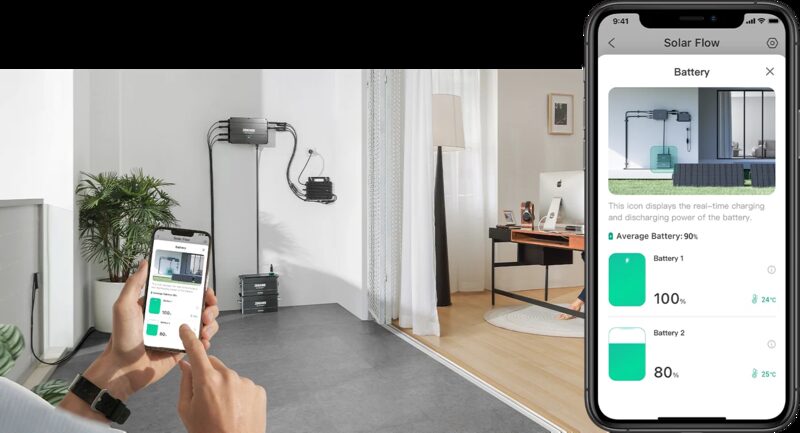
A battery turns a timing signal into stored value. You can store cheap electricity when prices are low and use it later, even during peak times, which can significantly increase your savings2. The same logic applies to a home storage battery: charge up your battery during off-peak hours, at the lowest rate, and use the energy during the peak-rate period to minimise your electricity bill23.
Solar adds a second, independent source of timing. Home batteries enable power produced during the day to be stored and used at another time, for example in the evening, when demand is higher24. Combining solar panels with a home battery lets you store free, renewable electricity to power your heat pump, making you less reliant on grid electricity25.
The interaction between the two is where the app earns its place. A battery can be filled from solar in the afternoon or from the grid overnight, and the choice depends on the weather, the tariff and the state of charge. To maximise savings, switching to a time-of-use tariff lets you charge the battery during off-peak times when electricity is cheap26. Without a tariff signal, a battery still shifts solar into the evening, but it cannot arbitrage the price difference.
The independence gain is real but partial. A battery plus solar reduces the volume of imported electricity and the price paid for what remains. It does not remove the grid connection, and it does not remove the supplier. It also introduces a new dependence: on the inverter, the battery management system and, in most cases, the manufacturer's app and cloud service. A household that wants the timing logic to keep working through an outage or a company failure should ask where the schedule actually lives.
Independence angle: what shifting your usage actually saves
Shifting load is the cheapest form of energy independence available to a UK household, because it requires no hardware beyond a smart meter. It is also the smallest in absolute terms, and it is worth being honest about the ceiling.
The mechanism is straightforward. Making small changes to when you use electricity can save you money27. The condition is that the household can actually move its use: to benefit from a smart time-of-use tariff, you must be able to move your electricity use to off-peak periods5. A home with someone in during the day, an EV, a heat pump with thermal mass, or a battery has that flexibility. A flat with an electric shower and a fixed evening routine has much less.
What the apps contribute is information and, in some cases, automation. The ivie app can help you pinpoint where in the home you're using the most energy28, which is the prerequisite for knowing what is worth moving. The Demand Flexibility Service pays for reductions during specific periods, for households with a smart meter7. Equiwatt pays rewards for cutting peak use through a Virtual Power Plant6.
The dependence that remains is unchanged by any of this. The household still imports from the grid, still buys from a supplier, and still relies on a meter, an app and, usually, a manufacturer's cloud service to see and act on the signal. Timing apps reduce the cost of dependence. They do not reduce the dependence itself. For the wider picture, see Household Energy Independence in the UK and Self-Consumption: How Much of Your Own Generation You Actually Use.
Sources28 cited
- Save, shift, share: three strategies for a more secure energy future, Low Carbon Hub, 2022-04-05
- Should I switch to a time of use tariff, Energy Saving Trust, 2026-01-23
- Best deal energy, Home Energy Scotland, 2026-09-20
- EV tariffs and home charging: what consumers need to know, Energy Ombudsman, 2026-09-11
- Time of use tariffs: all you need to know, Energy Saving Trust, 2026-05-20
- What is Equiwatt?, Equiwatt, 2026
- Smart homes, lower carbon footprint, Energy Saving Trust, 2026-01-21
- What is hydropower and how does it work, Smart Energy GB, 2026-08-19
- Why you should use your energy supplier's app, Which?, 2024-04-18
- What is consumer-led flexibility and what it means for your home and business, Low Carbon Hub, 2025-10-17
- Electric vehicle charger installation and maintenance, NICEIC, 2025-08
- Understanding your home energy usage, ivie, 2026-09-20
- Can a smart meter save you money?, ivie, 2024-08-22
- How smart meters work with heat pumps, Smart Energy GB, 2026-04-24
- What happens in an energy shortage, Energy Networks Association, 2026-09-17
- Emergency power cuts, Electricity North West, 2026-09-19
- Buying a house with solar panels, Energy Saving Trust, 2026-08-13
- Demand Flexibility Service, NESO, 2026-09-17
- Cheaper bills with energy flexibility, Centre for Sustainable Energy, 2026-09-15
- Octopus EV energy tariffs, Uswitch, 2025-10-09
- How to choose the best energy company, Which?, 2026-01-19
- Home electric vehicle chargers, Carwow, 2026-01-09
- The best heating for your home, Which?, 2025-09-22
- Batteries in the home, Solar Energy UK, 2026-09-17
- How to ensure a heat pump runs efficiently, Energy Saving Trust, 2026-05-19
- Battery storage, Home Energy Scotland, 2026-09-20
- Understanding low carbon technology, Electricity North West, 2026-09-20
- How to save energy at home: home appliances, ivie, 2026-09-20
 Demand Flexibility and the GridGetting paid to shift your electricity use away from peak times is now a real option for households with a smart meter.
 Controls and Time-of-Use TariffsCheaper electricity at night only saves money if your heating actually uses it then.
 The Full Smart Meters GuideDo smart meters really save you money, and how do you use one to cut your bills?
 Supplier Apps and AccountsWhat can you actually do in your supplier's app?
 Flexibility Payments for HomesCan you really get paid for using less electricity at peak times, and how much would a household actually earn?
 Time-of-Use Tariffs ExplainedCan you pay less for electricity by using it at different times of day?