
In this comparison
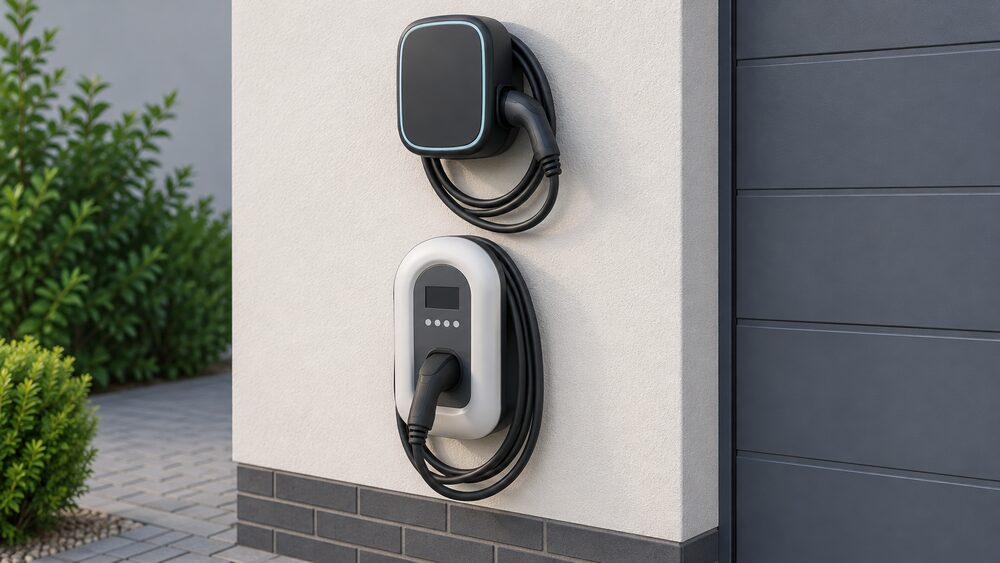
The Wallbox Pulsar Max and the myenergi zappi are both Mode 3 AC home charge points, and both are sold in the UK as smart chargers. The practical difference is where each one puts its intelligence. The Pulsar Max is a compact wall unit whose headline figure is up to 22 kW on a three-phase supply, with a 7.4 kW figure quoted for ordinary single-phase homes1. The zappi is built around solar self-consumption, made in the UK, and offered in a 7.4 kW single-phase version or a three-phase version quoted at up to 22 kW depending on the vehicle3.
Neither charger changes what the car can accept. A household on a single-phase supply, which is the great majority of UK homes, will see 7.4 kW from either unit, and the three-phase figures only apply where a three-phase supply exists, such as some larger properties, workplaces and commercial buildings3. What the two products really differ on is solar integration, app behaviour, tariff partnerships and the buying route.
What a home wallbox does: Mode 3 charging
A home wallbox is an AC charge point that the vehicle's own onboard charger converts to DC for the battery. The zappi datasheet lists its charging standard as Mode 3, which is the mode used by dedicated AC charge points rather than a domestic socket6. The same principle applies to the Pulsar Max: it is a wall-mounted AC unit, not a DC rapid charger, so the charging speed is set by the car's onboard charger as much as by the box.
That distinction matters for household energy independence. A wallbox lets a home charge from its own electricity supply, on its own tariff, without depending on a public network. It does not remove dependence on the grid or on a supplier, and it does not generate anything by itself. Where a household has solar panels or a home battery, the charger becomes the point at which self-generated electricity is diverted into the car rather than exported, and that is where the two products diverge most.
Both makers sell into the same UK market. Independent guidance lists the Wallbox Pulsar Plus and the myenergi zappi among the top smart chargers in the UK, alongside the EO Mini Pro7. The Pulsar Max sits in the same Wallbox family as the Pulsar Plus, and Wallbox describes it as compatible with most electric vehicle brands8.
Charging power: 7.4 kW single-phase, up to 22 kW three-phase

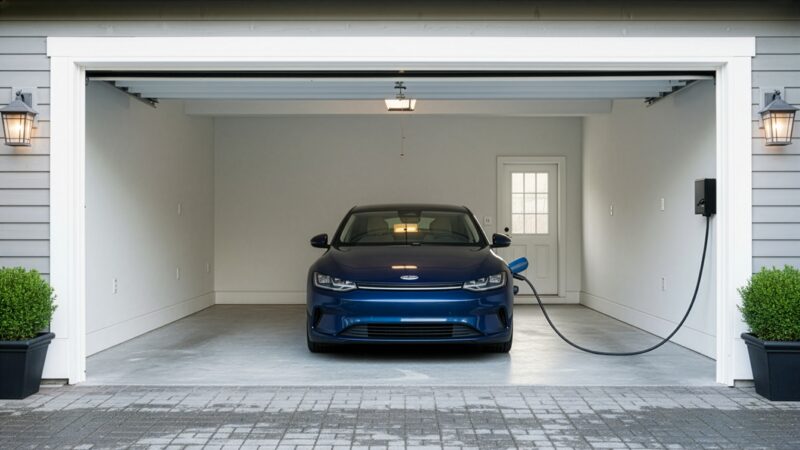
The power figures need reading carefully, because the two makers quote them differently. Wallbox states up to 22 kW for three-phase installations on the Pulsar Max, and a separate Wallbox page gives a charging speed of up to 22 kW9. Independent guidance for the same product gives charging power up to 7.4 kW2. The two are not in conflict: 22 kW is the three-phase ceiling, 7.4 kW is what a single-phase home gets.
The zappi follows the same pattern. The single-phase model offers a maximum charging speed of 7.4 kW and is compatible with a single-phase supply, while the three-phase model is quoted at up to 22 kW, vehicle dependent, and is aimed at properties with a three-phase supply such as workplaces, commercial buildings and some domestic sites3. The maker's support material puts the fast mode maximum at roughly 7.4 kW for a single-phase zappi and roughly 22 kW for a three-phase zappi11.
Independent guidance is clear that 22 kW at home requires a three-phase electricity supply12. For most UK households the realistic figure is 7.4 kW from either charger, and the three-phase option is a question about the property's supply rather than about the product.
| Wallbox Pulsar Max | myenergi zappi | |
|---|---|---|
| Single-phase power | 7.4 kW quoted2 | 7.4 kW maximum3 |
| Three-phase power | Up to 22 kW9 | Up to 22 kW, vehicle dependent3 |
| Charging mode | Mode 3 AC wallbox | Mode 36 |
| Standby consumption | Not stated in the available material | 3W6 |
| Mounting | Wall mount, pedestals sold separately13 | Indoor or outdoor14 |
How long charging actually takes
Charging time is a function of battery size and onboard charger, not of the wallbox badge. A wallbox delivers up to 11 kW alternating current on a three-phase supply, and its charging power is higher than from a conventional European power socket, shortening the charging times12. Standard chargepoints between 3.7 kW and 8 kW take five and a half to 11 hours for a full charge12.
At the more common 7 kW, guidance suggests roughly 30 miles of range per hour and a full charge in around 10 hours4. A plug-in hybrid charged from a 7 kW wallbox takes around three to five hours and works with regular use, though it needs setting up15.
The practical point for a household is that an overnight window is usually enough. A 7.4 kW charger running for seven or eight hours delivers a large share of a typical battery, which is why the single-phase figure matters more than the three-phase headline for most homes. Where a household has a short cheap-rate window, the charger's ability to schedule and to hold a set current becomes the useful feature rather than raw power.
Where the charger goes, and who fits it
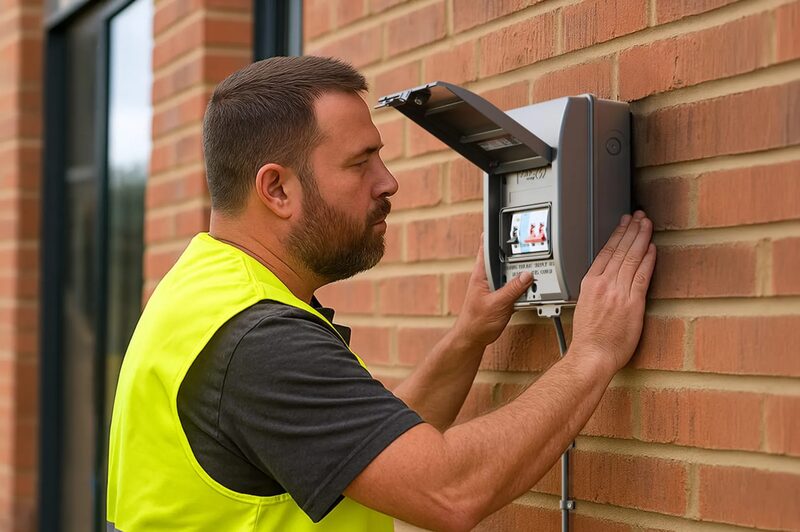
Both products are wall-mounted units, and both makers require professional installation. Wallbox states that smart chargers require professional installation and directs buyers to its installer partners1. Guidance on smart home charging is firmer still: stationary wallboxes must be installed by a qualified electrician to be safely connected to the power supply, and open protocols plus local control capability are recommended16. The NICEIC notes that home chargers are usually installed on the exterior of a home or garage17.
The zappi is listed by its maker as suitable for indoor or outdoor mounting14. Wallbox sells pedestals as an alternative to wall mounts for households wanting an outdoor charging station, in single or dual setups13. The black Pulsar Max bundle has been listed with a Wallbox load balancer device included and standard installation included5.
Installation standards are tightening. A 2026 consultation response from Citizens Advice called for stronger technical and professional frameworks for home upgrade work20. For a household, the practical consequence is that the installer's competence and the paperwork matter as much as the charger chosen.
Smart features, solar charging and energy management
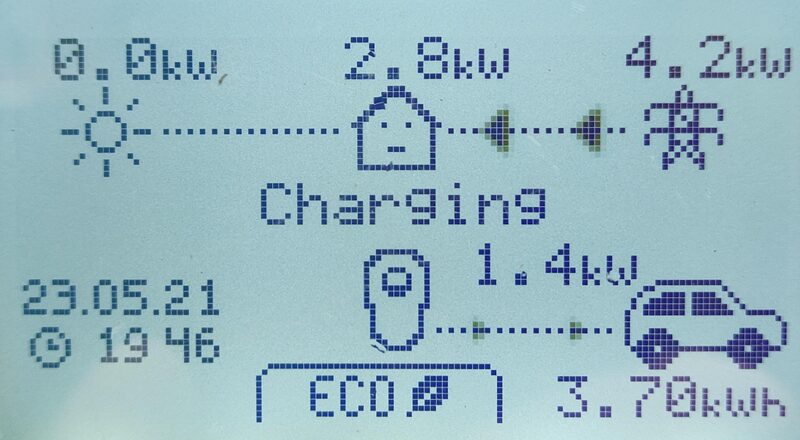
This is where the two products separate most clearly. The zappi is designed around balancing home energy, adjusting in real time to maximise efficiency and protect the grid, all from one app21. Its app allows switching to fast charging and monitoring devices22, and the charger can be integrated with smart energy tariffs, using timers or the boost function to schedule charging when electricity prices are lowest23. The maker also states that zappi chargers can integrate with a chosen energy tariff for lower cost overnight or off-peak charging24.
The Pulsar Max is a smart charger with a broad feature set rather than a solar-first design. The Wallbox app allows scheduling charging to take advantage of cheaper overnight tariffs, tracking energy usage, charging history and savings, starting or stopping charging remotely, and connecting with solar or home battery systems9. The app also provides advanced energy management features including solar charging and dynamic load management25. Dynamic load management on the Pulsar Max maximises charging speed while staying within the home's power limit, and requires a Wallbox power meter10.
Solar connection is an extra on the Wallbox side. The black Pulsar Max is listed as solar compatible with connection at additional cost5. Wallbox power meters are sold to enable solar EV charging18. Independent guidance for the Pulsar Max lists solar panel integration and built-in earthing among its features2.
"Enable solar EV charging"
Tariff compatibility differs too. Independent guidance states the Pulsar Max can make the most of the Intelligent tariff from Octopus, although it is not yet compatible with OVO's equivalent27. The zappi, by contrast, is available to purchase via OVO fully installed and fully integrated with OVO's Charge Anytime tariff26. That is a partnership difference rather than a technical limit, and it changes as suppliers sign new agreements.
For a household with solar, the zappi's real-time balancing is the more direct fit. For a household without solar, both chargers do the same core job, and the choice comes down to app preference, tariff partnerships and price.
UK availability, buying routes and price

Wallbox sells chargers and installation through its UK site and installer partners1. The Pulsar Max has been offered through E.ON Next with the E.ON Next Drive tariff and 24/7 support8. Wallbox has also stated that solar features are included at no additional cost for new Wallbox installations from 28 April 2025, with existing installations not eligible for an upgrade at that time.
Compliance with the UK smart charging regulations has moved on. Wallbox states that the Pulsar Max Revision C is fully compliant with the second part of the UK Smart Charging Regulations and needs no further action to be sold28. The same notice says some previous models may no longer be available in the UK, while the company will continue to service and support them28. Certified Wallbox partners can continue to sell Revision A by obtaining an Enforcement Undertaking through the partner portal28.
On price, the black Pulsar Max has been listed at £1,020 as an offer price, with standard installation included5. ScottishPower has advertised £50 off a Wallbox EV charger, available until 11.59pm on 3rd December29. Prices are otherwise installer-quoted and vary with cable run, earthing and any load management hardware.
The zappi's buying route is different. myenergi states that hundreds of trained zappi installers across the UK are ready to provide a quote, entered by postcode30. The charger is made in the UK24, and the maker offers UK-based technical support24. The zappi was voted Autotraders Best home charger 202526.
| Wallbox Pulsar Max | myenergi zappi | |
|---|---|---|
| UK buying route | Wallbox UK site, installer partners, E.ON Next1 | Postcode installer network30 |
| Listed price | £1,020 offer price, black, installation included5 | Installer-quoted |
| Manufacture | Not stated in the available material | Made in the UK24 |
| Support | 24/7 support via E.ON Next bundle8 | UK-based technical support24 |
| Smart charging compliance | Revision C fully compliant28 | Not stated in the available material |
What each charger means for household independence
Both chargers move a household's motoring fuel from forecourt to home supply, which is the main independence gain. Charging at home means the electricity comes through the household's own meter, on a tariff the household chooses, rather than through a public network with its own pricing. Neither charger removes dependence on the grid or on a supplier, and neither generates electricity.
The zappi's design leans further into self-sufficiency where solar or a battery exists, because it balances home energy in real time and can be paired with smart tariffs and the boost function21. The Pulsar Max can do solar charging too, but the connection is an additional-cost option and the solar features depend on Wallbox power meters5. Where a household has no solar, that difference largely disappears.
Both products also carry a dependence on the maker's cloud and app. The Wallbox App requires an online Pulsar charger connected by Wi-Fi or 4G, is not linked to OCPP, allows one charger per account, and works only with selected EV models supporting OEM app integration, with features varying by vehicle API25. That is a real limit: app-based features depend on the maker's servers and on the car's software, not only on the hardware on the wall.
For households weighing the two, the honest summary is that the Pulsar Max is a compact smart charger with a strong app and a clear UK compliance position, while the zappi is a solar-first charger made in the UK with a tariff partnership and a postcode-based installer network. Neither is a recommendation, and the right answer depends on the property's supply, the presence of solar, and the tariff available.
Sources30 cited
- Wallbox UK, Wallbox, 2026
- Home electric vehicle chargers, Carwow, 2024
- zappi product page, myenergi, 2026
- Electric car charging guide, Carwow, 2025
- Best EV tariffs for multi-car families, Uswitch, 2025
- zappi Multiphase Datasheet, myenergi, 2024
- Does a hybrid car need an EV tariff?, Uswitch, 2025
- What's new in the second part of the UK Smart Charging Regulation, Wallbox, 2026
- Top reasons to choose the Pulsar Max, Wallbox, 2026
- Pulsar Max EV charger socket, Wallbox, 2026
- Wallbox App, Wallbox, 2026
- Charging electric vehicles, Energy Saving Trust, 2026
- Accessories for your electric vehicle, Wallbox, 2026
- Citizens Advice response to DESNZ consultation, Citizens Advice, 2026
- EV charger installation and maintenance, NICEIC, 2025
- Accessories for your electric vehicle, Wallbox, 2026
- EV charger in a smart home, go-e, 2026
- myenergi and OVO EV charging partnership, myenergi, 2026
- zappi EV charger, myenergi, 2026
- Battery storage, Energy Saving Trust, 2026
- The myenergi app, myenergi, 2026
- Cinch your home charging with myenergi, myenergi, 2026
- What are the zappi charging modes, myenergi, 2026
- Our chargers, myenergi, 2026
- Powering EV charging with Wallbox and E.ON Next, Wallbox, 2026
- zappi, Power NI, 2026
- What is the lifetime cost of an electric vehicle?, Uswitch, 2026
- EV bundle, ScottishPower, 2026
- zappi Extended Warranty, myenergi, 2026
- Electric car charger home installation UK, myenergi, 2026
 Comparing Specs Like for LikeTwo solar panels or heat pumps can look different on paper even when they do the same job.
 Solar InvertersWhat does the box on the wall next to your solar panels do, and how long will it last?
 The Full EV Charging GuideCharging an electric car at home usually means a wallbox, but do you need one, and what will it cost to fit and run?
 Home EV Charger ManufacturersWhich home EV charger brands are worth considering, and how do you choose between them?
 Types of Home EV ChargerWhich home charger suits your car and your driveway?
 Solar Cell TechnologyBuying solar panels means choosing between cell types that work in different ways.