
In this guide
Wallbox is a maker of home EV chargers, energy management hardware and accessories, sold in the UK through the company's own site and a network of installer partners. Its domestic range covers the Pulsar family of wallboxes, the Copper SB, the Commander 2 and the Quasar 2 bidirectional charger, alongside power meters, cable holders, charging cables and a payment terminal for shared sites1. The company states it has sold more than 1.5 million chargers and that its equipment has avoided 2.6 million tons of CO2, calculated on an average consumption of 18 kWh per 100 km1.
For a household, a Wallbox charger is the piece of kit that turns a driveway or garage wall into a dedicated charging point. Wallbox recommends Level 2 (Mode 3) charging for use at home, which is the standard AC wallbox arrangement rather than a domestic socket2. The practical gain over a three-pin plug is speed: a 3-pin connector supports AC charging at approximately 2.3kW, while a single-phase home wallbox typically runs at around 7kW and a three-phase unit can go higher3.
The range's independence story is mixed, and worth stating plainly. A wallbox draws from the grid, so it does not reduce a household's reliance on a supplier. What it can do is shift when that electricity is drawn, and where it comes from: paired with a Wallbox power meter, the charger can take surplus solar generation instead of exporting it, and the app allows charging to be locked, unlocked and scheduled5. The dependence that remains is on the grid, on a broadband connection for remote features, and on the maker's app and servers.
Charging power: 7kW at home, up to 22kW on three-phase
The headline number for a UK home wallbox is around 7kW on a single-phase supply. Wallbox's own Pulsar Max is listed at up to 7.4kW charging power, which is the practical ceiling for most domestic installations7. Above that, the constraint is the electricity supply rather than the charger: chargers delivering up to 22kW can be installed at home, but this requires a three-phase electricity supply, which most homes do not have4.
Where three-phase is available, the circuit itself has to match. A three-phase 11kW or 22kW installation requires a three-phase supply and a 16A or 32A three-phase circuit9. Wallbox's energy management pages describe full three-phase charging up to 22kW with grid power10. The gap between 7kW and 22kW is therefore a property of the house, not of the box on the wall.
The comparison that matters most to a household is against the alternatives. A 3-pin connector supports AC charging at approximately 2.3kW3. Mode 3 charging, the standard a wallbox uses, covers single- or three-phase AC up to 50kW across the category, though domestic units sit far below that ceiling11. For a driver covering typical daily mileage, the difference between 2.3kW and 7kW is the difference between an overnight top-up and a charge that takes more than a day.
What this means for independence is limited but real. A faster charger does not reduce reliance on the grid, but it makes it practical to charge inside a cheap overnight window or a sunny midday period rather than leaving the car plugged in for long stretches. That flexibility is the point at which a wallbox starts to interact with EV energy tariffs and how they change home charging and with EV charging speeds and times.
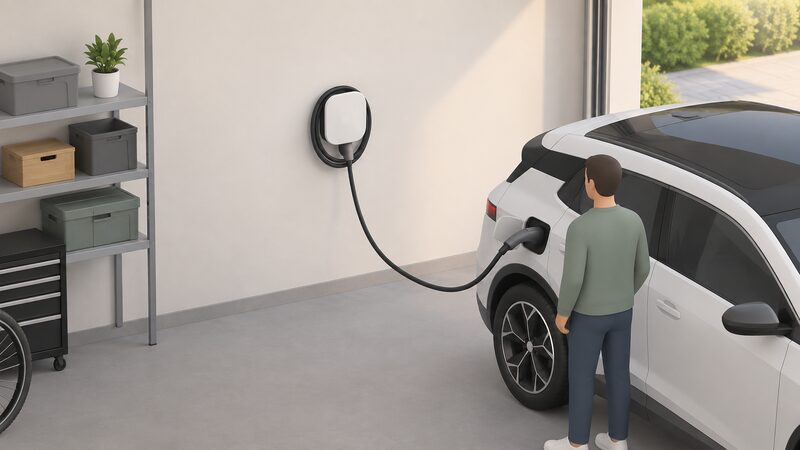
Pulsar Plus and the Wallbox range: chargers, meters, app and accessories
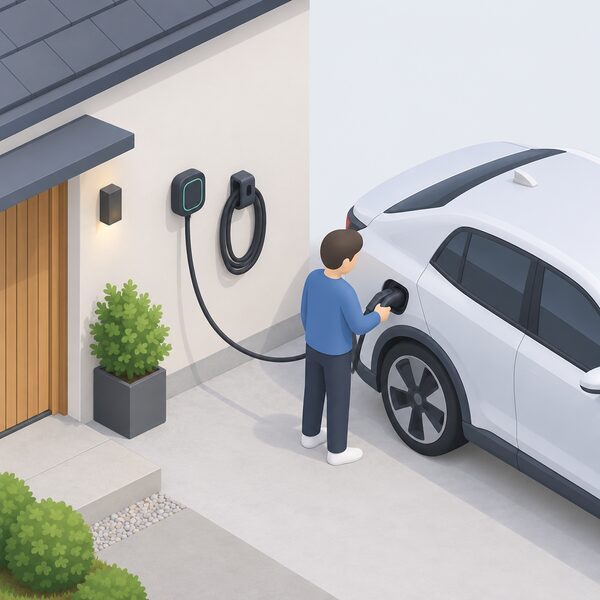
Wallbox organises its products into five groups: chargers, energy management, the Wallbox app, services and accessories5. The Pulsar Plus sits in the charger group and is offered with two cable types, described by the maker as compact for tight spaces6. The Pulsar Max is the model with the most published detail in UK-facing material: up to 7.4kW charging power, a 5m integrated charging cable, Wi-Fi and Bluetooth connectivity, Type 1 and Type 2 readiness, and solar panel integration7.
The Quasar 2 is the bidirectional line, and its energy management features require three things together: a Wallbox power meter, the Wallbox app and a Wallbox charger10. That is the clearest statement of how the ecosystem fits together, and it applies across the solar and energy management functions rather than to the Quasar alone.
| Product | Type | Key published figures |
|---|---|---|
| Pulsar Plus | Home wallbox | Two cable types, compact for tight spaces6 |
| Pulsar Max | Home wallbox | Up to 7.4kW, 5m integrated cable, Wi-Fi and Bluetooth7 |
| Pulsar Max Black | Home wallbox | Wi-Fi and Bluetooth, tethered Type 2 socket, load balancer included13 |
| Copper SB | Home wallbox | Compatible with Wallbox charging cables14 |
| Quasar 2 | Bidirectional | Needs power meter, app and charger together10 |
| Power meter | Energy management | Enables solar EV charging14 |
Accessories fill out the range. Cable holders and docks are compatible with all Wallbox chargers and come in black or white14. Charging cables are sold separately in 5m or 7m lengths with Type 1 (single phase) or Type 2 (three phase) connectors, compatible with the Copper SB and third party chargers14. RFID cards, used for access control, are compatible with the Pulsar Pro, Commander 2, Copper SB, Quasar 2 and eM4, and come in packs of 10, 25 or 5016. A payment terminal for shared sites includes electrical protections and LTE connectivity, with one terminal shared between all chargers15.
The app is the control layer. It can lock and unlock the charger, and a ready-by feature is available for the Pulsar Max, Pulsar Pro and Pulsar Plus NA with the latest software2. For households weighing how much of the system depends on the maker, EV charger apps, Wi-Fi, 4G and firmware sets out the wider picture.
Type 2 connector and what the charger's lights tell you
Type 2 is the connector that matters for home charging. It is the main connector for lower-powered AC charging, and home and slower chargers around 7kW use Type 2 connectors, while rapid chargers almost always use CCS plugs18. Wallbox's own cables are offered with Type 1 (single phase) or Type 2 (three phase) connectors, and the Pulsar Max Black is listed with a tethered Type 2 socket15. Cable holders and docks are designed for both Type 1 and Type 2 connectors14.
The practical consequence is that a Wallbox charger bought in the UK will normally be specified with a Type 2 connection, tethered or untethered depending on the model. EV connectors and cables covers the differences between tethered and untethered arrangements in more detail.
On the charger's indicator light, the published Wallbox material reviewed here does not set out a colour code. What the maker does publish is the colour choice for its cable holders and docks, which come in black or white15. A householder trying to interpret a specific light sequence should treat the maker's own support documentation as the authority, since a status light can indicate power, connection, charging or fault states depending on the model and firmware.
Solar EV charging with Wallbox power meters
The Wallbox power meter is the component that turns a wallbox into a solar-aware charger. Wallbox states that its power meters enable solar EV charging, and the Quasar 2's energy management features require the power meter, the app and a Wallbox charger together14. The Pulsar Max is separately listed with solar panel integration7.
What the meter does is measure the home's consumption and generation so the charger can respond to it. Wallbox's Power Boost function adjusts EV charging speeds based on home power use, which prevents fuse issues and avoids costly electrical upgrades6. That is load management rather than solar diversion, but the two functions sit on the same hardware and the same measurement.
For a household with panels, the appeal is straightforward: charging from surplus generation uses electricity the home has already produced, rather than exporting it and buying it back later. The Chartered Institute of Plumbing and Heating Engineering notes that EV chargers should be installed by a qualified electrician with relevant experience, and that compatibility between the charger, solar system and any battery storage should be considered from the outset20. That last point matters, because retrofitting a charger into an existing solar and battery setup is more constrained than designing the two together.
The limits are worth stating. Solar charging depends on the sun, on the size of the array and on the car being at home when generation peaks. A power meter does not store anything; it only directs. Households wanting to hold surplus for evening charging need a battery, and EV charging alongside a home battery covers how that pairing works. Charging an EV from solar panels sets out the wider economics.
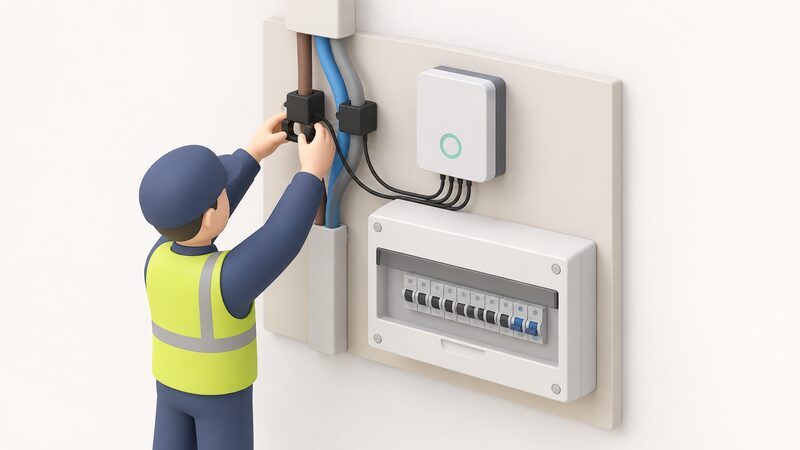
Installation: where it goes and why a professional is required
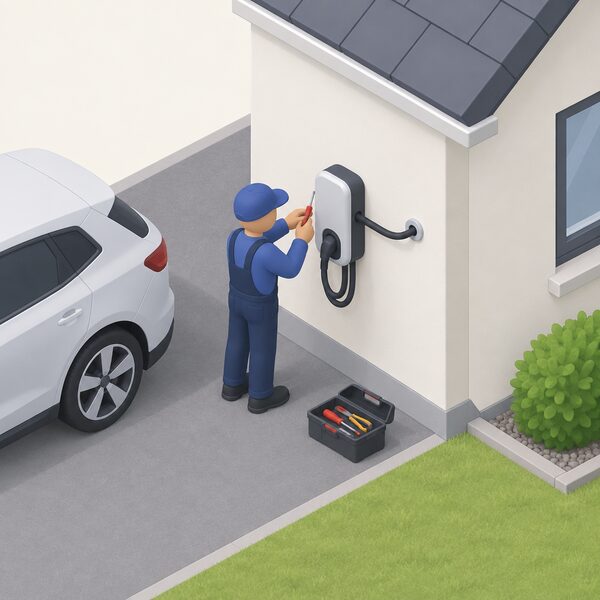
Home chargers are usually installed on the exterior of a home or garage21. Wallbox sells pedestals as an alternative to wall mounts for households wanting an outdoor charging station, and its condominium offer includes cable management accessories and pedestals for free-standing installations14. That covers the common cases: a garage wall, an outside wall beside a driveway, or a post at the edge of a parking space.
The installation itself is not a DIY job. Wallbox states that smart chargers require professional installation1. Independent guidance is consistent: EV charger installation should always be done by a qualified and certified electrician, and households should hire an electrician registered with a recognised certification body such as NICEIC22. NICEIC adds that EV chargers should be installed by a registered electrician with experience in this type of installation23. The same body notes that any work relating to the installation, replacement or repair of a consumer unit is a job for a registered electrician24.
The reason is not just the charger. A wallbox adds a continuous high load to a domestic supply, and the circuit protection, earthing and cable sizing all have to be right. Wallbox's own Power Boost exists precisely because adding a charger can otherwise push a supply towards its limits and trigger the cost of an upgrade6. Electrical requirements for a home EV charge point and home EV charge point installation cover the detail.
Using a Wallbox charger in the UK: availability, partners and equiwatt
Wallbox sells chargers and installation in the UK through its own site and installer partners1. The Pulsar Plus is listed among the top smart chargers in the UK in independent guidance, alongside the MyEnergi Zappi and the EO Mini Pro25. That is a market position rather than a performance claim, but it indicates the model is widely available and recognised.
The UK-specific feature that matters most for flexibility is the equiwatt connection. Wallbox chargers can be connected to the equiwatt app, which lets a household take part in equivents automatically and avoid charging when electricity is dirty and expensive26. The setup requires a smart meter sending half-hourly readings to be connected to the equiwatt account first, then the charger model and serial number are entered in the app26. Once linked, the charger responds to grid events without the driver intervening.
There is also a commercial route through energy suppliers. Scottish Power has offered a £50 discount on a Wallbox EV charger, available until 11.59pm on 3rd December, and bundles the charger with its EV tariff arrangements27. Offers of this kind change, and the terms sit with the supplier rather than the maker.
For households without a driveway, the picture is different. On-street charging is a separate infrastructure question, and charging an EV without a driveway covers the options. Smart charging, flexibility services and reward schemes explains how schemes like equiwatt fit into the wider flexibility market.
Wallbox as a company: scale, listing and recognition
Wallbox reports more than 1.5 million chargers sold and 2.6 million tons of CO2 avoided, calculated on an average consumption of 18 kWh per 100 km1. It was named in Fast Company's Most Innovative Companies list for 20231. These are the maker's own figures and its own award citation, so they describe the company's scale rather than the performance of any individual charger.
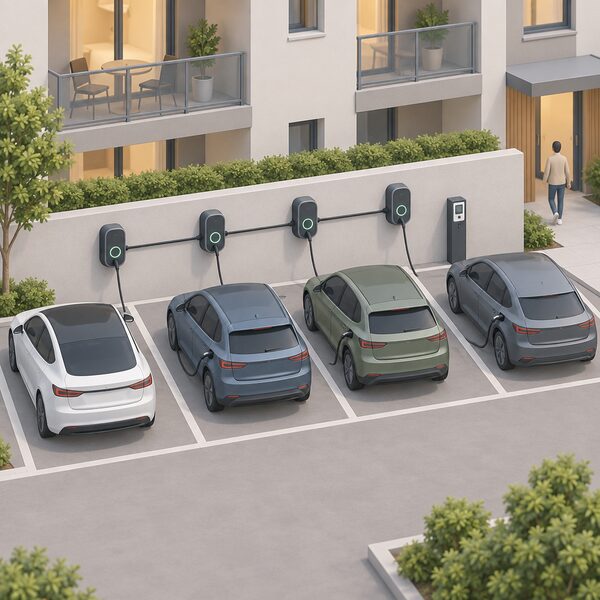
The company sells into several markets beyond the single-family home. Its Business Portal targets condominiums and multi-unit dwellings, with a network of certified installers for project planning and execution19. Its power meters are described as letting a household charge multiple vehicles without compromise15. For sites with several chargers, a payment terminal can be shared between all of them, and Pulsar Max units can be linked, up to four at once, with power distributed across the connected units15.
That multi-unit capability is the part of the range most relevant to flats and shared buildings. EV charging by home type and the Electric Vehicle Chargepoint Grant for renters and flat owners cover the grant and building context.
One product status point is worth flagging. A UK trade listing for the Pulsar Max Black, model reference PLP2-0-2-2-F-002C, states that the charger is discontinued28. That is a distributor's page rather than a maker announcement, so it reflects one seller's stock position rather than the withdrawal of the model line. Buyers looking for that specific variant should confirm availability before ordering.
Where a Wallbox charger has limits
The dependence a Wallbox charger creates is worth setting out as clearly as its benefits. The charger draws from the grid, so it does not make a household self-sufficient; it changes when and how quickly electricity is drawn. Remote features depend on a home broadband connection, the maker's app and the maker's servers, and the equiwatt connection depends on a smart meter sending half-hourly readings and on a third-party platform26. Solar charging depends on a power meter being fitted and on the sun14.
Installation depends on a qualified electrician, and the maker's own guidance routes buyers through its installer partners1. The charger's capability also depends on the house: 22kW needs a three-phase supply that most homes do not have4. And the ecosystem functions depend on buying into the maker's own hardware, since the Quasar 2's energy management requires a Wallbox power meter, the Wallbox app and a Wallbox charger together10.
None of that is unusual for a smart charger, and the same pattern applies across the market. What is a smart EV charger and how does it work and EV charging and household energy independence set out what a household can and cannot expect from a wallbox in independence terms. For the bidirectional line specifically, Wallbox Quasar 2 covers the vehicle-to-home specification, and vehicle-to-grid and vehicle-to-home charging in the UK explains the regulatory position.
Sources28 cited
- Wallbox UK home page, Wallbox, 2026
- The Wallbox app, Wallbox, 2026
- EV connector types, Zapmap, 2026
- Electric car charging guide, Carwow, 2025
- Home EV charging, Wallbox, 2026
- EV charging 101, Wallbox, 2026
- What is the lifetime cost of an electric vehicle?, Uswitch, 2024
- Home electric vehicle chargers, Carwow, 2026
- Section 722 EV charging complete guide, Elec-Mate, 2026
- Home energy management, Wallbox, 2026
- BEAMA guide to electric vehicle infrastructure, BEAMA, 2024
- EV charging 101, Wallbox, 2026
- Wallbox Pulsar Max Black listing, Trade Sparky, 2026
- Wallbox accessories, Wallbox, 2026
- Wallbox accessories, Wallbox, 2026
- Wallbox accessories, Wallbox, 2026
- Wallbox accessories, Wallbox, 2026
- Guide to EV charging, Zapmap, 2026
- Condominium EV charging, Wallbox, 2026
- Can solar panels charge electric cars?, Chartered Institute of Plumbing and Heating Engineering, 2026
- Electric vehicle charger installation and maintenance, NICEIC, 2025
- EV charger regulations in England, NICEIC, 2026
- EV charging, Uswitch, 2026
- Consumer units and fuse boxes, NICEIC, 2025
- Best EV tariffs for multi-car families, Uswitch, 2025
- Connecting your Wallbox charger to equiwatt, equiwatt, 2026
- EV bundle, ScottishPower, 2026
- On-street charging, Zapmap, 2025
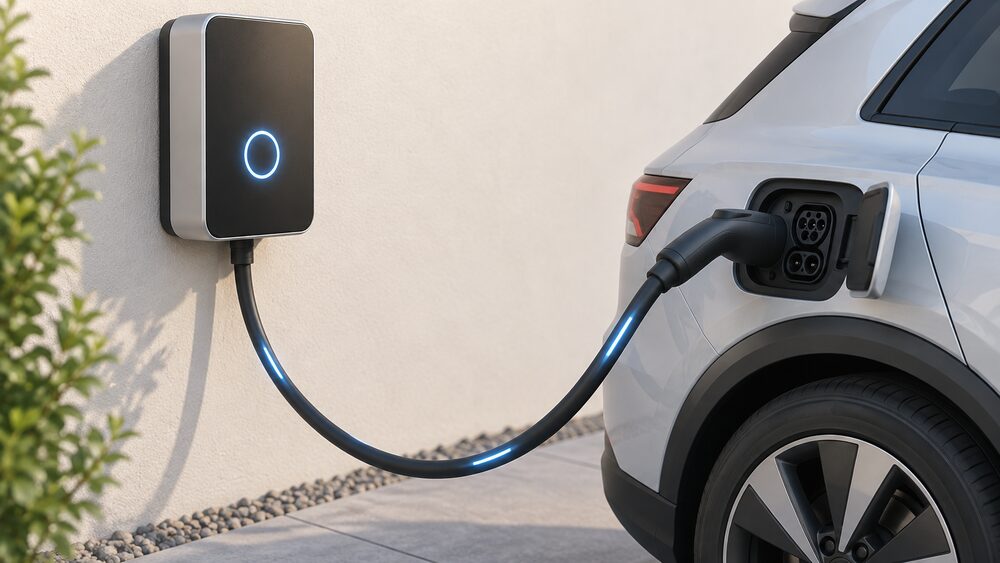 Wallbox Quasar Bidirectional ChargerThe Wallbox Quasar is the best-known domestic bidirectional charger by name, but UK availability is limited and the technology is still being trialled.
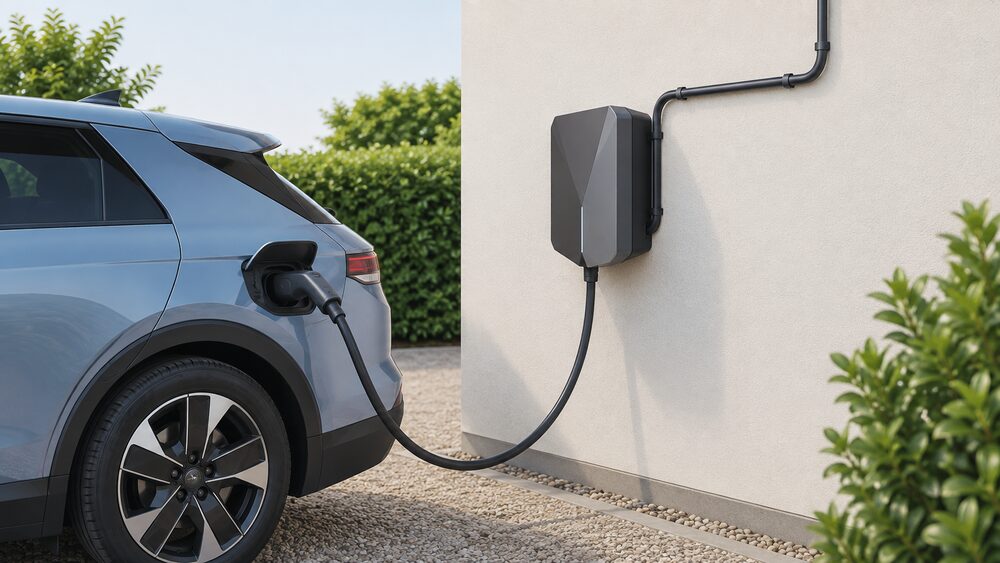 Wallbox Quasar 2The Wallbox Quasar 2 lets you run your home off your electric car and send power back to the grid.