
In this answer
Short answer
For most households the honest answer is that an existing home charger cannot be turned into a vehicle-to-grid (V2G) unit. V2G needs hardware that both draws power and exports it, and the Centre for Sustainable Energy states plainly that your EV and EV charger will need to be bidirectional charging compatible1. A standard unidirectional wallbox has no export path, whatever the car can do.
The exception is a charger designed with an upgrade route. Simpson & Partners states that its chargers are V2G upgradable through a simple expansion module, allowing energy to be exported back, and that they can be upgraded for emerging technologies like V2G because they are repairable2. That is a maker's claim about its own product, and it is the only retrofit path in the current UK market.
Everything else has to line up too. Uswitch lists three requirements for V2G: a smart meter, a compatible V2G charger and a car that supports the technology, and notes that V2G is still not widely available3. The network connection is a separate hurdle, and the money is modest: Cenex reports average UK revenue generation from V2G estimated at £150 to £200 per year4.
What V2G adds to a home charger
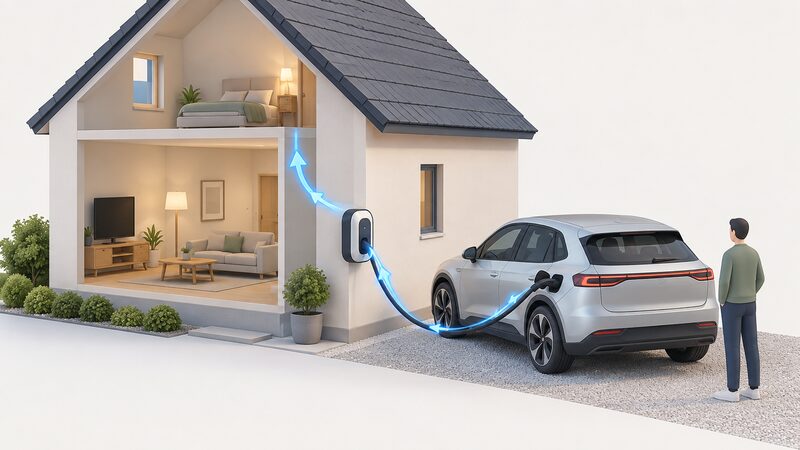
A V2G enabled chargepoint is able to draw power to charge the vehicle and export the electricity from the car battery back to the home or the grid, according to official guidance6. That single sentence describes the whole difference between a conventional wallbox and a bidirectional one: the direction of flow is reversible, and the car battery becomes a controllable store rather than a load.
In practice the added functions are peak shaving and dispatch into flexibility markets. Sigenergy describes its EV-HomeEnergyBridge module as providing V2G peak shaving and VPP dispatch7. Peak shaving means the home or the network draws from the car at times of high demand rather than from the grid; VPP dispatch means the car's battery is aggregated with others and instructed by a virtual power plant operator.
The physical connector does not change. Home chargers are available either with a tethered Type 1 or Type 2 cable, which can be plugged straight into the car, or with a Type 2 socket for use with the vehicle's charging cable8. A V2G unit uses the same Type 2 interface, which is why the retrofit question is about electronics and firmware rather than about plugs.
What V2G does not add is independence from the network. The car still charges from the grid, and the export still depends on a connection agreement and, in most cases, a supplier or aggregator paying for the service. It shifts when energy is bought and sold, not whether it is.
Can an existing charger be upgraded, or is a new one needed

For the great majority of installed chargers, a new unit is needed. The export function depends on hardware inside the charger, and a wallbox built only to rectify alternating current into direct current for the car has no inverter path back. Nothing in the current UK guidance suggests a firmware update can create that capability.
The electrical supply is often the harder constraint. Installing a home EV charger typically requires a fuse upgrade to 80 to 100 amps, which often cannot be done on a looped supply without overloading the shared cable9. A looped service is where one cable from the network is shared between neighbouring properties, and Northern Ireland Networks sets out the problem directly9. Where the supply needs upgrading, SP Energy Networks states that the work must be completed before the EV charger is installed10.
The installer's assessment comes first. Which? advises that the installer of your EV charger should assess the maximum load of your property, and that if charging would exceed the circuit breaker rating or service cable capacity, the energy network operator should be consulted and will need to upgrade the supply if it cannot cope5. Adding export on top of charging does not reduce that demand; it adds a second mode of operation to the same connection.
There is also a notification step. Electricity North West states that chargers must be type tested to G98 specifications to be eligible for connect and notify11. A retrofit that changes the export behaviour of a device may take it outside its original type test, which is a question for the installer and the network operator rather than something a household can settle alone.
Upgradable chargers: the expansion module route
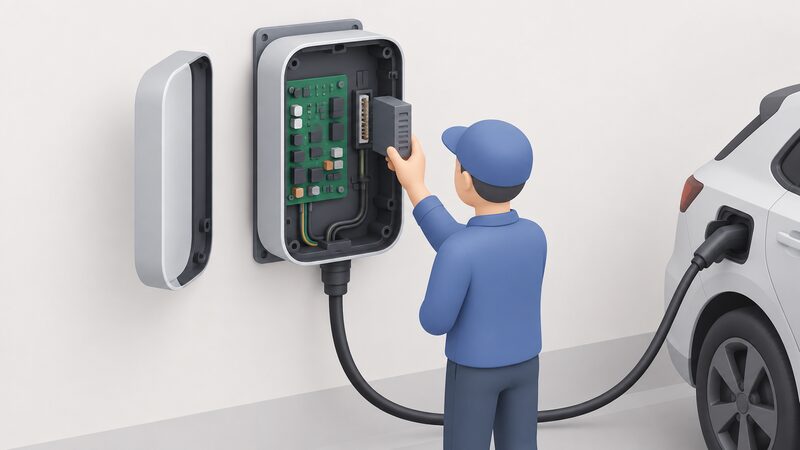
One UK maker has built its range around the retrofit idea. Simpson & Partners states that its chargers are V2G upgradable through a simple expansion module, allowing energy to be exported back2. Its support material adds that the chargers can be upgraded for emerging technologies like V2G, and that because they are repairable they can take a latest circuit board swap rather than being replaced12.
That is a meaningful difference for a household that has already paid for an installation. The alternative is to remove a working wallbox and buy a bidirectional unit, which means paying for hardware twice and for a second installation. The expansion module route keeps the mounting, the cable run and the existing circuit in place.
Two cautions apply. First, this is the maker's own description of its own product, and no independent test of the upgrade path appears in the current evidence. Second, an upgrade still has to satisfy the network operator: the G98 type test requirement applies to chargers with vehicle-to-grid capability, and an upgraded unit has to remain within whatever the original notification covered11.
The wider charger market is not standing still on expandability, but in a different direction. Go-e notes that dual chargers are self-contained units, and that if a household wanted to expand to handle a third or even fourth EV, adding another charge point may be better than replacing the existing one13. That is about adding capacity for more cars, not about adding export, and the two should not be confused.
What your car and electricity tariff must also support
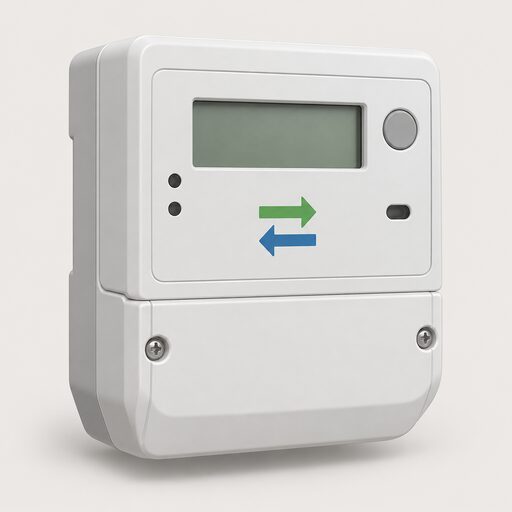
The charger is one link in a chain of three. Uswitch states that to use V2G you need a smart meter, a compatible V2G charger and a car that supports the technology3. The car requirement is the one a household cannot work around: the battery management system has to accept a controlled discharge, and that is a manufacturer decision taken when the vehicle is designed.
The tariff side has its own conditions. Most electric vehicle tariffs require a smart meter, as well as an electric vehicle charger14, and Uswitch notes that you must own or lease an EV vehicle to take one15. Some products are structured differently: Type of Use tariffs are add-ons to an existing energy tariff, and require a compatible home charger and a working smart meter16.
Installation itself has baseline requirements that apply whether or not V2G is involved. Uswitch lists a Wi-Fi connection, ownership of the property or the landlord's permission, and off-street parking in the form of a driveway or garage17. Without off-street parking the whole home-charging route changes, and V2G is not available at all.
The scale of what this could add up to nationally is set out by Ofgem, which models that if 50 per cent of 2030 electric vehicles were V2G enabled, this would open up 22 TWh of flexible EV discharging capacity per year18. That is a system-level figure, not a household one, but it explains why network operators and regulators are pushing the technology while domestic products remain thin on the ground.
Costs, grants and installation to plan for

A conventional installation sets the baseline. Which? reports that it now typically costs between £500 and £1,200 to buy and install a home EV charger, and that for most households 7kW chargers are a good choice and cost around £900 to buy and install5. Prices are installer-quoted, and UK Power Networks states that it is unable to provide an exact price or time frame online because both are determined by the specific work required19.
The V2G premium is the number that decides whether an upgrade is worth considering. The V2G Britain report suggests that the premium over an equivalent smart charger is expected to reduce to between £656 and £1,164 by 20301, and the same work projects a premium of around £650 to £1,150 in 2030 from top-down and bottom-up cost modelling20. Both figures are projections, not current prices, and no published UK retail price for a domestic V2G charger appears in the evidence.
Grant support is limited and has narrowed. Uswitch reports that landlords and flat tenants are eligible for a government grant of up to £350 for home EV chargers, reducing the installation cost to as low as £65021. That grant is aimed at the charger, not specifically at bidirectional hardware, and eligibility rules should be checked before any work is quoted.
What V2G means for household energy independence
The Committee on Climate Change defines V2X as allowing electric vehicles to operate bidirectionally, charging from the electricity grid but also discharging to the grid, building or home as needed22. Energy Networks Association describes V2G as allowing electric vehicles not only to draw power from the grid to charge their batteries but also to send electricity back to the grid when needed, generating cash for the EV owner23. Uswitch's glossary puts it in household terms: using your EV's battery to release power back through the charger either for use in the building it is connected to or back into the grid in general24.
What that buys a household is optionality rather than autonomy. The car becomes a store that can serve the building during a power cut, in the vehicle-to-home case, and can earn from the network at times of high demand. Uswitch notes that vehicle-to-home can provide backup power from your EV to your home during power outages and support off-grid setups, though it is limited to certain EV models and compatible chargers3.
The dependence that remains is substantial. The car still charges from the grid, the export still needs a network connection and a paying counterparty, and the whole arrangement rests on a manufacturer's software, a charger maker's firmware and an app. The Society of Motor Manufacturers and Traders frames the direction of travel as allowing EVs to not only draw energy from the grid but also return it when needed25, and the Energy Saving Trust describes V2G as allowing energy stored in the vehicle's battery to be exported to the grid during periods of high demand26. Electricity North West states the same function in its own guidance27.
The revenue evidence is where the case gets harder. Cenex reports average UK revenue generation from V2G estimated at £150 to £200 per year4. Its V2G Britain modelling suggests a 7kW V2G charger could achieve annual revenues of around £436 above smart charging for a high plug-in rate archetype20, but also finds that when grid services are included, smart charging captures 40 per cent of the total value of V2G for low plug-in scenarios, or merely 10 per cent for high plug-in cases20. In other words, the more often a household plugs in, the less of the V2G value is left for the V2G hardware to capture.
There is a property angle too. A study of over five million existing homes found EV charging points associated with a £5,400 to £7,400 increase in home value, or 2.0 to 2.75 per cent28. That figure covers charging points generally, not V2G units specifically, and should be read as context rather than as a return on a bidirectional upgrade.
For a household weighing the retrofit, the practical position is this: if the existing charger is an upgradable model, the expansion module route avoids paying twice for installation, and the decision then turns on the car, the smart meter and whether the household plugs in often enough for the modelled revenues to matter. If the existing charger is not upgradable, the choice is a new bidirectional unit at a projected premium of roughly £650 to £1,150 over a smart charger, against revenues that independent modelling puts between £150 and £436 a year depending on usage4.
Sources28 cited
- An introduction to vehicle-to-grid charging for electric vehicles, Cenex, 2026
- How to choose the right EV charger for your home, Simpson & Partners, 2026
- Vehicle-to-grid charging guide, Uswitch, 2025
- More than money: finding the true power of V2G, Cenex, 2026
- Electric car charging at home, Which?, 2026
- Register energy devices in homes or small businesses, GOV.UK, 2021
- SigenStor, Sigenergy, 2026
- Home charging, Zapmap, 2025
- Looped services, Northern Ireland Networks, 2026
- EV connections, SP Energy Networks, 2026
- EV connections, Electricity North West, 2026
- FAQs, Simpson & Partners, 2026
- Dual EV chargers, E.ON Next, 2026
- How to choose the best energy company, Which?, 2026
- Electric cars and energy bills, Uswitch, 2026
- EV energy tariffs, Zapmap, 2024
- EV charger home installation process, Uswitch, 2022
- Case study: UK hydrogen heated homes, Ofgem, 2030
- Electric vehicles: cost, time and what's involved, UK Power Networks, 2026
- V2GB: Vehicle to Grid Britain, Cenex, 2030
- EV charging statistics, Uswitch, 2025
- Well-adapted energy system, Climate Change Committee, 2026
- Connecting to the networks: LCT strategy, Energy Networks Association, 2026
- EV glossary, Uswitch, 2024
- Toyota to expand EV charging ecosystem across the UK, Society of Motor Manufacturers and Traders, 2025
- Five electric vehicle innovations to watch, Energy Saving Trust, 2026
- Storage, Electricity North West, 2026
- Watt a Save, Home Builders Federation, 2026
 Grid Connection Rules for V2GCan your charger send power back to the grid?
 Charger Apps and ConnectivityHow a home charge point connects: Wi-Fi, Ethernet, 4G and Bluetooth, what the app controls, what happens when the network drops, and how much of the charger depends on the maker's cloud.
 Charging With a Home BatteryHow a home battery and an EV charger share one supply, whether a battery can usefully charge a car, and how combined systems are controlled so the battery is not discharged into the vehicle at a loss.
 Charging Without a DrivewayParking on the street makes charging an electric car at home tricky.
 Bidirectional Charging StandardsDoes your electric car and charger actually support sending power back to your home or the grid?
 Charging and Energy IndependenceCharging an electric car at home can cut your fuel costs, but how much does it really free you from the grid?