

In this guide
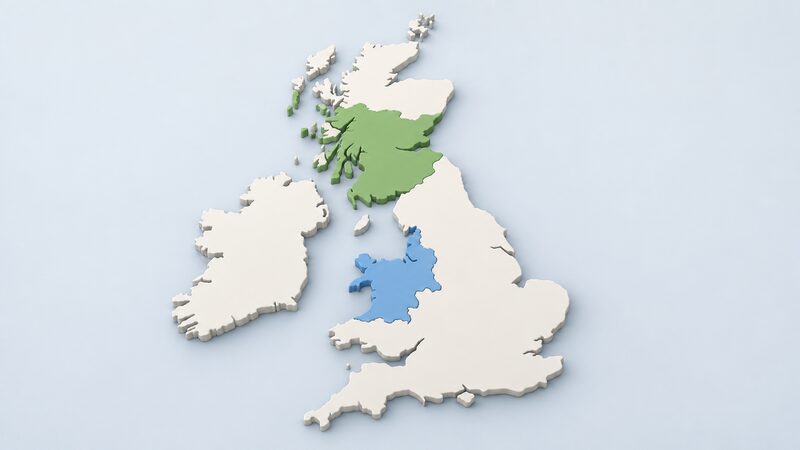
SP Energy Networks is the electricity distribution network operator for two licence areas: Cheshire, Merseyside and North Wales under distributor ID 13, and southern Scotland under ID 181. It owns and operates the cables and substations that carry power from the national transmission network to homes and businesses, and it is responsible for maintaining the physical electricity supply to a property2. It does not sell electricity: that is done by the retailer whose name appears on the bill2.
The distinction matters commercially. A household in central Scotland or Merseyside with a power cut, a connection query or a meter move deals with SP Energy Networks, while anything to do with billing, tariffs or credit sits with the supplier3. The two roles are separate companies and separate complaint routes.
For a household weighing its own energy independence, the network operator is the part of the system it cannot choose or replace. A solar array and battery reduce the units drawn through SP Energy Networks, but the connection itself, the fuse, the meter position and the right to export all run through the operator. This page sets out the areas covered, the contact routes, the published guide prices for moving a meter, the notification rules for EV chargers and solar, and where the limits of household control sit.
Licence areas 13 and 18: which one covers your home
SP Energy Networks holds two of the fourteen electricity distribution licence areas in Great Britain. Area 13 covers Cheshire, Merseyside and Northern Wales; area 18 covers southern Scotland1. Independent supplier guidance describes the same footprint in slightly different words, listing Merseyside, Cheshire, Shropshire and north Wales for the southern area6, and Merseyside, Cheshire, North Shropshire and North Wales elsewhere7. The Shropshire reference reflects the western edge of the Merseyside and North Wales area rather than a separate licence.
The Scottish boundary is the one households most often get wrong. SP Energy Networks covers central and southern Scotland; northern Scotland is served by Scottish and Southern Electricity Networks under ID 171. A household in Glasgow, Edinburgh or Ayrshire is in area 18. A household in Inverness, Aberdeen or the Highlands is in area 17 and deals with a different operator entirely.
Wales is split in the same way. Two network operators cover Wales: SP Energy Networks in the north and National Grid in the south8. A property in Wrexham or Bangor sits with SP Energy Networks; one in Cardiff or Swansea does not.
The way to confirm which area applies is the MPAN, the supply number on the electricity bill. It is 21 digits long and begins with the letter S7. The first two digits are the distributor ID, which runs from 10 to 28 and identifies the network operator9. Reading those two digits settles whether the property is in area 13 or area 18. The Energy Networks Association also runs a postcode lookup that identifies the operator for an address2.
What a Distribution Network Operator does for your supply
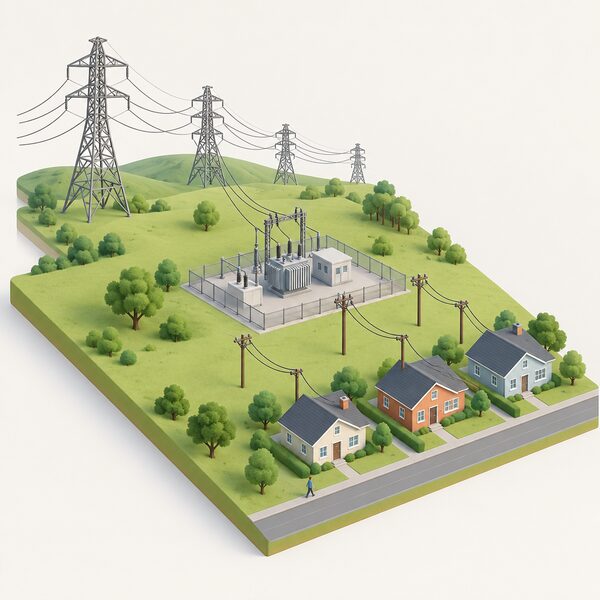
A distribution network operator owns and operates the infrastructure that delivers power to a property10. That means the towers and cables bringing electricity from the national transmission network down to homes and businesses, and the local substations and service cables beyond them2. The operator is responsible for maintaining the physical electricity supply to a home or business2.
What it does not do is sell electricity. Supply is the retailer's business, and the retailer's name is the one on the bill2. That split produces the single most common confusion in this area: a household with a fault, a power cut or a connection question has no commercial relationship with SP Energy Networks at all, yet SP Energy Networks is the organisation that has to act.
For a household, the practical consequences are these. The fuse and the service cable belong to the network, not the occupier. Work that alters the position of a meter or the point at which supply enters the property needs the operator's involvement. A new or upgraded connection is an operator process, not a supplier one. And when supply fails, the operator is the body that restores it, regardless of who bills the household.
The independence question follows directly. A home with solar panels and a battery still draws from and exports to the SP Energy Networks network, and still depends on that network being maintained. Self-generation reduces the volume of energy bought, but it does not remove the connection, the standing charges that come with it, or the need for the network to be there when the battery is empty. The wider picture of who owns and runs Britain's networks is set out in electricity distribution networks.
Power cuts and safety: who to call and when
Power cuts and connection issues in an area are a network operator matter3. That is the first routing decision: a household reporting an unplanned outage contacts SP Energy Networks, not the company that sends the bill.
The number to call is 105, the free power cut emergency number, which operates across England, Scotland and Wales and puts the caller through to the electricity network operator4. It is free and it routes automatically, so a household does not need to know in advance whether it sits in area 13 or area 18.
For anything involving a safety concern rather than an outage, SP Energy Networks publishes separate lines: 0800 001 5400 for area 13 and 0800 092 9290 for area 184. Supply assessment enquiries, which cover new connections and capacity questions, use 0845 270 0783 for area 13 and 0845 270 0785 for area 184.
Compensation is a separate question from restoration. Ofgem publishes guidance on whether a household can get payment after a power cut, which sets out the conditions under which a payment is due11. The Met Office also publishes seasonal advice on what to do in a power cut, covering the practical steps a household can take while supply is down2.
For a household thinking about resilience, the network's restoration process is the part outside its control. A battery, a generator or a stored supply changes what a home can do during an outage, but it does not change who restores the network or how long that takes. The limits of what a home can hold back are covered in energy security and household independence.
Moving your meter: guide prices of £1,401.98 without digging or £3,218.86 with digging
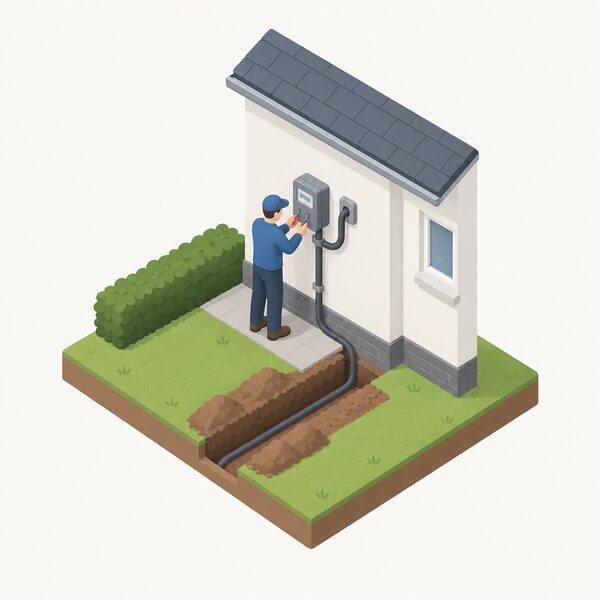
SP Energy Networks publishes basic guide prices for moving a meter: £1,401.98 where no digging is required, and £3,218.86 where digging is required1. These are guide figures rather than fixed quotes, and the difference between them is the excavation work.
The figures sit at the higher end of what network operators publish, which is worth understanding rather than treating as an anomaly. For comparison, SSEN quotes £308 to £607 for moving a supply or meter, excluding additional work such as digging or traffic management, with a detailed quote provided during the application process1. Northern Powergrid quotes single-phase meter moves from around £793, with an average of £1,200 for straightforward underground single-phase work1. SP Electricity North West quotes average prices for underground work at £965 to £1,470, depending on whether the operator performs the digging1.
| Operator | Published guide price | Scope |
|---|---|---|
| SP Energy Networks | £1,401.98 (no digging); £3,218.86 (with digging)1 | Meter move |
| SSEN | £308 to £6071 | Supply and/or meter move, excluding digging and traffic management |
| Northern Powergrid | From around £793; average £1,2001 | Single-phase meter move |
| SP Electricity North West | £965 to £1,4701 | Underground work, depending on who digs |
Gas meter moves are a different process with different operators. Northern Gas Networks quotes basic one-metre alterations from around £810 without digging, rising to £1,362 with digging, with each additional metre costing an additional £24 to £1141. SGN quotes basic alteration costs from around £605 to £1,210, depending on whether SGN performs the excavation and which part of the country the customer lives in1. Wales & West Utilities states that the cost of moving a gas meter starts at £1,200, with an online portal for an instant quote1.
Where a household digs in private land itself, the published rates are lower: £20 per metre excluding VAT for customer digging, against £95 per metre excluding VAT where the gas network digs12. Those rates are for gas connections rather than electricity meter moves, but they show how much of a quote is excavation.
The practical point is that a meter move is quoted, not listed. The published figures are starting points for a conversation with the operator, and the final number depends on the position of the existing service, the surface above it and whether the supply itself has to move. The process for moving a meter without moving the supply is covered in can I move my electricity meter without moving the supply.
Notifying SP Energy Networks before an EV charger or solar and battery connection
An EV charger or a heat pump draws far more electricity than most appliances, and several unreported installations in the same area can put pressure on the local network13. The reported consequences of that pressure are power cuts or flickering lights13. Notifying the network helps make sure a home has a reliable supply of electricity now and in the future13.
For solar, the notification route is explicit: the installer must contact the Distribution Network Operator through either "connect and notify" or "apply to connect"14. Which of the two applies depends on the size and type of the installation, and it is the installer's job rather than the householder's to select the correct route.
For EV chargers, building regulations approval is always required when installing a home charger, and a competent and reputable installer should be used, with specific processes for notifying the local building control authority15. That is a separate requirement from any network notification, and both can apply to the same installation.
The reason this matters for independence is straightforward. A home that adds a charger, a heat pump and a battery without telling the network is drawing more than the local infrastructure was planned for, and the risk falls on the household and its neighbours rather than on the installer. A notified installation gives the operator the chance to reinforce or adjust before a problem appears. The wider context of rising domestic demand is covered in rising electricity demand, and the connection process itself in getting a new or upgraded electricity connection.
Finding your supplier through SP Energy Networks: how the form process works

SP Energy Networks does not offer an online search tool to identify a household's electricity supplier. The route is a form: the household provides full contact details and the reason for contacting them, and then waits to be contacted by email or post with the details of the supplier7. Independent guidance describes the same process: fill in the online form and wait to be contacted by email or letter with the supplier's details6.
That is slower than the alternative. Of the network operators, five offer an online search tool to help identify an electricity supplier7. SP Energy Networks is not among them, so a household that has just moved in and does not know who supplies the property has to go through the form.
There is a faster route for identifying the network operator itself, which is a different question. The Energy Networks Association runs a postcode lookup that identifies the distribution network operator for an address2. The Energy Ombudsman also points households to the Energy Networks Association website to find out who their network provider is5.
Once the supplier is known, the complaint routes separate cleanly. Problems with late, incorrect or missing bills, back billing, being overcharged, a faulty meter, poor customer service, or a refusal to refund credit from an account go to the energy supplier3. Power cuts and connection issues go to the network operator3. Where a household has its own contract with an energy supplier, it can follow that supplier's complaints procedure, with details on the bill or the supplier's website16.
If a supplier fails, Ofgem runs a supplier of last resort process, choosing a new supplier through a bidding process in which energy companies bid to take on new customers17. The Energy Ombudsman covers disputes with energy suppliers, energy brokers, network operators, green deal providers and heat network suppliers18. Households struggling to pay can agree a payment plan, a payment break or a reduction with their supplier19.
What SP Energy Networks means for household energy independence
The network operator is the fixed point in a household's electricity arrangements. A home can change supplier, add solar, fit a battery and shift its usage, but it cannot change the company that owns the cables to its door. SP Energy Networks holds that position for two areas covering roughly the southern half of Scotland and the Merseyside, Cheshire and North Wales corridor1.
What a household can control is the volume of energy it draws through that network and the timing of when it draws it. Solar generation, battery storage and demand shifting all reduce the units bought, and the notification processes described above are what allow those additions to be made safely. What remains outside household control is the connection itself, the standing charges attached to it, the restoration timetable after an outage, and the operator's judgement about what the local network can carry.
There is a community dimension in Scotland specifically. The SP Energy Networks Transmission Net Zero Fund is administered by the Energy Saving Trust and supports Scotland's journey to net zero20. Its phases include knowledge sharing through tailored workshops for specific community groups and funding for community projects, with OSCR registered charities among the eligible groups20. Separately, the SP Energy Networks Re-Heat programme covered 32 rural or semi-rural homes across three council areas in Scotland21. Home Energy Scotland provides free, independent and impartial energy advice to householders, community groups and businesses throughout Scotland22.
For a household in England or Wales, the equivalent support routes differ. In Cheshire West, the network operators are SP Energy Networks for electricity and Cadent for gas, and the Priority Services Register is the route for households needing additional support during an outage23. The wider question of what a home can genuinely hold back, and what it cannot, is set out in energy security and household independence, with the Scottish picture in energy supply in Scotland and the Welsh picture in energy supply in Wales.
Sources23 cited
- How to move your gas or electricity meter, Uswitch, August 2026
- What to do in a power cut, Met Office
- Complain about your energy supplier or network operator, Ofgem, 2026
- Find my network operator, Energy Networks Association, 17 September 2026
- Network operators, Energy Ombudsman, 20 September 2026
- Who supplies my electricity and gas, Uswitch, 29 June 2026
- Who is my gas and electricity supplier, Confused.com, 3 July 2026
- Barcud Solar Panel Installation Scheme Specification, Sell2Wales, 15 June 2026
- FIT Guidance for Licensed Electricity Suppliers V17.1, Ofgem, 6 September 2024
- Domestic and homeowners, NESO, 17 September 2026
- Check if you can get payment for a power cut, Ofgem, 2026
- What to expect, Northern Gas Networks, 4 September 2026
- Why you need to inform NIE Networks, NIE Networks, 19 September 2026
- Building regulations renewables guidance, Bedford Borough Council, 17 September 2026
- Electric vehicle charging, Planning Portal, 2026
- Alternative homes energy guidance, Ofgem, 2026
- What happens if your energy supplier goes out of business, Ofgem, 2026
- How we can help, Energy Ombudsman, 19 September 2026
- Getting help if you can't afford your energy bills, Ofgem, 17 September 2026
- SP Energy Networks Net Zero Fund, Energy Saving Trust, 4 September 2025
- Low Carbon Infrastructure Transition Programme, Scottish Government, 28 June 2024
- Area Based Schemes, Glasgow City Council, 8 June 2026
- Support schemes, Cheshire West and Chester Council, 17 September 2026