

In this guide
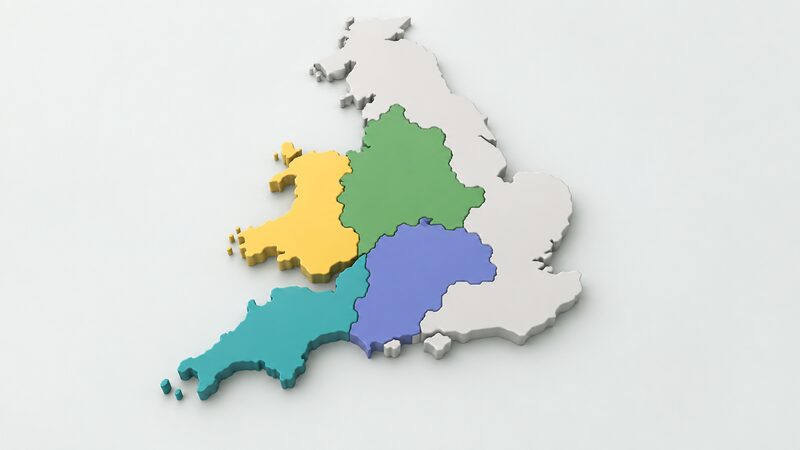
National Grid Electricity Distribution is the distribution network operator for the Midlands, the South West and South Wales, and it is the company most households in those regions still know by its former name, Western Power Distribution1. It runs four licence areas, East Midlands, West Midlands, South Wales and South West England, covering a service area of 55,300 square kilometres and reaching from Penzance on the tip of Cornwall to Skegness on the North Sea2.
The network it operates consists of 220,000 km of overhead lines and underground cables and 185,000 substations, serving 8 million customers2. It employs over 6,500 people and invests around £1 billion on the network annually3. It is one of 14 electricity distribution network operators in Great Britain, owned by six ownership groups5.
What matters for a household is the boundary of the job. A distribution network operator owns and operates the infrastructure that delivers power to a property, but it does not sell electricity, does not send a bill for the units consumed, and does not install or own the meter6. The supplier on the bill is a separate company. The network operator's role is the physical connection, the fault on the local network, and the connection of anything new that draws power from it.
What National Grid Electricity Distribution is and where it operates
The company describes itself as responsible for electricity distribution across the Midlands, the South West and South Wales, and its network spans the width of the country from Penzance on the tip of Cornwall to Skegness on the North Sea1. That geography is the practical answer to most questions about it: if a property sits in Cornwall, Devon, Somerset, Dorset, Gloucestershire, Wiltshire, the West Midlands, the East Midlands or South Wales, this is likely to be the network operator for the wires.
The distinction between transmission and distribution matters here. In England and Wales the transmission network, the high-voltage backbone, is operated by National Grid5. The distribution network operator takes electricity from that transmission network and delivers it to homes and businesses using smaller power lines and cables4. The two are different businesses with different responsibilities, even where the name overlaps.
The company is one of 14 electricity distribution network operators in Great Britain, owned by six ownership groups5. Its four regional networks are the former Western Power Distribution areas, and the rebrand has not changed the licence boundaries, the Distributor IDs or the contact routes for faults and connections9.
For a household, the network operator is the part of the electricity system that cannot be switched. A supplier can be changed in a matter of weeks; the distribution network operator for an address is fixed by geography. That is the dependence that remains regardless of tariff, and it is why the connection, the fault line and the connection application all run through this company rather than through the retailer.
The four licence areas and the Distributor IDs behind them
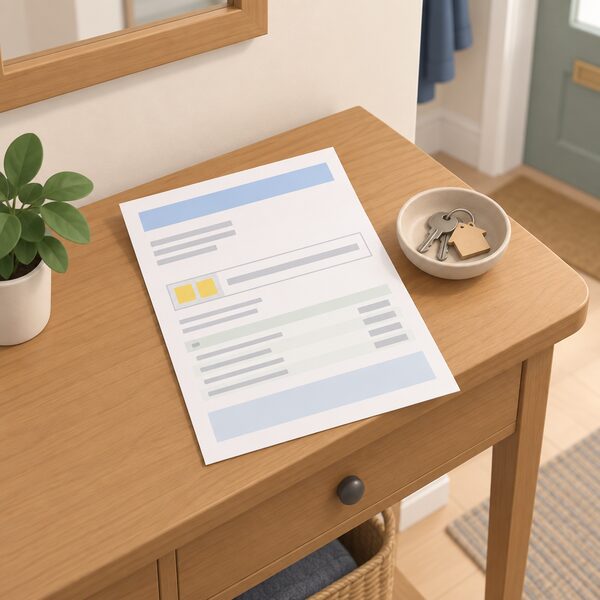
The four licence areas are East Midlands, West Midlands, South Wales and South West England, and each carries a Distributor ID that appears on the electricity bill9. The IDs are 11, 14, 21 and 229. The first two digits of the MPAN, the meter point administration number, are the Distributor ID, and a valid value sits in the range 10 to 28 because that number refers to the distribution network operator10.
The MPAN itself is 21 digits long and starts with an S11. A household does not need to decode it: the code on the electricity bill contains the Distributor ID, which identifies which network operator looks after the connection4. That is the fastest route to an answer without a postcode search.
| Licence area | Distributor ID | Network operator |
|---|---|---|
| East Midlands | 11 | National Grid Electricity Distribution9 |
| West Midlands | 14 | National Grid Electricity Distribution9 |
| South Wales | 21 | National Grid Electricity Distribution9 |
| South West England | 22 | National Grid Electricity Distribution9 |
| North Western England | 16 | Electricity North West9 |
| Eastern England, London, South Eastern England | 10, 12, 19 | UK Power Networks4 |
| North Eastern England, Yorkshire | 15, 23 | Northern Powergrid4 |
The neighbouring operators matter because a boundary can run through a single street. Electricity North West covers North Western England under ID 16, UK Power Networks covers Eastern England, London and South Eastern England under IDs 10, 12 and 19, and Northern Powergrid covers North Eastern England and Yorkshire under IDs 15 and 234. North-East England is Northern Powergrid's area12. Scotland and Northern Ireland sit outside this structure entirely, with NIE Networks serving over 910,000 customers including homes, businesses and farms in Northern Ireland13.
Finding your distributor: the postcode search and its limits
The Energy Networks Association runs a postcode lookup that returns the electricity distribution network operator for an address, and entering a postcode on that page is the standard route4. National Grid Electricity Distribution runs its own distribution area search as well2.
That search has one hard requirement: a full postcode is needed. Part of a postcode, or a town or city name, will not be found2. This is the single most common reason an address does not appear, and it is a formatting issue rather than a sign that the property is off the network.
Where a full postcode still fails, the Distributor ID on the bill is the reliable fallback, and the Energy Networks Association lookup covers every operator in Great Britain4. For gas, the equivalent service is Find My Supplier, which requires only a postcode to identify the gas supplier11. Several network operators also offer their own online search tools to help identify a supplier11.
The practical value of getting this right is that it determines who to call. A fault on the local network is the distribution network operator's responsibility; a problem inside the property is not. The network operator fixes power cuts that are not caused by a problem inside the home, and it can move an electricity meter4. Ofgem stipulates that distribution network operators must connect customers to the grid when requested7.
What a distribution network operator does, and what it does not do
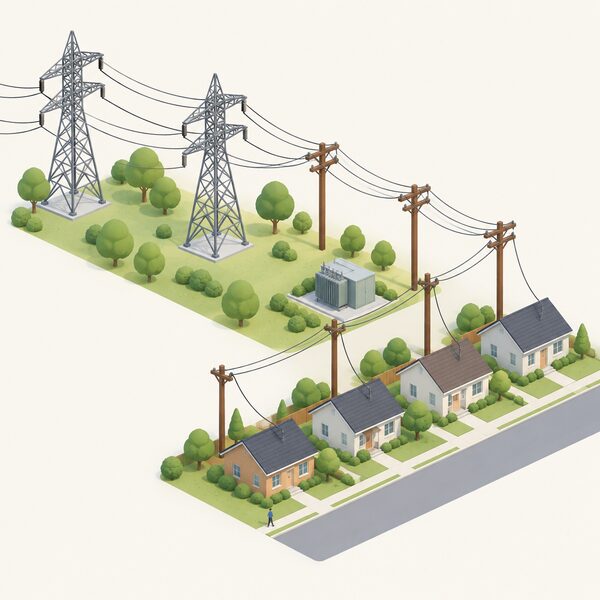
A distribution network operator owns and operates the distribution network of towers and cables that bring electricity from the national transmission network to homes and businesses14. It is responsible for maintaining physical electricity supplies to a home or business14. It does not sell electricity to consumers; that is done by the electricity retailers whose name appears on the bill14.
The list of what it does do is short and specific. It helps connect a home to electricity, it can move an electricity meter, and it fixes power cuts that are not caused by a problem inside the home4. It must connect customers to the grid when requested7. It also owns and operates the infrastructure that delivers power to a property15.
The list of what it does not do is longer, and it is where most confusion sits. It does not sell electricity, does not set the unit rate or standing charge, does not bill for consumption, and does not install or own the meter6. A household that pays for energy, whether owning or renting, should be able to book a smart meter installation where it is expected to work in the property, and that booking runs through the supplier, not the network operator16.
For a household's independence, this is the clearest limit in the whole electricity system. The supplier can be changed; the network operator cannot. The wires to the property, the substation serving the street and the connection capacity available are all fixed by the distribution network, and any change to them, whether an upgrade, a move or a new connection, is an application to this company. That is the dependence that remains after every other choice has been made.
Power cuts and emergencies: the 105 number and 24-hour lines
The free national power cut emergency number is 105, and it is worth saving to a phone8. National Grid Electricity Distribution lists 105 and 0800 6783 105, and states that these lines are free from all networks and available 24 hours a day, seven days a week17.
In Northern Ireland the arrangement is different. NIE Networks is the network operator, and power cuts can be reported through its website, WhatsApp, Facebook or by calling its helpline on 03457 643 64318. NIE Networks transports electricity from where it is generated to over 910,000 customers including homes, businesses and farms, and connects approximately 9000 customers a year to the electricity network13.
Repeat or multiple power cuts on the same street usually have a physical cause rather than a scheduling one. Electricity North West, explaining the same phenomenon in its own area, notes that 13,000 km of its network runs overhead and that it maintains and repairs 57,000 kilometres of cables serving customers19. Overhead networks are exposed to weather in a way underground cables are not, which is why storm categories and incident counts are calculated on the high voltage network over a 24 hour period20.
Planned disconnections are a separate matter. If required, the electricity system operator would legally instruct distribution network operators to disconnect power supplies21. Before any such instruction, the system operator takes steps including encouraging additional generation through the supply market, asking heavy industrial users to limit demand during peak periods, and reducing domestic power demand, including paying customers to change appliance use or reducing voltage across the country by a small percentage21. For a household, that is the sequence that would precede any rota load disconnection, and it is a national mechanism rather than a local fault.
Connections and network services: solar, EV chargers and heat pumps
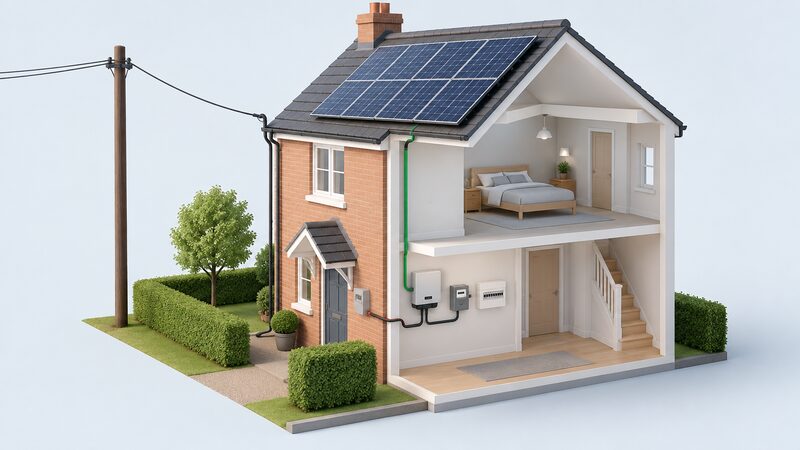
Anything added to a property that draws or exports power runs through the distribution network operator. Electrical grid connection requires approval from the distribution network operator, which applies to solar photovoltaic systems as much as to any other generation22. The same principle covers electric vehicle chargers and heat pumps, which are the loads most likely to require a network assessment before installation9.
The connection process has published timescales for small jobs. For a single new domestic connection, the estimated time to get a quote is 4 days; for two to four domestic connections or a small commercial job, the estimate is 10 days23. Those are quote timescales rather than completion times, and the work itself depends on what the connection requires.
Where a property is not yet connected, or the connection status is unclear, the route is to contact the local distribution network operator to find out whether the property is connected, or how to arrange it15. For a household adding generation, the approval step is the point at which the network operator's view of the local substation and its capacity becomes decisive.
There is a tax dimension to some of this work. VAT relief for energy-saving materials has been extended to add electrical batteries that store electricity generated by certain energy-saving materials and from the grid, along with water source heat pumps and diverters, and certain preparatory groundworks for ground and water source heat pumps24. Solar collectors, such as evacuated tube or flat plate systems, qualify together with associated pipework and equipment such as circulation systems, pumps, storage cylinders, control panels and heat exchangers24.
Investment, performance and the move to Distributed System Operator
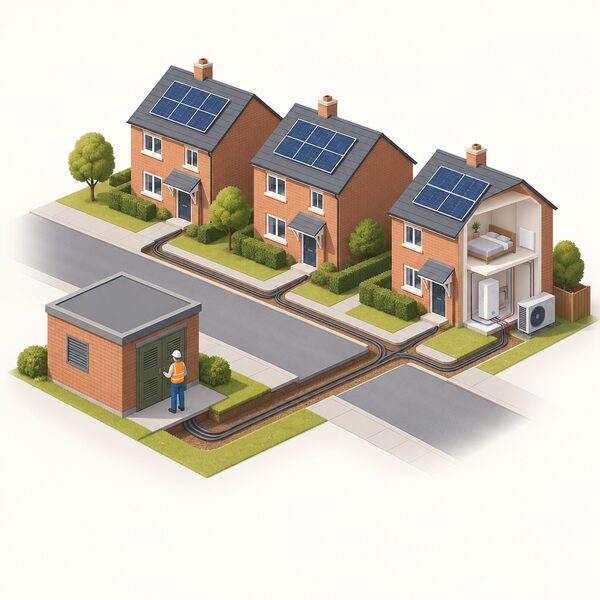
The company is committed to investing around £1 billion on the network annually3. That figure sits against a national picture in which the National Audit Office has warned that delayed grid upgrades could increase household energy bills, saying consumers face rising energy bills without urgent electricity grid upgrades and warning that constraint costs could rise substantially by 203025.
The regulatory framework behind that investment is the distribution network operator's licence, and the guaranteed standards of performance set the service levels a household can expect. Where a dispute concerns those standards, the route is the Complaints Team at National Grid Electricity Distribution, Pegasus Business Park, Derby, DE74 2TU, or by email, with a response aimed at within 10 working days20.
The wider shift is from distribution network operator to distributed system operator. The National Energy System Operator is responsible for planning and delivering the energy of today and the future UK energy system, and it has planned a connections reform25. In England and Wales the system operator role sits with National Grid5, and the National Grid ESO name stands for Electricity System Operator8. The move to a distributed system operator model means the local network is increasingly active in managing flows rather than simply delivering them, which is what the connection approvals for solar, batteries and heat pumps reflect in practice.
For a household, the investment figure and the reform programme translate into two things: the capacity available at the local substation, and the time it takes to get a connection or an upgrade approved. Both are set by the network operator, and neither is affected by changing supplier.
Complaints, meter data and scam emails
Complaints can be emailed to nged.complaints@nationalgrid.co.uk, or made by phone on 0800 055 6833, free, between 9am and 5pm17. A letter can go to Complaints Department, National Grid, Herald Way, Castle Donington, Derby, DE74 2TU17. Advisers are also available on WebChat from 8am to 8pm17. The online complaint form is limited to 4000 characters27. For Next Generation Texting and Textphone Minicom, the number is 18001 0800 096 3080, and a written response can be provided in large print or braille, or in Welsh or another language17.
On meter data, the position is narrow and specific. The company states that it will not be installing or owning the meter, but that information from smart meters will provide distribution network benefits28. All meter reading data will be held anonymously in a secure database, which will not contain names and addresses or other customer data28. It will only use the information to improve its electricity distribution network and does not intend to monitor or use data collected from smart meters to specifically identify individuals28. It keeps a record of the total amount of electricity customers use each month, and the amount used during each half hour period for every circuit and every substation28. Ofgem, the industry regulator, has approved its privacy plan28.
"We will not use your information to contact you with adverts, offers or promotions or sell your data to third parties for marketing purposes"
There is one exception to the anonymity. If a property is in a more remote area and is the only customer supplied from the local substation, the company needs to hold individual half hourly meter readings28. Separately, the meter itself sends usage data to the supplier using a secure network29, and Electralink stores data on smart meter installation numbers and location, supplier switching, and industrial and commercial consumption among other datasets30.
Scam emails are a live problem in this sector. There has been a recent increase in fraudulent emails targeting energy consumers that falsely claim to be from the Energy Ombudsman31. The characteristics are consistent: use of a company or broker name and logo without permission, reference to a complaint or review the consumer has not raised, links to fake forms or websites, pressure to act quickly, a free email service such as Gmail, or a misspelling of a company name31. The forms often request sensitive personal information such as full name, address, date of birth or bank details31.
Sources31 cited
- Distribution area search, National Grid Electricity Distribution, 2026
- General advice, National Grid Electricity Distribution, 2026
- Delivering value for money, National Grid Electricity Distribution, 2026
- Find my network operator, Energy Networks Association, 2026
- Energy networks explained, Energy Networks Association, 2026
- Energy terms explained, Ofgem, 2026
- How to find out if there's a power cut, Which?, 2026
- What happens in an energy shortage, Energy Networks Association, 2026
- Connecting electric vehicles and heat pumps to the networks, Energy Networks Association, 2026
- FIT guidance for licensed electricity suppliers, Ofgem, 2024
- Who supplies my electricity and gas?, Uswitch, 2026
- How to move your gas or electricity meter, Uswitch, 2026
- Emergency power cuts, NIE Networks, 2026
- What to do in a power cut, Met Office, 2026
- Domestic and homeowners, NESO, 2026
- Smart meters: your rights and expectations, GOV.UK, 2025
- Complaints, National Grid Electricity Distribution, 2026
- Power cut advice, NIE Networks, 2026
- Reasons for repeat or multiple power cuts, Electricity North West, 2026
- Standards of performance, National Grid Electricity Distribution, 2026
- Rota load disconnections, National Grid Electricity Distribution, 2026
- Generating your own energy: solar electricity, Welsh Government, 2018
- How much will my new supply cost?, Electricity North West, 2026
- VAT energy saving materials and grant funded heating supplies, HMRC, 2026
- The grid connection queue and connections reform, House of Commons Library, 2025
- The grid connection queue and connections reform, Parliamentary Office of Science and Technology, 2025
- How to make a complaint, National Grid Electricity Distribution, 2026
- Smart meters, National Grid Electricity Distribution, 2026
- Smart meters, Welsh Government, 2026
- Data protection and smart meter data, Open Energy, 2026
- Guidance: scam emails claiming to be from Energy Ombudsman, Energy Ombudsman, 2026