
In this answer
Short answer
Yes, in many cases the meter can be moved without moving the supply, but only a short distance and only if there is enough slack in the meter tails, the cables running from the meter to the consumer unit. That check is made by your electricity supplier, which owns the meter and is the only company permitted to relocate it1.
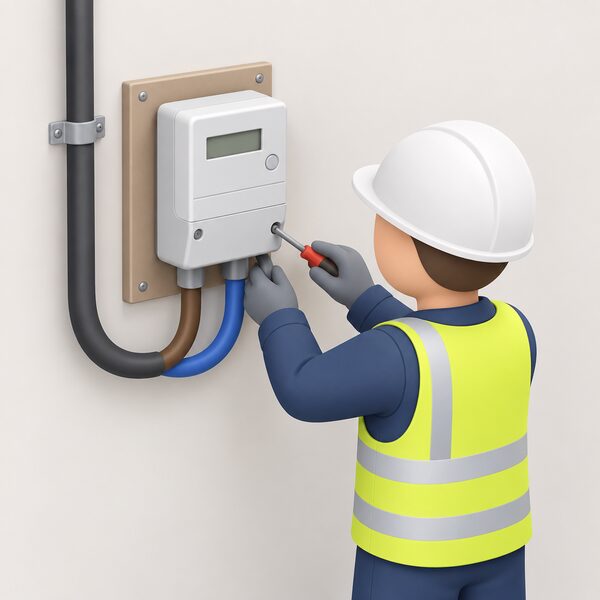
The two jobs are separate. Moving the meter is a supplier task. Moving the supply, the cable coming in from the road, is network operator work and has to be done by its qualified engineers, because ordinary electricians are not trained to work on the supply or the meter2. Where the meter alone is being relocated, the supplier arranges it and contacts the meter operator, and no network operator work is required1.
Where the supply has to move as well, the job becomes a service alteration with digging, ducting and a new meter box, and the price rises accordingly. Published guide prices range from £308 to £607 for SSEN, excluding digging and traffic management, to £1,401.98 without digging or £3,218.86 with digging for SP Energy Networks3. Electricity North West quotes from £700 for overhead supplies and £800 for underground ones4.
Moving the meter and moving the supply are two different jobs
The distinction matters because it decides who you contact, who does the work and what it costs. The meter is the property of your electricity supplier, and the supplier is the only company that can move it2. The supply is the cable, overhead line or underground service that brings electricity to the property, and that belongs to the network operator, which manages and maintains the underground cables, overhead wires and substations that bring electricity into your community5.
A qualified electrician can move the fuse box, the enclosure holding the trip switches, and can work on your internal wiring, but cannot touch the supply or the meter2. It is illegal to move the meter yourself, so the request has to start with the supplier6. SSEN's guidance is explicit that the householder should contact the energy supplier they pay their bills to in order to request a meter move7. The same applies to disconnection: that is arranged through the supplier, the company you pay your electricity bills to8.
For a household's energy independence, this is a reminder of where control sits. The meter and the supply are not household assets. A move changes where the equipment sits, not who owns it or who can work on it. The grid connection remains, and so does the dependence on a supplier and a network operator for anything upstream of the consumer unit.
Who does what: the network operator, your supplier and your installer
Three parties can be involved, and the split is not obvious to most householders. Electricity network operators help connect your home to electricity and can move your electricity meter, and they also fix power cuts that are not caused by a problem inside your home9. They manage the wires and infrastructure that powers your property and are different from the energy supplier10. Ofgem describes the same split: a network operator is responsible for the pipes and wires that move energy, and should be contacted about power cuts or connection issues in your area11.
Your supplier is the company you pay. It owns the meter, arranges meter moves and contacts the meter operator where needed1. Where a smart meter is being installed, it will always be your energy supplier or a third party working on its behalf that comes to your house to change the meter12.
Your installer, normally a qualified electrician, handles the internal side: the fuse box and the wiring inside the home2. On a supply move, Electricity North West notes that preparation may include digging on your land, hiring a builder, and employing an electrician to move your fuses to the new meter position, which the network cannot do13.
If you are unsure which network operator covers your address, the industry maintains a postcode lookup through the Energy Networks Association9. The operator for your area is the body that will quote for any supply work.
When the meter can be moved without touching the supply
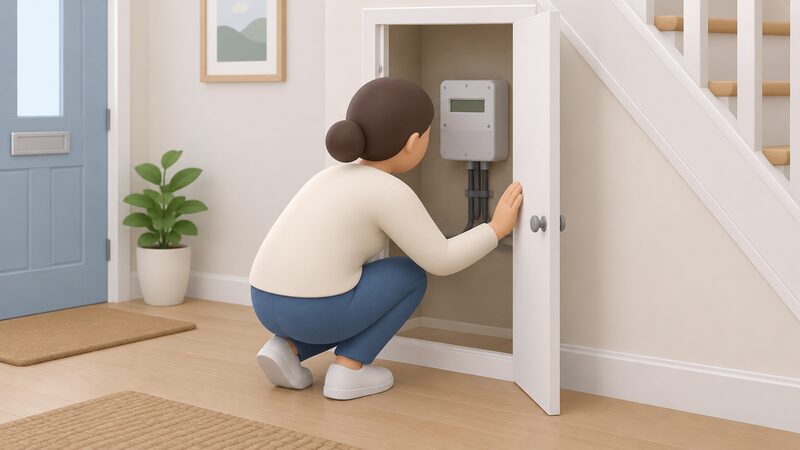
The short answer is: a short distance, if the meter tails allow it. UK Power Networks advises that you can request a check on whether the meter can be moved a short distance, as long as there is enough length in the meter tails1. That is the whole of the meter-only case. It is a supplier job, arranged through the supplier, with no network operator involvement1.
Citizens Advice sets out the recognised reasons a move might be possible: finding it difficult to read or access the meter, or doing building work14. Those are the circumstances in which a householder typically asks, and they are also the circumstances in which a short relocation often solves the problem without any cable work.
There is a cheaper alternative worth knowing about. Electricity North West notes that smart meters are free of charge and can be installed by a number of suppliers, and may be a more cost effective way of getting better access for meter reads4. A smart meter does not move the meter, but it can remove the need to read it by hand. Smart meters work on the DCC's secure, standalone network, so sending a reading does not require an internet connection15.
When the supply itself has to be altered: new connections and cable work
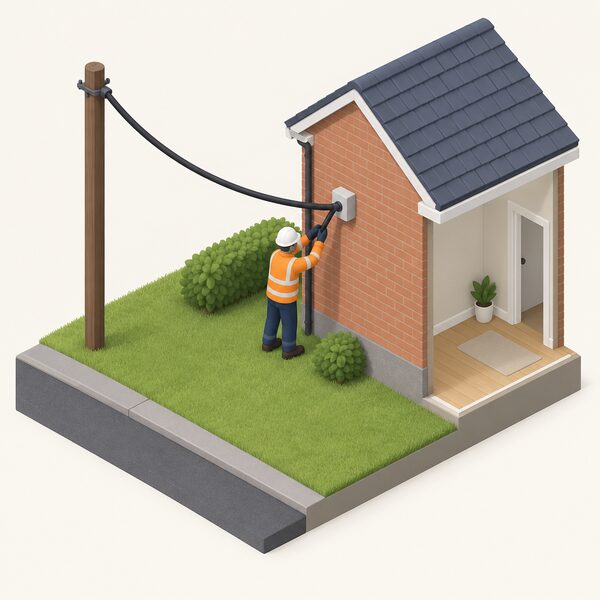
If the meter needs to go further than the tails allow, or to a different wall, the supply cable usually has to move too. That is a service alteration, and it is network operator work. Electricity North West states plainly that as part of the project it will move your supply and meter, even if this is a smart meter16.
The work itself can involve diverting the supply. Where the network allows, the operator will switch your electricity supply onto a different cable, enabling it to bypass any known faults17. That is a network operation, not something an electrician can arrange.
Two related points are worth separating out. First, a supply move is not the same as a new connection. A new connection is a fresh supply to a property that does not have one, or an upgrade to capacity; a move relocates an existing one. Second, if a meter genuinely cannot be moved, the supplier must replace it with a different type of meter18. That obligation sits with the supplier, not the network operator.
For the household, the independence question here is straightforward. A supply alteration changes the physical route of the connection but not the dependence on the network. The property remains connected to the distribution network, and the operator retains responsibility for the cable. What the household gains is a meter position that works for the building, not any measure of self-sufficiency.
Digging, ducting and the meter box: what the work involves on your land
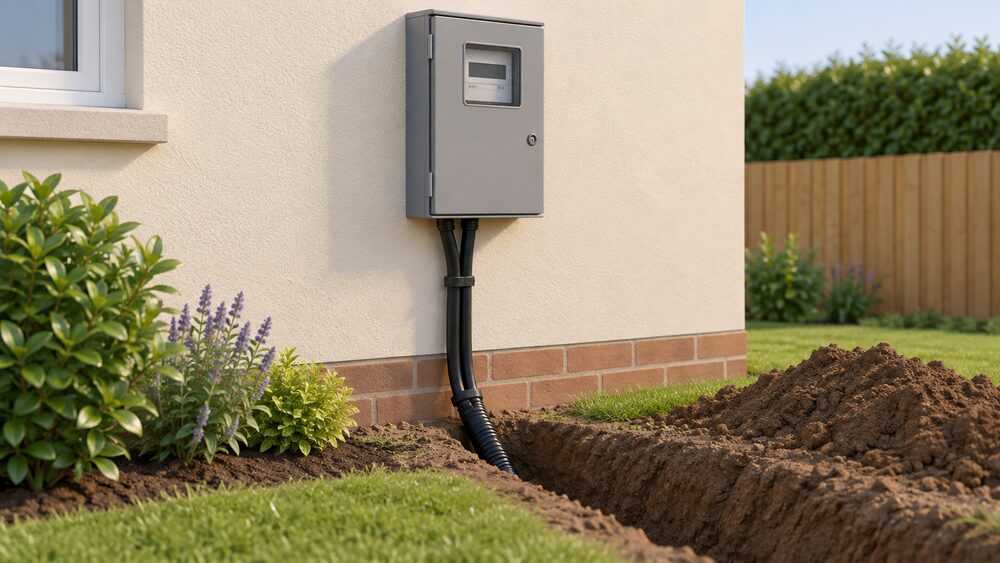
A supply move usually involves groundworks, and the split of responsibility follows the property boundary. Electricity North West will complete any digging on the public footpath or highway, but the digging on your land up to your property's boundary is not included in the quotation19. Where a customer carries out the digging, the trench needs to be dug on their land2.
The meter box is the householder's item. A new electricity meter box and black tubing, the ducting, will need to be installed on the outside wall of the property2. Where the meter is going outside the home, the customer supplies the meter box and ducting20. Electricity North West can include the cost of a meter box in the quote at trade cost, and can include or exclude the digging on your land, so the quote can be shaped to what the householder wants to take on13.
If you dig the trench yourself, it must be ready for the cable to be installed, and the meter box must be installed where the meter is to be moved to and connected3. If the network operator does the digging, it might take a few days to complete before the cable can be moved3.

Cost, surveys and how to get a price
Prices are quoted per job, and the published guide figures vary widely by operator and by how much digging is involved. SSEN's guide is £308 to £607, excluding additional work such as digging or traffic management, with a detailed quote provided during the application process3. SP Energy Networks publishes a basic guide price of £1,401.98 without digging or £3,218.86 with digging3. Electricity North West's prices start at £700 for overhead supplies and £800 for underground4.
| Network operator | Published guide price | What it covers |
|---|---|---|
| SSEN | £308 to £607 | Excludes digging and traffic management3 |
| SP Energy Networks | £1,401.98 | No digging3 |
| SP Energy Networks | £3,218.86 | With digging3 |
| Electricity North West | from £700 | Overhead supplies4 |
| Electricity North West | from £800 | Underground supplies4 |
The spread reflects scope, not just regional pricing. A move that reuses the existing route and leaves the householder to dig is a different job from one that requires the operator to excavate, manage traffic and reinstate surfaces. Electricity North West's quote options make this explicit: digging on your land can be included or excluded, and a meter box can be added at trade cost13.
On timing, UK Power Networks states its team will get back to you within 48 hours1. A second UK Power Networks page states a response within five working days. Both are dated 2026-09-17, so the 48-hour figure is the optimistic case and five working days the outer one.
Where designated parking bays sit outside the property, the network operator may need to apply to the council to suspend those spaces while the work is carried out2. That is a council process and can add time. Traffic management is also excluded from some published guide prices3.
For a householder, the practical sequence is: contact the supplier first about the meter, establish whether the tails allow a short move, and only then approach the network operator about the supply if the cable has to move too. The electricity distribution networks page explains which operator covers which area, and getting a new or upgraded electricity connection covers the separate case of a fresh supply rather than a relocation.
Sources20 cited
- Move your electricity supply, UK Power Networks, 2026-09-17
- What's involved in moving your supply, UK Power Networks, 2026-09-17
- Cost and time for moving your supply, UK Power Networks, 2026-09-17
- Meter move information, Electricity North West, 2026-09-20
- Why do you use generators, UK Power Networks, 2026-09-17
- Domestic and homeowner connections, NESO, 2026-09-17
- Existing electricity supplies, SSEN, 2026-09-19
- Disconnect an electricity meter, UK Power Networks, 2026-09-17
- Find my network operator, Energy Networks Association, 2026-09-17
- Power cut compensation, Energy Networks Association, 2026-09-17
- Complain about your energy supplier or network operator, Ofgem, 2026
- Do I have to accept a smart meter, Which?, 2026-05-12
- What's involved in a service alteration, Electricity North West, 2026-09-20
- Move your gas or electricity meter, Citizens Advice, 2026-09-20
- How to get a smart meter, Smart DCC, 2026
- Moving your meter, Electricity North West, 2026-09-19
- Restoration following a power cut, Electricity North West, 2026-09-19
- Prepayment meters: consumer guidance, Ofgem, 2026
- Service alteration costs, Electricity North West, 2026-09-20
- Connect 1 to 4 new properties: FAQs, SSEN, 2026-09-17
 Move, Exchange or Remove a MeterMoving a meter is not a DIY job and it is illegal to do it yourself.
 Moving Home Energy AccountsMoving home means you get a new energy supplier whether you choose one or not, so who supplies your new place and what happens to your old account?
 How Smart Meters CommunicateSmart meters send readings without using your home wifi or broadband, so they still work if your internet goes down.
 Private Wire NetworksHow a private wire carries electricity from a generator to a nearby home or building without using the public network, and the licensing exemptions that allow it.
 Submit Meter ReadingsThe routes for sending readings, by app, online account, phone and automated line, and the timing that gets them onto the right bill.
 Meter Readings and EstimatesWhy is my energy bill estimated, and how often should my meter be read?