In this guide
A new or upgraded electricity connection is arranged through your local distribution network operator, not your energy supplier. The DNO owns and maintains the cables, substations and service head that bring power to the property, and it is the company that quotes for a new supply, a capacity increase or a three-phase upgrade1. Your supplier sells you the energy; the DNO moves it.
The cost and the timescale depend on how much work the connection needs. Electricity North West publishes £1,300 including VAT as the minimum price for one new domestic connection, with £1,790 including VAT as the average, and four days as the estimated time to get a quote3. Where a connection is unusually expensive, the cost can change what a building is required to include: the £2,000 threshold for an additional grid connection cost is used in Scottish building standards to exempt new homes from the requirement to install an electric vehicle charge point4.
Once connected, the relationship continues through the Guaranteed Standards of Performance, which set minimum service levels and automatic compensation when they are breached6. Ofgem describes these as standards that "set minimum supplier service standards, with consumers automatically compensated if they are breached"6. The same framework covers restoration times after a power cut, repeat interruptions and severe weather, with separate arrangements in Northern Ireland7.
What a new or upgraded electricity connection involves
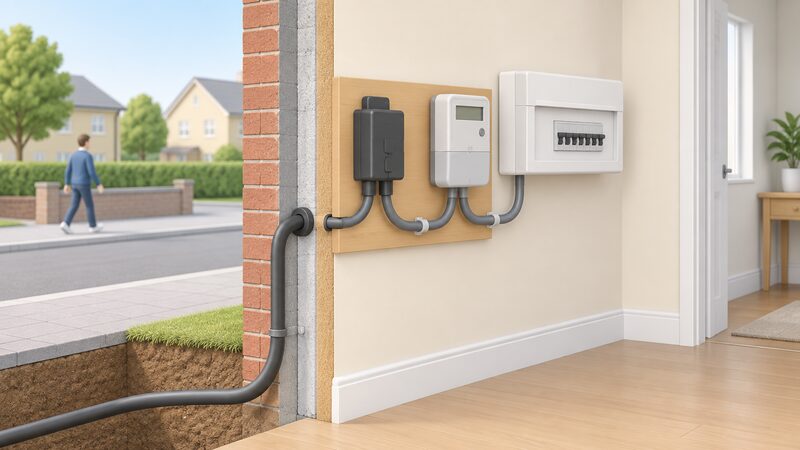
A connection is the physical link between the public distribution network and the wiring inside a property. The DNO is "responsible for maintaining physical electricity supplies to your home or business", which places the service cable, the cut-out and the metering point on its side of the boundary9. Anything beyond that, the consumer unit, circuits and sockets, belongs to the household and is covered by the building regulations rather than the network operator.
For a new dwelling, or an extension to an existing one, electrical work is notifiable to the local authority unless the installer is a member of a Competent Persons Self Certification Scheme10. Part P of the Building Regulations applies to all new electrical work in a dwelling, which includes a house, a flat or a small commercial premises linked to domestic accommodation, and the work must be designed and installed to account for it11.
An upgrade is a different job from a new connection. A household adding a heat pump, an electric vehicle charger or an induction range may find the existing service fuse and cable cannot carry the extra load, and the answer is a capacity increase, sometimes with a three-phase supply. The application route is the same: it goes to the DNO, which assesses what the network can deliver at that address.
Smaller generation and storage devices also sit inside this framework. Plug-in solar equipment must comply with the technical requirements for connection and parallel operation with low-voltage distribution networks in Great Britain, set out in Engineering Recommendation G98 Issue 2 Amendment 112. In Northern Ireland, connection requirements are governed by the Electricity Safety, Quality and Continuity Regulations (Northern Ireland) 2012 and by Engineering Recommendation G98/NI, which is set out separately from the Great Britain standard13.
Who to apply to: your local Distribution Network Operator
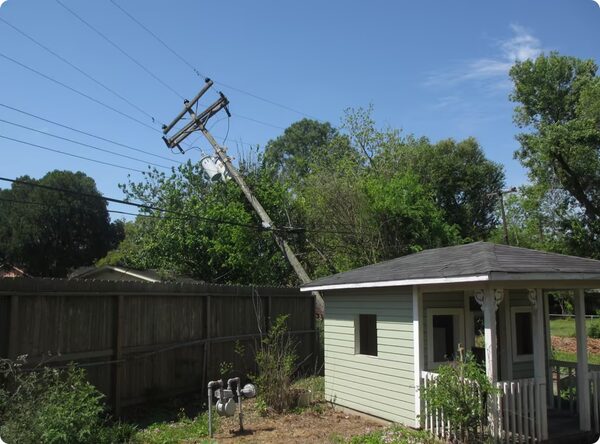
The first step is identifying the company. The Energy Ombudsman states that "you can find out who your network provider is via the Energy Networks Association website", which runs a postcode lookup covering every address in Great Britain2. The Met Office gives the same route, noting that the details for all the electricity Distribution Network Operator companies are held on the Energy Networks Association site9.
There are seven electricity DNO groups in Great Britain, and the one serving a property depends entirely on its postcode. The DNO is not the same as the supplier named on a bill, and it is not the same as National Grid, which owns the high-voltage transmission network rather than the local distribution cables. A household that has moved recently may never have dealt with its DNO at all, because the supplier handles metering and billing while the DNO stays in the background until something needs connecting or repairing.
For a connection enquiry, the DNO is the correct first contact. NESO advises that a domestic customer "will need to contact your local distribution network (DNO) to find out whether your property is connected, or how to" arrange a new or altered supply1. That applies whether the property has never had a supply, has had one disconnected, or needs more capacity than the existing service can provide.
How to apply and what the process covers
An application begins with the DNO's connection team, which asks for the address, the intended load and, for new builds, the site plans. The operator then designs the connection, which may be a simple service alteration or may require a new cable run, a new substation or reinforcement further up the network. The design work is what sits behind the quote, and it is why two apparently similar properties can receive very different figures.
The process for a domestic connection typically runs through these stages:
- Identify the DNO for the postcode through the Energy Networks Association lookup2.
- Submit the connection application with the address, the required capacity and any site plans.
- Receive a quote setting out the connection charge and the work involved.
- Accept the quote and pay any required contribution.
- The DNO carries out the network work and connects the property.
- The supplier arranges metering and the energy account.
Where a scheme involves a grant, the application route can sit with a different body. The electric vehicle chargepoint grant for residential landlords, for example, requires contacting an OZEV-authorised installer for a quote, then creating an account and applying through the form provided to submit details of the property and vehicle to OZEV15. That is a grant process rather than a connection process, but it shows how often a connection decision is tied to a funding condition.
The connection cost can also determine what a building must include. Scottish building standards use a £2,000 threshold: where the additional cost of the electricity grid connection exceeds £2,000 per charge point, the requirement to install an EV charge point is exempted4. A parallel rule in the English approved document requires at least two formal quotes to the building control body, at least one from a distribution network operator, to show that the connection cost is greater than £3,60016.
Connection quotes and timescales: what the standards require

Quote turnaround is the part of the process a household notices most, because nothing can be built until the figure arrives. Electricity North West gives four days as the estimated time to get a quote for one new domestic connection3. That is a published estimate from one operator, not a universal guarantee, and it applies to a straightforward single-property request.
Several factors push the timescale out. A connection that needs a new substation, a wayleave across third-party land, or reinforcement of the wider network takes longer to design and longer to deliver. A development of several properties is a different category of work from a single house. Where the request involves generation or storage as well as supply, the technical assessment adds a further layer, because the equipment must meet the connection and parallel operation requirements for low-voltage distribution networks12.
Ofgem has been looking at this area directly. Research commissioned to inform its review of energy supplier Guaranteed Standards of Performance identified "a limited number of areas where automatic compensation could be applied; new connections to the electricity network, where distribution network operators have guaranteed standards" among the topics examined17. That places connection performance alongside supply restoration as a service where standards and compensation may develop.
The same research found that consumer awareness of the existing standards is poor. "Participants had low awareness of Guaranteed Standards of Performance", and views on the appropriate level of compensation varied widely among those consulted17. Service failings related to loss of supply were typically seen as the most severe, and there was widespread agreement that compensation is an important element of responding to service failings when guaranteed standards are breached17.
What a connection costs: benchmark maximum charges by region
Connection charges are quoted case by case, but the wider cost of being on the network is published. Ofgem's benchmark maximum charges set the ceiling for what a supplier can charge a household in each region, and they show how much the standing charge and unit rate vary by area.
| Region and payment method | Nil kWh charge | Annual bill at 3,100 kWh |
|---|---|---|
| East Midlands, Standard Credit, single-rate | £214.73 | £887.3918 |
| East Midlands, Other Payment Method, single-rate | £194.73 | £833.8518 |
| N Wales and Mersey, Standard Credit, single-rate | £253.22 | £974.9818 |
| East Midlands, Standard Credit, multi-register | £214.61 | £1,072.11 at 4,200 kWh18 |
The figures move between charge restriction periods. For the later period, the East Midlands single-rate annual bill at 3,100 kWh is £875.41, with a nil kWh charge of £197.80, while the Northern region shows a nil kWh charge of £250.64 and an annual bill of £935.17 at the same consumption19. The gap between regions reflects the different costs of maintaining and reinforcing each distribution area, and it is the reason two identical homes in different parts of the country can pay different standing charges.
The price cap level for 1 July to 30 September 2026 gives a further regional comparison. In the North West, the single-rate standing charge is £165.50 with an annual bill of £787.60 at 2,500 kWh, and the multi-register figures are £163.01 and £952.88 at 3,400 kWh20. These are cap levels rather than connection charges, but they set the context in which a household judges whether a quoted connection cost is reasonable for its area.
Guaranteed Standards of Performance: your minimum service levels
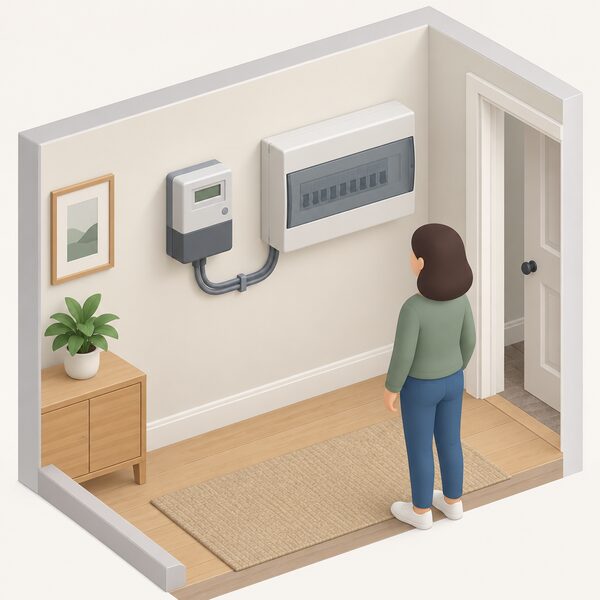
The Guaranteed Standards of Performance are the rules that turn service expectations into enforceable minimums. Ofgem describes them as standards that "set minimum supplier service standards, with consumers automatically compensated if they are breached"6. A related consultation describes the mechanism plainly: guaranteed standards "set out minimum performance standards which all energy suppliers must meet and, when they don't, au"tomatic payments are issued to the affected consumers21.
The framework has been strengthened. The government announced that Ofgem had been transformed to strengthen protections for energy consumers, with standards that "set minimum standards that all suppliers must meet for specific services or pay £40 automatic compensation if they" fall short22. That £40 automatic payment applies across suppliers where the minimum standards are not met.
The standards cover more than power cuts. Switching is included: where a supplier takes more than 20 working days to reply after being told about a switching mistake, there is £40 extra compensation, and where the old and new suppliers take more than 20 working days to agree whether a switch was correct, they will each pay £4013. These sit alongside the supply restoration standards, which are the ones most households encounter.
The territorial extent matters. Ofgem states that the power cut rules "cover England, Scotland and Wales", so Northern Ireland operates under a separate set of guaranteed standards administered by NIE Networks7. Ofgem also reviews and updates the amount paid for a power cut each year based on inflation, so the figures are not fixed permanently7.
Compensation when standards are missed: amounts and how payments work
The core payment structure for an unplanned power cut is tiered by how many properties are affected and how long the interruption lasts. Ofgem states that "you can get £100 for homes or £195 for businesses if" fewer than 5,000 properties are affected for more than 12 hours, or more than 5,000 properties are affected for more than 24 hours7. Beyond that, "you will get an extra £45 for every additional 12-hour period without electricity"7.
The maximum is capped. "The maximum amount you could be paid is £400 if the power cut affects 5,000 or more properties"7. Worked examples show how the tiers accumulate: a cut of more than 12 hours that is interrupted for 36 hours brings two additional £45 payments, adding up to £90, while a cut of more than 24 hours interrupted for 72 hours brings four additional £45 payments, adding up to £18023.
Citizens Advice sets out the same structure from the consumer side. Where fewer than 5,000 homes are affected, a household gets £100 if the power is off for 12 hours, then £45 for every 12 hours after that; where more than 5,000 homes are affected, it is £100 if the power is off for longer than 24 hours, then £45 for every 12 hours after that, up to a maximum of £40024. Planned cuts carry a separate £40 payment where no two days' notice is given, or where the cut happens on a different day from the one warned about24.
There is also a late payment rule. If a claim is made and the operator has not paid within 10 working days, an extra £40 compensation applies24. The amounts are reviewed annually against inflation, so the figures quoted here are the current published levels rather than permanent ones7.
Storms and severe weather: extended restoration deadlines and exemptions
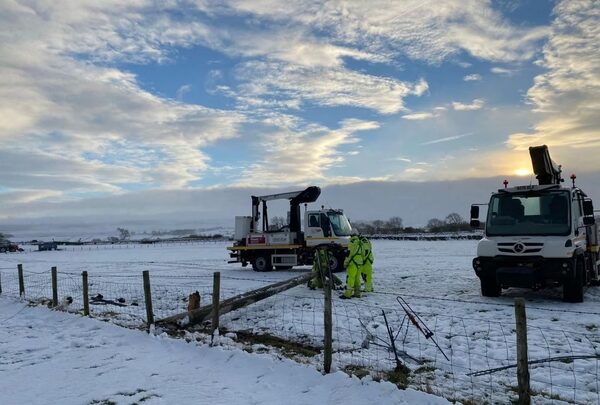
Severe weather changes the deadlines rather than removing them. In normal conditions, the restoration deadline is 12 hours for interruptions outside severe weather23. In severe storm category 1 weather it extends to 24 hours, and in severe storm category 2 weather it extends to 48 hours23.
The compensation structure changes with it. For storm category 2, a household can get £90 for the first 48 hours and an extra £45 for every 6 hours after23. That is a different shape from the normal weather tariff, where the first payment is £100 and the increments are £45 per 12 hours, and it reflects the longer expected outage during a named storm.
The distinction between normal weather and severe weather is the point at which most disputes arise. A cut that would attract £100 at 12 hours in ordinary conditions may fall inside the extended deadline during a category 1 or category 2 storm, so the payment clock starts later. The category is set by the network operator against the storm definitions, and the deadlines are published in advance rather than decided after the event.
For a household, the practical effect is that a storm outage is not automatically compensated at the normal rates. The extended deadlines apply, and the storm category determines both how long the operator has to restore supply and how the payment builds up. The rules cover England, Scotland and Wales, with Northern Ireland operating its own standards7.
Northern Ireland: NIE Networks' eleven guaranteed standards
Northern Ireland sits outside the Ofgem framework. NIE Networks publishes its own guaranteed standards, and its restoration standard is to "restore your electricity within 24 hours of a power cut"25. That is a single deadline rather than the tiered normal and storm deadlines used in Great Britain.
The compensation schedule is also different. NIE Networks pays £50 where it misses a connection quote deadline, and £25 where it misses a contact or an agreed appointment8. A missed meter installation appointment brings £50, or £125 for other premises8. A payment query that misses its response deadline brings £258.
The published figures for missed appointments differ. One set of guidance gives £50 or £125 for other premises, while another gives £25 for the same failure8.
Claim deadlines are stricter than in Great Britain. NIE Networks requires claims within one month of the day of the power interruption, and the same one-month deadline applies to planned interruption claims25. Where a distributor disconnects a supply, the legislation requires it to serve notice giving the reasons for the disconnection and, if applicable, details of required remedial measures as soon as reasonably practicable after the disconnection26.
Connection requirements in Northern Ireland are also set separately. They are governed by the Electricity Safety, Quality and Continuity Regulations (Northern Ireland) 2012 and by Engineering Recommendation G98/NI, which is distinct from the Great Britain standard13.
Grid capacity and delays: why connection times vary
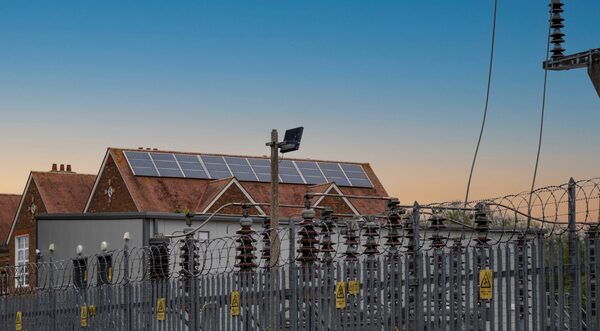
Connection times vary because the network is not uniform. Some areas have spare capacity at the local substation and can accept a new load quickly; others need reinforcement before a connection can be offered, and that work sits in a queue behind other schemes. The emissions intensity of the grid changes through the day and year as different generation mixes meet demand, which is a separate matter from capacity, but it illustrates how much the network's condition varies by time and place27.
The queue itself is a national issue. The National Audit Office warned that consumers face rising energy bills without urgent electricity grid upgrades, and that constraint costs could rise substantially by 203028. That warning bears directly on connection times, because a network under strain takes longer to release capacity for new demand.
There is movement on the information side. The National Underground Asset Register passed a year of operation with all seven electricity DNOs contributing data, mapping more than 3.2 million kilometres of buried assets with over 400 asset owners signed up29. Better records of what is already underground reduce the risk of surprises during excavation, which is one of the practical causes of delay on a connection job.
Policy is also shifting. The Department for Energy Security and Net Zero published draft social and environmental guidance to GEMA, with the revised guidance scheduled to come into effect after the parliamentary laying period30. For a household, the effect of all this is that a connection quote reflects not just the work at the property but the state of the network behind it, and that is why two similar applications can produce very different timescales.
Sources30 cited
- Domestic and homeowners connections guidance, NESO
- How we can help with network operators, Energy Ombudsman
- How much will my new supply cost, Electricity North West
- Scottish building regulations proposed changes, Scottish Government, 2021-07-23
- Electric vehicle charge points for new buildings consultation response, Transport Scotland, 2026-09-20
- Energy Consumer Outcomes proposed implementation, Ofgem, 2026-06-23
- Check if you can get payment for a power cut, Ofgem, 2026
- Customer standards, NIE Networks, 2026-09-19
- What to do in a power cut, Met Office
- Electrical safety and building regulations, Cumberland Council, 2026-09-17
- Building regulations and electrical works, Richmond Council, 2026-06-02
- Plug-in solar consultation document, GOV.UK, 2026-06-16
- Switch your home energy supplier, Ofgem, 2026
- Plug-in solar final interim product specification, GOV.UK, 2026-07
- Electric vehicle chargepoint grant for residential landlords, GOV.UK, 2026-09-18
- Approved Document S, GOV.UK, 2021
- Energy consumer experiences of customer service standards, Ofgem, 2026-06-23
- Benchmark Maximum Charges for Charge Restriction Period 12b, Ofgem, 2024-05
- Benchmark Maximum Charges for Charge Restriction Period 13a, Ofgem, 2025
- Energy price cap levels 1 July to 30 September 2026, Ofgem, 2026
- Smart Meter Guaranteed Standard statutory consultation, Ofgem, 2025-08-08
- Ofgem transformed to strengthen protections for energy consumers, GOV.UK, 2026-04-22
- Plan for a power cut, Ofgem, 2026
- Get compensation if you have a power cut, Citizens Advice, 2026-09-17
- How to find out if there's a power cut, Which?, 2026-06-04
- Electricity Safety, Quality and Continuity Regulations (Northern Ireland) 2012, Article 27, legislation.gov.uk, 2026-09-17
- Technical annex for chapter 2: what EPCs measure, GOV.UK, 2026-03-09
- Grid upgrade delays risk adding billions to energy bills, NAO warns, E&T, 2026-09-11
- Energy Live News, Energy Live News, 2026-09-16
- Draft strategic growth guidance for electricity networks consultation response, GOV.UK, 2026-11-17
 Getting a New Gas ConnectionHow a household applies for a new or upgraded gas connection, who carries out the work, the quotation and contribution rules, typical timescales, and what a connection means for a home's energy independence.
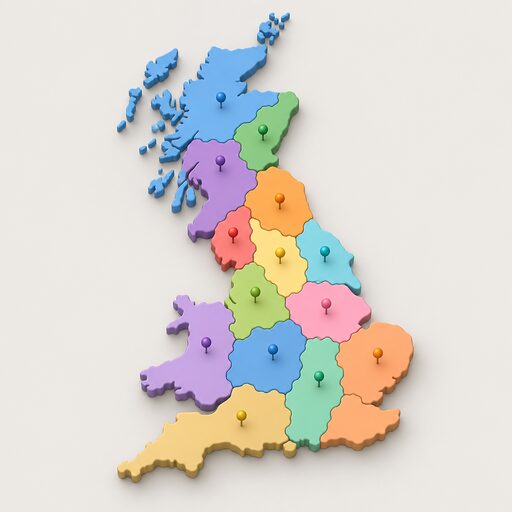 Unit Rates by RegionWhy do electricity and gas prices differ depending on where you live?
 Check Supply Capacity FirstAdding a heat pump, car charger or home battery can push your electricity supply past what it can safely handle.
 Network Operators and 105When the lights go out, who do you actually ring?
 Power Cuts in WalesWho do you call when the power goes out in Wales, and how long should it take to come back on?
 The Full Where to Start GuideWhich home improvements actually cut your bills, and which should you do first?