

In this guide
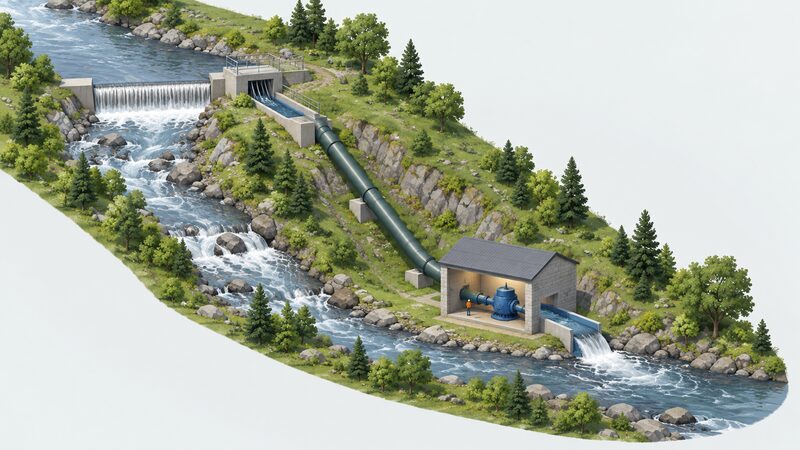
Hydropower is a small but old part of Britain's electricity supply. In Great Britain it made up just 2% of electricity generation in 20241, and an independent series puts hydro's share of UK electricity at 2.04% in 2024, against 1.87% in 2023 and 1.75% in 19902. Taking hydropower and tidal together, one parliamentary account put the combined share of UK electricity at 1.8% in 20233. Those numbers have barely moved in three and a half decades, which tells its own story: the best large sites in the Scottish Highlands and in Wales were developed long ago.
Pumped storage is the other half of the picture, and it is not a generator in the usual sense. It stores energy by pumping water into an upper reservoir when power is cheap or plentiful, then releases it through turbines when the system needs it. Pumped storage can generate electricity in quantities of gigawatts and deliver it very quickly, and hundreds of batteries would be needed to create the same power4. Wales alone has two operational pumped hydropower energy storage sites with a combined capacity of 2.1 GW and approximately 11 GWh of storage capacity5. Because pumped storage returns electricity that was drawn from the grid, official statistics count its output in the "oil and other fuels" line rather than among renewables: that line stood at 4.18% of UK electricity generation in 2024, 3.81% in 2023 and 6.47% in 19902.
For a household, neither technology is something you buy. Hydro and pumped storage act at national scale, firming up a grid that is increasingly wind-led, and the household benefit is indirect: a system that can ride through calm, dark evenings without burning gas. Only a small number of properties, with a watercourse and a usable drop, can generate hydroelectricity of their own.
What hydropower is, and why it counts as renewable
Hydropower uses moving water to turn a turbine. It is renewable because it uses the natural water cycle: rain and snowmelt refill the catchment, so the fuel is never consumed in the way coal or gas is1. Because it does not burn fossil fuels during operation, hydroelectric power produces very low greenhouse gas emissions once the system is running1.
The technique is far older than the grid. Hydropower or hydroelectricity, generated from dams, sluices and mill wheels, was used for many years to generate electricity in a local area, and this method of generation generally disappeared with the introduction of the electricity grid8. That is the key historical point for anyone asking why so many old mill sites sit idle: they were not exhausted, they were displaced by cheaper central generation delivered over wires.
Globally the picture is entirely different from the British one. Hydropower generates over 50% of renewable energy worldwide1, with one independent statistical summary putting hydro at more than half, 54%, of the world's renewable energy and nearly a fifth, 18%, of total global electricity9. Countries with large rivers and deep mountain valleys built their power systems around hydro; Britain built its own around coal, then gas, then wind.
The independence lens is worth stating plainly. Hydro is an indigenous resource: the rain falls here, no fuel is imported and no supplier contract sits behind it. Indigenous energy production fell by 1.0% in the period from February to April 202610, and every renewable that generates on UK soil offsets that. But hydro's contribution is capped by geography, and no amount of policy support changes how many suitable valleys exist.
Hydro's role in UK electricity: around 2% of generation
The fleet is concentrated where the rainfall and the relief are: Scotland and Wales, with smaller schemes elsewhere. The share it provides has been remarkably stable. Set against a grid where renewables provided a record 53.7% of electricity generation by Major Power Producers in the three months from September to November 202511, hydro's 2% looks marginal, and it is: wind and solar have done the heavy lifting of decarbonisation while hydro held steady.
Estimates of the overall renewable share differ by what is being measured and when. Official figures for 2024 record 51% of UK electricity generation from renewable sources and 14% from nuclear12. An independent guide puts renewables at around 35% of generation with nuclear at around 20%13, another estimates about 42% of the UK power grid coming from renewable sources with wind the biggest contributor14, and a further analysis of demand met puts it at around 38% renewables, 15% nuclear, 7% biomass and 30% fossil gas15. These are different metrics over different periods rather than a factual dispute, but the range is wide enough that a single quoted percentage should always carry its date.
| Share of UK electricity generation | 1990 | 2023 | 2024 |
|---|---|---|---|
| Hydro2 | 1.75% | 1.87% | 2.04% |
| Oil and other fuels, including generation from pumped storage2 | 6.47% | 3.81% | 4.18% |
New capacity arrives in small increments. In Wales, the community-owned 0.1 MW Bonwm Hydro scheme, commissioned in 2023, was the only hydropower project developed in the country that year, and it is expected to generate £220,000 for a local community benefit fund5. That is the shape of modern British hydro: single-digit megawatts at most, often community-owned, with local benefit rather than national scale as the argument for it. There may be fewer opportunities for new large-scale hydropower projects, but smaller schemes and community projects could provide local renewable electricity, energy storage and grid flexibility1.
Pumping water uphill: how pumped storage stores energy
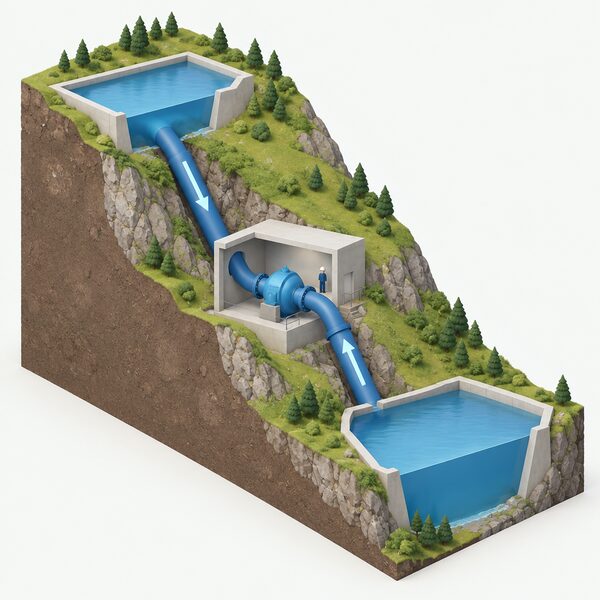
A pumped storage station has two reservoirs at different heights and reversible machines between them. When electricity is abundant, the machines act as pumps and move water to the upper reservoir, consuming power from the grid. When electricity is scarce or expensive, the water falls back through the same machines, now acting as turbines, and power flows the other way. Nothing is generated on balance: the plant is a store, and some energy is lost in each direction, which is why its output appears alongside oil and other fuels in the generation statistics rather than in the renewable column2.
What makes it valuable is the combination of size and speed. Pumped storage can generate electricity in quantities of gigawatts and deliver it very quickly, and hundreds of batteries would be needed to create the same power4. That is the distinction between pumped storage and grid-scale battery storage: batteries excel at fast, short bursts and at second-by-second frequency work, while pumped storage brings both scale and duration.
The stations are not always called on. A skip rate of 49% was recorded for pumped storage in May 20267, meaning that in roughly half of instances the plant was passed over when the system operator went looking for the response it had asked for. Skip rates matter commercially: a plant that is bypassed earns less than its technical capability suggests, which feeds back into the case for building more.
In planning terms the technology is formally recognised. Scotland's National Planning Framework 4 lists Pumped Hydro Storage as a national development in the North, in the North and West Coast and Islands, and in the Central area, describing it as extending hydro-electricity capacity to support the transition away from fossil fuels16. That designation is a planning signal rather than funding, but it places pumped storage in the same category as the transmission reinforcement it depends on.
The UK fleet: Scotland's glens and two Welsh sites
Britain's pumped storage stations are few and large, sited where a mountain and a reservoir already sat close together. Wales holds two of them. Those two operational pumped hydropower energy storage sites have a combined capacity of 2.1 GW and approximately 11 GWh of storage capacity, on the 2023 position5. Reading those two figures together gives the character of the fleet: very high power, moderate energy. At full output the Welsh sites would empty their upper reservoirs in a matter of hours, not days.
| Measure | Welsh pumped storage, 2023 | What it tells you |
|---|---|---|
| Combined capacity | 2.1 GW5 | How much power can be delivered at once |
| Storage capacity | approximately 11 GWh5 | How much energy is held, and so how long output lasts |
Scotland holds the remainder of the fleet, in the glens where the conventional hydro schemes were also built, and its planning framework treats further pumped hydro as a national priority across three separate spatial areas16. The detail of individual Scottish stations is covered on energy supply in Scotland; the Welsh position is set out on energy supply in Wales.
For the household, the practical consequence sits in the balancing services market and in electricity margins. Pumped storage is one of the few assets that can cover a sudden loss of generation at gigawatt scale within minutes, and it does so without gas. Its limit is duration: once the upper reservoir has run down, the plant needs cheap surplus power to refill, and the availability of that surplus depends on the weather and on wind output.
Long-duration storage at industrial scale: cap and floor and 7.6GW
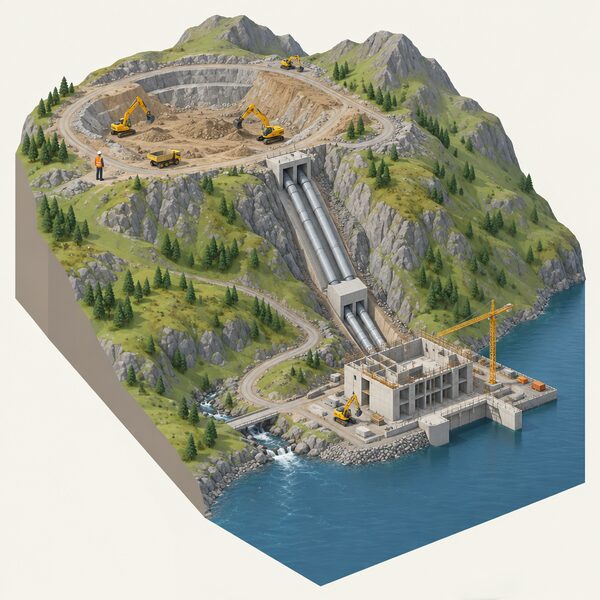
Pumped storage has long suffered from a financing problem. A scheme costs a great deal to build, lasts for decades and earns its money from price differences that no investor can forecast across that horizon. The policy answer has been a revenue guarantee. In March 2025 the government said it would introduce a cap and floor revenue support scheme for long duration energy storage technologies such as pumped storage hydro, compressed air energy storage, liquid air energy storage and flow batteries17. A floor gives a minimum revenue, a cap returns excess earnings, and between them they make a forty-year asset bankable.
That scheme has since begun to bite. By 26 June 2026, cap and floor investment support schemes were being provided to 7.6GW of new Long Duration Electricity Storage projects7. Pumped storage hydro is one of the named technologies eligible, alongside the newer options; the mechanism is examined in more detail on long-duration electricity storage.
What this means for household energy security is worth being exact about. Long-duration storage reduces the number of hours in which the system has to start a gas plant to cover a still evening, which in turn reduces exposure to international gas prices and to the wholesale market. It does not remove the household's dependence on the grid, a supplier or network charges. It shifts where the risk sits, from imported fuel towards domestic infrastructure and the time it takes to build.
Tidal power: less than 0.01% of UK electricity
Tidal energy is often described as a form of hydropower because it uses moving water to turn turbines6. It is a form of renewable energy that uses the natural movement of ocean tides to generate electricity, and it is renewable because those tides are caused by the gravitational pull of the moon and the sun, so the source is naturally replenished6. Its contribution today is very small: tidal power currently makes up less than 0.01% of energy generation in the UK6. The parliamentary figure of 1.8% for hydropower including tidal in 2023 is therefore almost entirely hydro3.
The case for tidal rests on predictability rather than volume. Tidal energy is highly predictable, because tides follow regular patterns, so generation can produce a relatively consistent amount of electricity compared with some other renewables6. It does not rely on burning fossil fuels, so these systems do not produce greenhouse gas emissions during operation, and although setting up a plant can be expensive, ongoing maintenance and operation costs are often relatively low once the system is in place6.
The constraints are equally clear:
- Tidal systems depend on location and can only be built in areas with strong, consistent tides, limiting where projects can be developed6.
- Building tidal electricity generation systems requires major infrastructure and specialist engineering6.
- Tidal barrages can affect local marine ecosystems, for example by disrupting fish migration, changing water flow, or affecting habitats for aquatic life6.
Support has come through auctions rather than direct grants. In 2023, four tidal stream developers received Contracts for Difference for projects totalling over 22 MW5, a route described further on contracts for difference. For most households, tidal energy would not directly change day-to-day electricity use, but it could affect consumers indirectly by supporting a more diverse low-carbon grid over time6.
Tidal lagoons and the Swansea Bay story
A tidal lagoon impounds a body of seawater behind a breakwater and lets the tide fill and empty it through turbines. The best-known British proposal was at Swansea Bay, which obtained planning permission in 2015. In June 2018 the government decided the project was not cost effective and did not proceed with it. No lagoon has been built in the UK since.
Welsh policy has continued to probe the question rather than abandon it. In March 2023 the Welsh Government opened its £750,000 Tidal Lagoon Challenge Fund, aimed at projects addressing barriers to, or quantifying the benefits of, tidal range schemes5. The sum is modest by the standards of energy infrastructure, and it is explicitly a research and development fund rather than construction money: it buys evidence about whether the barriers are surmountable.
The Swansea Bay episode is the clearest illustration of tidal's central difficulty. The resource is real, the output would have been predictable, and the engineering was understood. What failed was the cost comparison against offshore wind, whose price fell through the same decade. Any future lagoon has to clear that same test.

Could a household generate its own hydroelectricity?
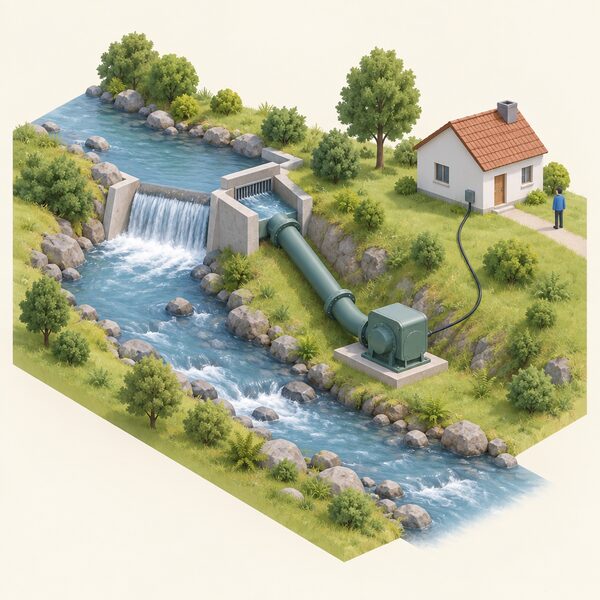
Only a small minority of properties can. The viability of an installation depends on whether there is enough water flowing per second and the height, or head, that the water falls from8. Both matter: a large flow with almost no drop, or a steep drop with a trickle, will not produce useful power. There should also be enough residual flow to maintain the watercourse8, so a scheme cannot take everything the stream offers even where the hydrology looks generous.
Two prerequisites sit before any turbine. The first is fabric. Official guidance is direct on the point:
The second is regulatory: various consents and licences are required for a hydro project8. A hydro scheme abstracts and impounds water, alters a watercourse and usually involves permanent civil works, so it engages the planning authority and the relevant environmental regulator, and the requirements differ between England, Scotland, Wales and Northern Ireland. A listed building or a site with heritage protection brings listed building consent into the picture as well.
On money, no published typical price exists for a domestic hydro installation, because the civil works, the pipework run and the grid connection are site-specific. Prices are installer-quoted. For a sense of scale in domestic generation and storage generally, battery storage costs are estimated at up to £10,000 depending on size, with a typical 5kWh system around £4,60018.
Two financial frameworks touch small hydro:
- Export payment. Technologies supported by the Smart Export Guarantee include solar PV, wind, micro-CHP, hydropower and anaerobic digestion, up to 5 megawatts in capacity, and installations must be located in Great Britain19.
- The closed predecessor. The Feed-in Tariff scheme covered small-scale renewable and low-carbon technologies up to a Total Installed Capacity of 5MW in England, Wales and Scotland20. It is closed to new applicants; existing generators continue under the Feed-in Tariff and related legacy schemes.
- VAT. Water turbines are listed among energy-saving materials in the VAT legislation21, and were reinstated as energy-saving materials in Great Britain from 1 April 202222.
A household hydro scheme, where one is possible, is the most continuous form of domestic generation available: it runs day and night as long as water flows. The dependence that remains is real, though. The turbine, inverter and controls come from a manufacturer, the export payment comes from a supplier, and grid-connected schemes still rely on the distribution network to absorb what is exported and to supply the home when the stream runs low in summer.
What hydro and tidal mean for net zero and energy independence
Great Britain is working towards net zero by 20501, and hydro's part in that is stabilising rather than transformative. It provides firm, dispatchable, domestically fuelled output in a grid that is increasingly weather-driven, and pumped storage provides the means to move surplus renewable power from one part of the day to another without gas. Those are structural contributions that a percentage share understates.
The limits should be stated as firmly. Hydro has been near 2% of UK generation for decades2, tidal remains below 0.01%6, and there may be fewer opportunities for new large-scale hydropower projects in the UK1. The growth in the sector is concentrated in storage rather than generation, which is why the 7.6GW of long-duration storage projects receiving cap and floor support7 is the more consequential number for the next decade than any figure for new hydro capacity.
For a household, the honest conclusion is that hydropower and pumped storage improve the resilience and carbon content of the supply arriving at the meter, without changing the household's relationship to it. Self-generation from water is available to very few homes and is governed by consents that reflect the shared nature of a watercourse. The broader question of what a home can actually control is covered on energy security and household independence, and the mix these plants sit within on the UK electricity generation mix and the pillar page on UK energy supply.
Sources22 cited
- What is hydropower and how does it work, Smart Energy GB, 19 August 2026
- UK energy statistics, Uswitch, 17 December 2025
- Marine and hydro energy briefing, UK Parliament POST, 2023
- How does storage help us balance the grid, NESO, 17 September 2026
- Energy generation in Wales 2023, Welsh Government, February 2025
- How does tidal energy work, Smart Energy GB, 19 August 2026
- Clean Flexibility Roadmap, July 2026 update, GOV.UK, 26 June 2026
- Hydropower, nidirect, 17 September 2026
- Green energy statistics, Uswitch, 12 November 2024
- Energy Trends and Prices statistical release, 30 June 2026, GOV.UK, 30 June 2026
- Energy Trends and Prices statistical release, 29 January 2026, GOV.UK, 29 January 2026
- Electricity generation debate pack, House of Commons Library, 2025
- Decarbonisation of heat, Energy Systems Catapult, 27 June 2025
- Home energy efficiency key terms explained, Development Bank of Wales, 17 October 2024
- What's in an energy bill: wholesale costs, Nesta, 22 November 2024
- National Planning Framework 4, Scottish Government, 13 February 2023
- Long duration energy storage briefing, House of Commons Library, March 2025
- Domestic energy storage briefing, UK Parliament POST, 25 June 2026
- Smart Export Guarantee briefing, House of Commons Library, 13 May 2026
- Guidance for Feed-in Tariff generators, Ofgem, 1 April 2026
- VAT Act 1994, Schedule 8, energy-saving materials, legislation.gov.uk, 1 May 2023
- VAT on energy-saving materials, HMRC, 1 April 2022
 Community Wind and HydroExplains how community-owned wind and hydro projects are organised, financed and shared with local households, and the scale of installed community capacity across the UK.
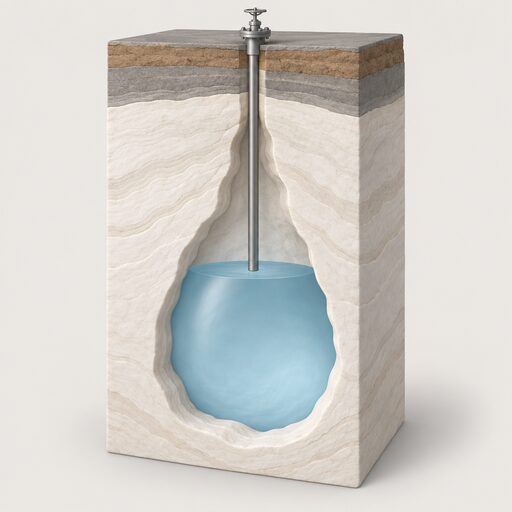 UK Gas StorageHow much working gas storage Great Britain holds, what the eight remaining sites do, how storage is filled and drawn down across a winter, and how Britain's position compares with continental Europe.
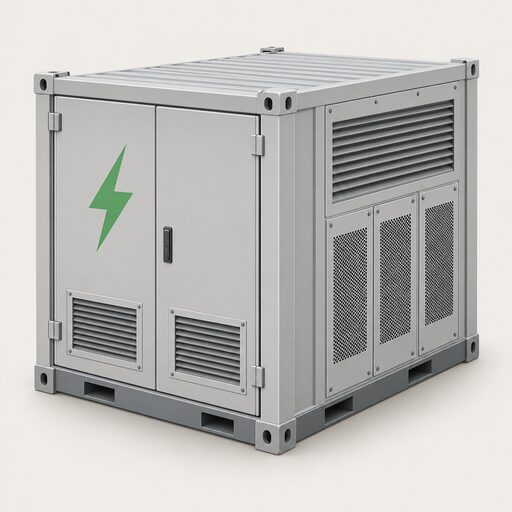 Grid-Scale Battery StorageConnected and pipeline battery capacity in Great Britain, what these assets are paid to do, how long they can run, and how grid batteries differ in purpose and scale from a home battery.
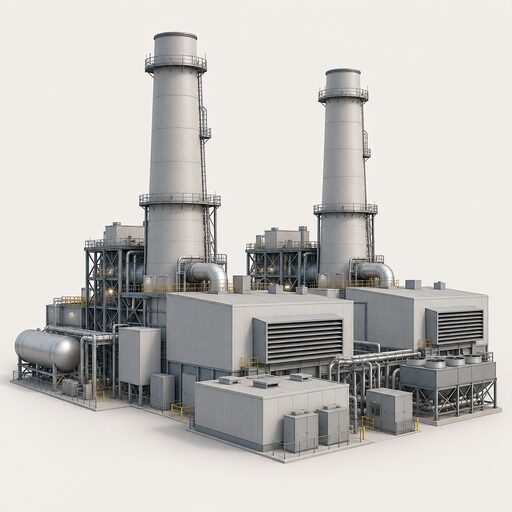 UK Electricity Generation MixBreaks down the shares of gas, wind, nuclear, solar, biomass, hydro and imports in UK electricity generation, how those shares move by hour and season, where the published figures come from, and what the mix means for a household's energy independence.
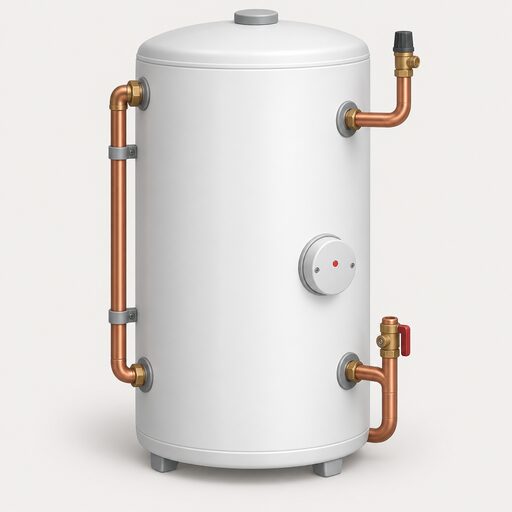 Air-to-Water Wet SystemsAir-to-water heat pumps feed radiators, underfloor heating and a hot water cylinder, and are the most common domestic heat pump in the UK.
 The Full Statistics GuideHow many homes in the UK have solar panels, heat pumps or batteries?