In this guide
A hydro scheme on a stream or river is a licensed activity before it is an engineering project. Taking water to drive a turbine is an abstraction, and holding the land, or the fishing rights, or the riverbank does not remove the requirement. Northern Ireland's official guidance is blunt about the sequence: "Various consents and licences are required for a hydro project."1 Planning permission and the water consent are separate approvals, granted by different bodies, and both are normally needed.
The regulator depends on where the water is. The Environment Agency covers England, the Scottish Environment Protection Agency covers Scotland, Natural Resources Wales covers Wales, and the Northern Ireland Environment Agency covers Northern Ireland. Each sets its own conditions, including the residual flow that must be left in the channel, and each decides how much water a scheme may take and when. There is no single UK-wide licence.
Two physical numbers decide whether a scheme is worth consenting at all: the flow available per second and the head it falls from. Northern Ireland guidance states that "The viability of the installation will depend on whether there is enough water flowing per second and the height or 'head' that it falls from."1 Consents come after that assessment, not before it, because a licence for a site that cannot produce useful power is an expense with no return.
Why a hydro scheme needs consents before anything else
The consent stage is not paperwork that follows the decision to build. It is the decision. A licence fixes the maximum volume a scheme may abstract, the seasons in which it may operate, and the flow that must be left in the channel at all times. Those three conditions together determine the turbine's output, and therefore the cost per kilowatt hour over the scheme's life. A household that buys a turbine before the licence is granted is buying against an unknown duty.
The same principle runs through the wider microgeneration rules. Planning approval is needed for small-scale wind turbines4, and permitted development rights for wind turbines and air source heat pumps are only accorded for equipment installed by an installer certificated through the Microgeneration Certification Scheme, using a certificated product5. Consents and certification are the gate, not the afterthought.
Hydro sits inside a broader consent landscape that also covers water-based heating. Open loop heat pump systems, which abstract and discharge water, require an abstraction licence if more than 20 cubic metres per day is taken6. That threshold is a useful marker of how seriously the regime treats water taken from a source, even where nothing is consumed. A hydro turbine returns its water downstream, but it still abstracts it first.
There is also a heritage layer. If the property is listed, listed building consent is usually needed before installing an air source heat pump, even where planning permission is not required7, and permitted development rights do not apply for such installations within the curtilage of a listed building, so planning permission and listed building consent must both be applied for8. A hydro scheme on a listed mill or estate building inherits the same logic.
What an abstraction licence actually permits
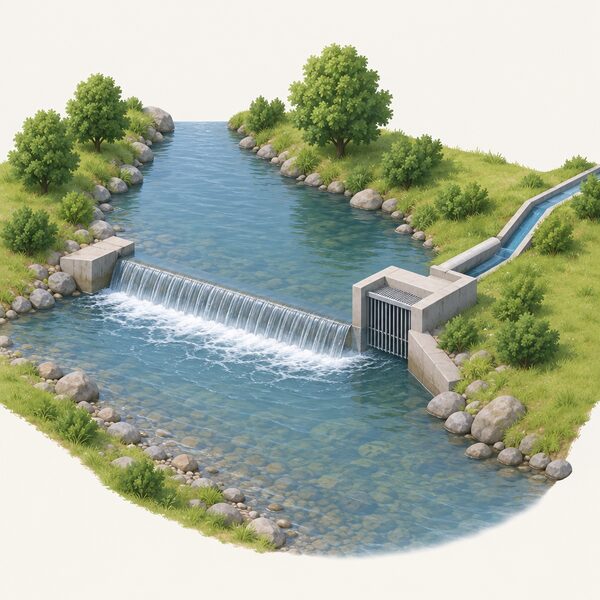
An abstraction licence permits the taking of water from a specified source, up to a stated quantity, subject to conditions. It is not a general permission to use the river. The licence names the point of abstraction, the maximum rate and volume, and the conditions under which abstraction must stop or reduce. For a hydro scheme, the practical effect is a cap on the water available to the turbine at any moment, which is why the licence and the turbine specification have to be designed together.
Impoundment is the second consent. Where a scheme needs a weir, a pond, a barrage or any structure that raises or holds back water, that is impoundment and it is licensed separately from abstraction. A run-of-river scheme with a small intake may need both. The distinction matters because impoundment consents engage with fish passage, sediment movement and flood risk in ways that a pure abstraction consent does not.
The regime is not uniform across the UK. Legislation relating to the energy performance of buildings is devolved in Scotland and Northern Ireland, while competition law and consumer protection law are reserved to the UK Government9. Water regulation is devolved in practice across all four nations, so the licence conditions, the application forms and the timescales differ by regulator. A scheme on a border watercourse, or a household comparing a site in two nations, is comparing two regimes.
The financial treatment of hydro equipment also differs by nation. Water turbines qualify for a lower rate of VAT in Great Britain only3, and in Northern Ireland they do not qualify, attracting VAT at 20 per cent3. Water turbines are listed as energy-saving materials in the relevant legislation10, and the reduced rate for the installation of wind turbines and water turbines was withdrawn11. The current position is set out in the 2022 regulations12. The VAT position is a live example of how a UK-wide technology can carry different costs depending on where the water flows.
Viability first: flow, head and residual flow
Before any application, the two physical variables have to be measured. Northern Ireland guidance states that viability depends on whether there is enough water flowing per second and the height or head it falls from1. Flow is the volume passing a point per second; head is the vertical drop the water can be made to fall through. Power rises with both, and a site with modest flow but good head can outperform a high-flow, low-head site.
The residual flow condition then reduces the flow available. Guidance states that there should also be enough residual flow to maintain the water course1. That is a principle rather than a figure: the actual hands-off flow is set by the regulator for the specific watercourse, and it is written into the licence. In practice it means the turbine is designed around the flow remaining after the residual flow is deducted, not around the total flow in the river.
The consequence for a household is that the licence condition, not the turbine, sets the ceiling on generation. A scheme sized on the winter peak will spend much of the year constrained by the residual flow condition. A scheme sized on the flow that is reliably available after the condition is met will produce less at peak but run more of the year. The regulator's condition is therefore the first input to the sizing calculation, and it should be obtained before any equipment is specified.
"The viability of the installation will depend on whether there is enough water flowing per second and the height or 'head' that it falls from."
Environment Agency and SEPA: who regulates what, where

The four nations have four regulators, and the boundaries between them are not always obvious to a householder.
| Nation | Water regulator | Notes |
|---|---|---|
| England | Environment Agency | Abstraction and impoundment licences for English watercourses |
| Scotland | Scottish Environment Protection Agency (SEPA) | Separate regime; Home Energy Scotland provides advice, administered by the Energy Saving Trust on behalf of the Scottish Government14 |
| Wales | Natural Resources Wales | Devolved water regulation |
| Northern Ireland | Northern Ireland Environment Agency | Guidance published by nidirect1 |
The Environment Agency also runs functions beyond water. It runs the HFC quota system for the whole of Great Britain15, which illustrates that some environmental regulation is GB-wide while water consents are not. A household should not assume that a body with a GB-wide role in one area has a GB-wide role in another.
Scotland's position is distinct in another way. Home Energy Scotland is administered by the Energy Saving Trust on behalf of the Scottish Government14, and it is an advice service rather than a consenting body. SEPA is the regulator for the water consent itself. Households in Scotland therefore deal with two organisations for two different purposes, and neither substitutes for the other.
For general enquiries about the Energy Company Obligation, Ofgem publishes a contact address at eco@ofgem.gov.uk for all other questions16, and a separate address at laflex@ofgem.gov.uk for LA flex compliance, declarations, notifications and statements of intent16. These are not water regulators, but they are the published contact routes for the energy efficiency schemes that often sit alongside a hydro project. Bristol City Council publishes 0117 922 3000 for listed building alteration enquiries17, which is the kind of local contact a hydro scheme on a listed property may need.
What a small scheme can power: lighting and household appliances
A micro hydro plant is unusual among domestic renewables in the steadiness of its output. Guidance notes that for houses with no mains connection but with access to a micro hydro site, a good hydro system can generate a steady, more reliable electricity supply than other renewable technologies at a lower cost18. It also states that useful power may be produced from even a small stream18. The combination of steady output and small resource is what makes hydro attractive off grid.
The scale of what is possible should be read against the wider range of small generators. Individual wind turbines vary in size and power output from a few hundred watts to two or three megawatts, where one megawatt equals 1,000 kilowatts4. A domestic hydro scheme sits at the small end of that spectrum, but unlike wind it can run continuously where the flow is reliable.
Export is possible where the scheme is grid connected. The Smart Export Guarantee supports solar photovoltaics, wind, micro-combined heat and power, hydropower and anaerobic digestion, up to 5 megawatts in capacity, or up to 50 kW for micro-CHP, and installations must be located in Great Britain2. Ofgem's guidance for SEG licensees sets out the supplier obligations19, and the scheme requires licensed electricity suppliers to offer export tariffs to anaerobic digestion, hydro, onshore wind and other eligible technologies20. Hydro installations of any capacity up to 5MW apply to Ofgem for ROO-FIT accreditation under the Feed-in Tariff21, and the eligible sources for that route include hydro up to 5MW21.
For a household, the practical picture is that a small hydro scheme can cover lighting and household appliances continuously, and export the surplus where a grid connection exists. Where there is no mains connection, the same steady output is what makes battery storage and direct use practical. The limit is the licence condition, not the turbine.
Insulation before installation

Official guidance advises making sure a property is properly insulated before installing renewable technologies1. The order matters because generation is the expensive way to meet a heat demand that fabric measures could have removed. A well-insulated house needs a smaller turbine, a smaller licence volume and a smaller capital outlay for the same level of comfort.
The same sequencing appears in the planning rules for related technologies. Only the first installation of any wind turbine would be permitted development, and only if there is no existing air source heat pump at the property22, and the same condition applies to building-mounted turbines23. Additional wind turbines or air source heat pumps at the same property require an application for planning permission23. The rules assume a household will install one generating or heating technology and then stop, which is a reason to get the fabric right first.
There is a devolved dimension to this. Legislation relating to the energy performance of buildings is devolved in Scotland and Northern Ireland, while competition law and consumer protection law are reserved to the UK Government9. Energy performance certificates and the standards attached to them therefore differ by nation, and a household in Scotland or Northern Ireland is working to a different framework from one in England.
Hydropower's place in the UK's net zero path
Hydro is a small part of the national picture but a durable one. The Climate Change Committee's Balanced Net Zero Pathway for UK building heat demand in 2050 puts heat networks at 42 per cent and hydrogen boilers at 5 per cent24, which shows how much of the decarbonisation challenge is expected to be met by infrastructure rather than individual generation. Hydro sits outside that split, as a source of electricity rather than heat.
In Northern Ireland, the Committee's pathway finds that more than half, 55 per cent, of the reduction in emissions required to meet the Fourth Carbon Budget is delivered by electrification, rising to 5 per cent of that needed to meet the 2050 Net Zero target25. Electrification on that scale depends on generation, and small hydro is one of the few renewable sources that can run continuously without storage.
The UK government's response to the Committee's progress report sets out the clean energy superpower mission26, and the wider pipeline includes over 25 GW of floating offshore wind based on confirmed seabed exclusivity, the largest such pipeline worldwide26. That is the scale of the national programme. A domestic hydro scheme is not a contribution to it in capacity terms, but it is a contribution to the household's own independence from it.
The historical arc is instructive. Hydropower generated from dams, sluices and mill wheels was used for many years to generate electricity in a local area1, and this method of generation generally disappeared with the introduction of the electricity grid1. The resource did not fail; the economics of a central grid displaced it. Rising grid costs and decarbonisation targets are the conditions under which local generation becomes worth revisiting.
Where to start: contacting the regulator
The first step is to establish which regulator covers the watercourse, then to ask what the residual flow condition is likely to be before any equipment is specified. The Environment Agency covers England, SEPA covers Scotland, Natural Resources Wales covers Wales, and the Northern Ireland Environment Agency covers Northern Ireland. Home Energy Scotland, administered by the Energy Saving Trust on behalf of the Scottish Government14, is the advice route in Scotland.
The second step is to confirm the planning position. Planning approval is needed for small-scale wind turbines4, and hydro schemes typically need consent for structures as well as the abstraction. Where the property is listed, listed building consent is usually needed before installing an air source heat pump even if planning permission is not required7, and permitted development rights do not apply within the curtilage of a listed building, so planning permission and listed building consent must both be applied for8. Adding renewable energy solutions might be acceptable but will require listed and or planning consent17.
The third step is to check the certification route. Permitted development rights for wind turbines and air source heat pumps are only accorded for equipment installed by an installer certificated through the Microgeneration Certification Scheme using a certificated product5. Where a turbine is not attached to the house, only the electrical installation and connection will be captured by the requirements of the building regulations27, and an installer registered with the relevant competent person scheme may be authorised to self-certify the work without involving local authority building control27.
For related reading, micro hydro power for homes covers how a scheme works, head and flow covers the sizing calculation, and fish passage, screening and environmental requirements covers the environmental consents that sit alongside the abstraction licence. The microgeneration pillar sets out how hydro compares with wind, micro-CHP and fuel cells.
Sources27 cited
- Hydropower, nidirect, 2026-09-17
- Smart Export Guarantee guidance for generators, Ofgem, 2026-05-13
- Tax on shopping: energy-saving products, GOV.UK, 2026-09-17
- Wind, nidirect, 2026-05-18
- The Microgeneration Certification Scheme, Planning Portal, 2026
- Open loop heat pump systems: permits, consents and licences, GOV.UK, 2016-02-01
- Draft exemption conditions for closed loop ground source heat pump activities, Defra, 2026-09-17
- Air source heat pumps, Westmorland and Furness Council, 2026-09-17
- Edinburgh Local Heat and Energy Efficiency Strategy, City of Edinburgh Council, 2026-09-17
- Energy Act 1994, Schedule 8, Part II, legislation.gov.uk, 2026-09-17
- Draft TIIN: VAT changes to the reduced rate for energy-saving materials, HM Treasury, 2026-09-17
- The Value Added Tax (Installation of Energy-Saving Materials) Order 2022, legislation.gov.uk, 2022-03-23
- Explanatory Memorandum to the Value Added Tax Order 2022, legislation.gov.uk, 2026-09-17
- EPC reform consultation: government response, Scottish Government, 2025-01-21
- Planning permission: wind turbines, Welsh Government, 2026-09-17
- Making alterations to a listed building, Bristol City Council, 2026-09-17
- Heat pumps, New Forest District Council, 2026-09-17
- Hydro electricity, Planning Portal, 2026
- Guidance for SEG licensees, Ofgem, 2019-12-12
- FIT guidance for licensed electricity suppliers, Ofgem, 2024-09-06
- Feed-in Tariff guidance for renewable installations, Ofgem, 2016-06-20
- Planning permission: stand alone wind turbines, Planning Portal, 2026-09-17
- Building-mounted wind turbine permitted development rules, Planning Portal, 2026-09-17
- Northern Ireland's fourth carbon budget, Climate Change Committee, 2025-03-19
- Accelerating to net zero: government response to the CCC progress report, GOV.UK, 2024-12-17
- Energy Company Obligation: contacts, guidance and resources, Ofgem, 2026-09-17
- Building regulations, Planning Portal, 2026
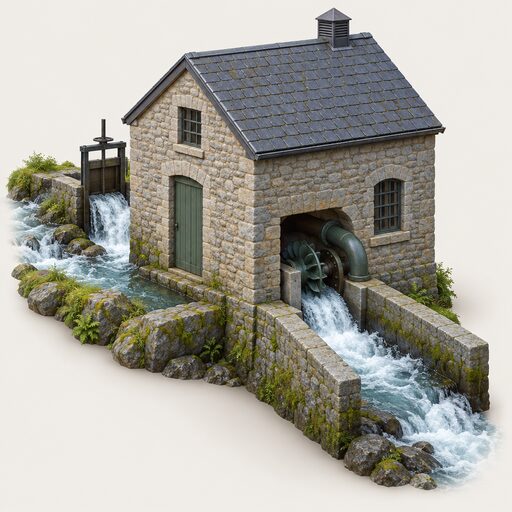 Micro Hydro Power for HomesA stream on your land that flows all year can make steady electricity, day and night, even when there is no sun or wind.
 Micro Hydro InstallationHow much water do you need, and how far does it have to fall, for a micro hydro system to be worth it?
 G98 and G99 Grid ConnectionConnecting a wind turbine, hydro turbine or micro-CHP unit at home raises the question of whether it needs G98 or G99.
 Off-Grid Water and WasteWhere does your water come from if there is no mains supply, and where does everything you flush away actually go?
 Water Source Heat PumpsYour home sits near a river, lake or the sea.
 Permitted Development RightsDo you need planning permission for solar panels or a heat pump?