
In this guide
Micro-CHP is a heating appliance that produces electricity as a by-product. A domestic unit generates about 1kW of electricity while it is running, according to Northern Ireland's official guidance, and it is gas-fired1. That single figure explains both the appeal and the arithmetic: the electricity arrives only when the boiler is heating the house, so the value of a unit depends on how many hours a year the home calls for heat.
The cost side is simpler than the output side. Servicing sits in the same band as an ordinary boiler, at around £90 to £100 typically, or £80 to £120 including VAT for a gas boiler2. The purchase price is the harder number: no published UK list price appears in the official and independent record, so a micro-CHP unit is installer-quoted, and the capital figure has to be obtained from an MCS certified installer rather than read off a page.
What follows sets out the output, the cost structure, the running-cost claims, the fuels, the installation route, the export rules and the planning position, and then looks at how much electricity a UK unit actually generates in a year.
What micro-CHP is: heat first, electricity as a by-product
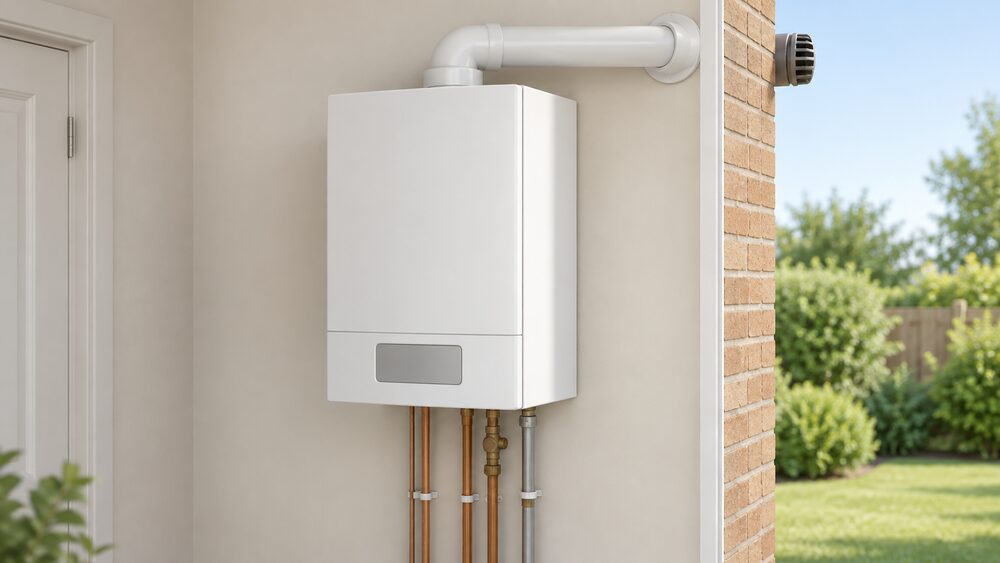
A micro-CHP unit is a boiler that also generates. It burns a fuel to heat the home and, in the process, drives a generator that produces electricity for the property. The heat is the primary product; the electricity is the secondary one. That ordering matters commercially, because it means the unit is sized to the home's heat demand, and the electrical output follows from that sizing rather than from a separate decision.
The technology is recognised in official scheme rules. One approved innovation measure is described as a domestic sized micro Combined Heat and Power (mCHP) unit that contains a low temperature fuel cell6. That places fuel cell units inside the same policy framework as engine-driven and Stirling engine designs, which are covered on the micro-CHP types page.
Northern Ireland's guidance is the clearest official statement of what a unit does in a home: a CHP unit is gas-fired, and it generates about 1kW of electricity while it is running1. Domestic sized models are now available1. The same guidance frames the technology as a heating appliance first, which is the correct way to read every cost and saving figure that follows.
For a household's energy independence, the position is mixed and worth stating plainly. A micro-CHP unit reduces the electricity drawn from the grid while it runs, which is a real reduction in dependence on a supplier for those hours. It does not remove dependence on the gas grid, on a gas supplier, or on the manufacturer for parts and servicing. It is not an off-grid technology. A unit that generates only when the heating is on cannot carry a home through a summer week, and it has no storage of its own.
Output: around 1kW while running, against scheme limits of 2kW and 50kW
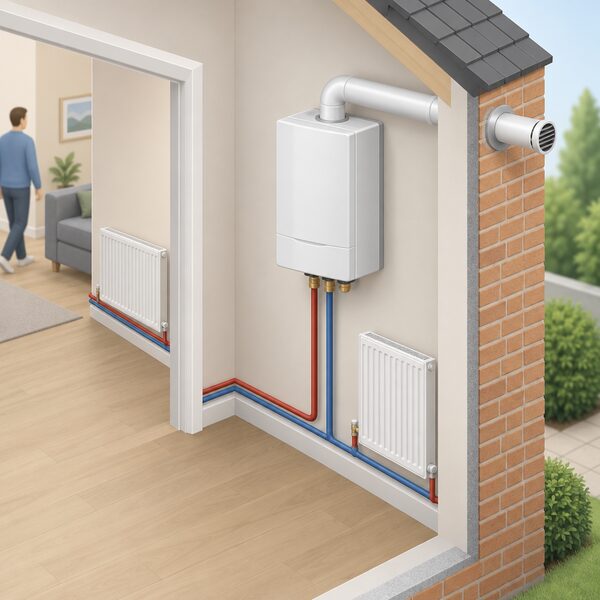
The headline output figure is about 1kW of electricity while the unit is running1. That is the number to hold on to, because everything else about the economics flows from it. A unit running for 2,000 hours a year at that rate would produce roughly 2,000 kWh of electricity, but the actual running hours depend on the home's heat demand, the outdoor temperature and the control settings, and no official figure for typical annual UK generation appears in the record.
The capacity limits set by the support schemes give a second view of the scale. Under the Feed-in Tariffs scheme, installations could have a Total Installed Capacity up to 5MW, or 2kW for micro-CHP4. The same 2kW ceiling appears in the scheme's guidance for licensed suppliers and in the decision on replacement generating equipment, where it is expressed as 2kW combined total installed capacity for an accredited installation and any extensions7. The Smart Export Guarantee takes a different approach: micro-CHP installations must be no more than 50 kW total installed capacity, with the exception carved out explicitly3. The Feed-in Tariffs closure guidance uses the 2kW figure for the MCS route8.
The two limits are not in conflict so much as different in purpose. The 2kW figure is the micro-CHP threshold under the Feed-in Tariffs scheme, which is closed to new applicants. The 50 kW figure is the Smart Export Guarantee ceiling, which is the live route for export payments. A household looking at a unit today is dealing with the 50 kW limit, and any domestic unit will sit far below it.
Cost: more than a traditional boiler, with servicing similar to a standard one
The servicing side of micro-CHP cost is well documented and reassuring. A gas boiler service runs at £80 to £120 including VAT, and typically around £90 to £1002. The average cost of a boiler service varies from around £90 to £100, and one trade figure puts the average at £100 including VAT as of March 20262. Oil boiler servicing is typically around £90 to £95, and an electric combi boiler around £902. A micro-CHP unit is a more complex appliance than a heat-only boiler, but the servicing market prices it in the same band.
The purchase and installation cost is where the record is thin. No official or independent UK figure for the capital cost of a domestic micro-CHP unit appears in the available sources, and no published price is available. Prices are installer-quoted. That is not a dodge: it reflects the reality that a unit is specified to the home, and the quote covers the appliance, the flue, the controls and the labour together.
What can be said with confidence is the direction of travel. A micro-CHP unit costs more than a traditional boiler, because it contains a generating set or a fuel cell stack in addition to the heat exchanger and burner. The servicing cost, by contrast, is similar to a standard boiler. That combination, a higher capital figure and a normal servicing figure, is the shape of the cost structure.
| Item | Figure | Source basis |
|---|---|---|
| Gas boiler service | £80 to £120 including VAT, typically around £90 to £100 | Independent guidance2 |
| Average boiler service | £100 including VAT as of March 2026 | Independent guidance2 |
| Oil boiler service | Typically around £90 to £95 | Independent guidance2 |
| Electric combi boiler service | Typically around £90 | Independent guidance2 |
| Micro-CHP unit purchase | Installer-quoted, no published UK price | No official or independent figure available |
For independence, the cost structure means the household is buying a generating asset bundled into a heating appliance. The capital outlay buys a reduction in imported electricity during the heating season, and nothing more. It does not buy storage, and it does not buy a hedge against gas prices, because the unit runs on gas.
Running costs and claimed savings of up to 30 per cent on energy bills
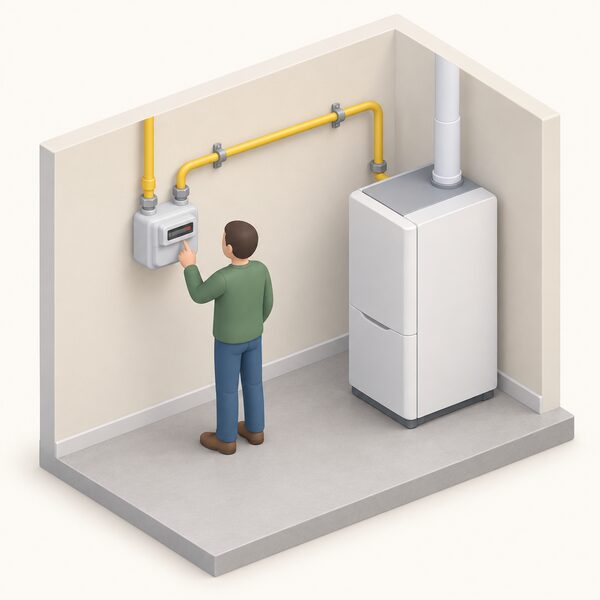
Savings claims for micro-CHP need to be read carefully, because the headline percentages in the record come from schemes and strategies rather than from measured micro-CHP performance. The Scottish Government's SME Loan and Cashback scheme offered a 30 per cent cashback grant up to £10,000 for energy efficiency measures9. That is a grant rate, not a micro-CHP saving, and the two should not be conflated.
The measured savings that do exist for micro-generation are modest. Under ECO3, micro-generation delivered £27.91 in lifetime bill savings, representing 0.4 per cent of measures and 1,712 installations, or 0.2 per cent10. First time central heating, by comparison, delivered £500.38 in lifetime bill savings across 27,472 installations10. Those figures are for the ECO3 scheme population and are not a micro-CHP performance claim, but they show the scale of saving that a micro-generation measure has historically been credited with.
At the level of the whole housing stock, the numbers are larger. Almost £24bn of consumer bill savings is included in a £40bn figure for EPC Band C retrofit benefits11. That is a modelled national total, not a per-household figure, and it covers the full retrofit package rather than micro-CHP alone.
The running-cost arithmetic for a micro-CHP unit is driven by three things: the price of the fuel it burns, the price of the electricity it displaces, and the number of hours it runs. The energy price cap for a dual-fuel home with typical usage in Great Britain paying by direct debit was around £1,758 for 1 January to 31 March 202612. Some households saw a small increase in standing charges of up to £20 per year for a typical dual fuel consumer from 1 April13. Those are the baseline bills against which any saving is measured.
Fuels and where a unit fits: gas, LPG, oil or bio-liquids in a family home
The official position on fuel is narrow: a CHP unit is gas-fired1. That is the technology as described in Northern Ireland's guidance, and it reflects the dominant UK product design, which burns mains gas.
For homes off the mains gas grid, the wider fuel picture is LPG, oil or bio-liquids. The Alternative Fuel Payment was a one-off £200 credit on energy bills from February 2023 for households using alternatives to mains gas for heating, such as heating oil, LPG or coal14. That payment is a marker of how many UK homes sit outside the gas grid and what they burn instead.
The cost of those alternative fuels is substantial. Bulk propane for a three-bed semi-detached house in Great Britain was put at £1,800 to £2,200 a year as of March 202615. That is the running-cost context for any LPG-fired unit, and it is far above the £1,758 typical dual-fuel bill under the price cap for 1 January to 31 March 202612.
Where a unit fits is a question of heat demand as much as space. A family home with a steady winter heating load gives a micro-CHP unit the running hours it needs to generate meaningful electricity. A small, well insulated property with a low heat demand gives it few hours, and therefore little output. The unit is a poor fit for a home that heats intermittently or that has already been retrofitted to a very low heat demand.
| Fuel | Annual heating cost | Basis |
|---|---|---|
| Mains gas, typical dual-fuel home | Around £1,758 | Price cap, 1 January to 31 March 202612 |
| LPG (bulk propane), three-bed semi-detached | £1,800 to £2,200 | Great Britain regions, March 202615 |
| Alternative Fuel Payment | One-off £200 credit | Households using oil, LPG or coal, February 202314 |
Installation: little difference from fitting a regular boiler, but use an MCS-approved installer
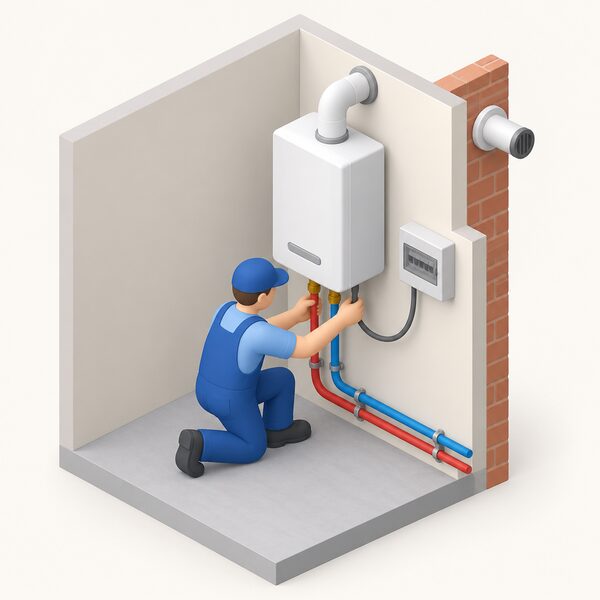
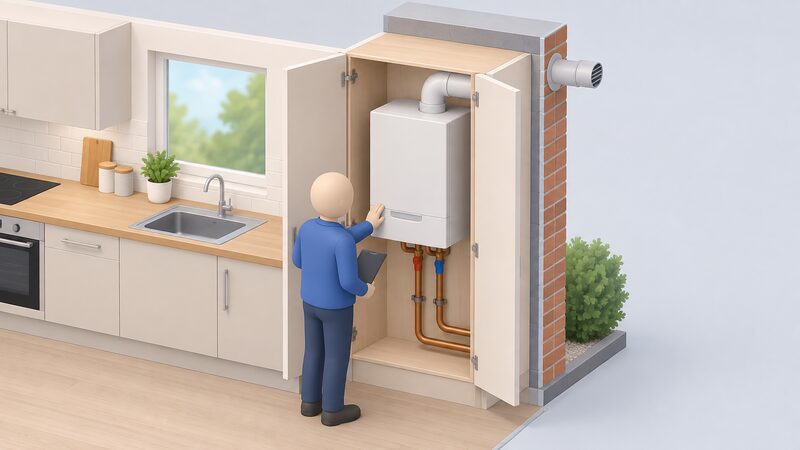
Fitting a micro-CHP unit is close to fitting a regular boiler in practical terms. The appliance takes the place of the boiler, connects to the same heating circuit and draws on the same fuel supply. The differences are the electrical connection, which must be made under the relevant connection standard, and the flue, which has its own rules.
The installer route is the part with a clear official answer. Only Microgeneration Certification Scheme (MCS) registered installers can access the Boiler Upgrade Scheme16. That statement is about the Boiler Upgrade Scheme specifically, but it establishes the principle that MCS registration is the recognised quality mark for this class of work. MCS certification is offered for micro combined heat and power units17.
The electrical connection is a separate matter from the heating installation. A generating unit connected to the grid must meet the relevant connection requirements, which are covered on the G98 and G99 page. In Northern Ireland the equivalent arrangements are set out on the grid connection page.
For independence, the installation route is the point at which the household commits to a technology that depends on a manufacturer for parts and on a fuel supplier for gas. The MCS framework gives a route to a competent installer and a performance estimate, which is the main protection available.
Selling surplus electricity back to the grid and SEG eligibility
Micro-CHP is an eligible technology under the Smart Export Guarantee. The scheme requires licensed electricity suppliers to offer export tariffs, and micro-CHP installations must be no more than 50 kW total installed capacity3. To receive payment, a generator presents a Microgeneration Certification Scheme certificate or equivalent for solar PV, wind and micro-CHP installations up to 50kW3.
The scheme's purpose is to let a household sell surplus electricity back to the grid18. For a micro-CHP unit, the word surplus is doing a lot of work. A unit producing about 1kW while it runs will often be generating less than the house is consuming, so there may be little or nothing to export. The export route is available, but it is unlikely to be the main source of value.
The scale of micro-CHP within the export scheme is small. In the Smart Export Guarantee's third year, £7,788, or around 0.1 per cent of payments, went to the 29 wind and micro-CHP stations that received payments19. That is the whole wind and micro-CHP category, and it shows how marginal these technologies are within the export framework.
Export rates reported for the scheme have varied, with 16.5p and 12p per kWh both cited, and the two figures are not reconciled18. A household should treat the rate as supplier-specific and confirm it with the supplier offering the tariff. The Feed-in Tariffs scheme, which is closed to new applicants, had its own micro-CHP capacity limit of 2kW4, and the Feed-in Tariff page covers that closed scheme in full.
Planning permission and flue rules
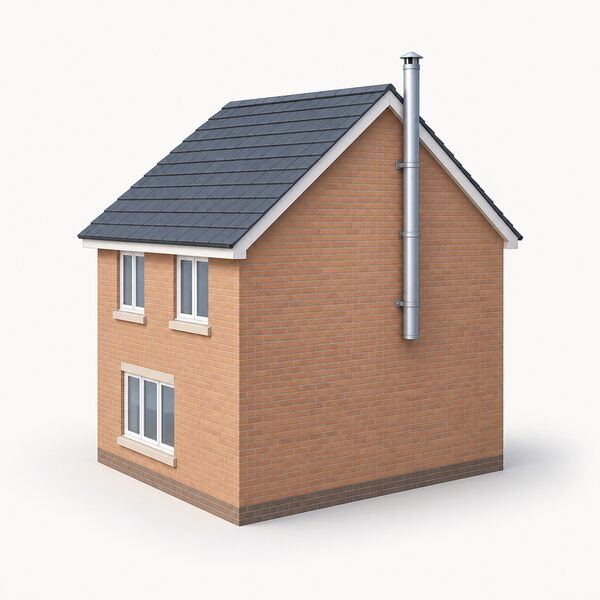
Planning permission is not normally needed when installing a micro-combined heat and power system in a house if the work is all internal5. That covers the common case of a unit replacing a boiler in the same position.
The flue is where the rules bite. Flues on the rear or side elevation of the building are allowed to a maximum of one metre above the highest part of the roof5. In a conservation area or in a World Heritage site the flue should not be fitted on the principal or side elevation if it would be visible from a highway5. The same conservation area rule appears in the guidance for biomass fuelled appliances, which states that in a conservation area or World Heritage site the flue should not be fitted on the principal or side elevation if it would be visible from a highway20.
If the building is listed or in a designated area, even where permitted development rights apply, it is advisable to check with the local planning authority before a flue is fitted, and consent is likely to be needed for internal alterations5. If the project also requires an outside building to store fuel or related equipment, the same rules apply to that building as to other extensions and garden outbuildings5.
Where a formal application is needed, the fees are set out in local guidance. A householder planning application is £548, and a commercial planning application is £30921. Work falling under prior approval, such as a larger rear extension, carries a £249 fee22. Councils offer pre-application routes: Somerset's "Do I Need Planning Permission?" service cost £66.50 as of August 202523, while Buckinghamshire Council's online planning permission checker is a free service24.
| Planning matter | Position | Source |
|---|---|---|
| Internal work only | Permission not normally needed | Official guidance5 |
| Flue on rear or side elevation | Maximum one metre above the highest part of the roof | Official guidance5 |
| Conservation area or World Heritage site | Flue should not be on the principal or side elevation if visible from a highway | Official guidance5 |
| Householder planning application fee | £548 | Local guidance21 |
| Commercial planning application fee | £309 | Local guidance21 |
| Prior approval fee | £249 | Official guidance22 |
How much electricity micro-CHP actually generates in the UK
The honest answer is that the record does not contain a measured figure for typical annual UK generation from a domestic micro-CHP unit. What it contains is the instantaneous output, about 1kW while running1, and the capacity limits that define the technology's place in the support schemes.
The regional electricity price cap figures give the value side of the calculation. For 1 October to 31 December 2025, the cap for a typical 3,100 kWh single-rate Standard Credit customer was £1,023.11 in Eastern, £983.41 in London, £1,136.66 in North Wales and Mersey, £953.66 in North West and £935.82 in South East25. Under Charge Restriction Period 15b, the multi-register figure for 3,900 kWh was £1,146.23 in Midlands, £1,200.28 in London and £1,098.29 in East Midlands26. The London figure is given as both £1,200.28 and £1,121.1526.
Every kilowatt-hour a micro-CHP unit generates is a kilowatt-hour not bought at those prices. That is the saving mechanism, and it is real but bounded by running hours. A unit that runs for 1,500 hours in a heating season at about 1kW produces roughly 1,500 kWh, which at the cap levels above is a meaningful reduction in imported electricity. A unit in a low-demand home that runs for 500 hours produces roughly 500 kWh, which is not.
The wider context is that micro-generation has historically delivered small measured savings. Under ECO3, micro-generation delivered £27.91 in lifetime bill savings10. The Feed-in Tariffs scheme, which supported micro-CHP at a 2kW limit4, is closed. The Smart Export Guarantee is the live route, and micro-CHP's share of it is around 0.1 per cent of payments19.
For a household's independence, the conclusion is narrow and firm. A micro-CHP unit reduces grid electricity imports during the heating season, and it does so at a servicing cost in line with an ordinary boiler. It does not remove dependence on the gas grid, on a gas supplier, on the manufacturer for parts, or on the grid for the many hours when the heating is off. It is a partial reduction in one dependency, not a route to self-sufficiency. Households weighing it against alternatives can compare it with a condensing gas boiler or an air source heat pump, and the wider picture of home generation technologies is set out on the microgeneration pillar.
Sources26 cited
- Micro combined heat and power, nidirect, 2026-09-17
- How much does a boiler service cost?, Uswitch, 2026-09-03
- Smart Export Guarantee Annual Report Year 5, Ofgem, 2025-12
- Feed-in Tariffs Annual Report Scheme Year 13, Ofgem, 2023-12
- Micro combined heat and power: planning permission, Planning Portal, 2026
- ECO4 Innovation Approved Innovation Measures, Ofgem, 2023-04
- Feed-in Tariffs: treatment of replacement generating equipment, Ofgem, 2021-12-13
- Guide to the Feed-in Tariffs closure, Ofgem, 2020-09
- Heat in Buildings Strategy 2022 update: progress, Scottish Government, 2022-10-31
- ECO3 Final Determination Report, Ofgem, 2023-02
- Energy efficiency and EPC Band C retrofit, UK Parliament, 2025-05-09
- Energy price cap explained, Welsh Government, 2026
- Energy price cap will rise 6.4% in April, Ofgem, 2025-02-25
- Alternative Fuel Payment, UK Parliament, 2023-02
- LPG and heating costs, UK Parliament, 2026-03
- Boiler Upgrade Scheme, Oxfordshire County Council, 2026-09-17
- MCS Microgeneration Certification, BSI, 2026-09-17
- Smart Export Guarantee guidance for generators, Ofgem, 2026-08-13
- Smart Export Guarantee Annual Report 2022-23, Ofgem, 2023-09
- Biomass fuelled appliances: planning permission, Planning Portal, 2026
- Solar panels guidance, City of York Council, 2026-09-17
- Householder planning consent, Planning Portal, 2026-09-17
- Planning and solar, Frome Town Council, 2025-08
- Find out if you need planning permission, Buckinghamshire Council, 2026-09-17
- Energy price cap levels 1 October to 31 December 2025, Ofgem, 2025
- Charge Restriction Period 15b cap tables, Ofgem, 2025-11
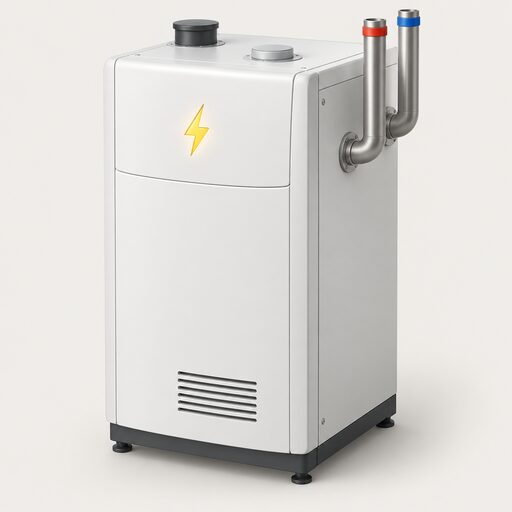 Micro-CHP for HomesA micro-CHP boiler makes electricity while it heats your home, but only when the heating is on.
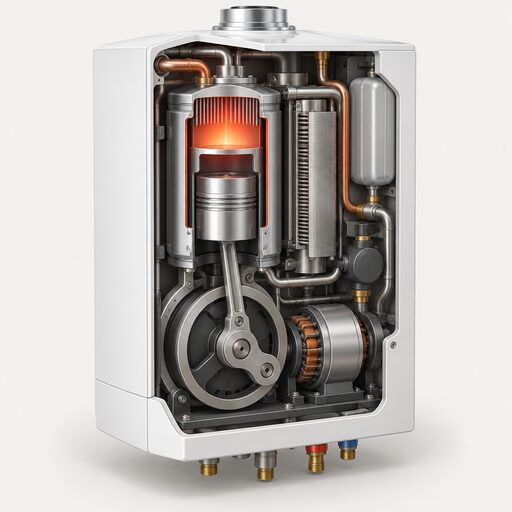 Micro-CHP TypesWhich type of micro-CHP actually gets fitted in UK homes, and how much electricity does one make while it heats your house?
 Micro-CHP Performance TestingHow well a micro-CHP boiler performs in your home decides what you get paid and what you save.
 Micro Hydro CostHow much does a micro hydro scheme cost to build and run, and what makes one worth it?
 Portable Power Station CostHow much does a portable power station cost in the UK, and what does the money actually buy?
 How Much Does a Heat Pump CostA heat pump usually costs around eleven thousand pounds installed, though quotes vary a lot depending on your home.