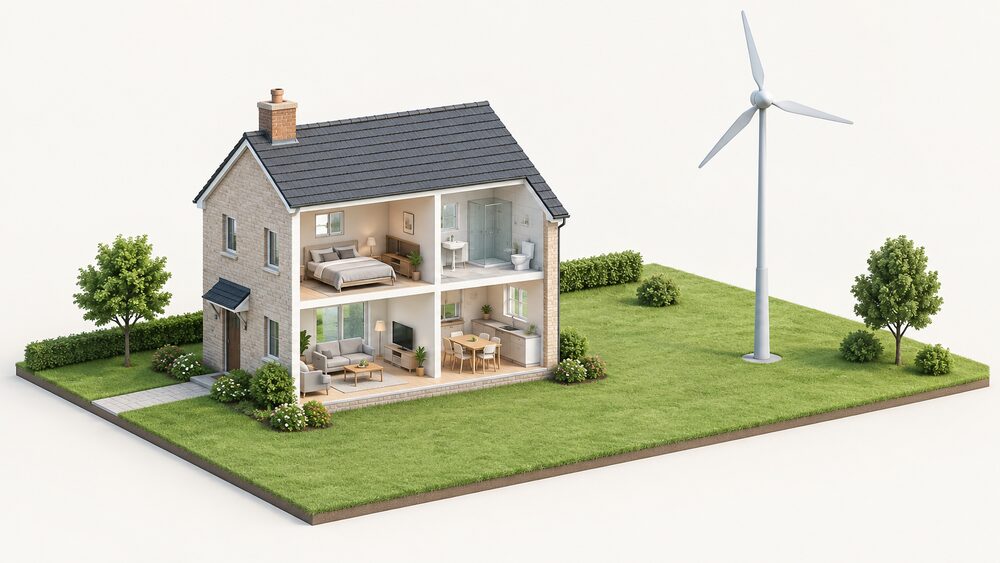
In this guide
A home wind turbine's output is set by the wind at the site, not by the number on the box. A typical domestic system is 2.5 to six kilowatts, depending on the location and size of the house1. A well-sited 6kW turbine can generate around 9,000 kWh a year, enough to supply two average homes2. At the other end of the range, small turbines with a rotor diameter of about one metre give only a few hundred kilowatt hours a year, even on a site with good average wind speeds3. A commonly quoted band for UK domestic machines as a whole is 1,000 to 5,000 kWh a year, described as very site-dependent4.
Rated power tells you what the machine can do in a strong wind, not what it will do over a year. The stronger the wind, the more energy produced1, and because power rises with the cube of wind speed, doubling the wind speed yields eight times as much power3. That single relationship explains why two identical turbines, one on an exposed hilltop and one behind a row of houses, produce wildly different annual totals: a turbine on a good site, in an open area and on a high tower, would generate 20 to 30 times as much electricity as those on the poor sites recorded in the Warwick Wind Trials5.
For a household, the independence question is therefore a siting question before it is a product question. An average UK home uses around 2,500 kWh of electricity per year on one estimate6, and around 3,400 kWh on another7. A well-sited 6kW machine covers that comfortably; a roof-mounted micro turbine in a built-up area covers a fraction of it. Wind alone never removes the grid connection either, because output is intermittent and comes in DC form that must be stored or converted.
Output by turbine size, from micro units to 6kW pole-mounted machines
Domestic-scale machines span an enormous range. At the bottom are small units that generate around 100W and charge a battery; larger units generate between 0.6 and 50kW and can power homes and businesses8. Individual wind turbines as a class vary from a few hundred watts to two or three megawatts1. Small turbines that can power a single property may have an electricity generating capacity of 10kW2, while the largest machines in operation reach 10,000kW2.
In everyday output terms, pole-mounted turbines typically produce 3 to 15 kWh of electricity, and building-mounted turbines around 1 to 2 kWh9. Small turbines usually produce less than 100 kilowatts per day10. Building-integrated units, mounted on gable walls, roof-tops or poles, are rated at 1kW to 6kW depending on the model1; one independent guide puts building-mounted machines at around 2kW and pole-mounted machines at around six kW11.
| Type | Rated power | Typical daily output |
|---|---|---|
| Micro battery-charging unit | around 100W8 | a fraction of a kilowatt hour3 |
| Building-mounted | around 2kW11; 1kW to 6kW by model1 | around 1 to 2 kWh9 |
| Pole-mounted domestic | around six kW11 | 3 to 15 kWh9 |
| Single-property small wind | up to 10kW2 | less than 100 kilowatts per day10 |
Manufacturers' own figures sit at the top of that spread. Each SD6 turbine installation is estimated to produce between 21,000 kWh and 26,000 kWh depending on the annual mean wind speed in each location12, and a G-11 machine at an eco-house in the UK averaged 77 kWh a day in its first year13. Those are large machines on open sites and are not representative of a suburban plot. Larger turbines from makers such as SD Turbines and Britwind have a rotor several metres in diameter mounted on a high tower, and are not suitable for most homes5. Further detail sits with domestic wind turbines and roof and building-mounted wind turbines.
Why wind speed matters most: doubling the wind gives eight times the power
The cubic relationship between wind speed and power is the governing fact of small wind. Doubling the wind speed yields eight times as much power3, and the same point is put as up to eight times more electricity generated when wind speed doubles14. A site with an annual average of 5 m/s is not marginally better than one at 4 m/s; it is in a different class.
This is also why rated capacity is a weak guide. A turbine's rated figure is achieved only at a high wind speed. Even large commercial turbines generally produce just 30 to 40 per cent of their stated capacity, depending on wind speed and air density10. For domestic machines in sheltered locations the fraction is far lower. Turbines usually begin generating electricity at wind speeds of around 6 to 9 mph15, so below that cut-in point the output is zero regardless of the rating.
Obstructions matter as much as regional wind climate. Building-mounted turbines in built-up urban areas are far less effective owing to lower wind speeds8. Wind speeds increase significantly with height, so even small turbines need to be mounted on a high tower, away from buildings and trees3. An ideal site is a smooth hilltop with a clear open stretch, at least in the prevailing wind direction3; higher placements catch stronger, steadier winds9.
For the household, the practical consequence is blunt. Where the wind resource is poor, no amount of equipment quality recovers the output, and the money buys very little independence from the grid. Where it is good, a single machine can cover an entire year's household electricity and more.
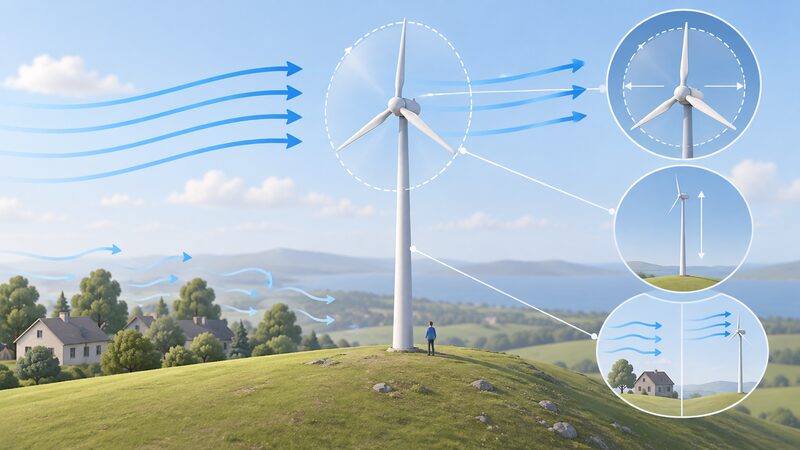
Rotor diameter and swept area: a 1m rotor and a 10m rotor are a hundredfold apart
Output scales with the area the blades sweep, and area goes up with the square of diameter. When you double the diameter of a rotor, it makes the swept area four times as big, and a rotor with a 10 metre diameter will capture one hundred times as much wind as one with a one metre diameter3.
That arithmetic sets realistic expectations for small machines. A turbine with a rotor diameter of about one metre on a site with good average wind speeds could give a few hundred kilowatt hours of electricity per year3. To get as much energy per year as a whole solar roof array, a rotor about four metres across is needed3. Small wind turbines are usually between two and eight metres high16, which limits both the rotor that can be carried and the height at which it sits.
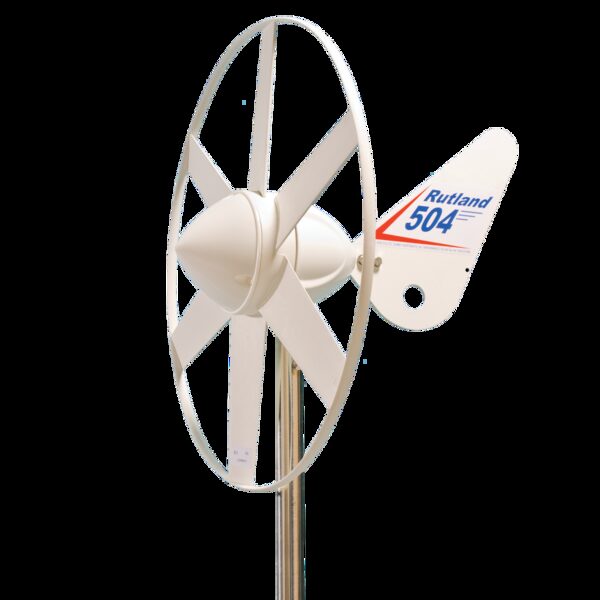
Micro machines still have a role, but a narrow one. Marlec and Leading Edge make small turbines that can generate a few hundred watts of power in a strong wind, used in off-grid setups such as boats or remote cottages5. Those units are sized to keep a battery topped up, not to run a house. Comparisons of specific machines are covered in Rutland vs Leading Edge small wind turbines.
Typical annual output for a UK home, and what it covers
The most useful single band for UK households is 1,000 to 5,000 kWh a year, explicitly described as very site-dependent, for systems of 1 to 5 kW mounted on a roof or pole4. A 2.5kW turbine is quoted as producing between 2,500 and 5,000 kWh of electricity on an ideal site with a 5 m/s average annual wind speed17. Small domestic turbines of around 1 to 10 kW may generate a few thousand kilowatt hours a year, depending on wind conditions15.
Set those against household consumption. Figures given for an average UK home run from around 2,500 kWh a year6 to around 3,400 kWh a year7. A well-sited 6kW turbine generating around 9,000 kWh would exceed all of those, which is why it is described as enough to supply two average homes2.
| Output figure | System | Source type |
|---|---|---|
| 1,000 to 5,000 kWh a year | 1 to 5 kW roof or pole-mounted4 | guidance |
| 2,500 to 5,000 kWh a year | 2.5kW on an ideal 5 m/s site17 | maker |
| a few thousand kWh a year | 1 to 10 kW domestic15 | maker |
| around 9,000 kWh a year | well-sited 6kW2 | network operator |
| 21,000 to 26,000 kWh a year | SD6 installation12 | maker |
The comparison with solar is instructive rather than competitive. An average domestic solar PV system can generate between 3,400 and 4,200 kilowatt hours of electricity a year18, with another figure of 3,800 to 4,350 kWh for rooftop panels19. A small wind turbine only matches that on a genuinely exposed site, which is why small wind is described as best suited to exposed rural sites only4 and as especially practical for remote areas where connecting to the grid may be costly or challenging9. See micro wind vs solar PV for an off-grid home.
Siting, tower height and the 5 m/s threshold
The widely applied test is that the local annual average wind speed should be five metres per second or more1, a threshold repeated as a recommendation to install only in areas with at least 5 m/s8, as an optimum of around five metres per second2, and as a general need for an average of more than 5 m/s5.
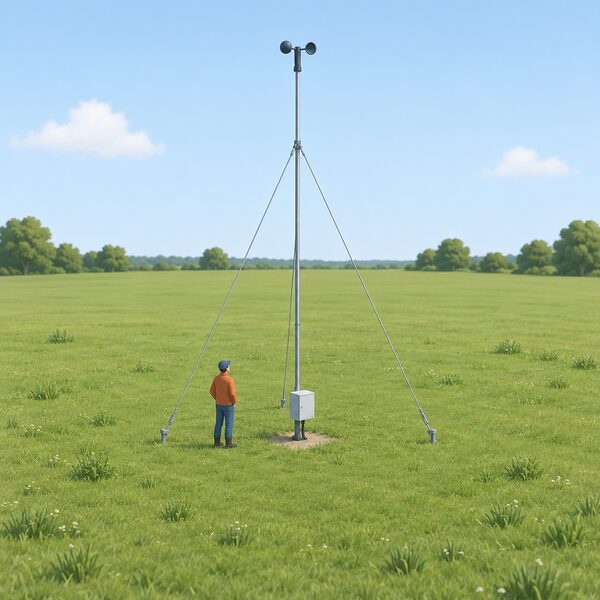
Estimating that figure has two stages. Average wind speed can first be estimated from a grid reference using a wind speed database or the Carbon Trust's wind yield estimation tool8. MCS planning calculations obtain wind data at 10 metres above ground level20. Desk estimates, however, cannot see the trees and buildings around a particular plot.
Site measurement closes that gap. Northern Ireland guidance states the position directly:
"An ideal site is a smooth hilltop with a clear open stretch, at least in the prevailing wind direction."
One MCS prediction method uses wind speed monitoring data collected for at least six months, combined with the characteristics of the proposed turbine, to predict annual energy generation21. A shorter approach is also described: installing an anemometer where the turbine is planned and leaving it there for a couple of months22. Before spending thousands of pounds on a turbine, it could be worth spending a few hundred on wind monitoring equipment such as a mast and data logger3. This is explored further in wind speed and siting for a home wind turbine and how long should I measure wind before installing a turbine.
Planning limits across the four nations
Under permitted development rights it is possible in some cases to install domestic wind turbines without a planning application, so long as specified limits and conditions are met; in other cases an application to the local authority is required23. Those limits bear directly on output, because they cap the tower height that determines the wind the rotor sees.
| Nation | Key limits |
|---|---|
| England | Development not permitted where the distance between ground level and the lowest part of any blade would be less than 5 metres24; the highest part of a stand alone turbine must not exceed 11.1 metres25. One guide summarises English permitted development as no taller than 15 metres total, at least 5 metres of blade clearance, and nowhere near a conservation area4 |
| Scotland | No part of a turbine on a detached dwellinghouse may be less than 5m from ground level or 5m from the curtilage boundary; free-standing turbines must not exceed 15m blade tip height, with the lowest blade at least 5m from the ground and a distance of not less than 110% of blade tip height from the curtilage of another dwelling26 |
| Wales | The highest part of a stand alone turbine must not exceed 11.1 metres and the installation must comply with Microgeneration Certification Scheme Planning Standards or equivalent; a planning application is necessary for a building-mounted turbine27. Permitted development does not apply where it would result in more than one stand alone turbine within the curtilage28; homeowners are required to minimise the effect on the amenity of the area29 |
| Northern Ireland | Planning approval is needed1 |
Dedicated pages cover the rules in England, Scotland, Wales and Northern Ireland.
Cost per kilowatt and what it buys
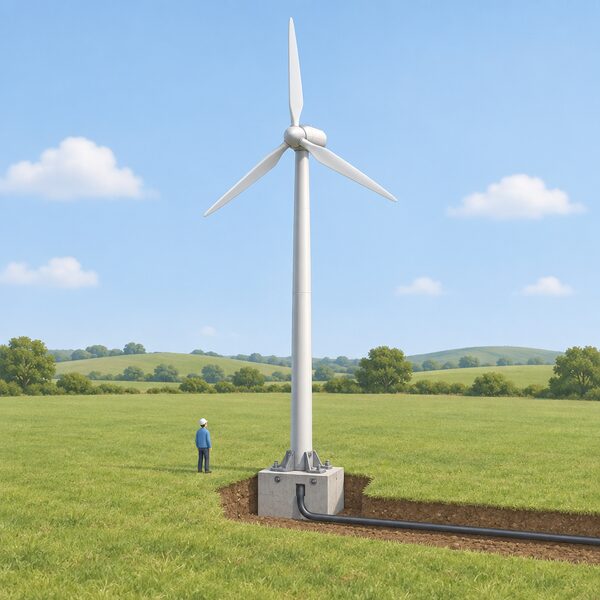
A turbine plus tower and installation might cost between £2,500 and £6,000 per rated kilowatt3. On that basis, published system prices line up: a 6kW pole-mounted system costs around £35,000 for equipment and installation11, with an earlier figure of around £31,000 for the same size2. A more useful 2.5 to 5 kW pole-mounted turbine is put at £10,000 to £30,000 or more once foundations, cabling and installation are included4.
Very small wind turbines may cost a few hundred pounds, and their power output will be a fraction of a kilowatt3. Roof-mounted systems around 1 kW are quoted at £2,000 to £4,0004, at up to £3,000 for a 1kW system30, and at about £2,000 on average for turbines between 0.5 kW and 2.5 kW, which tend to generate 1 to 2kW22. Prices are installer-quoted and vary with ground conditions, cable runs and electrical work.
Savings depend on the same wind resource as output. A well-sited 6kW turbine could save around £650 a year in Great Britain and £800 in Northern Ireland11; an earlier figure for the same size was around £610 a year31, and an estimate of around £700 a year on electricity is also cited9. Estimates for the time taken to recover the investment vary wildly, from 6 to 20 years31. Funding is limited: under the Home Energy Scotland Grant and Loan, a wind turbine attracts a maximum of £2,500 as a loan only, with no grant available32. Costs are set out in full in how much does a domestic wind turbine cost.
Batteries, solar and what happens to surplus electricity
Most small wind turbines generate direct current and store it in a battery1. Battery storage lets a household store electricity generated from renewable sources including solar panels and wind turbines for later use33, so excess electricity can be used when there is no wind. Where battery storage is present, excess electricity from wind turbines and solar panels can be stored to use later11. For storage systems, typical battery life is around six to ten years depending on the type, so batteries may need replacing within the turbine's life1.
Pairing wind with solar addresses the seasonal mismatch directly: a wind and solar hybrid system covers low light and low wind conditions9. Where electricity is exported rather than stored, the Smart Export Guarantee applies to small wind of 5MW or less34. Both routes are covered in off-grid wind power and selling electricity from a wind, hydro or CHP generator.
The independence gain is real but partial. Storage shifts generation in time, not season, and a household with a turbine and a battery still relies on the grid through long calm spells, on an inverter and controller from a manufacturer, and often on a supplier for export payments.
Maintenance, lifespan and long-term output
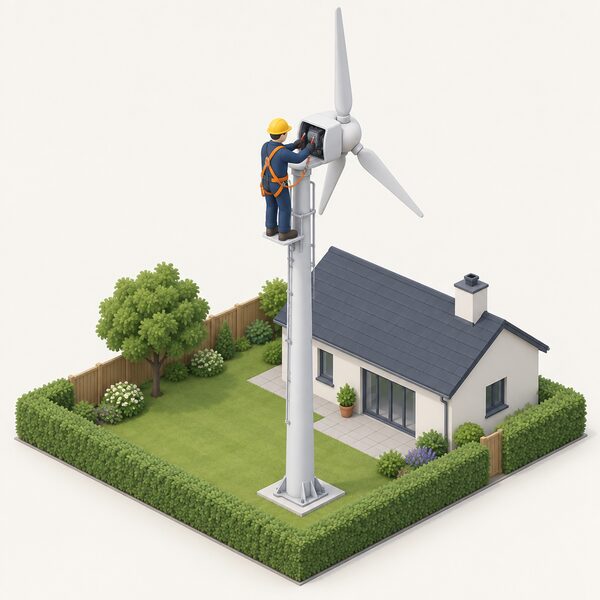
Maintenance checks for small wind turbines are generally needed every few years9, typically costing between £100 and £200 depending on the size of the system9, a figure repeated as around £100 to £200 per year depending on turbine size35. Some moving parts may have to be replaced during a lifetime of around 20 years3. Where an inverter is needed, it is likely to need replacing within the life of the turbine3, and for a larger system that replacement usually costs between £1,000 and £2,0009.
Stated lifespans differ. Wind turbines can have a life of up to 22.5 years, but need service checks every few years to make sure they work efficiently1. With regular upkeep, a small wind turbine can last over 20 years9; one maker gives 20 to 25 years15, and one guide gives 15 to 20 years with regular servicing4. Most parts of a generating unit such as a wind farm, hydro station or solar site have a lifespan of 20 to 40 years, after which refurbishment or replacement may be needed36. The documents therefore agree on the order of magnitude, roughly two decades, but not on the precise number.
Because small wind has more moving parts than solar, maintenance is characterised as higher4, and it is a recurring cost that must be set against the annual saving. A turbine producing 3,000 kWh a year on a modest site earns back less than the £100 to £200 annual service cost consumes in relative terms than a machine producing 9,000 kWh on a good one. Practical detail sits in installing and maintaining a domestic wind turbine and across the wider microgeneration lane.
Sources36 cited
- Wind energy guidance, nidirect, 2026-05-18
- Wind power, Electricity North West, 2026-09-19
- Wind power information sheet, Centre for Alternative Technology, 2025-06-27
- Solar panels vs wind turbines, Heatable, 2026
- Domestic wind power, Centre for Alternative Technology, 2023-10-01
- How solar panels work on a house, Fuse Energy, 2026-04-17
- How much electricity do solar panels generate, Jackery, 2026-04-29
- Wind turbines guide, Uswitch, 2026-01-06
- Small wind turbines, MCS, 2026-08-18
- Renewable energy statistics, Uswitch, 2025-05-13
- Wind turbines, Energy Saving Trust, 2026-05-20
- Energise fuel poverty scheme delivers 90 small wind turbine projects, SD Wind Energy, 2026-09-20
- Eco-House UK case study, Ryse Energy, 2026
- How do wind turbines work, Good Energy, 2024-12-09
- How does wind energy work, Power NI, 2026-04-09
- Microgeneration energy guide, Uswitch, 2026-06-08
- Wind and solar for grid-connected properties, Wind and Sun, 2023-07-13
- Solar power, Electricity North West, 2026-09-19
- Plug-in solar panels, Which?, 2026-09-15
- MCS 020 planning standards, MCS, 2019-06-19
- MCS publishes updates to small wind turbine standards, MCS, 2024-12-06
- Home wind turbines: pros, cons and cost, OVO Energy, 2021-05-06
- Wind turbines: planning permission introduction, Planning Portal, 2026
- Class H: installation or alteration of wind turbine on domestic premises, legislation.gov.uk, 2026-09-17
- Planning permission for stand alone wind turbines, Planning Portal, 2026-09-17
- Circular 1/2024: householder permitted development rights, Scottish Government, 2024-05-28
- Planning permission for wind turbines, Welsh Government, 2026-09-17
- Town and Country Planning (General Permitted Development) (Amendment) (Wales) Order, legislation.gov.uk, 2012
- What could the next Senedd do on heat pump planning, Nesta, 2026-01-26
- Generate your own electricity, Sunsave, 2026-08-05
- Renewable energy FAQs, Electricity North West, 2023-02-23
- Grants and loans, Home Energy Scotland, 2026-09-17
- Storing energy, Energy Saving Trust, 2026-07-15
- Smart Export Guarantee, MCS, 2026-04-27
- Wind turbines, Home Energy Scotland, 2026-09-20
- Generation connections, SSEN, 2026-09-19
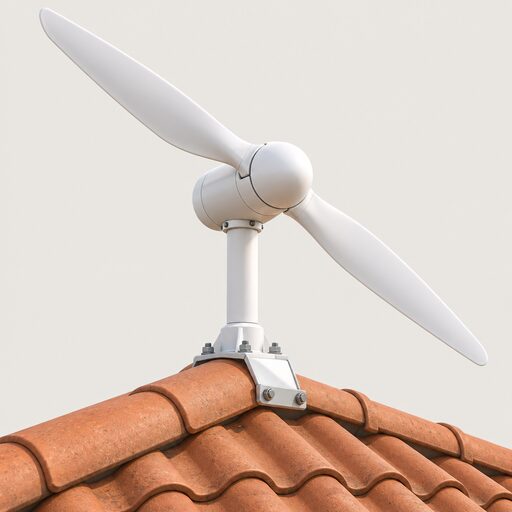 Building-Mounted Wind TurbinesWill a wind turbine on your roof actually make enough electricity to be worth it?
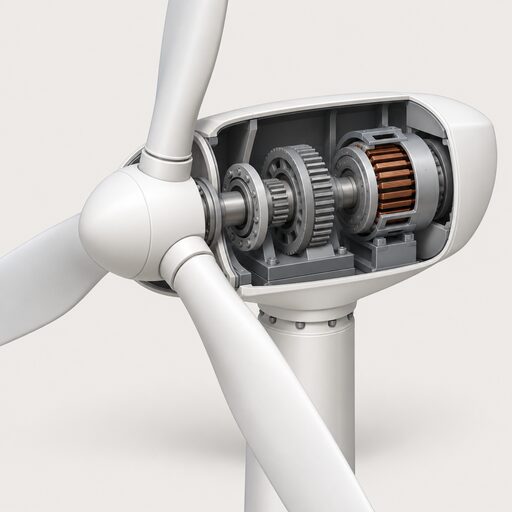 Domestic Wind TurbinesCan a wind turbine really power a home, and is your site windy enough?
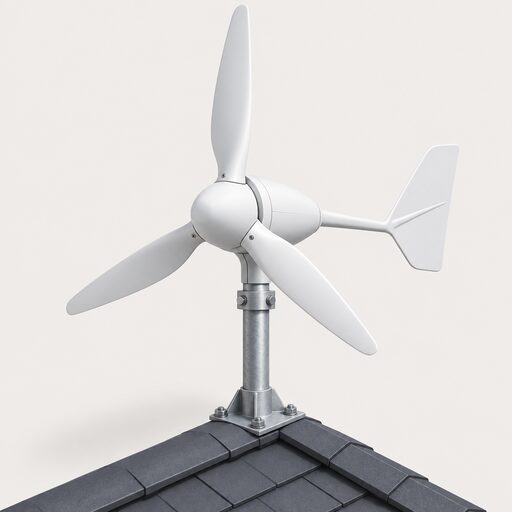 Domestic Wind Turbine CostA home wind turbine usually costs between nine thousand and nineteen thousand pounds, but the real price depends on its size and how it is mounted.
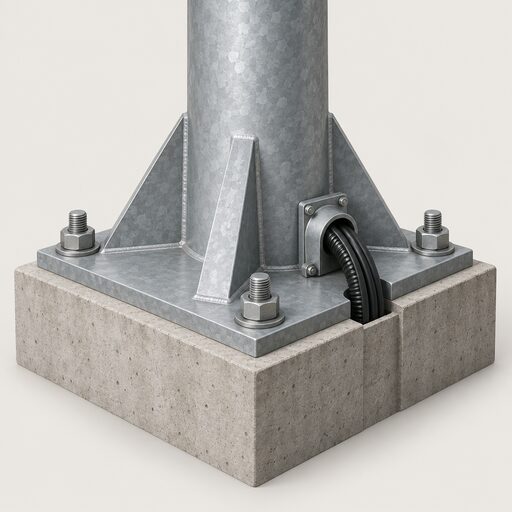 Wind Turbine InstallationWill a wind turbine actually pay for itself in a normal British garden, and how much wind does your spot really need?
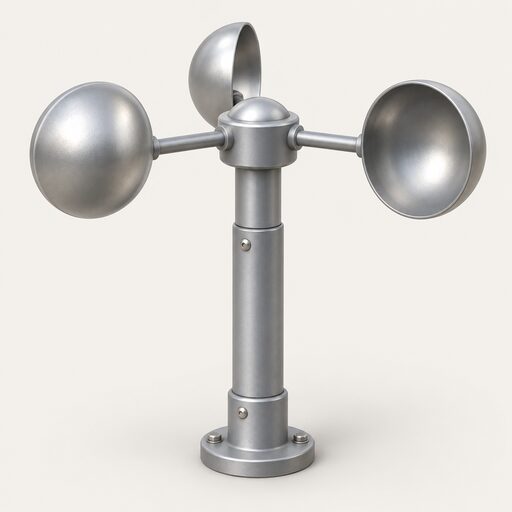 Turbine Siting and Wind SpeedIs my garden windy enough for a home wind turbine?
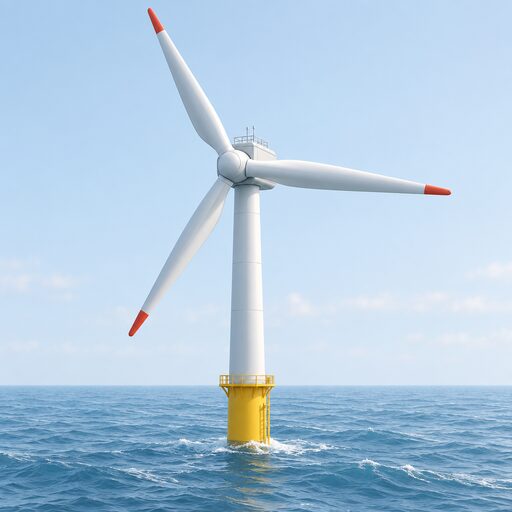 Wind Power on the UK GridOffshore wind now supplies a big share of Britain's electricity, and it keeps growing.