
In this guide
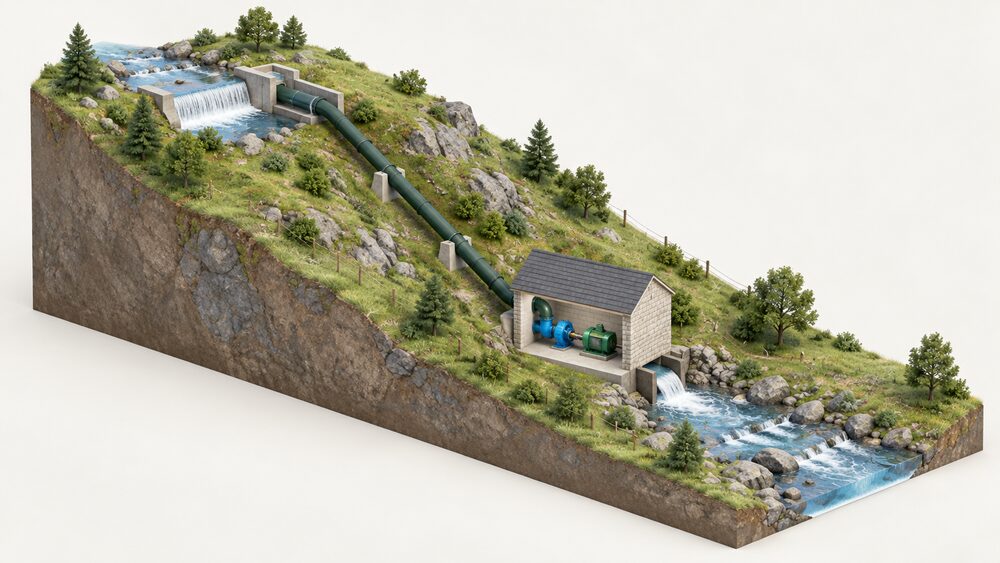
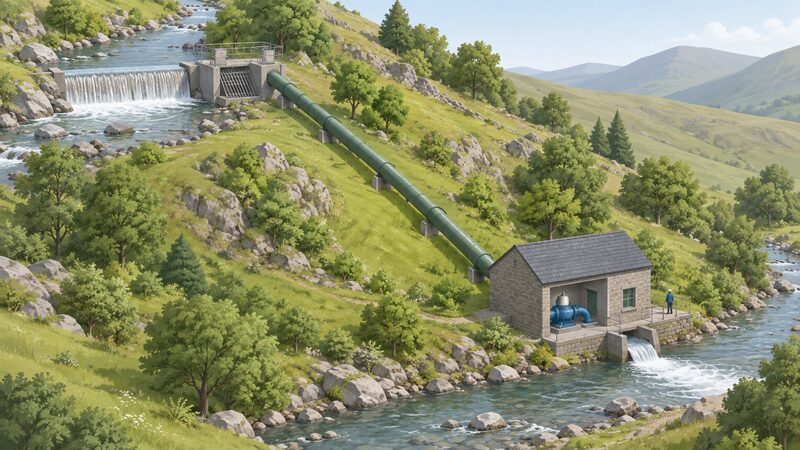
A micro hydro scheme is priced as a civil engineering project with a turbine attached, not as an appliance. The turbine and generator are usually the smallest line in the budget. What costs money is the water: the intake, the weir or leat, the pipeline that carries water downhill, the powerhouse, the outfall, and the electrical connection at the other end. Official guidance is blunt about the shape of the economics: total system costs can be high, but often less than the cost of a grid connection, and with no electricity bills to follow1.
That comparison is the one that matters for a remote property. Where a mains connection would have to be built across land, a hydro scheme can be the cheaper route to a permanent supply, and it produces power continuously rather than only when the wind blows or the sun shines. For houses with no mains connection but with access to a micro hydro site, a good hydro system can generate a steady, more reliable electricity supply than other renewable technologies at a lower cost1.
There is no published national price list for a domestic scheme. Costs are installer-quoted and site-specific, and the figures that follow are the ones that can be evidenced: published planning fees, published insulation costs, the tariff and support rules, and the price of the electricity a scheme displaces. A micro hydro plant is one that generates less than 100 kilowatts, which is the scale at which a single property or a small group of properties sits1.
What a micro hydro scheme is, and where the idea came from
Hydropower or hydroelectricity, generated from dams, sluices and mill wheels, was used for many years to generate electricity in a local area7. That is the origin of the idea: before a national network existed, a falling head of water on a estate, a mill or a farm was the obvious way to make electricity where it was needed. This method of generation generally disappeared with the introduction of the electricity grid7. Central stations and a distribution network made small local plants uneconomic, and the water sites fell out of use.
The revival is recent and policy-driven. The UK Government's Contracts for Difference scheme is its main mechanism for supporting new low-carbon electricity generation projects in Great Britain, and hydropower sits within the family of technologies that qualify8. At the small end, hydropower is one of the technologies supported by the Smart Export Guarantee, alongside solar photovoltaics, wind, micro-combined heat and power and anaerobic digestion, which can be up to 5 megawatts in capacity, or up to 50 kW for micro-CHP, with installations located in Great Britain2.
The distinction that matters for a household is between a scheme that offsets imported units and one that replaces a connection entirely. The first is a generation project with an export arrangement; the second is a substitute for infrastructure, and it is priced against the cost of that infrastructure rather than against a retail tariff. Both are legitimate, and they lead to very different budgets.
Whether your site is viable: flow, head and residual flow
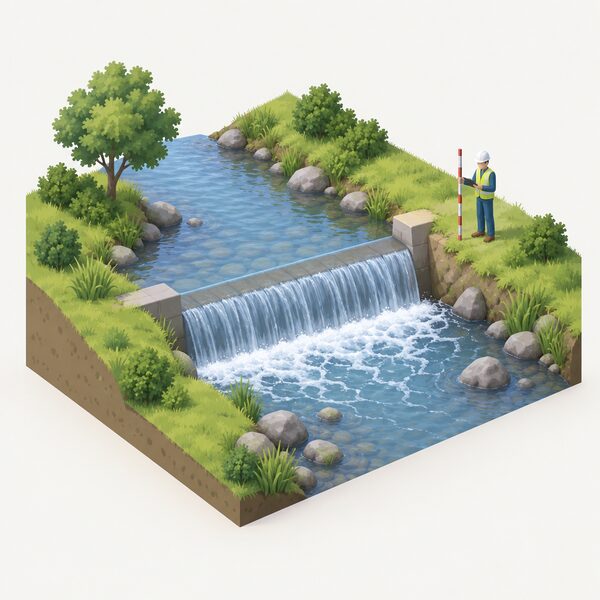
Nothing can be costed until the water is measured. The viability of the installation will depend on whether there is enough water flowing per second and the height or 'head' that it falls from7. Those two numbers, flow in litres per second and head in metres, set the energy available, and therefore the size and price of every component downstream of them.
Head is the vertical drop between the point where water is taken and the point where it is returned. A site with a steep fall over a short distance can use a high-head turbine and a narrow pipe; a site on a gentle river needs a much larger machine and a much larger flow to produce the same output. The turbine family follows from that: Pelton and Turgo wheels suit high head, crossflow and propeller machines suit lower head with more flow, and an Archimedean screw suits very low head on a wide channel. The head and flow guide sets out how the two are matched, and the turbine types comparison explains which machine follows from which site.
Residual flow is the constraint that catches people out. There should also be enough residual flow to maintain the water course7. A scheme cannot take the whole river; the abstraction licence will specify what must be left in the channel, and that figure reduces the flow available for generation. A site that looks generous on a winter spate may be marginal in a dry summer, and the sizing has to be based on the reliable low flow rather than the peak.
The practical sequence is a site survey first, then a flow and head assessment, then a scheme design, and only then a price. The micro hydro overview covers how a scheme works end to end, and the project timeline sets out how long each stage takes.
What drives the cost of a micro hydro scheme
The cost structure is inverted relative to most home energy equipment. The turbine and generator are manufactured items with known prices; the civil works are bespoke and priced by the ground they sit in.
- Intake and weir. Building a structure that takes water reliably, screens out debris and fish, and survives floods. This is concrete and steel work in a river, and it is the item most likely to overrun.
- Pipeline or leat. The channel or pipe that carries water from intake to turbine. Length, diameter, ground conditions and the number of road or fence crossings drive the price, and a longer penstock is a larger cost even when the head is the same.
- Powerhouse and outfall. A structure to house the turbine and generator, and a return channel to the watercourse.
- Turbine, generator and controls. The machine itself, its governor, and the electrical panel.
- Grid connection or off-grid electrical works. Cable, transformer and protection where the scheme connects to the network, or batteries and a dump load where it does not.
- Consenting and survey costs. Ecological survey, engineering design, licence applications and planning fees.
The comparison that official guidance offers is against the alternative, not against a retail tariff: total system costs can be high but often less than the cost of a grid connection and with no electricity bills to follow1. For a property already on the mains, that comparison does not apply, and the scheme has to justify itself against imported units instead.
Where a scheme connects to the network, the electrical side has its own rules. The G98 and G99 guide covers the connection standards, and exporting electricity covers how payments work once the scheme is running.
Consents and licences: the approvals a scheme needs before any spending

Hydro is a regulated activity because it takes water from a watercourse. Various consents and licences are required for a hydro project7. In practice a scheme needs an abstraction licence, agreement on residual flow, landowner consent for the intake and pipeline route, and planning permission for the structures, unless the works fall within permitted development.
Planning fees are published and can be stated exactly. Work falling under prior approval, for example a larger rear extension, carries a £249 fee3. Larger or non-householder applications are priced differently, and the fee for a scheme that requires full planning permission will follow the application type rather than the householder scale. The planning portal guidance on hydroelectricity is the starting point for what a scheme needs.
Certification matters where support payments are claimed. The Smart Export Guarantee and the government's previous Feed-in Tariff and Renewable Heat Incentive schemes all require the renewable energy product and installer to be certified and to meet MCS standards2. The MCS certification guide for wind and hydro explains what that involves, and the grants and funding page covers the support that remains open.
The Feed-in Tariff is closed to new applicants, but it still shapes the paperwork for schemes already accredited. Ofgem's guidance for FIT generators sets out the ongoing obligations, and the year 17 determination lists an ongoing generator charge of £30 per generator6. For a scheme that is not accredited, that charge does not apply, but the metering and reporting discipline it represents is a fair picture of what an accredited generator has to maintain.
How much electricity a household scheme can produce
Output is a function of flow and head, and it is continuous in a way that wind and solar are not. A run-of-river scheme generates whenever water is available, which for a well-sited scheme is most of the year, with output falling in dry periods rather than stopping entirely. That constancy is the reason hydro is valued out of proportion to its installed capacity.
The scale ceiling for a domestic scheme is generous. A micro hydro plant is one that generates less than 100 kilowatts1, and hydropower up to 5 megawatts in capacity is eligible for the Smart Export Guarantee2. A single house typically needs a small fraction of that, which means a modest scheme on a good site can cover the whole property and export the surplus.
For comparison, the electricity price cap for 1 July to 30 September 2025 was set at £1,038.15 a year for 3,100 kWh per annum on single-rate metering in North Wales and Mersey, and £1,012.80 on the third payment method table for the same consumption9. A scheme that displaces those units is displacing a bill at that level, and the value of the generation is the retail price of the units it replaces plus whatever the export arrangement pays.
The output and sizing page works through how flow and head translate into kilowatt hours, and the run-of-river load factor page explains how much of the year a scheme runs at full power. The lifespan page covers how long the plant is expected to last, which is the other half of any payback calculation.
Insulation first: preparing your property before installing
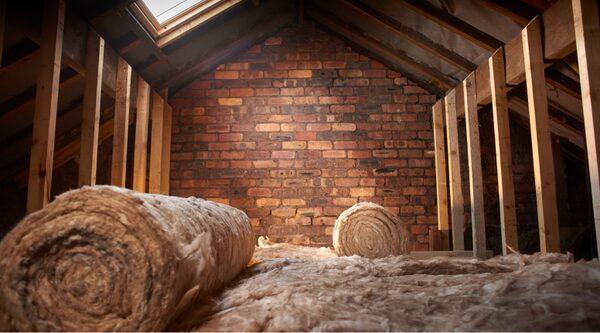
Official guidance is unambiguous that demand reduction comes before generation: the property should be properly insulated before renewable technologies are installed7. The reason is arithmetic: every unit of demand removed is a unit the scheme does not have to generate, and generation capacity is the expensive part of the project. Insulation work itself carries a cost. Traditional loft insulation is typically between £600 and £1,100 professionally installed using traditional materials such as mineral fibre, depending on the size of the property, and professional draughtproofing around £200, with annual savings of £25 to £50. Foam insulation around exposed hot water pipes can cost as little as £15 as a DIY fit.
Insulation is not free, and published examples give a sense of scale. One worked example charges the installer £400 excluding VAT for the insulation material, and £1,000 excluding VAT for the installation4. Those are illustrative figures for a specific measure rather than a quotation, but they show the order of magnitude against which a generating scheme should be judged.
The wider policy context is that the government's heat and buildings strategy sets out a plan to significantly cut carbon emissions from the UK's 30 million homes and workplaces in a simple, low-cost and green way whilst ensuring this remains affordable and fair for households across the country10. Scotland's equivalent assessment covers heat technologies such as ground and air source heat pumps and biomass boilers under the UK Government's Renewable Heat Incentive11, and Wales has published its own draft heat strategy12. The four nations differ in the detail of their schemes, and a household should check the position in its own nation.
The energy independence page sets out how demand reduction and on-site generation combine, and the home and site type guide helps establish which technology suits which property.
Micro hydro's place in the UK's energy mix and net zero plans
Hydro is a small contributor to a renewable share that is itself substantial. It is estimated that about 42% of the UK power grid comes from renewable sources, with wind being the biggest contributor5. Hydro's role within that is steady rather than large: it produces when wind and solar are variable, which gives it a system value beyond its raw output.
The direction of travel in the statistics is clear. UK indigenous energy production fell by 1.2% over the three month period September 2025 to November 2025 compared to the same period a year earlier, and the fossil fuel share of electricity generation by Major Power Producers was down 5.5 percentage points over the same comparison13. As fossil generation recedes, every low-carbon source including hydro takes a larger share of what remains.
Support for low-carbon generation is being directed through central mechanisms rather than small-scale tariffs. The Contracts for Difference scheme is the UK Government's main mechanism for supporting new low-carbon electricity generation projects in Great Britain8, and Ofgem has given the provisional green light to an initial £24bn investment programme to enhance energy security and transmit clean energy14. The Feed-in Tariff, which once supported small hydro, is closed to new applicants, and the Smart Export Guarantee is the route by which a new scheme is paid for what it exports2.
The carbon case for hydro rests on the civil works rather than the operation. A scheme burns nothing and produces no combustion emissions once built, and the embodied carbon sits in the concrete, the pipework and the machine. The CO2 emissions page examines that balance, and the micro hydro versus solar PV comparison sets the two against each other for a rural property.
Community and small-scale schemes: where the opportunities are
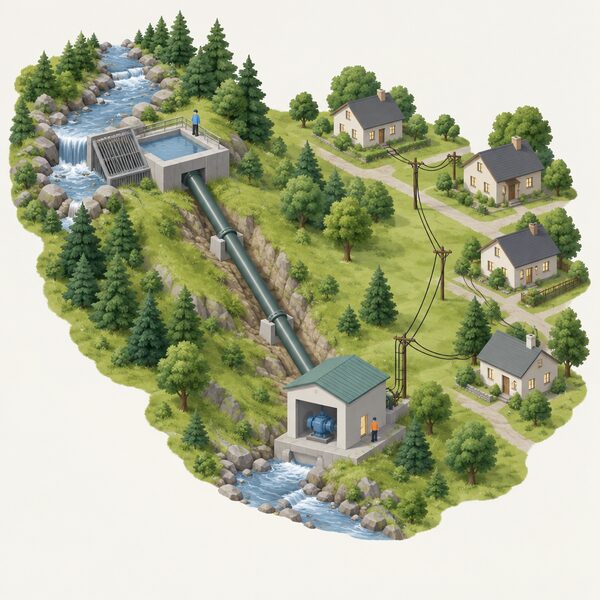
The economics improve with scale and with shared cost. A scheme serving several properties spreads the fixed costs of intake, pipeline and powerhouse across more beneficiaries, and the civil works do not double when the output does. That is why community schemes are the most common form of new small hydro in the UK, and why the community wind and hydro schemes page is the natural next step for a group of neighbours.
The policy environment for shared ownership is developing. Secondary legislation is planned for 2027 to enact the Infrastructure Act 2015 provision for a community right to own a proportion of on and offshore renewable energy developments15. Wales has adopted a target for at least 1.5 GW of renewable energy capacity to be locally owned by 2035, alongside a target to meet the equivalent of 100% of annual electricity consumption from renewable sources by 203516. Those targets create a framework in which community hydro is a recognised category rather than an outlier.
Northern Ireland has its own arrangements, and the guidance there covers hydropower separately from Great Britain7. Domestic sized micro-combined heat and power models are now available in Northern Ireland17, which is a reminder that the support landscape differs by nation and that a scheme's business case has to be built on the rules that apply where it sits.
For a single household, the honest position is that a micro hydro scheme is a capital project with a long payback, justified either by the cost of the grid connection it replaces or by a site good enough to generate well beyond the property's own demand. The micro hydro versus micro wind comparison sets out when each is the better fit, and the installation and maintenance page covers what the scheme costs to keep running after it is built.
Sources17 cited
- Hydroelectricity, Planning Portal, 2026-09-17
- The Smart Export Guarantee, House of Commons Library, 2026-05-13
- Householder planning consent, Planning Portal, 2026-09-17
- Draft VAT guidance on changes to energy-saving materials, GOV.UK, 2019
- Home energy efficiency key terms explained, Development Bank of Wales, 2024-10-17
- Feed-in Tariffs determinations, year 16, GOV.UK, 2026-02-26
- Hydropower, nidirect, 2026-09-17
- UK Solar Roadmap, DESNZ, 2025-06
- Energy price cap levels, 1 July to 30 September 2025, Ofgem, 2025-07-01
- Heat and buildings strategy, GOV.UK, 2021-10-19
- Heat in Buildings Strategy environmental report, Scottish Government, 2021-02
- Draft heat strategy for Wales, Welsh Government, 2023-08
- Energy trends and prices statistical release, GOV.UK, 2026-01-29
- Energy price cap will rise 2 percent in October, Ofgem, 2025-08-27
- Community and locally owned energy, Parliamentary Office of Science and Technology, 2026
- Social Housing Decarbonisation Fund Wave 1 impact evaluation, GOV.UK, 2026-08-27
- Heat Pump Ready Programme Stream 1, Phase 2 clarification questions, GOV.UK, 2022-10-27
 Micro Hydro InstallationHow much water do you need, and how far does it have to fall, for a micro hydro system to be worth it?
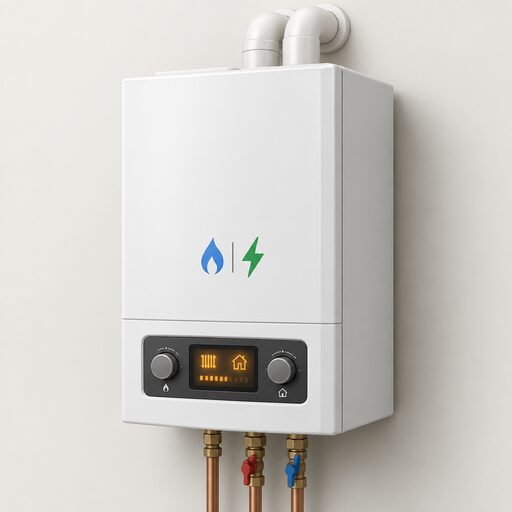 Micro-CHP Cost and OutputDomestic micro-CHP costs more than a conventional boiler and produces roughly 1kW of electricity alongside its heat.
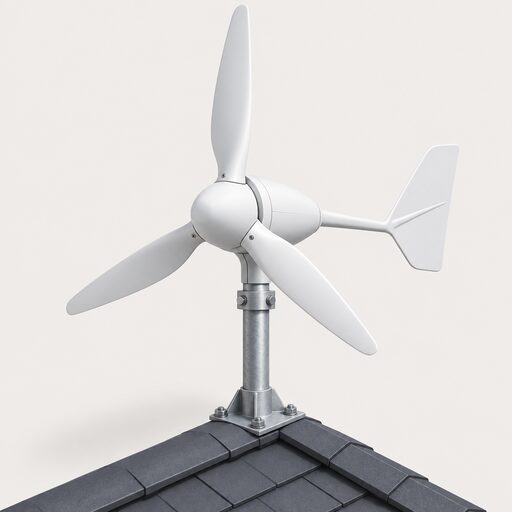 Domestic Wind Turbine CostA home wind turbine usually costs between nine thousand and nineteen thousand pounds, but the real price depends on its size and how it is mounted.
 Micro Hydro Head and FlowHead is the drop from the top of your water supply to the bottom, and flow is how much water comes down.
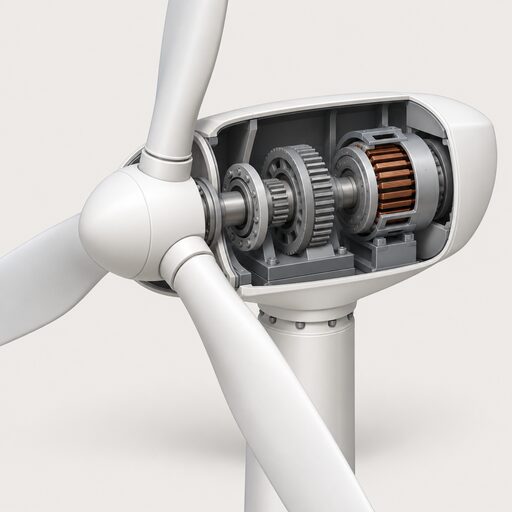 Domestic Wind TurbinesCan a wind turbine really power a home, and is your site windy enough?
 Off-Grid System CostWhat does going off grid really cost, and what makes up most of that figure?