
In this comparison
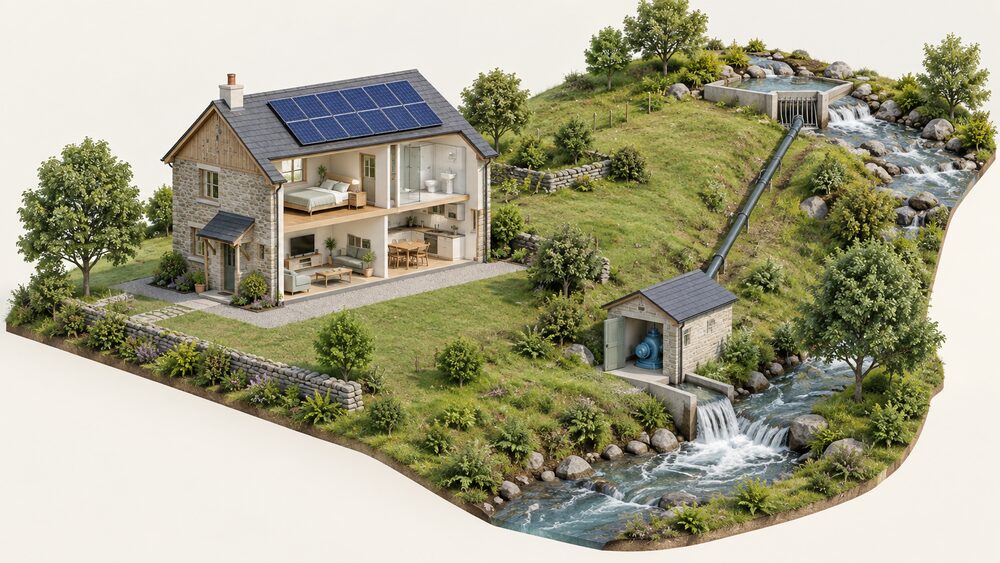
Micro hydro and solar PV answer two different questions. Solar PV uses energy from the sun to create electricity to run appliances and lighting, and it works in daylight, making it effective even in cloudy climates1. Micro hydro uses running water turning a turbine to produce electricity, and a micro hydro plant is one that generates less than 100 kilowatts3. The core difference is what drives output: daylight for one, rainfall and gradient for the other.
For a rural property with a stream, the practical comparison is not which technology is better in the abstract but which resource the site actually has. Useful power may be produced from even a small stream, according to official guidance, so a modest watercourse can be worth investigating3. Solar, by contrast, needs a suitable roof or ground area and is far more widely installed: apart from micro-CHP, solar PV installations are on average smaller than the installations of other technology types4.
The two are not rivals so much as complements. Hydro output follows rainfall and tends to be strongest in winter; solar output follows daylight and peaks in summer. For houses with no mains connection but with access to a micro hydro site, a good hydro system can generate a steady, more reliable electricity supply than other renewable technologies at a lower cost3. That reliability, rather than raw output, is usually the deciding factor for a remote property.
Micro hydro vs solar PV: the core difference
The two technologies differ in almost every dimension that matters to a household: what they harvest, how predictable they are, how much civil work they need, and how the planning system treats them.
Solar PV is a modular, manufactured product. It uses energy from the sun to create electricity to run appliances and lighting, and it is defined in legislation as solar photovoltaics including plug-in solar2. Small-scale solar is generally defined at sizes of less than 5 megawatts, and installations smaller than 5 MW accounted for 99.9% of total installations and 55% of installed capacity in 20255. The technology is standardised, certified and widely available.
Micro hydro is a site-specific civil engineering project. Hydroelectrical power systems use running water turning a turbine to produce electricity, and the plant is classified as micro when it generates less than 100 kilowatts3. Output depends on two variables that cannot be manufactured: the flow of water available and the vertical fall, or head, through which it drops. Two sites a mile apart can have completely different potential.
That difference shapes everything downstream. A solar array can be specified from a roof area and a budget. A hydro scheme has to be designed around a particular stream, and its output is fixed by that stream's behaviour across the year. The Feed-in Tariffs scheme's own statistics note that, apart from micro-CHP, solar PV installations are on average smaller than the installations of other technology types, a reflection of how easily solar scales down to a single roof4.
For energy independence, the distinction is sharp. Solar reduces dependence on a supplier during daylight hours and, with a battery, into the evening. Hydro, where the resource exists, can reduce it around the clock, because a stream does not stop at night. That is why hydro is treated as the stronger option for genuinely remote properties, and why it is unavailable to the great majority of homes.
When a stream makes micro-hydro viable
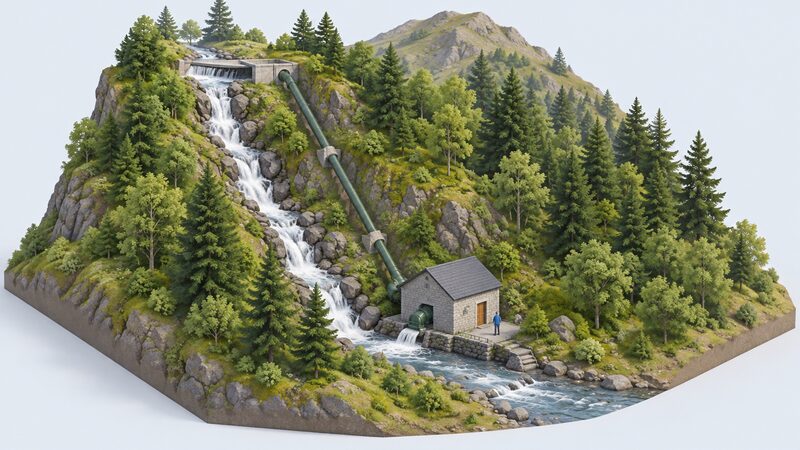
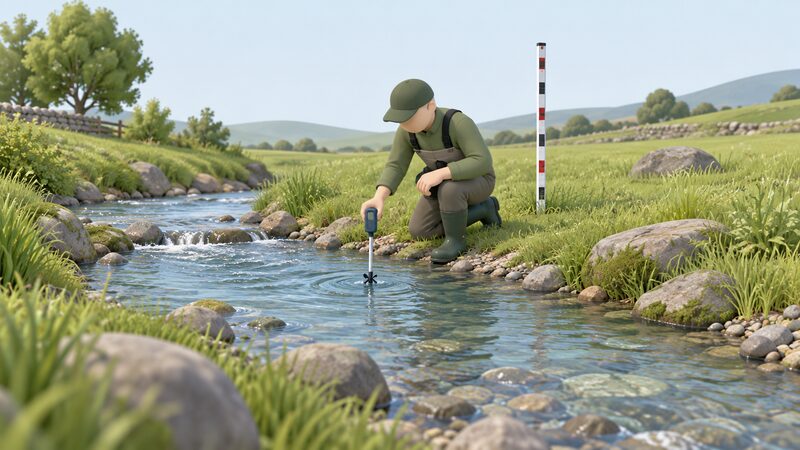
Viability rests on two measurements, not on whether a stream looks impressive. The first is flow: the volume of water passing a point per second. The second is head: the vertical distance the water can be made to fall. Useful power may be produced from even a small stream, so a modest watercourse is not automatically ruled out3. A site with low flow and high head can generate more than one with high flow and almost no drop.
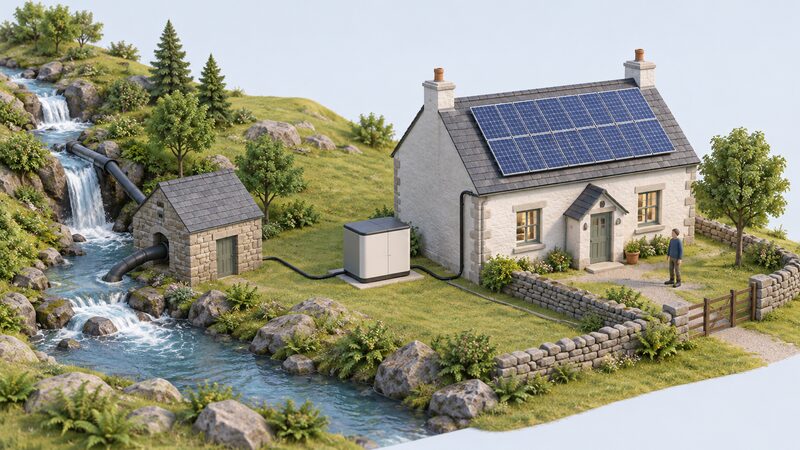
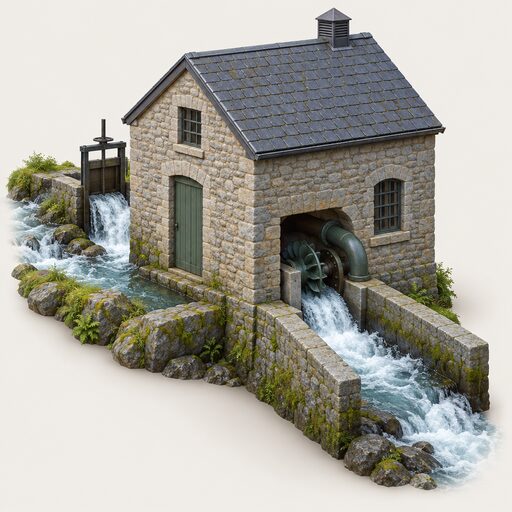
The practical constraints are less about the water than about the land around it. A scheme needs a point where water can be taken off, a route for a pipeline or channel to the turbine, a turbine house, and a point where the water returns to the watercourse. Each of those touches on permissions: abstraction, discharge, and the environmental protection of the watercourse itself. The planning system treats hydro as a development rather than a householder right, so a planning application is normally part of the process.
There is also a seasonal dimension. A stream's flow varies through the year, and a scheme sized for winter peak will be underused in summer, while one sized for summer low flow will spill water in winter. This is the hydro equivalent of overshading on a solar array: the resource is there, but not always at the strength the design assumes.
For a household weighing the two, the honest test is whether the site has been measured. A stream that runs strongly after rain but trickles in a dry August may still be viable with a large enough head, but the annual output will be lower and less predictable than a solar array of comparable peak rating. The measurement work, flow gauging and head survey, is the point at which most rural hydro projects either become real or are abandoned.
What micro-hydro can deliver for a remote property
For a property with no mains connection, hydro's value is not just the kilowatt-hours but the shape of the supply. Official guidance is explicit that for houses with no mains connection but with access to a micro hydro site, a good hydro system can generate a steady, more reliable electricity supply than other renewable technologies at a lower cost3. Steady is the operative word: a run-of-river scheme produces a continuous baseline rather than a daily peak and trough.
That baseline changes what a battery bank has to do. A solar-only off-grid system needs enough storage to carry the property through every night and every dull week. A hydro system that runs continuously can carry the base load directly, with batteries sized for peaks and outages rather than for the whole night. Space and water heating can be supplied when available power exceeds demand, which is a further use of surplus that a solar-only system would have to dump or store3.
The limits are equally clear. Hydro output is capped by the site, and a scheme that produces a few hundred watts continuously will not run an all-electric house without support. Most remote properties combine sources: hydro for the base, solar for summer daytime, and a battery bank and generator for the rest. The independence hydro offers is real but partial, and it is bounded by the watercourse.
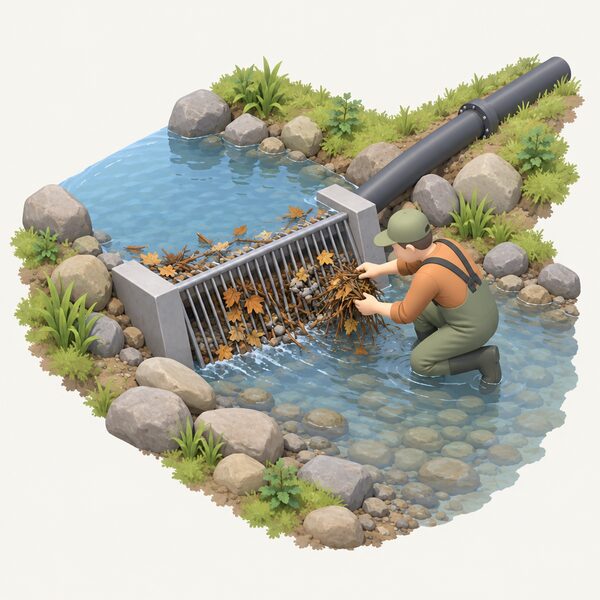
There is also a maintenance dimension that remote owners should weigh. A hydro intake can block with leaves, gravel and debris, and a blocked intake means zero output until it is cleared. Solar has no moving parts and no intake. The trade is between a steady but attended supply and an intermittent but largely unattended one.
Output and reliability: flow and fall versus daylight
The reliability profiles of the two technologies are almost opposite, and that is their strongest argument for being used together.
Solar PV works in daylight, making it effective even in cloudy climates, but its output falls to nothing every night and drops in winter1. Solar water heating shows the seasonal effect starkly: output drops to around 25% of hot water requirements in winter6. Electricity savings from solar PV also decline over time, falling by around a fifth between Year 1 and Year 5 after installation in England and Wales for installations made between 2011 and 20159.
Hydro's profile is driven by rainfall and catchment, not by the clock. A stream fed by upland drainage typically runs higher in winter, which is precisely when solar is weakest. That complementarity is the practical case for running both: hydro covers the winter and the night, solar covers the summer and the day.
| Micro hydro | Solar PV | |
|---|---|---|
| Primary resource | Running water, flow and head3 | Daylight1 |
| Size definition | Under 100 kilowatts3 | Small-scale under 5 MW5 |
| Seasonal peak | Winter, following rainfall | Summer, following daylight |
| Night output | Continuous where flow allows | None without storage |
| Moving parts | Turbine and intake, wear and blockage | None |
| Typical maintenance | Intake clearing, mechanical checks | Minimal; annual check by electrician or installer10 |
Neither profile is superior in isolation. A property that needs power at night and through the winter is better served by hydro where the resource exists; a property with a good roof and a grid connection is better served by solar, which is cheaper, simpler and far more widely installed.
Costs and practicalities of installing each
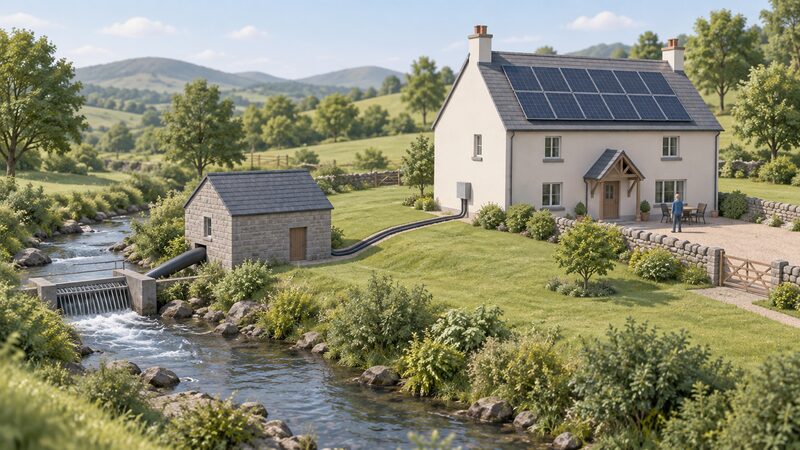
The cost structures of the two technologies have little in common. Solar PV is a manufactured product installed in a day or two, with costs that have fallen sharply and a market of competing MCS-certified installers. Hydro is a civil engineering project with earthworks, pipework, a turbine house, electrical works and a permitting process, and its cost is dominated by site-specific factors rather than by the price of the generating equipment.
Official guidance on floating solar notes that its costs are currently higher than those for conventional ground mount solar, which illustrates how much installation context matters even within solar11. For hydro, the equivalent point is stronger: the civil works, not the turbine, usually determine the budget, and those works depend entirely on the site.
Both technologies can earn from exported electricity. The Smart Export Guarantee supports solar photovoltaics, wind, micro-combined heat and power, hydropower and anaerobic digestion, which can be up to 5 megawatts in capacity, or up to 50 kW for micro-CHP, and installations must be located in Great Britain12. That means a hydro scheme and a solar array can both be paid for what they export, subject to the scheme's rules.
Certification matters for both. The Microgeneration Certification Scheme certifies, quality assures and provides consumer protection for microgeneration installations and installers including solar photovoltaic panels, biomass, wind, heat pumps and heat products13. For hydro, the same certification route applies, and it is also the route by which permitted development rights for some technologies are unlocked.
Planning and permitted development in the UK
This is where the two technologies diverge most sharply, and where the four nations differ.
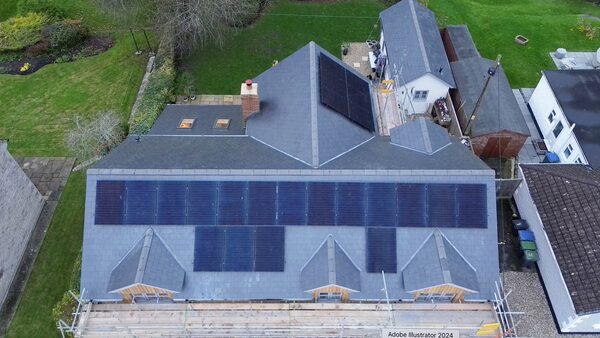
Solar PV benefits from permitted development rights in most cases. Placing solar panels on the roof of a house or flat, or on a building within the grounds, is considered in most cases permitted development under The Town and Country Planning (General Permitted Development) (England) Order 2015, Schedule 2, Part 14, Class J14. If the proposed solar panels meet the requirements, no planning application is needed10. In England, permitted development for solar photovoltaic equipment not on a roof is limited to microgeneration output of 50 kilowatts, and for solar thermal equipment not on a roof to 45 kilowatts7. Changes introduced in 2026 were intended to broaden the scope of solar installations for houses in England without requiring an application15.
Scotland has its own route. Class 6HA covers the installation, alteration or replacement of solar PV or solar thermal equipment on a dwelling under Scottish permitted development rights16. Northern Ireland has separate legislation, and the position there should be checked with the local authority17.
Micro hydro has no equivalent householder right. It is a development requiring planning permission, and it also engages water abstraction and environmental permitting. The planning portal's guidance on hydro electricity sets out the process, and it is a different order of application from a roof-mounted solar array3. Where a scheme involves a listed building or a sensitive site, further consents may apply; for solar, listed building consent orders have been used to permit installation on residential listed buildings subject to conditions, while non-residential listed buildings still require planning permission18.
| Solar PV | Micro hydro | |
|---|---|---|
| Permitted development | Usually, if criteria met10 | Not covered by householder rights |
| England output limit, not on a roof | 50 kW PV, 45 kW thermal7 | Site-specific; planning application |
| Scotland | Class 6HA for solar on a dwelling16 | Planning application |
| Additional permits | Rarely | Abstraction and environmental permits likely |
| Listed buildings | Consent orders can permit, subject to conditions18 | Case by case |
Which suits an off-grid rural home
For a genuinely off-grid property with a usable watercourse, hydro is the stronger single source. The official position is that a good hydro system can generate a steady, more reliable electricity supply than other renewable technologies at a lower cost for houses with no mains connection but with access to a micro hydro site3. That combination of steadiness and lower lifetime cost is what makes hydro attractive where it is possible.
But possible is a narrow category. Most rural properties do not have the combination of flow, head, land access and permitting that a scheme requires. For those, solar PV is the practical route, and it is a strong one: small-scale solar represented around 55% of installed UK solar capacity in 2025, and the UK has a total solar target of 45 to 47 gigawatts by 2030, compared to 18 gigawatts in 20255. Solar is the default because it works almost anywhere with a roof or a patch of ground.
The most robust off-grid design uses both. Hydro carries the base load and the winter; solar carries the summer daytime and reduces the load on the battery bank; storage covers the gaps in both. Installing solar PV and battery storage alongside a heat pump can significantly lower bills in all cases, according to official guidance, which underlines that the value comes from the combination rather than from any single generator21.
For a household thinking about independence, the honest summary is this: solar PV reduces dependence on a supplier during daylight and, with storage, beyond it, but it does not remove the need for a grid connection or a substantial battery bank. Micro hydro, where the site allows, can remove more of that dependence and can run continuously, but it comes with planning risk, permitting, civil works and ongoing maintenance. Neither removes dependence entirely, and a remote property will usually need storage and a backup source whatever is installed.
Sources21 cited
- Hydro electricity, Planning Portal, 2026
- Solar electricity (photovoltaics), Planning Portal, 2026
- Sustainable home energy solutions, Planning Portal, 2024
- Feed-in Tariffs Annual Report Scheme Year 13, Ofgem, 2023
- Small-scale solar technologies, Parliamentary Office of Science and Technology, 2026
- Could solar water heating work for you, Energy Saving Trust, 2026
- Permitted development rights impact assessments, Scottish Government, 2026
- ECO4 Measures Table v4.0, Ofgem, 2025
- National Energy Efficiency Data-Framework need report, Department for Energy Security and Net Zero, 2026
- Solar panels planning permission checklist, Islington Council, 2025
- UK Solar Roadmap, Department for Energy Security and Net Zero, 2025
- The Smart Export Guarantee, House of Commons Library, 2026
- ECO flexibility funding, Ceredigion County Council, 2026
- Solar panels, East Hertfordshire District Council, 2026
- Changes to permitted development rules for domestic solar installations, Planning Portal, 2026
- Circular 1/2024: Householder permitted development rights, Scottish Government, 2024
- The Planning (General Permitted Development) Order (Northern Ireland) 2015, legislation.gov.uk, 2015
- Clifton Local Listed Building Consent Order guidance, Bristol City Council, 2025
- Building consent order: solar panels, Royal Borough of Kensington and Chelsea, 2026
- Planning and solar, Frome Town Council, 2025
- Heat pump transition report, Department for Energy Security and Net Zero, 2026
 Micro Hydro Power for HomesA stream on your land that flows all year can make steady electricity, day and night, even when there is no sun or wind.
 Microgeneration and IndependenceWhat can you use when solar cannot cover winter evenings, and does it really make you independent?
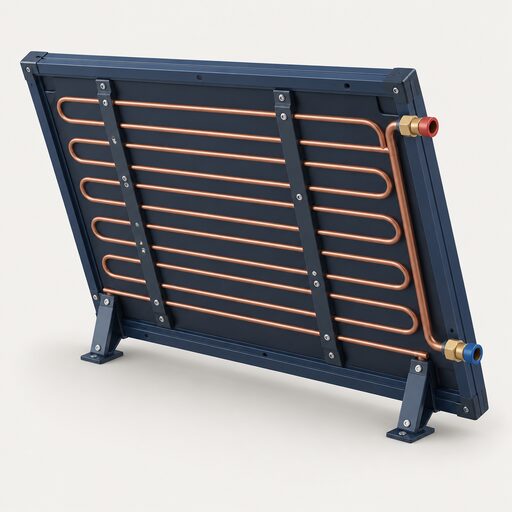 PVT Hybrid PanelsA PVT panel makes electricity and heats water from one roof space, so it suits homes without room for two separate systems.
 Microgeneration by Home TypeA stream running through your land, a windy exposed spot, or a gas boiler that runs almost all day: each points to a different technology.
 The Full Wind, Hydro and Micro-CHP GuideCould a small wind turbine or water wheel work at your home, and what about boilers that make their own electricity?
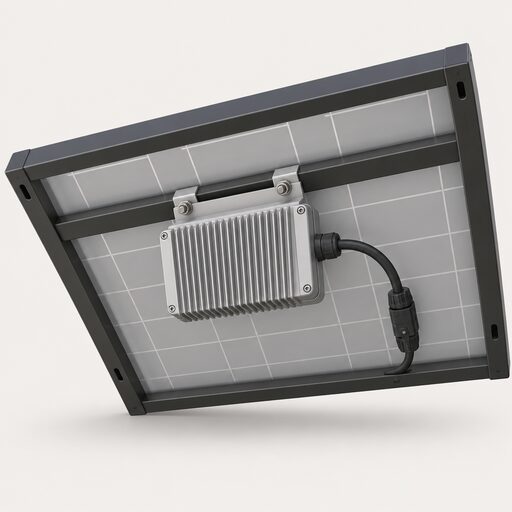 MicroinvertersMicroinverters sit behind each panel and turn its power into household electricity right there on the roof.